
Social proof is the tendency to look at what other people do when deciding what to do ourselves. In marketing, it means showing that real people already choose, use and recommend a brand, through reviews, ratings, testimonials, case studies, customer numbers and user-generated content.
It is one of the most reliable principles in behavioural science in marketing, and one of the easiest to apply. This guide explains why social proof works, what the research shows, the main types with examples, how to use it well and where the legal and ethical lines sit.
What is social proof?
The term was popularised by psychologist Robert Cialdini in his 1984 book Influence. He described social proof as one of the core principles of persuasion: when people are unsure what to do, they assume the actions of others reflect the right choice.
Social proof is strongest in two situations:
- Uncertainty: when a decision is new, complex or risky, people look for evidence that others have made it safely.
- Similarity: people are most influenced by others who seem like them, such as customers in the same industry, city, age group or situation.
Why social proof works
Most buying decisions are made quickly, with limited time and information. Copying what others have done is a mental shortcut that usually serves people well: if many customers are happy with a product, it is probably a safe choice. Social proof reduces perceived risk, saves effort and makes a decision feel easier to justify.
For businesses, this means the evidence that others trust you is often more persuasive than anything you say about yourself. A strong review carries more weight than a strong claim, and visible word of mouth spreads that trust to new audiences.
What the research shows
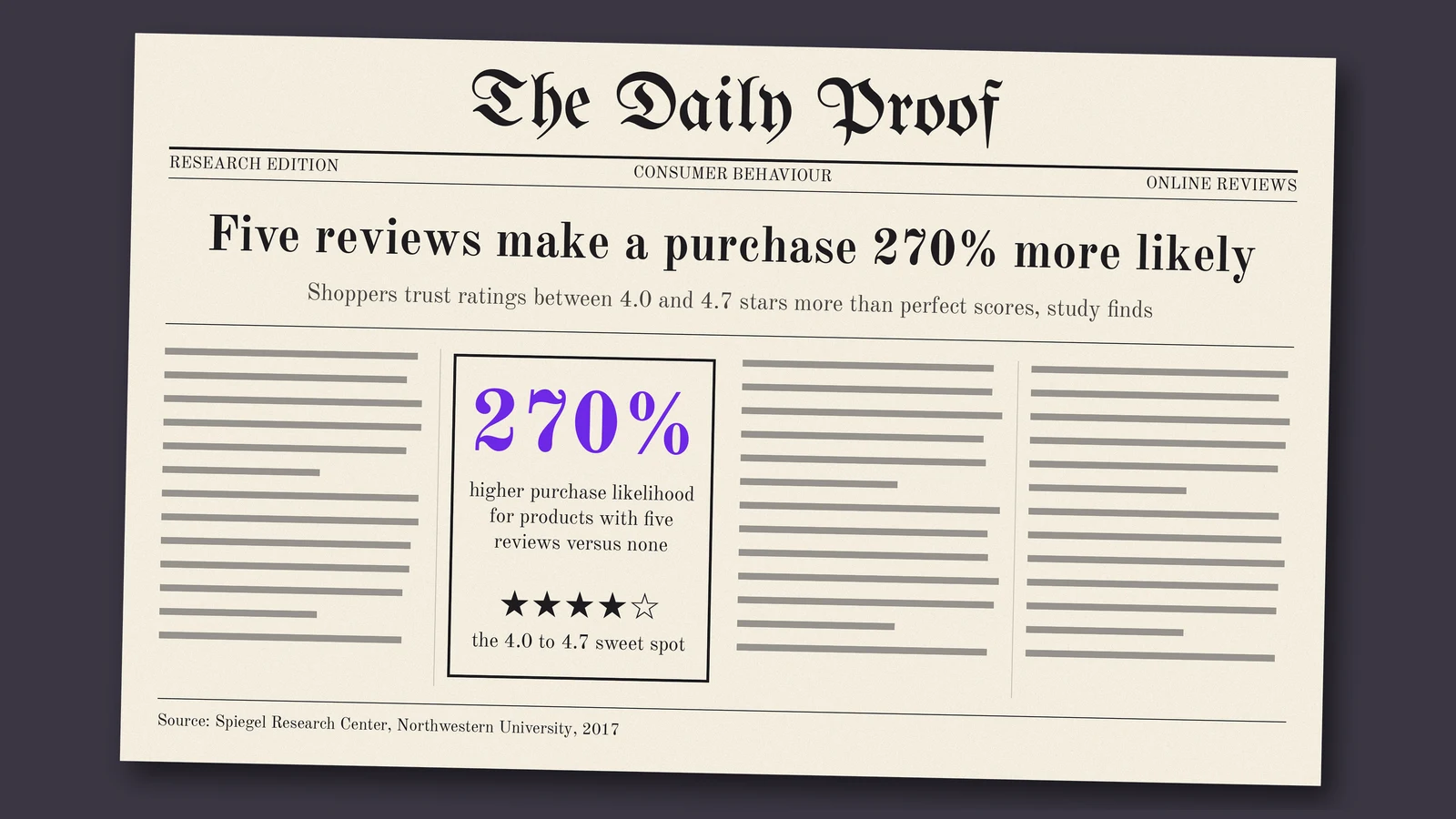
- Reviews drive purchases. Research by the Spiegel Research Center at Northwestern University found that a product with five reviews was 270% more likely to be purchased than one with no reviews. The effect was stronger for higher-priced products.
- Perfect scores are less convincing. The same research found that purchase likelihood peaked for ratings between 4.0 and 4.7 stars, then fell as ratings approached 5.0, which shoppers may see as too good to be true.
- Norms can change behaviour at scale. In UK government trials, letters telling late taxpayers that most people in their area had already paid increased payment rates, as described in our guide to behavioural science.
- Context matters. A famous 2008 hotel study found that signs saying most guests reused their towels worked better than standard environmental messages. A 2014 replication in Germany found that both kinds of message worked, but the social version was not better. Social proof is powerful, but its effect depends on the audience and setting.
Types of social proof
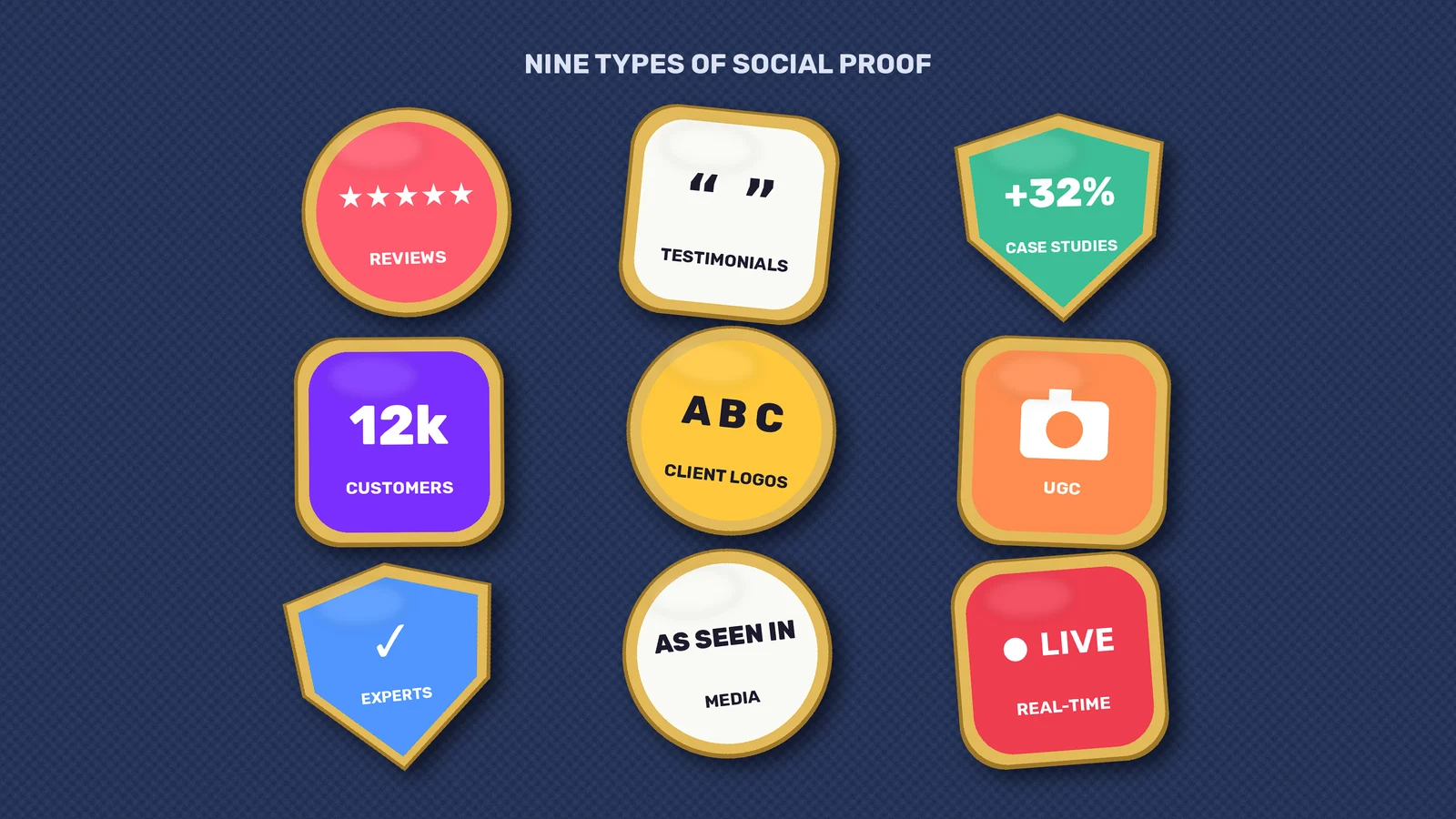
| Type | Example | Works best for |
|---|---|---|
| Customer reviews and ratings | Star ratings on product pages | E-commerce, local businesses, apps |
| Testimonials | A short quote with a name, photo and role | Services, consultancies, B2B |
| Case studies | A detailed story with measurable results | B2B and high-value purchases |
| Customer numbers | “Trusted by 12,000 UK businesses” | Software, subscriptions, memberships |
| Client logos | A row of recognisable customer brands | B2B and agencies |
| User-generated content | Customer photos and videos | Fashion, food, travel, lifestyle |
| Expert endorsement | A recommendation from a respected specialist | Health, finance, technical products |
| Media mentions and awards | “As featured in” or industry awards | New brands building credibility |
| Real-time activity | “14 people booked this today” | Travel, events, limited stock |
Social proof examples across the customer journey
- Homepage: a clear statement of how many customers you serve, a few recognisable client logos and one strong testimonial.
- Product and service pages: ratings and reviews close to the price and the main call to action, where hesitation is highest.
- Pricing pages: labels such as “most popular” on the plan most customers choose, combining social proof with a helpful default.
- Checkout and sign-up: short reassurance near the button, such as a rating, a review count or a security badge.
- Email: customer stories and reviews in welcome and follow-up emails, especially for people who have not bought yet.
- Social media: reposting user-generated content with permission, and sharing results clients are happy to make public.
- Advertising: ratings, review quotes and customer numbers in ad copy, and creator partnerships through influencer marketing.
How to use social proof effectively
- Be specific. “4.8 from 1,240 reviews” is more convincing than “customers love us”. Real numbers, names and details build trust.
- Show similar people. Choose testimonials from customers who look like your target audience, in the same sector, size or situation.
- Place it at the moment of doubt. Put proof next to prices, forms and buttons, not only on a separate testimonials page.
- Keep it fresh. Recent reviews and current customer numbers are more credible than proof that looks out of date.
- Do not hide imperfection. A few honest critical reviews make the positive ones more believable, and the research suggests near-perfect scores can reduce trust.
- Test what works. The type and placement of social proof that works best varies by audience. Measure its effect on your conversion rate rather than assuming.
Negative social proof: a common mistake
Social proof works in both directions. Messages such as “most people forget to renew” or “thousands of customers abandon their basket” can accidentally tell people that the unwanted behaviour is normal.
Cialdini’s research at Arizona’s Petrified Forest National Park showed this clearly: a sign stressing that many visitors had taken petrified wood led to more theft than a sign that simply asked people not to take it. When you want to change behaviour, highlight what the majority does right, not what too many people do wrong.
Social proof and the law
In the UK, fake reviews are now explicitly banned under the Digital Markets, Competition and Consumers Act 2024. Since 6 April 2025, businesses must not write, commission or publish fake reviews, and must take reasonable steps to prevent and remove them. The Competition and Markets Authority can fine businesses up to 10% of global turnover for breaches of consumer law.
- Only show reviews and testimonials from real customers, and get permission before using names or photos.
- Do not hide or selectively filter negative reviews in a way that misleads people.
- Clearly disclose incentivised reviews and paid endorsements, including influencer partnerships.
- Keep customer numbers, ratings and real-time claims accurate and up to date.
How to collect more social proof
- Ask at the right moment. Request a review shortly after a positive experience, such as a successful delivery or a completed project.
- Make it easy. Send a direct link and keep the process short.
- Turn results into case studies. Interview happy clients about the problem, the solution and the measurable outcome.
- Encourage customer content. Invite customers to share photos or videos, and ask permission before reposting them.
- Reply to reviews. Thoughtful responses, including to criticism, show future customers that you listen.
Frequently asked questions
What is social proof in marketing?
Social proof in marketing is the use of evidence that other people choose, use and recommend a brand, such as reviews, ratings, testimonials, case studies, customer numbers and user-generated content, to make new customers more confident in their decision.
Who came up with the idea of social proof?
The term was popularised by psychologist Robert Cialdini in his 1984 book Influence, where he described it as one of the core principles of persuasion.
What are the main types of social proof?
The main types are customer reviews and ratings, testimonials, case studies, customer numbers, client logos, user-generated content, expert endorsements, media mentions and awards, and real-time activity.
Is a perfect five-star rating best?
Not necessarily. Research from the Spiegel Research Center found that purchase likelihood peaked for ratings between 4.0 and 4.7 stars, as near-perfect scores can seem less believable.
Are fake reviews illegal in the UK?
Yes. Since 6 April 2025, the Digital Markets, Competition and Consumers Act 2024 explicitly bans fake reviews, including commissioning or publishing them, and requires businesses to take reasonable steps to prevent them.
Put your best proof where it counts
Kutola reviews websites and customer journeys to find where trust breaks down, and where the right proof would help people decide. Get in touch to see where your journey could work harder.