

Brand strategy is a long-term plan for what a brand should mean to the people it wants to reach and how the business will earn that meaning through everything it says and does. It sets the brand’s purpose, audience, position, personality and identity, so that decisions on messaging, design and marketing all work from the same fixed point.
A clear brand positioning sits at the heart of every brand strategy, but the strategy covers more ground: why the brand exists, how it should sound and look, how it relates to other brands in the business and how progress is measured. This guide explains what brand strategy is, how it differs from marketing strategy, the components and frameworks behind it, how to build one in seven steps, real brand strategy examples and a one-page template you can adapt.
What is brand strategy?
Start with the brand itself. A widely used definition from the American Marketing Association, quoted in the Open University’s introduction to marketing, describes a brand as a name, term, design, symbol or any other feature that identifies one seller’s goods or services as distinct from those of other sellers. That is the part a business controls.
The part it does not control is what customers remember. Kevin Lane Keller’s 1993 paper on customer-based brand equity described brand knowledge as two things held in memory: awareness of the brand and the associations attached to it. A brand is valuable when people know it and link it with favourable, strong and unique ideas.
Brand strategy connects those two sides. It decides which associations the business wants to own, then shapes the product, the customer experience and the communication so that those associations build up over years. A logo redesign or a new tagline can express a brand strategy, but neither is one on its own.
Brand strategy vs marketing strategy, positioning and identity
These terms overlap, and teams often use them loosely. The table shows how they fit together.
| Term | What it decides | Time horizon |
|---|---|---|
| Brand strategy | What the brand stands for, who it is for, how it should be seen and how it will be recognised | Years, reviewed rarely |
| Brand positioning | The specific place the brand aims to own in customers’ minds compared with alternatives | Years, part of the brand strategy |
| Brand identity | The name, logo, colours, type, tone of voice and other assets that express the brand | Years, refreshed with care |
| Marketing strategy | Which audiences, channels, budgets and messages will hit the business’s growth targets | Usually one to three years |
| Marketing plan | The campaigns, content, dates and owners that put the strategy into action | Months to a year |
The simplest way to tell them apart: brand strategy decides what the business should mean to people, and a digital marketing strategy decides how to reach those people and turn that meaning into sales. The marketing strategy changes as channels and targets change. The brand strategy should outlast several of them. For a closer look at how positioning differs from branding, messaging and a USP, see the comparison in our guide to brand positioning vs related terms.
Why brand strategy matters
The case for brand strategy rests on what strong brands can do that weak ones cannot. Three effects show up repeatedly in the research.
- Pricing power. Kantar’s analysis of its BrandZ data found that being seen as different accounts for 49% of the drivers of a brand’s pricing power, while salience, simply coming to mind, accounts for 6%. A brand that stands for something specific can charge for it.
- Lower price sensitivity over time. Les Binet’s work with the IPA Databank links long-term brand building with firmer pricing: customers who value a brand are less likely to switch when a cheaper option appears.
- More efficient marketing. When every campaign repeats the same ideas and assets, each one adds to the memory left by the last. Without a brand strategy, each new agency, campaign or hire tends to start again from zero.
There is a newer reason too. When people ask ChatGPT, Gemini or Google’s AI Overviews to recommend a supplier, the answer is assembled from what the web says about each brand. A brand that describes itself consistently on its own site, in reviews and in third-party coverage is easier for those systems to summarise accurately, which is why brand consistency now sits at the centre of generative engine optimisation.
The components of a brand strategy
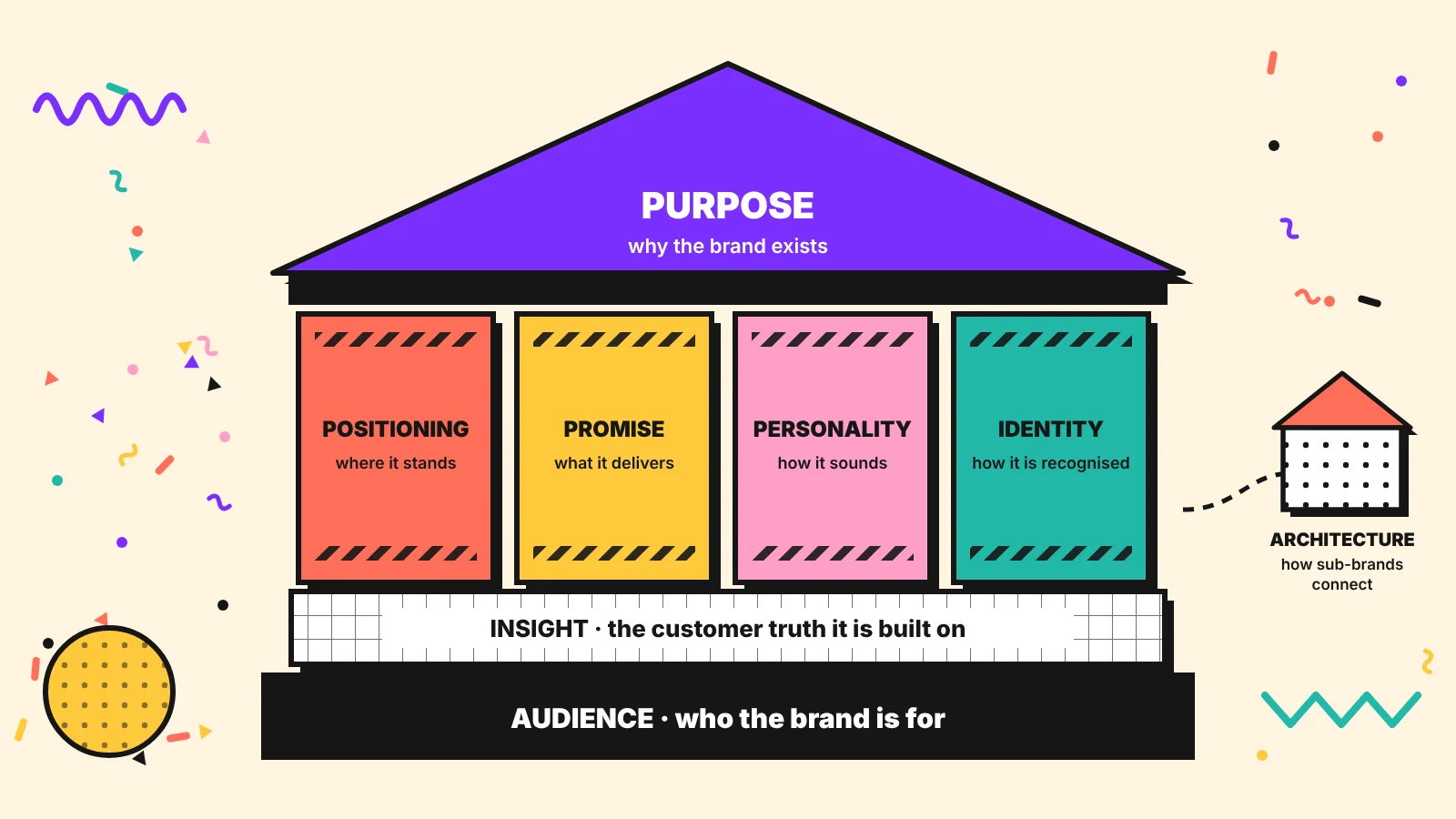
Different agencies name the parts differently, but most brand strategies answer the same eight questions.
- Purpose: why the brand exists beyond making money. A useful purpose is specific enough to rule some things out. “Making life better” rules out nothing.
- Audience: the people the brand is built for, described by their needs and situations as well as demographics. A short persona for each core group helps.
- Insight: the customer truth the brand is built on, usually a tension between what people want and what the category gives them.
- Positioning: the category the brand competes in, how it is different and the proof behind that difference. A positioning statement captures it in a few sentences.
- Promise: what customers can rely on every time they deal with the brand. The promise turns positioning into an experience that operations, service and product teams can deliver.
- Personality and voice: the human traits the brand shows and the way it writes and speaks. Three or four traits, each with a “this, not that” note, are easier to apply than a long list of adjectives.
- Identity and distinctive assets: the name, logo, colours, type, shapes, sounds and phrases that make the brand recognisable at a glance. Jenni Romaniuk of the Ehrenberg-Bass Institute calls the strongest of these distinctive brand assets and measures them on two things: how many people link the asset with the brand and how few link it with competitors.
- Architecture: how the main brand relates to sub-brands, products and services. This matters as soon as a business sells more than one thing under more than one name.
How to build a brand strategy in 7 steps
The process below works for a start-up defining its brand for the first time and for an established business that has drifted. Larger organisations spend longer on research, but the order stays the same.
- Start from the business strategy. Write down where the business wants to be in three to five years: markets, products, margins and the type of customer it wants more of. A brand strategy that is not tied to these goals becomes a design exercise.
- Research how the brand is seen today. Interview customers, lost prospects and staff. Read reviews and sales call notes for the words people actually use. Ask AI assistants to describe your business and your competitors, and note what they get wrong. A digital marketing audit gives you the channel data to go with these conversations.
- Map the competition. List direct competitors and the other ways customers solve the problem. Plot them on a perceptual map to see where the market is crowded and where there is space worth owning.
- Define purpose, audience and positioning. Agree on the core audience, the insight and the position. Test each draft by asking whether a competitor could say the same thing. If it could, keep going.
- Set the personality, voice and promise. Describe how the brand behaves and sounds, and the promise it makes. Write sample headlines, emails and replies to complaints in the new voice to check that it works in real situations.
- Choose or audit the distinctive assets. Decide which colours, shapes, characters or phrases the brand will use consistently. If assets already exist and people recognise them, keep them. Replacing a recognised asset throws away years of memory.
- Roll it out and measure it. Turn the strategy into brand guidelines, a messaging framework and training for anyone who writes or speaks for the business. Update the website, profiles and sales materials first, then set the brand measures described further down this guide.
Brand strategy frameworks
Frameworks give structure to the thinking. They do not replace research, and no single one covers everything, so most strategists borrow from two or three. These are the most widely used.
Keller’s brand equity pyramid
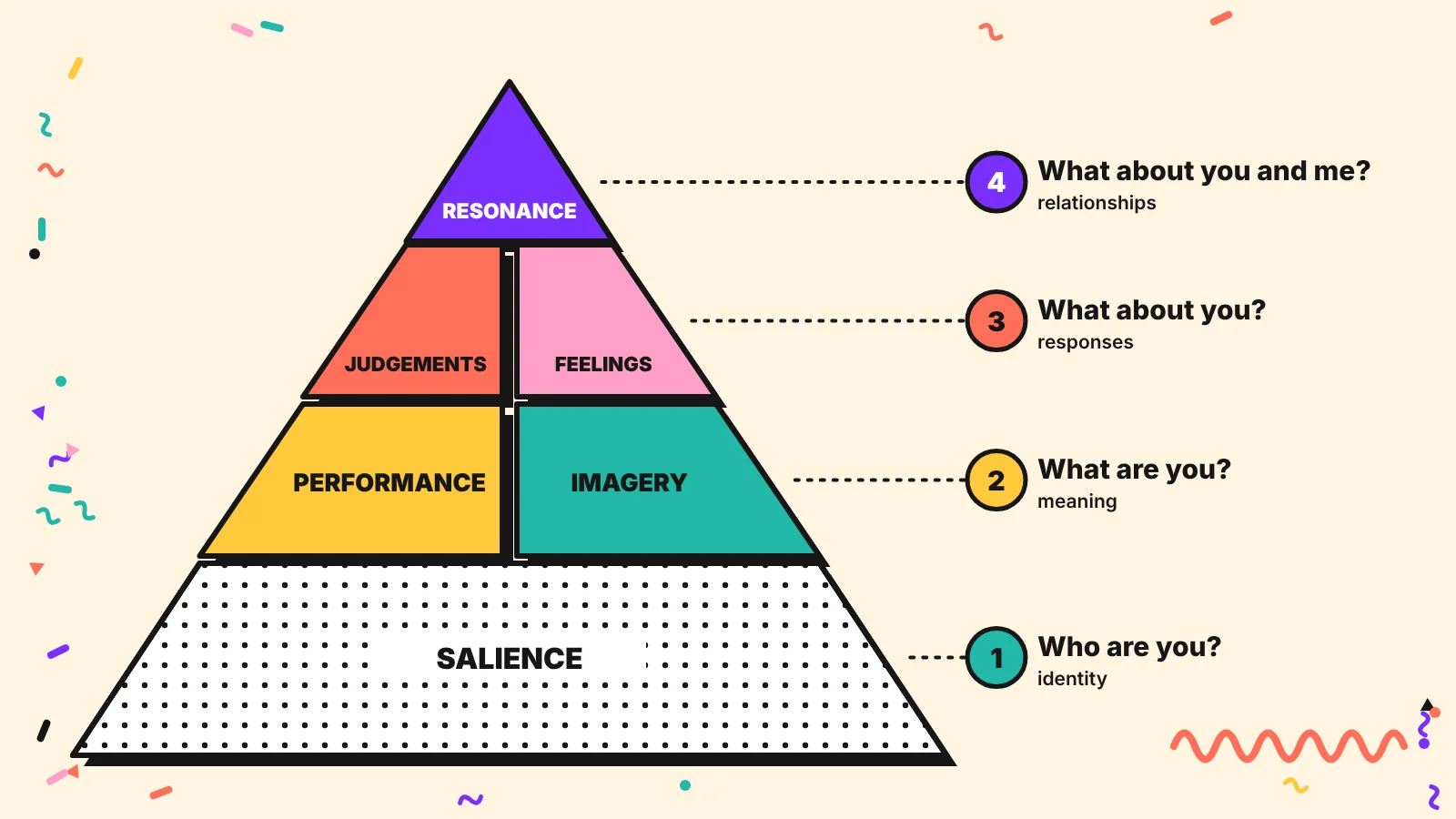
In a 2001 Marketing Science Institute paper, Building Customer-Based Brand Equity, Keller set out brand building as a sequence of four questions customers ask: who are you, what are you, what about you and what about you and me? Each answer is a level of the pyramid, from salience at the base to resonance, the loyal and active relationship, at the top. The model is useful for diagnosing where a brand is stuck. Many small brands have decent performance and good reviews but low salience, so too few people think of them in the first place.
Kapferer’s brand identity prism
Jean-Noël Kapferer’s prism, introduced in his book Strategic Brand Management, describes a brand’s identity through six facets: physique (how it looks), personality, culture (its values), relationship (how it treats customers), reflection (the typical customer it portrays) and self-image (how customers see themselves when they use it). It works well as a checklist for the personality and identity parts of a brand strategy, especially for consumer brands where image and belonging matter.
Aaker’s brand relationship spectrum
For architecture decisions, David Aaker and Erich Joachimsthaler’s brand relationship spectrum sets out the options between two ends. A branded house puts one master brand on everything, as FedEx does across its services. A house of brands runs separate brands with little visible link to the parent, as Procter & Gamble does with Pampers, Ariel and Gillette. Between them sit sub-brands and endorsed brands. Most growing businesses should stay close to the branded house end for as long as they can, because one brand is cheaper to build than several.
Brand strategy examples
Good brand strategy examples show a choice that was hard to make and then kept for years. Each of these three brands is known for a different part of the strategy.
- LEGO: focus and architecture. LEGO was on the brink of bankruptcy in 2004 when Jørgen Vig Knudstorp became chief executive. Looking back, he described a company that had taken customer loyalty for granted by stretching the brand too thin. The recovery started by cutting back to the core business and to what the brand meant to the families who loved it: building with bricks.
- Dove: purpose kept for two decades. In 2004 Dove launched its Campaign for Real Beauty, showing women of different ages, sizes and ethnicities instead of professional models. In 2024, twenty years on, it extended the same idea to a new technology by committing never to use AI to represent real women in its advertising. The purpose came first, and each new campaign has been an expression of it.
- Monzo: a distinctive asset from day one. The UK bank’s hot coral card stands out in a category of black, navy and silver plastic, so the card advertises the brand every time someone pays with it. Monzo has protected the asset as the product changed: when it redesigned its card in 2020, it made the coral even brighter and carried it through the core of the card.
None of the three relied on advertising alone. LEGO changed its product range, Dove changed how it casts and retouches people, and Monzo built its colour into the physical product. A brand strategy that only reaches the marketing department rarely changes what customers believe.
A one-page brand strategy template
A brand strategy does not need to be a 60-slide deck. The table below is a one-page template filled in for an illustrative example: an IT support firm in Leeds that works with small accountancy and law practices. The business is fictional and used only to show how each line can be completed.
| Element | Example |
|---|---|
| Business goal | Double the number of practices on monthly support contracts in three years without competing on price |
| Purpose | Let small professional firms work without worrying about their technology |
| Audience | Partners and practice managers at firms of 5 to 40 people in West Yorkshire, often without anyone in-house who understands IT |
| Insight | They fear a data breach that damages client trust more than they fear the cost of IT, but most providers sell on response times and hardware |
| Positioning | The IT partner for regulated small practices, who understands their compliance duties as well as their systems |
| Promise | A named engineer who knows your firm, a plain-English report every quarter and help with client data questions |
| Personality and voice | Calm, not alarmist. Plain, not technical. Direct, not salesy. |
| Proof | Cyber Essentials Plus certification, case studies from local practices and reviews that mention “peace of mind” |
| Distinctive assets | A deep green colour used everywhere, a shield-shaped logo and engineers’ first names on every report |
| Architecture | One brand. The new cyber training service is sold as a service of the main brand, not under a new name. |
| Brand measures | Share of local searches for IT support, branded search volume, review themes and the price premium achieved on new contracts |
Once this page is agreed, the marketing strategy can take over: which channels reach practice managers, what content answers their questions and how many enquiries the business needs each month.
How to measure a brand strategy
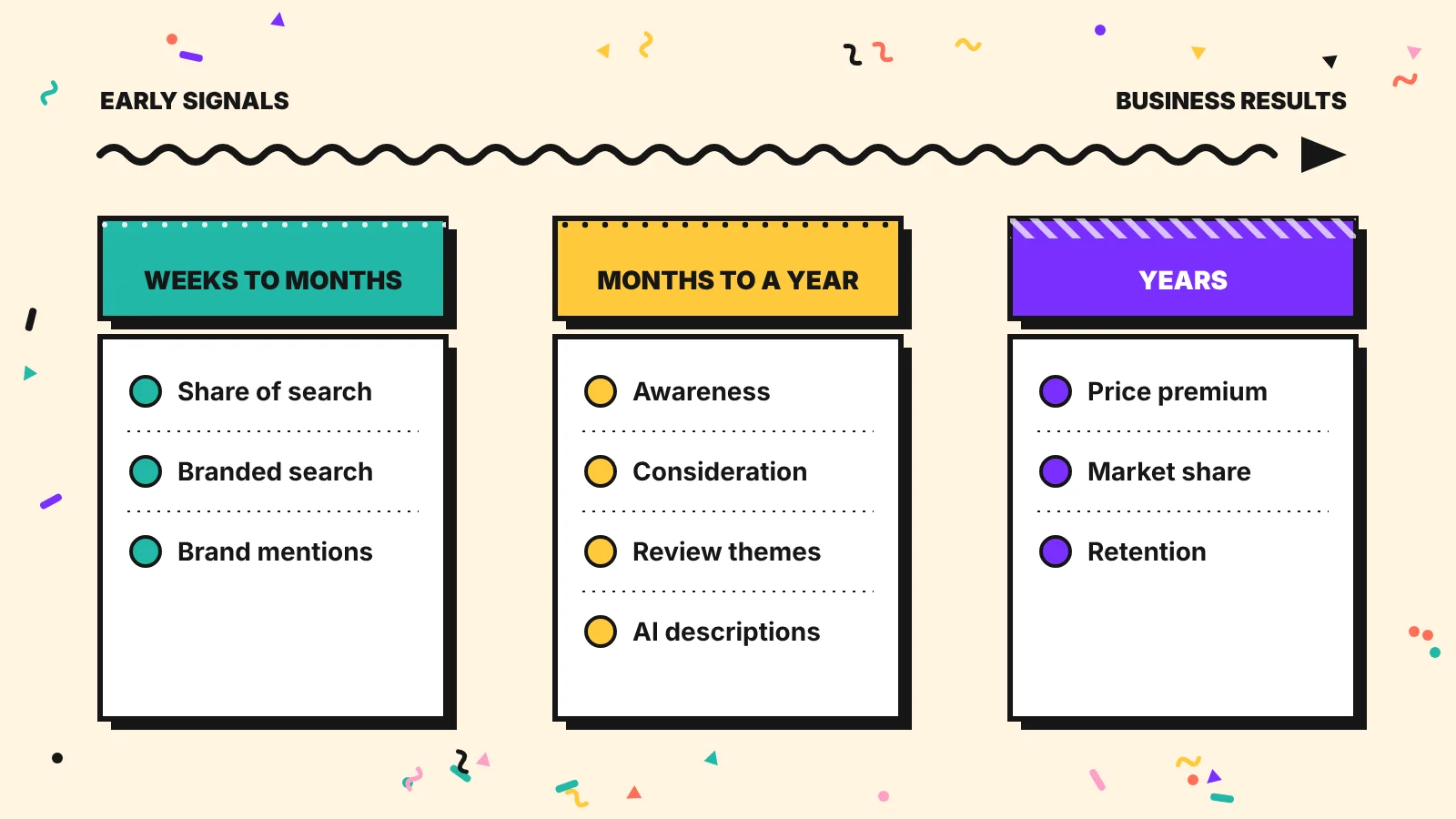
Brand effects build slowly, so measurement needs a mix of early signals, which move within weeks or months, and business results, which can take years. Useful measures include:
- Share of search: searches for your brand as a share of searches for all brands in your category. Les Binet presented research to the IPA in 2020 showing that share of search correlates with market share and often predicts it, with a lead of up to a year in categories such as cars. Google Trends provides the data for free.
- Branded search: impressions and clicks for queries containing your brand name in Google Search Console.
- Awareness and consideration: prompted and unprompted awareness from a short survey of your target audience, run once or twice a year with the same questions.
- Associations: the words customers use in reviews, interviews and social posts, compared with the associations the strategy set out to build. Share of voice and brand mentions add context.
- AI descriptions: how ChatGPT, Gemini and Google’s AI Overviews describe your brand and whether they mention it for category questions. Our guide to measuring GEO performance explains how to track this.
- Business results: price premium compared with competitors, conversion rate on enquiries, repeat purchase and customer retention.
Common brand strategy mistakes
- Starting with the logo. A new identity without a strategy behind it is decoration. Decide what the brand should mean first, then design how it looks.
- Writing values nobody could disagree with. Integrity, quality and passion describe almost every business. Values only guide decisions when they cost something to keep.
- Skipping customer research. A strategy built only from internal workshops reflects how the team sees the business, which is rarely how customers see it.
- Changing assets too often. Marketers get bored of their own brand long before customers notice it. Each redesign resets some of the recognition already built.
- Keeping it in the marketing team. If sales, service and product teams never see the strategy, customers will meet a different brand at every touchpoint.
- Judging it on next month’s sales. Brand work pays back over years. Track the early signals above and give the strategy enough time before deciding it has failed.
Frequently asked questions
What is brand strategy?
Brand strategy is a long-term plan for what a brand should mean to its target customers and how the business will earn that meaning. It covers the brand’s purpose, audience, positioning, promise, personality, identity and architecture.
What is the difference between brand strategy and marketing strategy?
Brand strategy decides what the business should stand for and how it should be recognised, and it changes rarely. Marketing strategy decides which audiences, channels, budgets and messages will reach growth targets, and it is usually reviewed every one to three years.
What are the key components of a brand strategy?
Most brand strategies define a purpose, a target audience, a customer insight, a positioning, a brand promise, a personality and tone of voice, distinctive brand assets and a brand architecture.
What is an example of a brand strategy?
Dove’s Campaign for Real Beauty is a well-known example. Since 2004 the brand has built its strategy around showing real women instead of professional models, and in 2024 it extended that purpose by committing never to use AI to represent real women in its ads.
How long does it take to build a brand strategy?
For a small business, research and definition usually take a few weeks. For a larger organisation with several audiences or sub-brands, it can take several months. Building the brand in customers’ minds takes years of consistent work after that.
Does a small business need a brand strategy?
Yes, although it can be short. A one-page strategy covering audience, positioning, promise, voice and distinctive assets helps a small business stay consistent and stops it competing on price alone.
Build a brand people remember for the right reasons
Kutola helps businesses turn customer research into a clear brand strategy, then carry it through their website, content, search and social media. Get in touch to talk about where your brand stands today and what it could stand for.