
A positioning statement is a short, internal summary of who your brand serves, what it offers and why it is different from the alternatives. It is the sentence every marketing decision should be checked against, from the homepage headline to the next campaign.
This guide gives you a simple positioning statement template, explains each part, shows positioning statement examples for four different types of business and ends with a checklist to test your own. It builds on the ideas in our guide to brand positioning, which covers the wider strategy behind the statement.
What is a positioning statement?
A positioning statement describes the place you want your brand to own in customers’ minds, written in a few plain sentences. It is written for the people who build and market the brand, not for customers. Its job is to keep everyone aligned: designers, writers, salespeople, agencies and leadership should all be able to read it and make consistent decisions.
Because it is internal, a positioning statement can be specific, unpolished and even a little dull. Clarity matters far more than style. The creative work of turning it into taglines, headlines and campaigns comes later.
Positioning statement vs tagline, mission and value proposition
| Term | Audience | Purpose |
|---|---|---|
| Positioning statement | Internal teams and partners | Defines who you serve, your category and your difference |
| Value proposition | Customers | Explains the benefit customers get and why it matters to them |
| Tagline | Customers and the public | A short, memorable line that expresses the brand |
| Mission statement | Employees, investors and the public | Describes why the company exists and what it aims to achieve |
The positioning statement usually comes first. A strong value proposition and tagline are much easier to write once the position is clear.
A simple positioning statement template
The most widely used template comes from Geoffrey Moore’s book Crossing the Chasm. Fill in each bracket:
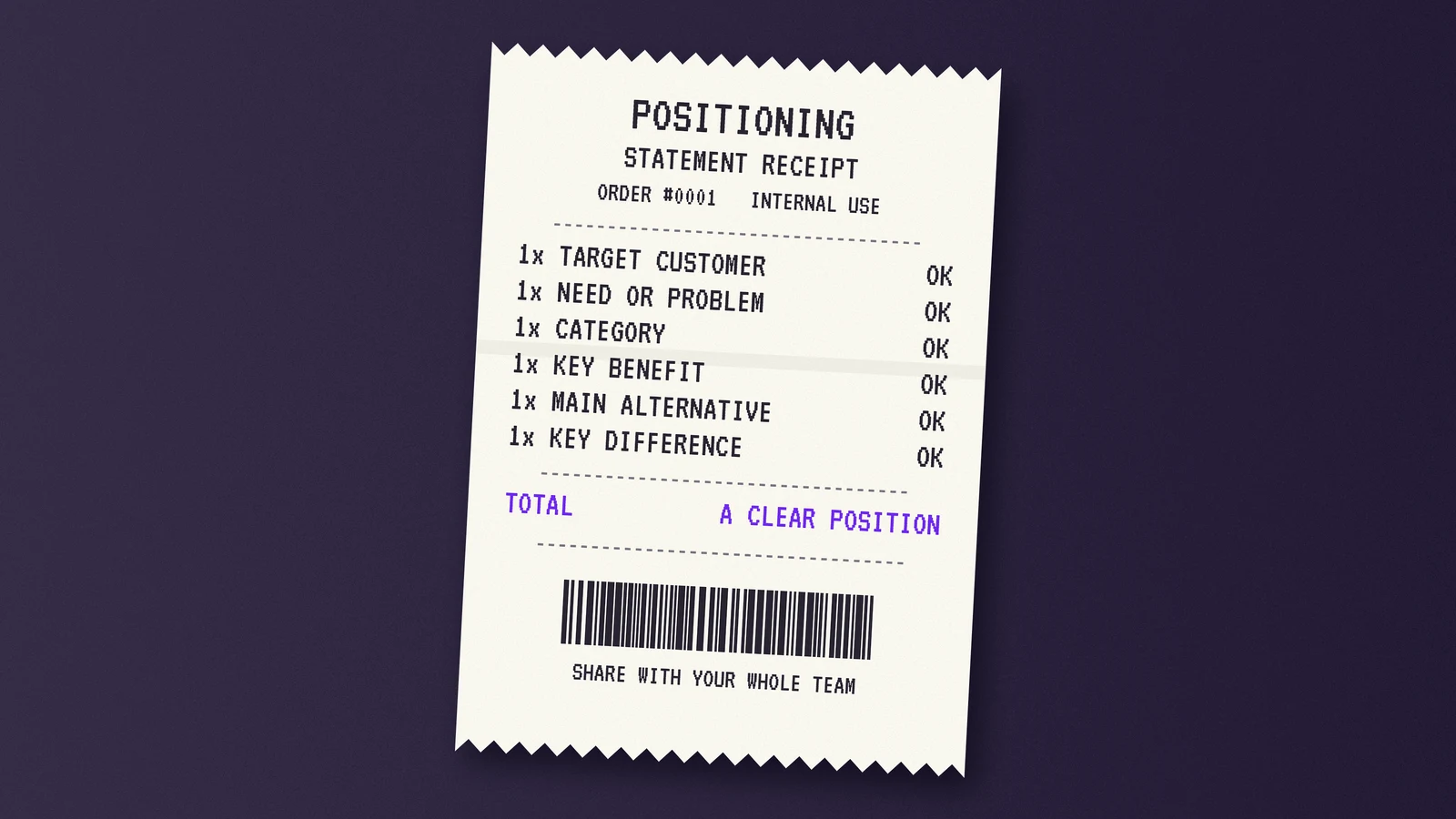
For [target customer] who [need or problem], [brand] is a [category] that [key benefit]. Unlike [main alternative], [brand] [key difference].
Each part has a specific job:
- Target customer: the specific group you serve best. Be narrower than feels comfortable. A clear persona helps.
- Need or problem: the situation that makes this customer look for a solution, described in their words rather than yours.
- Category: the frame of reference that tells people what you are and who you compete with.
- Key benefit: the single most important outcome the customer gets, not a list of features.
- Main alternative: what the customer would do if you did not exist. This may be a competitor, a different type of solution or doing nothing at all.
- Key difference: the reason your brand is a better choice than that alternative, ideally something that is hard to copy.
Positioning statement examples
The examples below use fictional brands to show how the template works for different types of business.
B2B software
For freelance designers who lose hours chasing late invoices, Paydock is an invoicing app that gets them paid on time without awkward reminders. Unlike general accounting software, Paydock sends polite, automatic follow-ups written in the freelancer’s own tone of voice.
Local service business
For homeowners in Reading who need urgent repairs, Northgate Plumbing is a local plumbing service that arrives within two hours. Unlike national call-out companies, every Northgate engineer lives within ten miles and the price is agreed before work begins.
E-commerce brand
For runners who train in the dark, Lumen Run is a sportswear brand that keeps them visible without looking like safety gear. Unlike high-visibility vests, Lumen Run builds reflective detail into everyday running clothes that people want to wear.
Professional services
For growing UK manufacturers expanding abroad, Meridian Export is an export consultancy that gets products into new markets within six months. Unlike general business advisers, Meridian works only with manufacturers and handles regulations, distributors and local marketing in one place.
Notice what these have in common. Each names a specific customer, a real problem, a clear category and a difference that a competitor could not simply claim as well.
Beyond the template: five components of positioning
Positioning expert April Dunford, author of Obviously Awesome, suggests working through five components before writing anything. They make the template easier to fill in with substance rather than slogans:
- Competitive alternatives: what customers would use if your product did not exist.
- Unique attributes: the features or capabilities you have that those alternatives lack.
- Value: the benefit those attributes deliver for customers.
- Target customers: the people who care most about that value.
- Market category: the context that makes your value obvious to those customers.
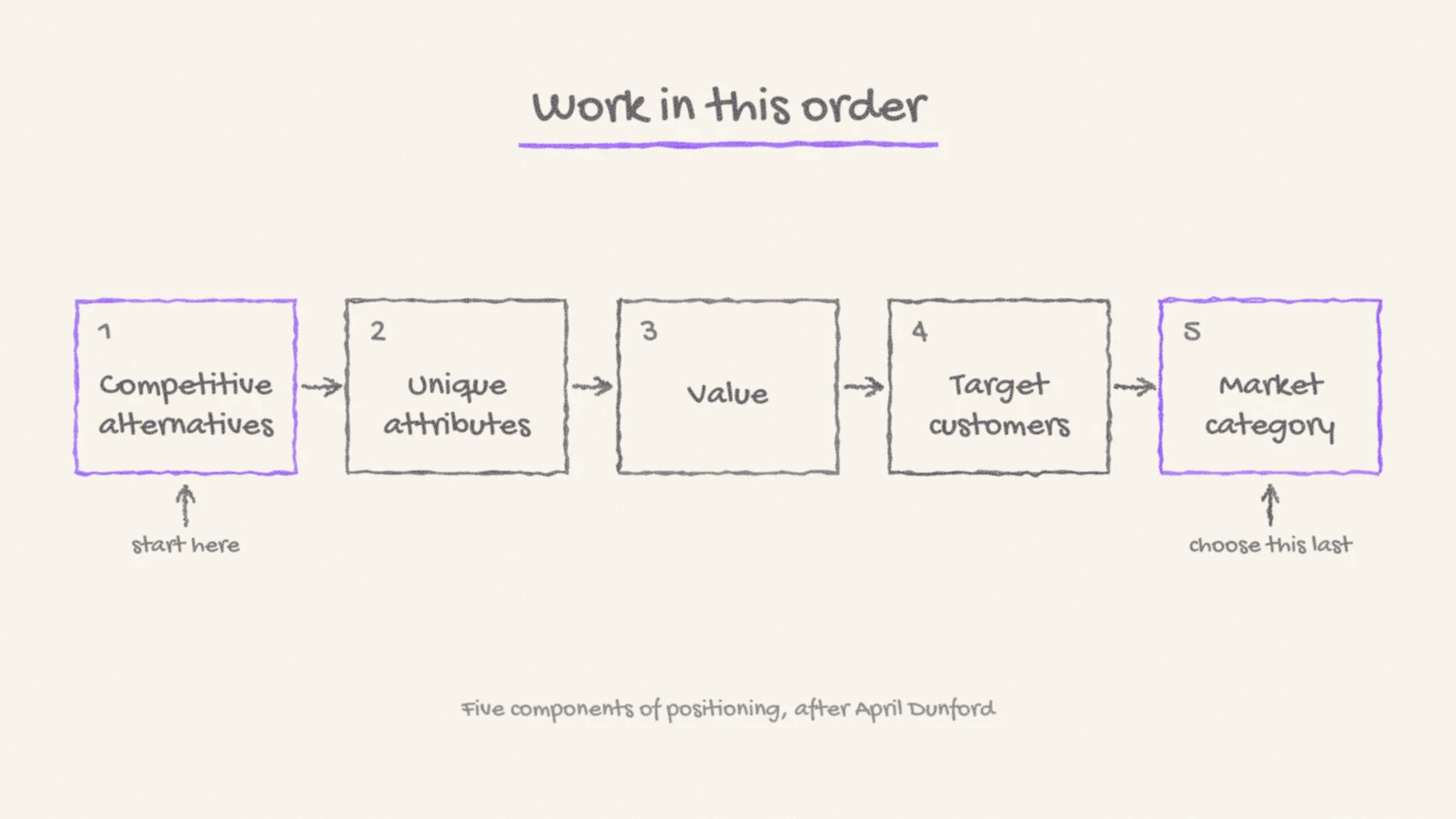
Working in this order, from alternatives to category, helps avoid a common trap: choosing a category first and then trying to force your strengths into it.
How to write a positioning statement
- Talk to your best customers. Ask why they chose you, what they compared you with and how they would describe you to a friend. Their words often make the best raw material.
- List the real alternatives. Include competitors, other types of solution and the option of doing nothing. A perceptual map can help you see where each one sits.
- Find your true difference. Keep only the differences that customers value and competitors cannot easily copy.
- Narrow the audience. Choose the segment that values your difference most, even if it feels small.
- Fill in the template. Write several versions, then combine the strongest parts.
- Test it with people. Share it with colleagues and a few customers. If they cannot repeat it back or do not recognise themselves in it, keep refining.
Checklist: is your positioning statement strong?
- Could a new employee understand it without extra explanation?
- Does it name a specific customer rather than everyone?
- Is the benefit an outcome, not a feature?
- Is the alternative something customers really consider?
- Would it become false if you swapped in a competitor’s name?
- Can you prove the key difference with evidence?
- Does it still make sense if you read it in a year’s time?
Common positioning statement mistakes
- Writing it like advertising. Clever wordplay belongs in the tagline, not the positioning statement.
- Describing the audience too broadly. “Small businesses” or “anyone who wants to grow” gives teams nothing to work with.
- Listing every benefit. One clear benefit is stronger than five vague ones.
- Ignoring the alternative. Without a clear comparison, the difference has no meaning.
- Writing it and filing it away. The statement only works if it guides the website, content, sales materials and campaigns.
Frequently asked questions
What is a positioning statement?
A positioning statement is a short internal summary of who a brand serves, what category it competes in, the main benefit it offers and how it differs from the alternatives. It keeps everyone who works on the brand aligned.
What is the positioning statement template?
A widely used template is: For [target customer] who [need or problem], [brand] is a [category] that [key benefit]. Unlike [main alternative], [brand] [key difference].
Is a positioning statement the same as a tagline?
No. A positioning statement is an internal tool written for clarity. A tagline is a short, public line written to be memorable. The tagline usually expresses the position defined in the positioning statement.
How long should a positioning statement be?
Usually one to three sentences. It should be long enough to name the customer, category, benefit and difference, and short enough for anyone in the business to remember.
How often should you update a positioning statement?
Review it when your product, market or audience changes significantly, or at least once a year. Frequent rewrites are a sign that the position is not yet clear.
Turn your positioning into words that work
Kutola helps brands define a clear position and express it consistently, from the positioning statement to the homepage, content and campaigns. Get in touch to sharpen how your brand is described.