

A digital marketing strategy is a plan for how a business will use online channels to reach its goals: who it wants to reach, what it wants those people to think and do, which channels it will use and how it will measure progress. It turns broad ambitions such as “more leads” or “more online sales” into a small set of choices that guide every campaign, post and pound of budget.
This guide explains what a digital marketing strategy is and how it differs from a marketing plan, why it matters, the main channels and frameworks, how AI search changes the picture and an eight-step process for building your own, with a worked example, the UK rules to plan around and the mistakes to avoid.
Key takeaways
- A digital marketing strategy sets the goals, audience, position, channels and measures for your online marketing. Plans, campaigns and tactics follow from it.
- Start from a business objective with a number and a date, not from a channel you feel you should be on.
- Owned, earned and paid channels do different jobs. Most businesses get further with two or three channels done well than with six done badly.
- Balance long-term brand building with short-term sales activation. IPA research points to roughly 60:40 as a starting benchmark.
- AI search now shapes how people find and judge brands, so a consistent position across your site, reviews and third-party sources is part of the strategy.
- Track a few KPIs tied to the original objectives and review the strategy on a set rhythm.
What is a digital marketing strategy?
Digital marketing covers every way a business markets itself through digital channels: search engines, social media, email, websites, content, online advertising and, increasingly, AI assistants. A digital marketing strategy is the set of decisions that tells you which of those channels to use, for whom and why.
A useful strategy answers five questions:
- Where are we now? Current performance, audience, competitors and how the brand is seen.
- Where do we want to be? Business objectives translated into marketing goals.
- Who are we trying to reach? The audience segments that matter most to those goals.
- Why should they choose us? The position, message and offer that make you the better option.
- How will we get there, and how will we know? Channels, content, budget and the KPIs that show progress.
A good strategy is short enough to remember. Many of the best fit on a single page. The detail lives in the marketing plan and the campaign briefs that follow from it.
Digital marketing strategy vs marketing plan vs tactics
The three terms are often used as if they mean the same thing. They describe different levels of decision:
| Level | What it decides | Typical time frame | Example |
|---|---|---|---|
| Strategy | Goals, audience, position, channel mix and how success is measured | One to three years, reviewed yearly | Become the first-choice accountant for creative freelancers in Manchester |
| Marketing plan | What happens when, who does it and what it costs | Twelve months, broken into quarters | A content calendar, a quarterly paid search budget and an email programme |
| Tactics | The individual actions and campaigns | Days to weeks | A LinkedIn carousel, a Google Ads campaign or a webinar |
Getting the order right matters. Teams that start with tactics are often busy without being effective: posting every day on platforms their buyers rarely use, or paying for clicks to a website that never explains why anyone should choose them.
Why a digital marketing strategy matters
Most buying journeys now run through a screen at some point. UK adults spent an average of 4 hours 30 minutes a day online on their personal devices in May 2025, according to Ofcom’s Online Nation report, and 77% of that time was on smartphones. Advertisers have followed the attention: the UK digital ad market reached £40.5bn in 2025, with search alone accounting for £17.9bn and social media for £11.5bn, according to IAB UK.
That scale cuts both ways. There are more ways to reach people than ever, and more competition for every moment of their attention. Without a strategy, digital marketing tends to become a list of disconnected activities. With one, you get:
- Focus. Time and budget go into the few channels that matter to your audience.
- Consistency. Every channel tells the same story, so each touchpoint builds on the last instead of starting again.
- Accountability. Clear goals and KPIs show what is working and what to stop.
- Resilience. When an algorithm changes or a channel gets more expensive, you know which objective it served and can move budget without losing direction.
The main digital marketing channels
Digital channels fall into three groups, usually called owned, earned and paid media. Each does a different job, and the strongest strategies make them work together.
| Type | Channels | Main role | Speed and cost |
|---|---|---|---|
| Owned | Website, blog, email list, social media profiles, app | Explain what you offer, convert interest and keep customers | Slow to build, but the value compounds and you control it |
| Earned | Organic search rankings, AI citations, reviews, press coverage, shares and recommendations | Build trust and reach through other people’s voices | Slow and hard to buy, but carries the most credibility |
| Paid | Search ads, social ads, display, video, influencer partnerships, retail media | Reach new audiences quickly and capture existing demand | Fast, but results usually stop when spending stops |
Some channels sit across the lines. With SEO, you own the pages but have to earn the rankings. Social media is similar: the profile is yours, but reach increasingly depends on whether people find you through search inside the platforms, which is why social media SEO has become a discipline of its own.
Few businesses need every channel. A local trades business may get most of its enquiries from its Google Business Profile, reviews and a well-built website. A B2B software company may rely on LinkedIn, in-depth content and lead nurturing by email. The right mix comes from where your audience spends time and how they make decisions, which is what the steps below are designed to uncover.
How to build a digital marketing strategy in 8 steps
The process below works for a start-up, a growing SME or a team inside a larger company. The depth changes with the size of the business. The order stays the same.
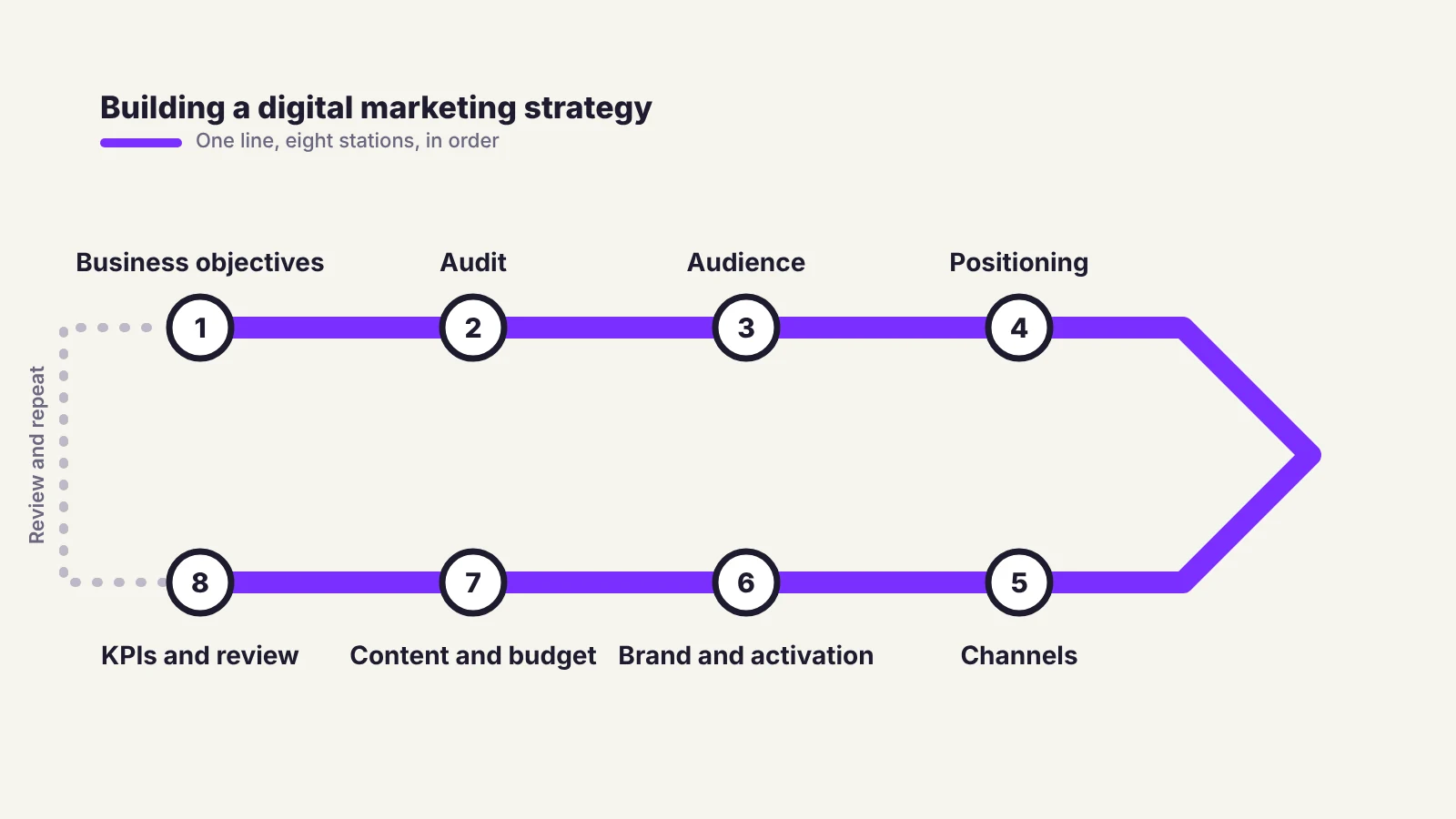
1. Start with business objectives
Begin with what the business needs, not with what marketing would like to do. Revenue, new clients, average order value, entering a new market and keeping existing customers are business objectives. Turn each one into a marketing goal with a number and a date. “Generate 120 qualified enquiries a quarter from search by June” is something a team can plan against. “Increase awareness” is not, unless you also decide how awareness will be measured.
The UK government’s guidance on creating a digital marketing strategy for exporters makes the same point: digital activity in a new market should support the goals the business already has at home.
2. Audit where you are now
Look at what is already happening before deciding what should change. A useful audit covers:
- Performance: traffic, conversion rates, cost per lead or sale and which channels actually drive results, using Google Analytics 4 and Google Search Console.
- Visibility: where you rank, whether AI tools mention you and what people find when they search for your brand name.
- Reputation and trust: reviews, mentions and the credibility signals on your own site. An E-E-A-T checklist is a quick way to check the last of these.
- Competitors: which channels they use, what they promise and where they are absent.
Keep the output short. Three to five findings that will change what you do are worth more than a fifty-slide report.
3. Define your audience
Decide who you most want to reach and describe them in terms that affect marketing decisions: the problem they are trying to solve, the words they use when they search for help, who else is involved in the decision and where they look for advice. A persona or segment helps, as long as it comes from real evidence such as customer interviews, sales calls, search queries and reviews rather than guesswork.
Then map how these people move from first noticing a need to buying and recommending. People rarely decide in the tidy order a funnel diagram suggests, so it helps to understand the shortcuts and biases at play. Behavioural science across the customer journey shows which principles matter at each stage.
4. Clarify your positioning
Your strategy needs a clear answer to “why choose you?” long before it needs a content calendar. Brand positioning defines who you are for, the category you compete in, how you are different and the proof behind that difference. Without it, each channel ends up saying something slightly different and none of it sticks.
If your position isn’t settled yet, work through the positioning process first and capture the result in a positioning statement. Every channel decision that follows will be easier.
5. Choose your channels
With objectives, audience and position in place, choosing channels becomes much simpler. For each candidate, ask whether your audience uses it when they are thinking about this kind of purchase, whether you can do it well with the people and budget you have and which objective it serves. A channel that can’t answer the last question doesn’t belong in the strategy.
For many small and mid-sized businesses, a sensible core is a website that converts, search visibility (organic and, where demand already exists, paid search), one social platform where the audience is genuinely active and email marketing to stay in touch with people who have shown interest. Paid social, video, influencer marketing and digital PR earn a place when there is a clear job for them.
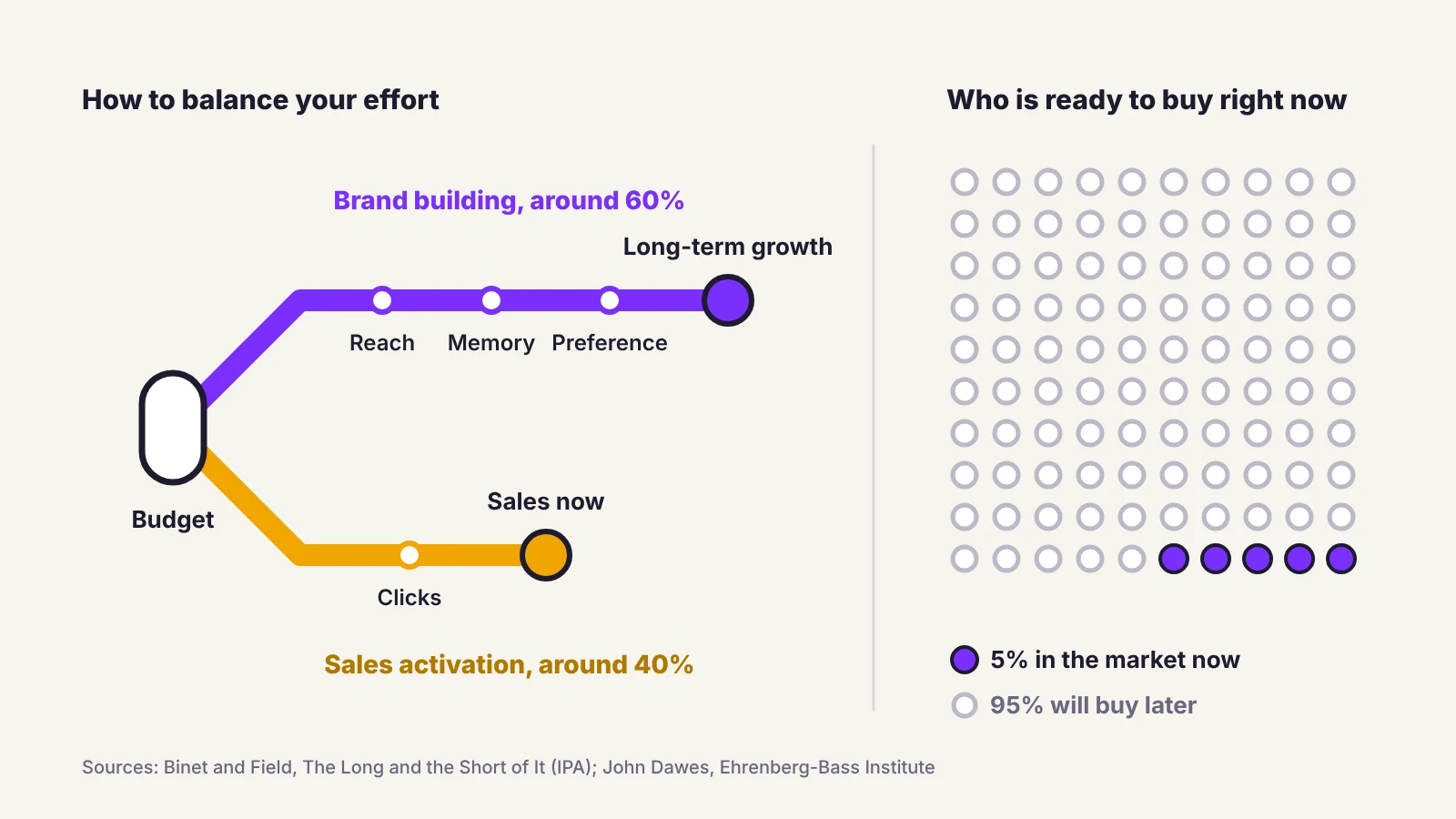
6. Balance brand building and demand capture
Some marketing captures demand that already exists, such as a paid search ad for “accountant near me” or a remarketing campaign. Other marketing creates future demand by making sure people know and remember you before they need you. Both matter, and they work on very different timescales.
Les Binet and Peter Field’s analysis of the IPA Databank, published as The Long and the Short of It, found that sales activation produces short-term spikes while brand building drives most long-term growth. Their work points to a split of around 60% brand building and 40% activation, best treated as a benchmark to check your own balance against rather than a fixed rule.
The 95-5 rule from Professor John Dawes of the Ehrenberg-Bass Institute explains why this matters. In B2B markets, only around 5% of potential buyers are looking to buy at any given time. The other 95% will buy later, and the brands they already know when that moment arrives have a far better chance of making the shortlist.
For a small business, none of this means spending heavily on awareness campaigns. It means not putting everything into bottom-of-funnel tactics. Useful content, a recognisable visual identity, an active social presence and a steady flow of good reviews all build memory at a modest cost.
7. Plan your content and budget
Content is what most channels run on, so plan it around the questions your audience asks at each stage rather than around a posting quota. One substantial piece, such as a guide, original research or a detailed case study, can feed search, social posts, emails and sales conversations for months. This is the thinking behind content marketing.
Set the budget from the objectives backwards. Work out how many customers you need, what you can afford to pay to win each one and what each channel is likely to cost. Your customer acquisition cost and customer lifetime value set the limits. Keep a small, fixed share aside for testing new channels and ideas, so experiments don’t eat into what already works.
8. Set KPIs and a review rhythm
Choose a handful of KPIs that connect directly to the objectives from step 1, and keep them separate from the diagnostic metrics you check along the way:
- Business KPIs: revenue, new customers, qualified leads, cost per acquisition and return on investment.
- Channel metrics: rankings, organic traffic, click-through rates, email open rates and engagement. Useful for spotting problems, rarely worth reporting on their own.
- Brand signals: branded search volume, share of voice, review ratings and how AI tools describe you.
Review channel performance monthly, the plan quarterly and the strategy itself once a year, or sooner if something important changes: a new competitor, a new product or a shift in how your customers search. Visibility in AI answers needs its own measures, covered in how to measure GEO performance.
Digital marketing strategy frameworks
Frameworks don’t do the thinking for you, but they give a strategy a structure that a whole team can follow. Three are widely used:
| Framework | Stages | Best used for |
|---|---|---|
| SOSTAC | Situation, objectives, strategy, tactics, action, control | Structuring the strategy document from analysis through to measurement |
| RACE | Plan, then reach, act, convert, engage | Setting goals and KPIs for each stage of the customer lifecycle |
| Marketing funnel | Awareness, consideration, decision (top, middle and bottom of the funnel) | Checking that you have content and activity for every stage |
SOSTAC was created by PR Smith in the 1990s and works well as the outline of a strategy document, because it moves in a logical order from where you are to how you will know you have arrived. The RACE framework, developed by Dave Chaffey at Smart Insights, organises digital activity around the customer lifecycle and suits teams that want clear targets at every stage. The funnel is the simplest of the three, as long as you remember that real buyers move back and forth between stages.
Pick one and use it consistently. A strategy document laid out with SOSTAC, with KPIs grouped by RACE stage, is a practical combination many teams use.
Digital marketing strategy and AI search
Search is changing faster than at any point since Google became the default way to find things. Ofcom’s research found that around 30% of searches in the UK now show an AI overview, and 53% of adults say they often see these summaries, according to its report From apps to AI search. Tools such as ChatGPT, Perplexity and Google’s AI Mode answer questions directly, often without sending a click anywhere.
This changes a digital marketing strategy in three practical ways:
- Visibility now includes being cited. AI tools build answers from sources they trust, so generative engine optimisation belongs in the channel plan next to SEO.
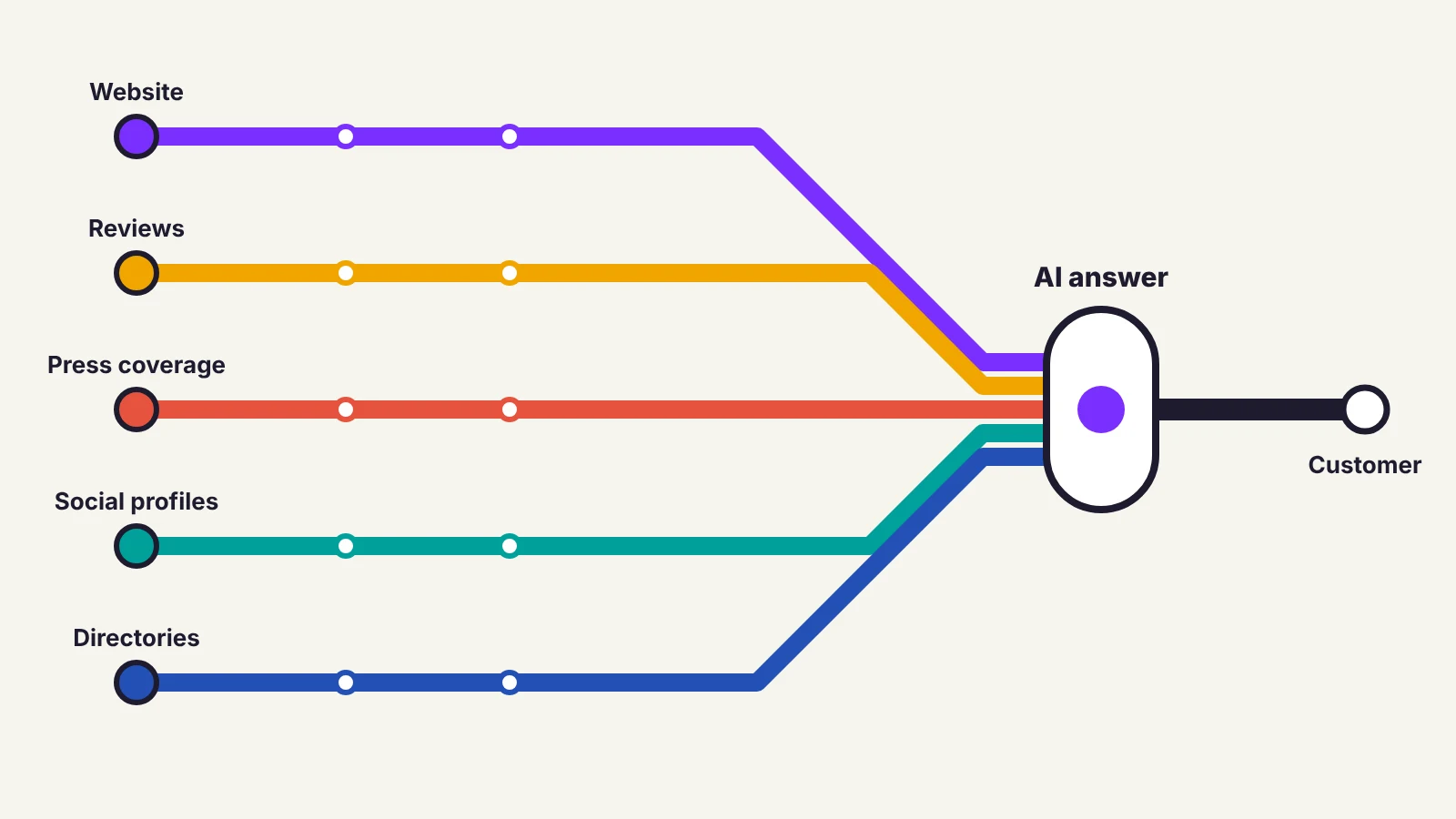
- Consistency carries further. AI systems summarise what the whole web says about you: your website, reviews, directories, press coverage and social profiles. A clear position, repeated everywhere, is more likely to be described accurately.
- Trust signals count twice. Named authors, real expertise, evidence and independent reviews help in classic search results and in AI answers. That is the core of E-E-A-T.
Some familiar numbers will also behave differently. Informational searches send fewer clicks than they used to, so pair traffic targets with enquiries, branded search and mentions in AI answers. It also helps to treat SEO, AEO and GEO as overlapping parts of one search strategy rather than three separate projects.
Digital marketing strategy example
Gymshark is a well-known example of a digital-first strategy. Launched in 2012, the fitness clothing brand grew largely through partnerships with fitness creators on YouTube and Instagram and through its own online store. It reported sales of £646m for the year to July 2025, its 13th consecutive year of growth. The useful lesson is the focus behind the channels: one clearly defined audience, the platforms where that audience already spent its time and a community kept at the centre for more than a decade.
Most businesses work at a much smaller scale, so here is what a one-page strategy could look like for an independent accountancy firm that wants more clients among creative freelancers in Manchester:
| Element | Example |
|---|---|
| Objective | 40 new freelance clients in 12 months, at an average fee of £1,200 a year |
| Audience | Self-employed designers, photographers and developers in Greater Manchester, many filing one of their first Self Assessment returns |
| Position | The accountant who understands creative work: fixed monthly fees, quick replies and practical advice on irregular income |
| Channels | A website with clear pricing, SEO for local and tax questions, Google Business Profile and reviews, Instagram and a monthly email |
| Content | Guides to allowable expenses for creatives, deadline reminders and short videos answering common tax questions |
| Brand and activation | Year-round content, social posts and local events to build memory, plus paid search in the months before the 31 January Self Assessment deadline |
| KPIs | Qualified enquiries a month, enquiry-to-client conversion rate, cost per new client, number and rating of reviews |
| Review | Enquiries checked monthly, plan reviewed quarterly, strategy reviewed every January after the deadline rush |
Every line traces back to the objective. Instagram is there because the audience uses it to find and judge creative services, and paid search runs only when demand peaks. Anything that doesn’t serve the 40 new clients waits.
UK rules to build into your strategy
Several channels come with legal requirements in the UK. Building them in at the strategy stage is far cheaper than fixing a campaign after a complaint.
- Email and text marketing: under PECR, you generally need consent before sending marketing emails or texts to individuals, unless the “soft opt-in” for existing customers applies. Bought-in lists can’t rely on the soft opt-in. The ICO’s guidance on electronic mail marketing sets out the conditions.
- Advertising and social media: the CAP Code, enforced by the Advertising Standards Authority, covers paid ads and marketing claims on your own website and social media accounts. Ads, including influencer posts, must be obviously identifiable as advertising.
- Reviews and pricing: since 6 April 2025, the Digital Markets, Competition and Consumers Act 2024 has banned fake reviews and drip pricing, and the CMA can fine businesses directly. Any strategy that leans on reviews needs a clean way to collect them, as explained in social proof and the law.
Common digital marketing strategy mistakes
- Starting with channels. “We need to be on TikTok” is a tactic looking for a reason. Start with the objective and the audience, then see whether TikTok fits.
- Copying competitors. A rival’s channel mix reflects their budget, audience and position. Without those, the same tactics rarely produce the same results.
- Spreading too thin. Six half-maintained channels look worse to customers, and to AI tools, than two that are clearly cared for.
- Measuring activity instead of outcomes. Posts published and followers gained are easy to count. Enquiries, sales and cost per customer are what the business needs to see.
- Only harvesting demand. Putting everything into search ads and retargeting works until the pool of ready buyers runs dry. Brand building keeps refilling it.
- Writing it once and filing it away. A strategy that isn’t reviewed against results slowly turns into a historical document.
Frequently asked questions
What is a digital marketing strategy?
A digital marketing strategy is a plan for how a business will use online channels to reach its goals. It sets out the objectives, target audience, positioning, channel mix, budget and the KPIs used to measure progress.
What should a digital marketing strategy include?
It should include clear business objectives, an audit of current performance, a defined audience, your brand positioning, the chosen channels, a content and budget plan and a set of KPIs with a regular review rhythm.
What is the difference between a digital marketing strategy and a marketing plan?
The strategy decides where you are going and why: goals, audience, position and channel mix. The marketing plan sets out what happens when, who does it and what it costs, usually over twelve months.
How do I create a digital marketing strategy for a small business?
Start with one or two clear business goals, define the customers you most want to reach and pick two or three channels you can run well, such as your website, search and one social platform. Set a few KPIs tied to enquiries or sales and review them monthly.
How often should you review a digital marketing strategy?
Review channel results monthly, the marketing plan quarterly and the strategy itself once a year. Review it sooner if your market, product or customers’ search behaviour changes significantly.
Turn your goals into a digital marketing strategy
Kutola helps businesses build digital marketing strategies grounded in clear objectives, a sharp position and the channels their customers actually use, from search and AI visibility to social media. Get in touch to talk about where your marketing stands today and where it could take you.