

Brand positioning is the place a brand occupies in the minds of its target customers, and the deliberate choices a business makes to earn that place. It answers a simple question: when people think of your category, why should they think of you, and what should they think?
Strong positioning makes every other marketing decision easier. It shapes your messaging, your prices, your website, your content and even the way AI tools describe you. This guide explains what brand positioning is, how it differs from related ideas, the main positioning strategies, well-known examples and a step-by-step process for defining your own.
Key takeaways
- Brand positioning is the place a brand occupies in customers’ minds: who it is for, its category, its difference and the proof behind it.
- Positioning comes first. Branding, messaging and taglines are how it is expressed.
- Most strong brands build their position around one dominant idea and stay with it for years.
- Aim for both differentiation (a reason to choose you) and distinctiveness (being easy to recognise and remember).
- A positioning statement keeps teams aligned, and a perceptual map shows where there is space to own.
- Today, your position is also shaped by reviews, social profiles and the way AI tools describe you.
What is brand positioning?
The idea was popularised by Al Ries and Jack Trout, whose 1981 book Positioning: The Battle for Your Mind argued that marketing is not a battle of products but a battle of perceptions. People cannot remember every brand, so they file a small number of them into mental categories. Positioning is the work of securing a clear, relevant and ownable spot in those categories.
In practice, brand positioning combines four elements:
- Target customer: who the brand is for, defined as precisely as possible. A clear persona or segment helps.
- Category: the frame of reference customers use to understand what you are and who you compete with.
- Difference: what makes the brand a better or distinct choice for that customer.
- Proof: the evidence that makes the difference believable, such as results, features, reviews, credentials or track record.
A position is not what a company says about itself. It is what customers actually believe. The company’s job is to choose the position it wants and then make every touchpoint consistent with it.
Why brand positioning matters
- It makes choice easier. Customers facing many similar options look for a reason to pick one. A clear position gives them that reason.
- It supports pricing. A brand with a strong, relevant position competes on value rather than only on price.
- It focuses the business. Positioning tells teams what to say, what to build and, just as importantly, what to ignore.
- It makes marketing more efficient. Consistent messages build memory over time, so each campaign adds to the last instead of starting again.
- It shapes how AI describes you. AI tools summarise what the web says about a brand. A clear, consistent position makes it more likely they describe you accurately.
Brand positioning vs branding, messaging and USP
These terms are often used interchangeably, but they describe different things:
| Term | What it is | Example question it answers |
|---|---|---|
| Brand positioning | The strategic place you want to own in customers’ minds | Why us, for whom, compared with what? |
| Branding | The expression of that position through name, identity, design and voice | How do we look, sound and feel? |
| Messaging | The words used to communicate the position to different audiences | What do we say, and to whom? |
| USP | A single standout benefit or feature that sets an offer apart | What can we claim that others cannot? |
| Tagline | A short, memorable line that sums up the brand | What will people remember? |
Positioning comes first. Branding, messaging and taglines are how it is expressed. A USP can be part of a position, but a position is broader: it includes who you serve and the category you choose to compete in.
Types of brand positioning strategy
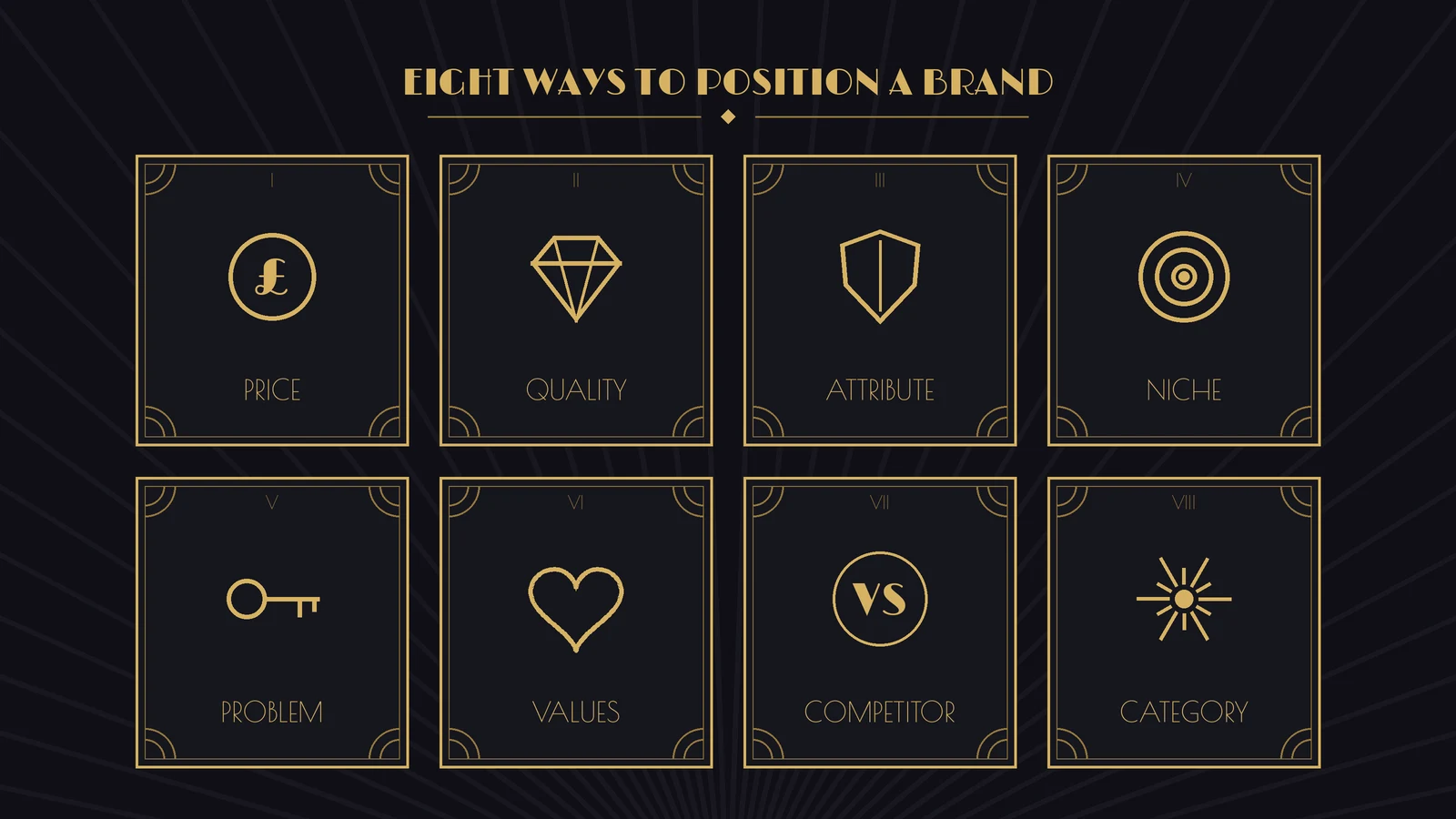
Most brands build their position around one dominant idea. The most common brand positioning strategies are:
- Price or value: offering the best price or the best value for money in the category.
- Quality or premium: being the best, most crafted or most exclusive option, usually at a higher price.
- Attribute or benefit: owning one specific attribute, such as safety, speed, simplicity or durability.
- Niche or audience: being the obvious choice for a specific group, such as small businesses, beginners or a particular profession.
- Problem and solution: being known for solving one painful problem better than anyone else.
- Values or purpose: standing for a belief that customers share, such as sustainability or independence.
- Competitor-based: defining the brand directly against a well-known leader.
- Category creation: framing the product as the first or best in a new category rather than competing in an existing one.
The right strategy depends on the market, the competition and what the business can genuinely deliver. A position that cannot be backed up with proof will not hold.
Brand positioning examples
Some of the clearest brand positioning examples come from brands that chose one idea and stayed with it for years:
- Volvo: safety. Volvo introduced the three-point seatbelt in 1959 and has built its brand around safety ever since. Decades later, safety is still the first word many people associate with it.
- Avis: the challenger. In 1962, Avis turned being the number two car rental company into a strength with the line “We try harder”, positioning itself against the market leader.
- Aldi: value. In the UK, Aldi’s “Like brands. Only cheaper.” campaigns compare its products directly with familiar brands, reinforcing a position built on quality at a lower price.
- Patagonia: values. Patagonia’s position rests on environmental responsibility, famously expressed in its 2011 “Don’t buy this jacket” advertisement, which urged people to think before they consume.
- Liquid Death: category reframing. Liquid Death sells canned water with the look and tone of a heavy metal beer brand, turning a commodity into something people talk about.
- Innocent: personality. Innocent’s playful, friendly tone of voice sets it apart in a category where most brands talk about ingredients and health claims.
What these brands share is focus. Each chose a single idea that mattered to its audience, expressed it consistently and backed it up with product decisions, not only advertising.
Differentiation vs distinctiveness
Classic positioning theory focuses on differentiation: giving customers a meaningful reason to prefer you. Marketing scientist Byron Sharp of the Ehrenberg-Bass Institute challenged this in his 2010 book How Brands Grow, arguing that many buyers see little difference between competing brands and that being easy to notice and remember, which he calls distinctiveness, often matters more.
The practical answer is to aim for both. A clear position gives people a reason to choose you, and distinctive assets such as a consistent colour, logo, tone of voice or phrase make sure they recognise and remember you when it is time to buy. Both rely on the mental shortcuts described in our guide to behavioural science in marketing.
How to map your position: the perceptual map
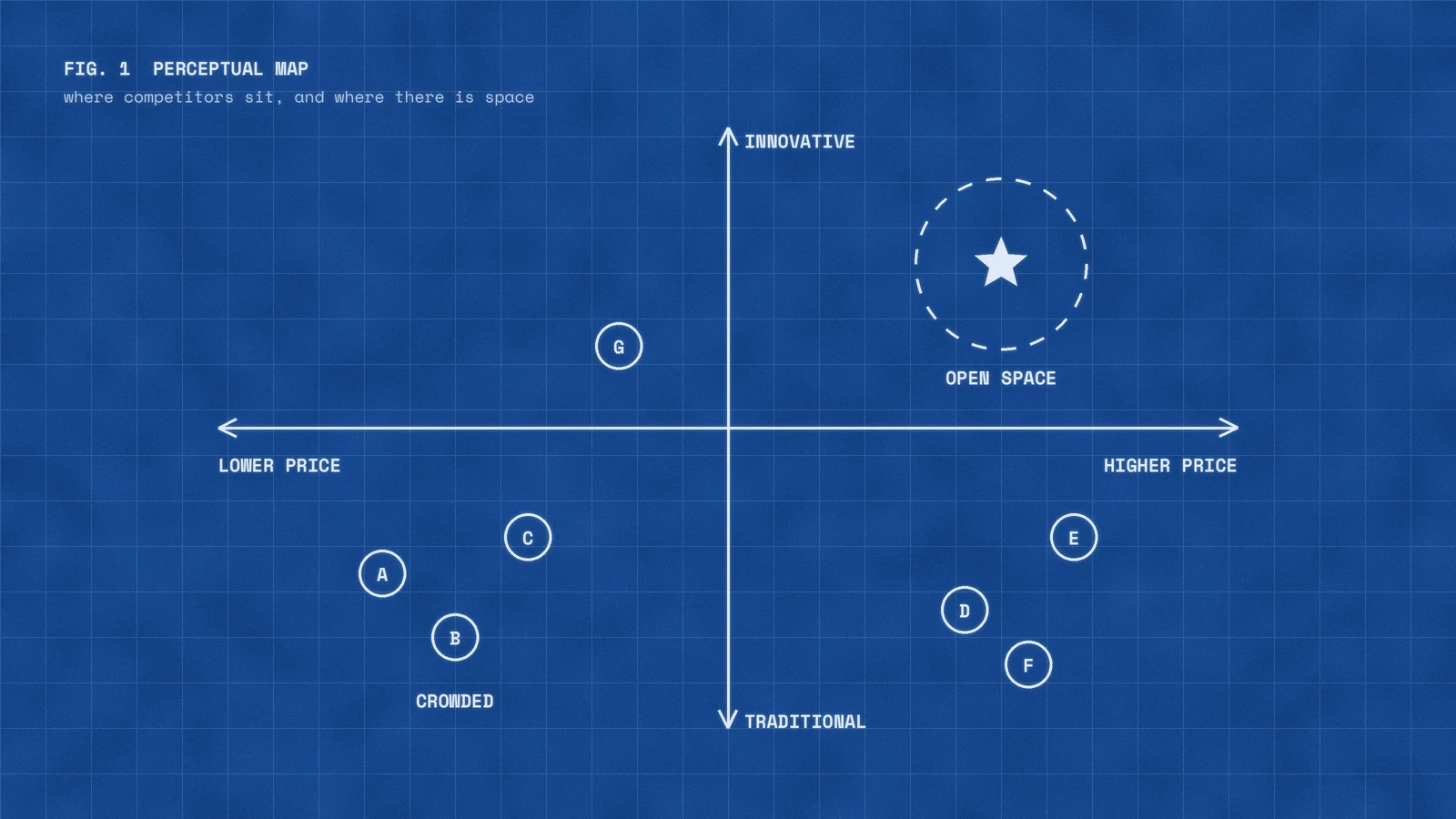
A perceptual map is a simple chart that shows how customers see competing brands on two dimensions that matter to them, such as price and quality, or traditional and modern. Plotting your brand and your competitors reveals where the market is crowded and where there is space to own.
- Choose two attributes that genuinely drive buying decisions in your category.
- Place each competitor on the map based on customer research, reviews and how they present themselves, not on your own assumptions.
- Look for gaps that are both empty and valuable. An empty space no customer cares about is not an opportunity.
- Decide where you want to be and what would need to change for customers to see you there.
How to develop a brand positioning strategy
- Understand your customers. Interview customers and prospects to learn why they buy, what alternatives they consider and which words they use to describe the problem.
- Map the competition. Include direct competitors and the other ways customers solve the problem, including doing nothing or doing it themselves.
- Identify what makes you different. List the capabilities, features, experience or beliefs that competitors cannot easily copy.
- Connect differences to value. For each difference, ask why a customer would care. Keep only the differences that lead to real value.
- Choose the category and the audience. Decide which frame of reference makes your value most obvious and which customers care most about it.
- Write a positioning statement. Summarise the position in a few sentences for internal use (see the next section).
- Express it everywhere. Translate the position into your website, messaging, content marketing, sales materials and social profiles.
- Test and review. Check whether customers repeat your position back to you. Review it when the market, the product or the audience changes.
The positioning statement
A positioning statement is a short internal summary of your position. It is not a tagline or advertising copy. Its job is to align everyone who works on the brand. A widely used template, popularised by Geoffrey Moore in Crossing the Chasm, looks like this:
For [target customer] who [need or problem], [brand] is a [category] that [key benefit]. Unlike [main alternative], [brand] [key difference].
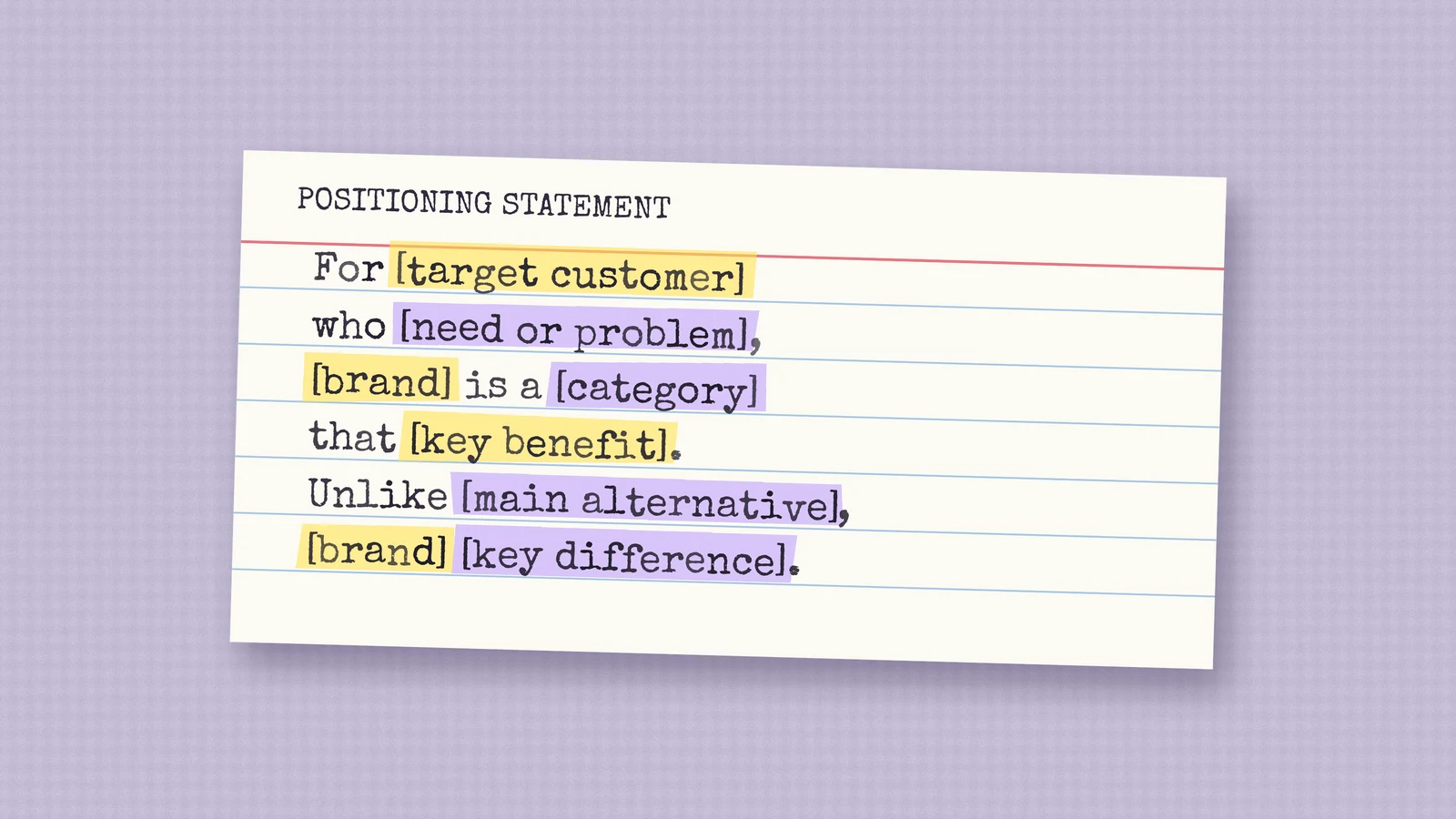
For example: For busy parents who want healthy meals without the planning, FreshBox is a meal kit service that delivers balanced recipes ready in 20 minutes. Unlike supermarket ready meals, every FreshBox meal is cooked fresh at home from whole ingredients. FreshBox is a fictional brand used only to illustrate the template.
A good statement is specific, believable and hard for a competitor to copy word for word. If you could swap in a rival’s name and it would still be true, the position is not yet clear enough. For more examples and a step-by-step method, see how to write a positioning statement.
Brand positioning in a digital world
Positioning used to live mainly in advertising. Today, customers form their view of a brand from dozens of digital touchpoints, many of which the brand does not control:
- Your website: the homepage headline, service pages and About page should state your position clearly within seconds.
- Social profiles: bios, pinned posts and content themes should reinforce the same idea. Consistent profiles also help people find you through social media SEO.
- Reviews and conversations: what customers say about you in reviews, forums and word of mouth is the real test of whether your position has landed.
- AI answers: when someone asks an AI tool to recommend a brand in your category, its answer is built from what the web says about you. A consistent position across your site and third-party sources is central to generative engine optimisation.
Track whether the market sees you the way you intend. Share of voice, brand mentions, the words customers use in reviews and the way AI tools describe you are all useful signals.
Common brand positioning mistakes
- Trying to appeal to everyone. A position that fits every customer is not a position. Focus creates clarity.
- Claiming what everyone claims. Words such as quality, innovation and customer service are expected, not distinctive.
- Positioning without proof. A position customers do not believe does more harm than no position at all.
- Changing too often. Positions take years to build. Frequent changes erase the memory you have already built.
- Leaving it in a document. A position that never reaches the website, the product and the customer experience does not exist in customers’ minds.
Frequently asked questions
What is brand positioning?
Brand positioning is the place a brand occupies in the minds of its target customers, and the choices a business makes to earn that place. It defines who the brand is for, which category it competes in, how it is different and why customers should believe it.
What is the difference between brand positioning and branding?
Brand positioning is the strategy: the place you want to own in customers’ minds. Branding is how that strategy is expressed through the name, visual identity, design and tone of voice.
What are the main types of brand positioning?
Common types include price or value, quality or premium, attribute or benefit, niche or audience, problem and solution, values or purpose, competitor-based positioning and category creation.
What is a positioning statement?
A positioning statement is a short internal summary of a brand’s position. A common template is: For [target customer] who [need], [brand] is a [category] that [key benefit]. Unlike [alternative], [brand] [key difference].
How often should a brand change its positioning?
Rarely. Positioning takes years to build in customers’ minds. It should be reviewed when the market, the product or the audience changes significantly, but frequent changes weaken recognition and trust.
Find the position only you can own
Kutola helps brands define a clear, credible position and carry it consistently across their website, content, social media and search. Get in touch to find out how your brand is seen today and where it could stand.