
Generative engine optimisation (GEO) is the practice of making your brand, content and expertise easy for AI systems such as ChatGPT, Google AI Overviews, Gemini and Perplexity to find, understand and cite in the answers they generate. Where traditional SEO aims for a high position in a list of links, GEO aims for something different: being part of the answer itself.
This guide explains where generative engine optimisation came from, how generative engines decide which sources to use, how GEO relates to SEO, and the practical steps any business can take to improve its visibility in AI search.
Key takeaways
- Generative engine optimisation (GEO) focuses on being cited and mentioned inside AI-generated answers, not only on ranking in search results.
- It builds on SEO rather than replacing it. Crawlable, well-structured, trustworthy content remains the foundation.
- Research shows that adding evidence such as statistics, quotations and cited sources can meaningfully improve visibility in AI answers.
- Your brand’s presence beyond your own website (reviews, publications, forums, directories) strongly influences how AI systems describe you.
- GEO needs its own measurement, because ranking reports alone no longer show the full picture.
What is generative engine optimisation?
A generative engine is a search or assistant tool that doesn’t just return a list of links. It retrieves information from multiple sources, then writes a single synthesised answer, often with citations. ChatGPT search, Perplexity, Gemini, Google AI Overviews, Google AI Mode, Microsoft Copilot and Claude all work this way to some degree.
The term itself has an academic origin. It was introduced in 2023 by researchers at Princeton, whose foundational paper framed generative engine optimisation as a method for helping content creators improve their visibility in responses from generative engines. The paper was later presented at KDD 2024, one of the leading conferences in data science.
In practical terms, GEO asks three questions about your brand:
- Can AI systems access and read your content?
- Do they understand clearly who you are and what you’re an authority on?
- When they build an answer in your area, is your content the most useful and trustworthy material to draw from?
Why GEO matters now
AI search is no longer an early adopter habit. ChatGPT reached 900 million weekly active users in February 2026, and Google reported more than one billion monthly AI Mode users in May 2026. Your customers are increasingly asking an AI for a recommendation, a comparison or an explanation before they ever visit a website.
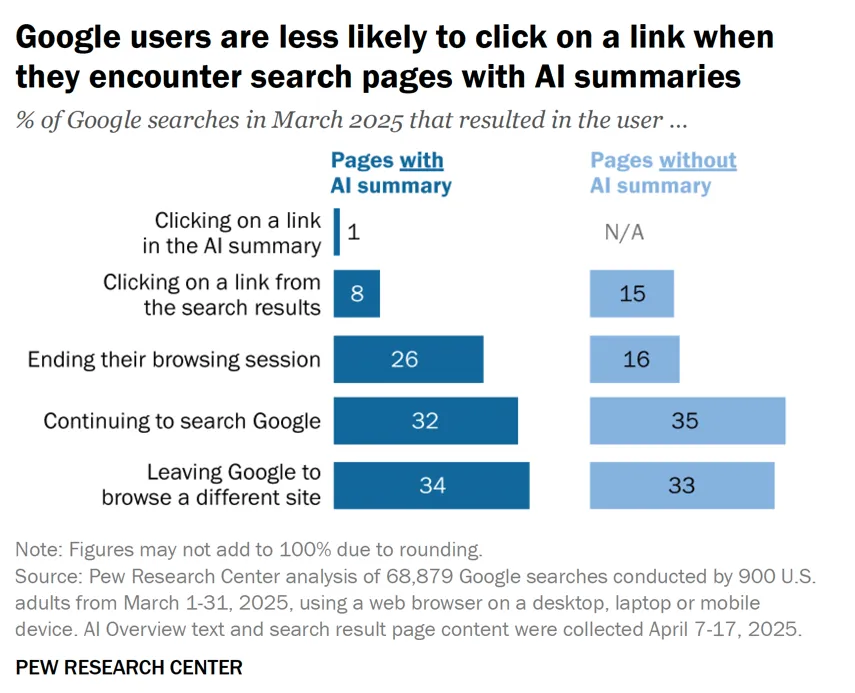
This changes how search traffic behaves. A Pew Research Center study of real browsing data found that users who saw an AI summary on Google clicked a traditional search result in 8% of visits, compared with 15% for users who didn’t see one. Clicks on links inside the summary itself happened in only 1% of visits. Pew also found that questions starting with words like “who”, “what” or “why” triggered an AI summary 60% of the time.
The implication is straightforward. For many informational and research-stage queries, the AI answer is becoming the first impression of your brand. If you’re cited, you’re part of the conversation. If you’re not, a competitor is shaping how your category is explained.
There’s an upside too. Visitors who do arrive from AI tools tend to be further along in their thinking, because they’ve already asked detailed questions and compared options. Several industry analyses report stronger conversion rates from AI referrals than from average organic traffic, although results vary widely by sector.
How generative engines choose what to cite
To optimise for AI search, it helps to understand roughly how an answer is built. Most generative engines draw on two sources of knowledge.
Training data. Large language models learn from vast amounts of text during training. What the web said about your brand and your industry at that time shapes the model’s baseline understanding. You can’t edit this directly, but a consistent, widely referenced brand presence influences it over time.
Live retrieval. When a tool searches the web in real time, it retrieves relevant pages, extracts useful passages and combines them into an answer. This is where most GEO work has its effect.
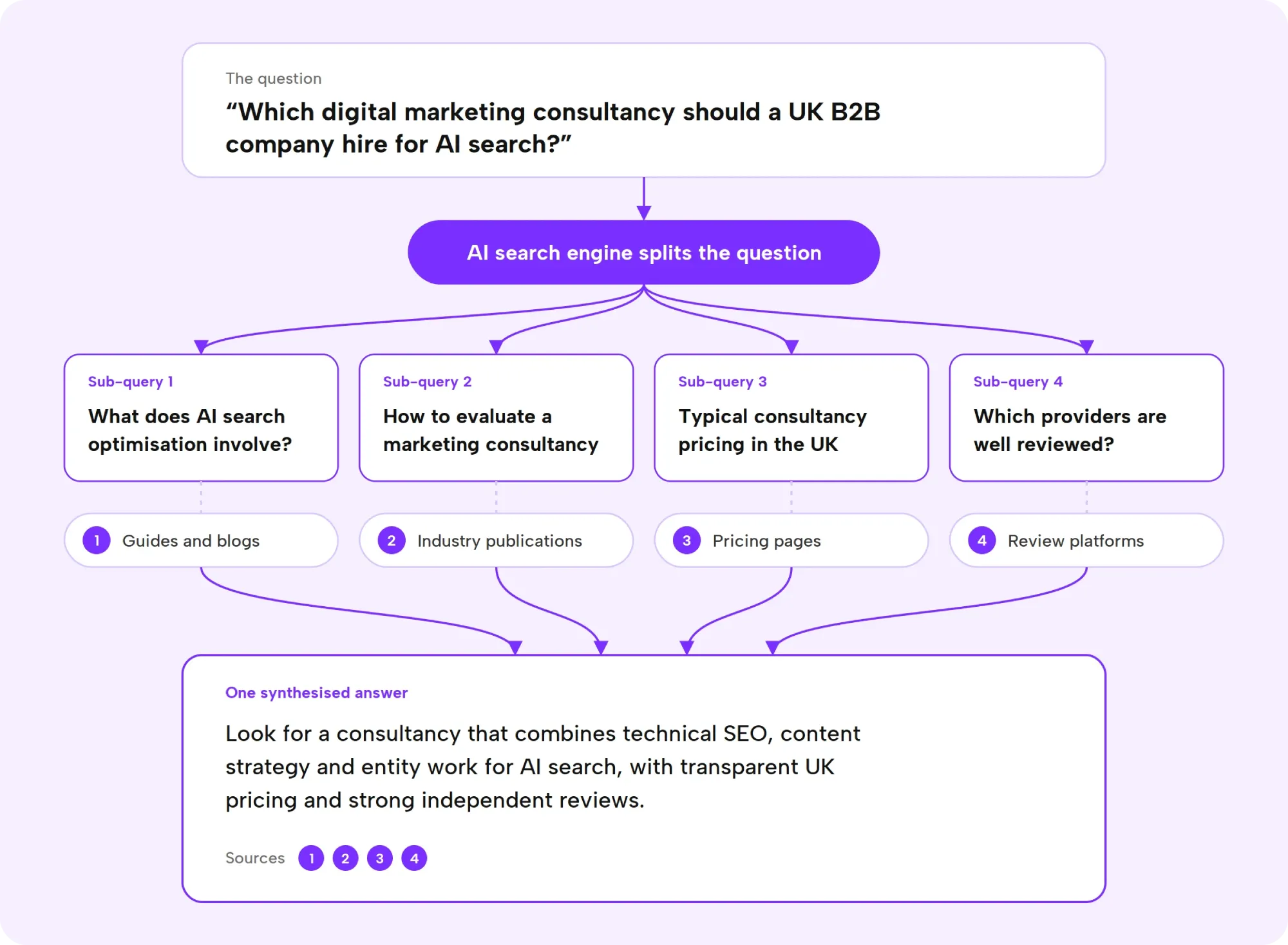
A key mechanism in live retrieval is the query fan-out. Rather than searching for a complex question exactly as typed, the AI splits it into several parallel sub-queries and retrieves content for each one separately. Google confirms that both AI Overviews and AI Mode may use this technique, running multiple related searches across subtopics and data sources to build a response.
So a question such as “which digital marketing consultancy should a UK B2B company hire for AI search?” may be broken down into sub-questions about what AI search optimisation involves, how to evaluate a consultancy, typical pricing and which providers are well reviewed. Each sub-question is a separate opportunity to be cited, which is why depth and breadth of coverage matter so much.
How GEO relates to SEO and AEO
These three terms overlap heavily, and they’re often used interchangeably. The clearest way to separate them is by what each one is trying to win.
| SEO | AEO | GEO | |
|---|---|---|---|
| Goal | High rankings in search results | Being the direct answer to a question | Being cited or mentioned in AI-generated answers |
| Main surfaces | Google and Bing organic results | Featured snippets, voice assistants, AI answers | ChatGPT, Perplexity, Gemini, AI Overviews, AI Mode |
| Primary metric | Rankings, clicks, organic traffic | Answer ownership | Citation frequency, share of AI answers, brand sentiment |
| Key signals | Relevance, links, technical health | Clear, concise answers, structured content | Evidence, entity clarity, third party mentions, freshness |
In short, SEO targets positions on traditional results pages with organic clicks as the core measure, while GEO targets how often a brand is cited or mentioned in AI responses. Answer engine optimisation sits between the two, focused specifically on becoming the extractable answer to a question.
The important point is that GEO doesn’t replace SEO. Google states plainly that appearing in AI Overviews or AI Mode doesn’t require any additional steps or special optimisation, and recommends reviewing fundamental SEO best practices instead. A page must still be crawlable, indexable and genuinely useful before any AI system will draw on it.
That said, SEO performance and AI visibility don’t move in perfect step. Some industry studies suggest that fewer than 10% of the sources cited by ChatGPT, Gemini and Copilot rank in Google’s organic top 10 for the same query. Methodologies differ and the figures should be treated with caution, but the direction is consistent: ranking well is necessary, but it’s not the whole story.
For a detailed side-by-side comparison, including a table and how to prioritise each, see our guide to GEO vs SEO vs AEO.
What the research says actually works
The original Princeton study tested a range of content changes across a benchmark of 10,000 queries. It found that optimisation methods could increase visibility in generative engine responses by up to 40%.
The most effective techniques had something in common: they made content more credible and more useful as evidence. Adding quotations and adding statistics were among the approaches that produced the largest gains. Citing reputable sources also performed well. Traditional tactics such as keyword stuffing, by contrast, offered little or no benefit.
One finding is particularly encouraging for smaller businesses. The researchers observed that these methods tended to help lower ranked websites more than dominant ones, because generative engines weigh the quality of a passage, not just the authority of the domain it sits on. A well evidenced page from a specialist firm can be cited alongside, or instead of, a larger competitor.
How to optimise for GEO: a practical framework
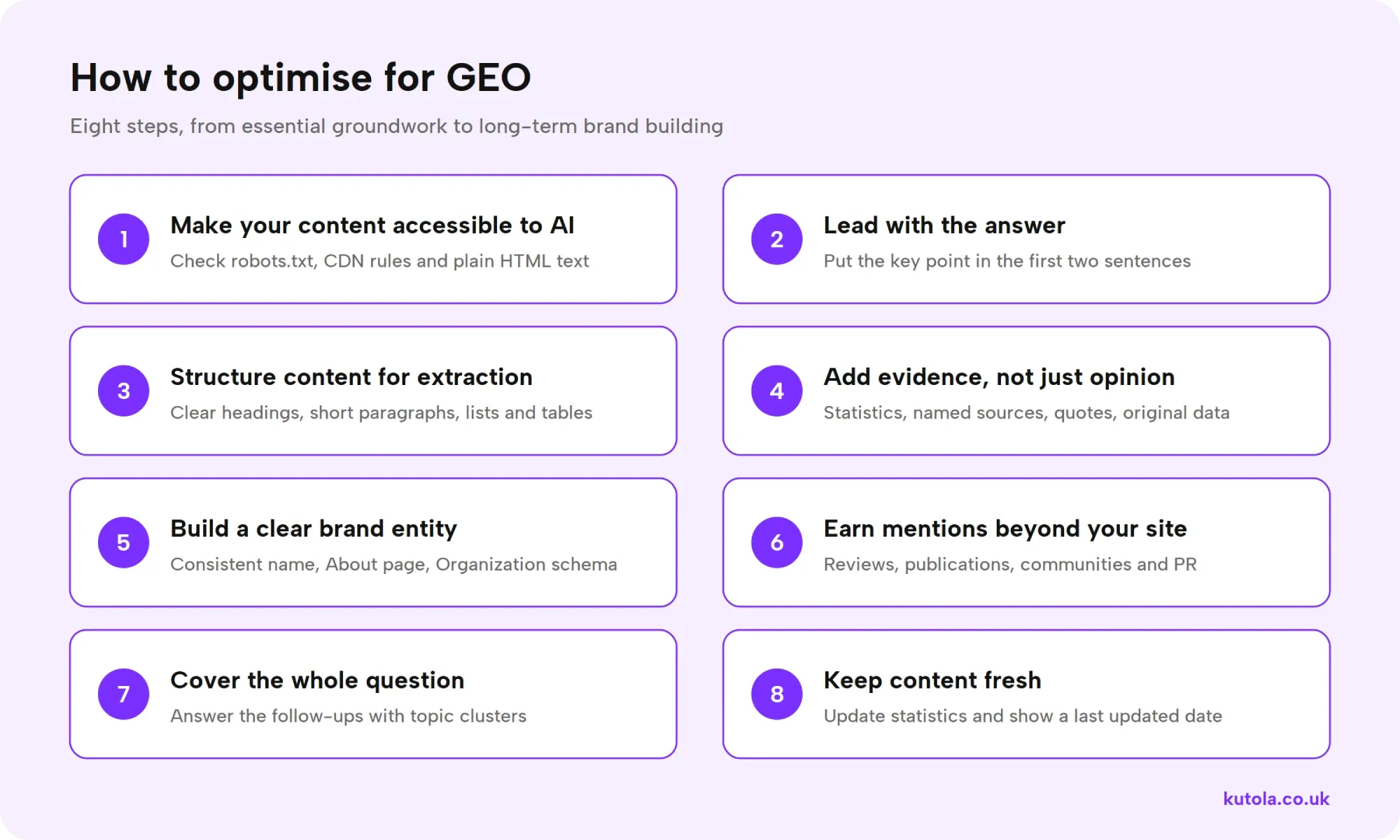
The following eight steps form a solid GEO foundation for most businesses. They’re ordered roughly from essential groundwork to longer term brand building.
1. Make sure AI systems can access your content
Nothing else matters if AI crawlers can’t read your pages. Check your robots.txt file and CDN or firewall settings, which sometimes block AI crawlers without anyone noticing.
It’s worth knowing that different crawlers serve different purposes. OpenAI, for example, uses GPTBot for model training and OAI-SearchBot for ChatGPT search, so a business can choose to block one without blocking the other. Similarly, Google-Extended controls whether content is used for Gemini training, but doesn’t affect how your site appears in Google Search or AI Overviews.
Make sure key content is available as plain HTML text. Important answers hidden inside images, tabs that require interaction or content that only loads through JavaScript are harder for AI systems to extract reliably.
2. Lead with the answer
Generative engines look for passages that answer a question directly. Structure each section so the key point comes first, followed by explanation and detail. This is sometimes called the BLUF approach: bottom line up front.
A simple test is to read only the first two sentences under each heading. If they don’t answer the question the heading asks, rewrite them.
3. Structure content for extraction
Clear structure helps both readers and machines. Use descriptive headings that mirror how people actually ask questions, keep paragraphs short, and use lists and tables where the content is genuinely list-like or comparative. A comparison table, for example, gives an AI system a clean, reliable source for “X vs Y” questions.
Each section should make sense on its own, because AI tools often extract a single passage rather than the whole page.
4. Add evidence, not just opinion
This is where the research is clearest. Support claims with specific statistics, name your sources, include expert quotations and, wherever possible, publish original data. Proprietary insight, such as findings from your own client work, surveys or audits, is especially valuable because no one else can offer it.
Evidence also builds trust with human readers, which aligns GEO with Google’s emphasis on E-E-A-T (experience, expertise, authoritativeness and trustworthiness).
5. Build a clear brand entity
AI systems think in terms of entities: people, organisations, products and concepts, and the relationships between them. Your goal is to make it unambiguous who your brand is, what it does and what it’s an authority on.
Practical steps include using your brand name consistently everywhere, maintaining a detailed About page, adding Organization schema with sameAs links to your official profiles, and ensuring author information is visible and credible. Inconsistent descriptions of your business across different platforms create confusion, and confused AI systems tend to cite someone else.
AI tools can only describe a brand consistently if the brand itself is consistent, which starts with clear brand positioning.
6. Earn mentions beyond your own website
What others say about you often matters more than what you say about yourself. Generative engines draw heavily on third party sources, including review platforms, industry publications, comparison articles, directories, podcasts and community discussions. Reddit, for instance, ranked as the first or second most cited domain on every major AI engine as of March 2026.
This makes digital PR, expert commentary, guest contributions and genuine participation in industry communities part of GEO. The aim isn’t to plant mentions, which tends to backfire, but to be visibly present wherever your category is discussed.
Platforms such as Reddit, YouTube and LinkedIn are among the sources AI tools cite most, which makes social media SEO part of any GEO strategy.
7. Cover the whole question, not just the keyword
Because of query fan-out, a single page optimised for one keyword is rarely enough. Think about the follow-up questions a buyer would ask and make sure your site answers them. Building topic clusters around a central pillar page, like this guide, is one of the most effective ways to demonstrate depth on a subject.
8. Keep content fresh
AI search tools often favour recent, up-to-date information, particularly on fast-moving topics. Review key pages regularly, update statistics, show a visible “last updated” date, and remove or consolidate outdated content that could lead an AI system to describe your business inaccurately.
How to measure GEO performance
Measuring GEO is less mature than measuring SEO, but it’s entirely possible to track progress. Useful approaches include:
- Prompt tracking. Define a set of questions your customers are likely to ask and check regularly whether, and how, your brand appears in the answers across different AI tools.
- Share of AI answers. Compare how often your brand is mentioned relative to competitors for the same prompts. This is often called share of model or AI share of voice.
- Sentiment and accuracy. Check what AI tools actually say about you. An inaccurate or outdated description is a problem worth fixing even if you’re mentioned often.
- AI referral traffic. In Google Analytics 4, track sessions from sources such as chatgpt.com, perplexity.ai and gemini.google.com, and compare their engagement and conversion with other channels.
- Branded search and direct traffic. People who discover you through an AI answer often search for your name later, so rising branded search can be an indirect signal.
Keep in mind that Google Search Console doesn’t currently report AI Overview performance separately, so some visibility will always need to be inferred rather than measured directly. A growing range of dedicated AI visibility tools can automate prompt tracking at scale.
Common GEO myths and mistakes
“GEO means SEO is dead.” It doesn’t. Most generative engines rely on search indexes and quality signals, so weak SEO usually means weak AI visibility.
“There’s a special file or markup that gets you into AI answers.” Google has stated that no special structured data or new machine-readable AI files are needed. Files such as llms.txt may have a role for some AI tools, but none is a shortcut.
“Writing for AI means writing for machines.” Content that reads awkwardly or is padded with keywords performs poorly with both people and AI systems. The best GEO content is simply exceptionally clear, well evidenced and well organised.
“GEO is a one-off project.” AI answers change as models are updated and new content is published. Visibility needs ongoing monitoring, just like rankings.
“You can game it.” Tactics such as hidden instructions for AI systems, fake reviews or mass produced low quality content may appear to work briefly, but they risk your reputation and your visibility once platforms adapt.
Which businesses benefit most from GEO?
Every business with an online presence is affected by AI search, but generative engine optimisation tends to deliver the most value where buyers research before they commit. That includes B2B services, professional services, software, finance, healthcare, education, travel and higher value consumer products.
It’s also highly relevant for businesses entering new markets or categories. When a buyer asks an AI tool to recommend providers in a space, the brands that appear in that first answer have a significant head start, and that first impression is increasingly formed before anyone reaches your website.
Frequently asked questions
What does GEO stand for in marketing?
GEO stands for generative engine optimisation. It refers to improving a brand’s visibility in answers produced by generative AI tools such as ChatGPT, Perplexity, Gemini and Google AI Overviews.
Is GEO different from SEO?
Yes, but they’re closely connected. SEO aims to rank pages in search results, while GEO aims to have content cited or mentioned in AI-generated answers. Strong SEO is the foundation for effective GEO.
How long does GEO take to show results?
Technical fixes, such as unblocking AI crawlers, can have an effect relatively quickly for tools that search the web live. Building authority, third party mentions and a clear brand entity typically takes several months of consistent work.
Can small businesses compete in AI search?
Yes. Research suggests that well evidenced, clearly structured content can help smaller websites gain visibility in AI answers, because generative engines assess the usefulness of individual passages rather than relying purely on domain size.
Do I need to pay to appear in ChatGPT or AI Overviews?
No. Citations in AI answers are earned through content quality, accessibility and authority, not bought. Paid advertising in AI tools is a separate channel.
Getting started with GEO
Generative engine optimisation is best understood as the next layer of search visibility. The fundamentals of good SEO still apply, but the goal has widened: to be the source AI systems trust when they explain your category to your future customers.
A practical first step is an honest assessment of where you stand today. How do AI tools currently describe your brand? Are your key pages accessible to AI crawlers? Which competitors are being cited instead of you, and why?
If you’d like help answering those questions, Kutola works with businesses to understand how their brand appears in AI search and what it will take to improve it. Get in touch to start the conversation.