What does PECR mean for your marketing emails, texts and cookies?
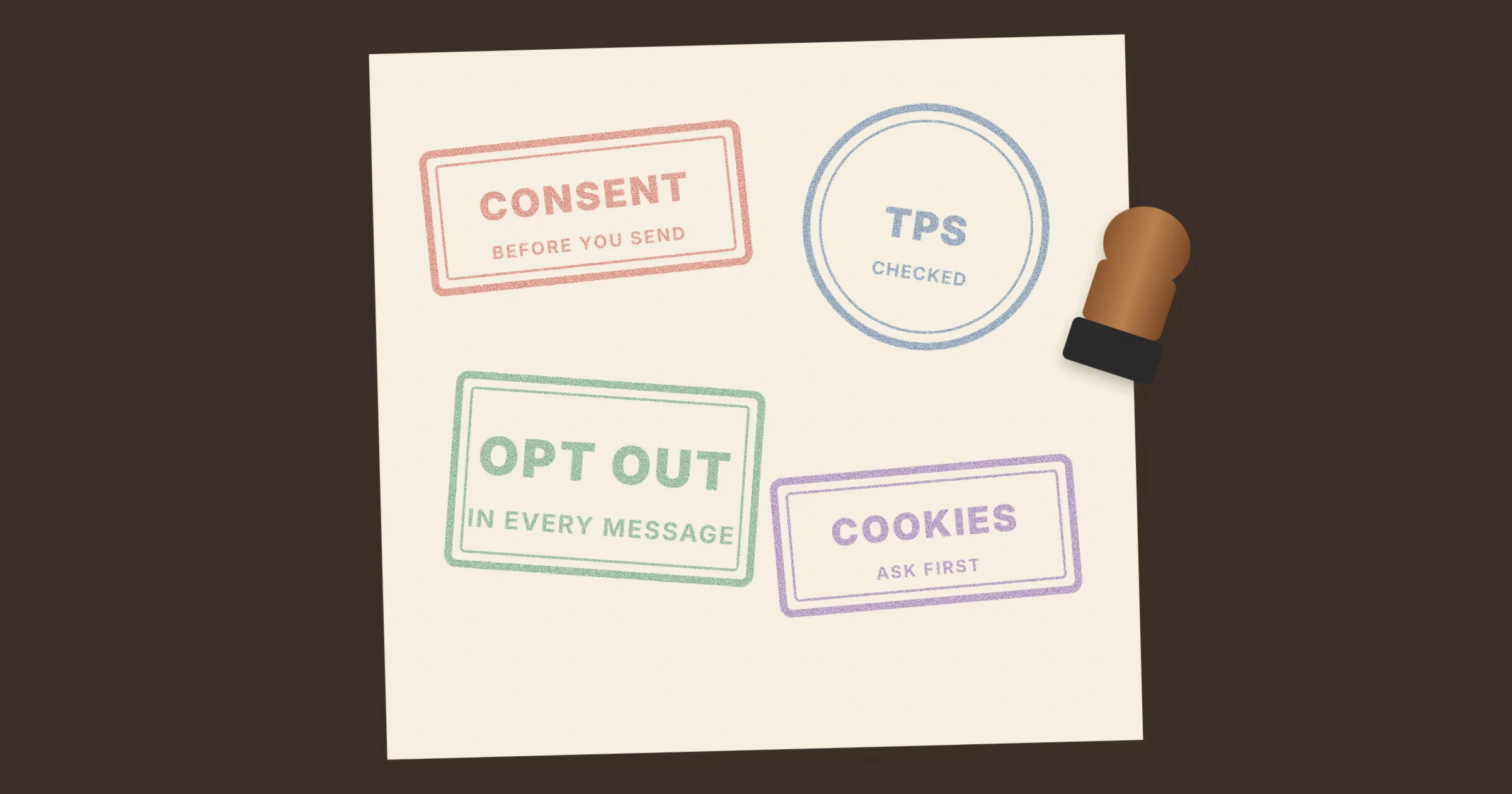
PECR, the Privacy and Electronic Communications Regulations, are the UK rules for marketing by email, text and phone, and for cookies and similar tracking on websites and apps. In short: you need consent to send marketing emails and texts to individuals unless the soft opt-in applies, you must screen marketing calls against the Telephone Preference Service and you need consent for non-essential cookies. Since February 2026, the ICO can fine businesses up to £17.5 million or 4% of global turnover for breaking them.
PECR shapes almost every part of email marketing, from how you build a list to what you can send to past customers. This guide explains what PECR covers, the rules for each channel, what changed under the Data (Use and Access) Act 2025 and a simple checklist to keep your marketing on the right side of the law. It is a plain English summary, not legal advice.
What is PECR?
PECR came into force in 2003 to put the EU’s ePrivacy Directive into UK law, and it stayed in place after Brexit. It sits alongside UK GDPR: UK GDPR covers how you handle personal data in general, while PECR adds specific rules for electronic marketing and for storing or reading information on people’s devices. Where both apply, you must comply with both.
PECR covers four main areas:
- Electronic marketing: marketing emails, texts, phone calls and faxes.
- Cookies and similar technologies: anything that stores or reads information on a user’s device, including tracking pixels and device fingerprinting.
- Communications services: security, confidentiality and the use of traffic and location data by phone and internet providers.
- Caller ID and directories: rules on showing your number and on listing people in phone directories.
The ICO’s guide to PECR is the official reference, and the ICO enforces the rules.
Marketing emails and texts
The rule for emails and texts depends on who you are sending to.
Individuals need consent
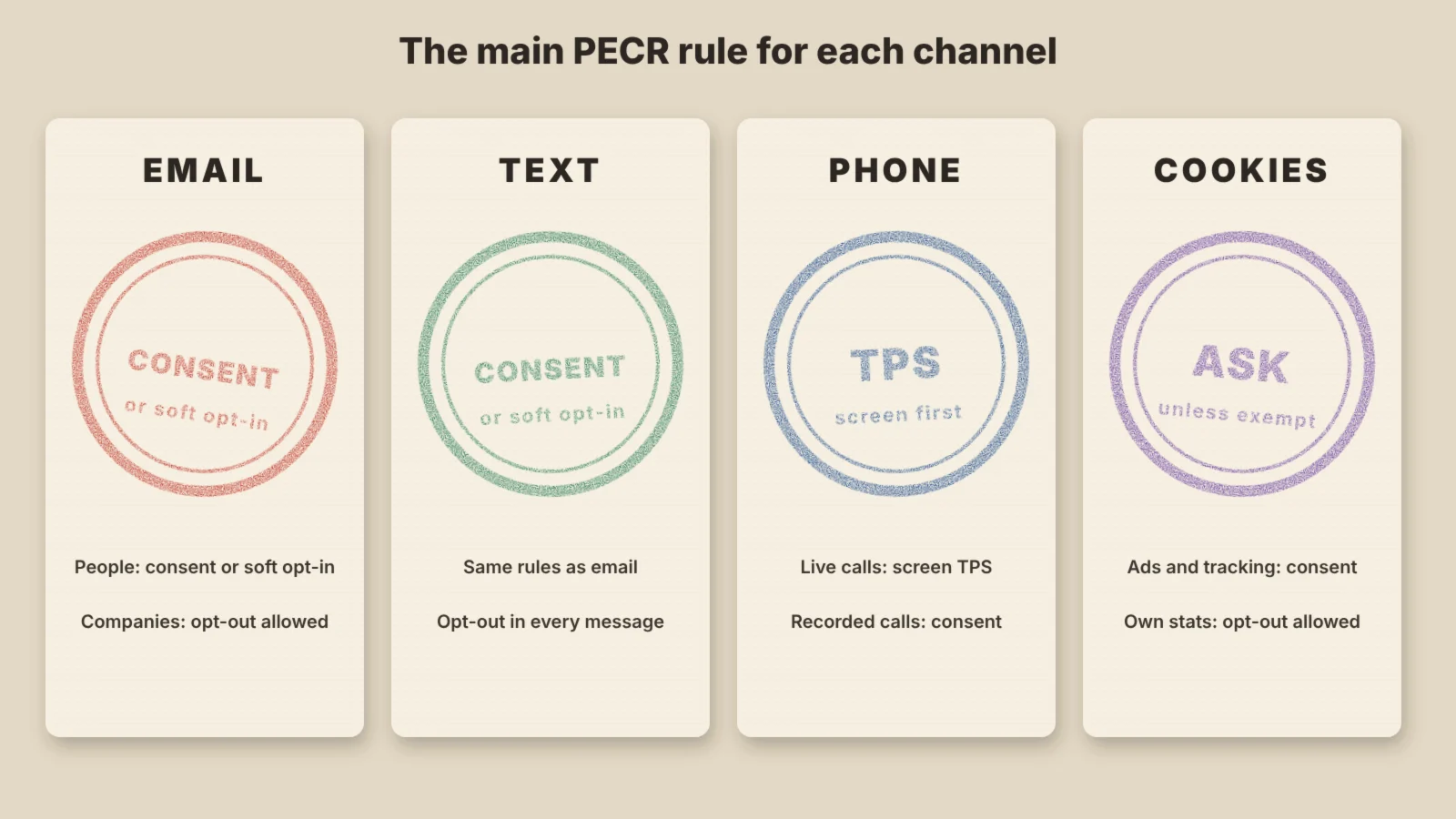
To send marketing emails or texts to individuals, including sole traders and some partnerships, you generally need their specific consent to receive that type of message from you. Consent you bought from a list seller or collected for someone else does not count, so bought lists are rarely usable for email or text marketing.
The soft opt-in for existing customers
You can market to people without consent if all of these apply:
- you got their contact details during a sale, or negotiations for a sale, of a product or service
- you are marketing your own similar products or services
- you gave them a simple way to refuse when you collected the details
- you give them a simple way to opt out in every message
The soft opt-in does not usually cover people who only entered a competition or downloaded a free guide, because no sale was being negotiated. It also only works for your own marketing, not for partners.
Charities can now use a soft opt-in
The Data (Use and Access) Act 2025 created a version of the soft opt-in for charities. Since February 2026, a charity can email or text people who have supported its work or expressed an interest in it, as long as the marketing furthers its charitable purposes and people can opt out from the start. The ICO sets out the conditions in its guidance on the charitable purpose soft opt-in.
Business addresses
PECR’s consent rule does not apply to “corporate subscribers” such as limited companies, LLPs and government bodies. You can send B2B marketing emails to company addresses without prior consent, but you must still say who you are, give a valid contact address and stop when asked. UK GDPR still applies to named addresses such as [email protected], so you need a lawful basis (usually legitimate interests) and a privacy notice.
Every marketing email and text, to anyone, must identify the sender and include a free and easy way to opt out.
Marketing phone calls
- Live calls. You can make live marketing calls without consent, but not to numbers registered with the Telephone Preference Service (TPS) or Corporate TPS, or to anyone who has told you not to call, unless they have specifically agreed to calls from you. Screen your list against the TPS before every campaign.
- Automated calls. Recorded marketing messages need specific consent to receive automated calls from you.
- Claims management and pensions. Calls about claims management services or pensions need prior consent in almost all cases.
- Caller ID. Always show a number people can call back. Hiding your number is a breach in its own right.
Cookies and tracking
PECR requires consent before you store or read information on someone’s device, unless an exemption applies. That covers cookies, local storage, tracking pixels and similar technologies, including those set by third-party tools you add to your site.
The Data (Use and Access) Act widened the exemptions from February 2026. Consent is no longer needed for:
- Strictly necessary storage, such as a shopping basket, login or security and fraud prevention.
- Statistics about your own service, such as first-party analytics used only to understand and improve your website, provided you tell people and give them a simple, free way to object.
- Appearance and preferences, such as remembering a chosen language or display setting.
- Emergency assistance, where information is needed to locate someone in an emergency.
Advertising cookies, remarketing pixels and most third-party tracking still need consent. Analytics that share data with an ad platform, or are used for anything beyond your own statistics, may not qualify for the new exemption. The ICO’s guidance on storage and access technologies, updated in 2026, explains how to judge each tool. A cookie banner that sets tracking before people choose, or makes rejecting harder than accepting, is the most common failure.
What counts as direct marketing?
Direct marketing means advertising or promoting products, services, aims or ideals to particular people. It is broader than sales emails:
- Newsletters that promote your products or offers usually count.
- A charity’s fundraising appeal counts, because it promotes the charity’s aims.
- Service messages, such as an order confirmation, a delivery update or a change to terms, do not count, as long as they do not include promotion.
Adding a sales pitch to a service message turns it into marketing. In January 2026 the ICO fined two companies a combined £225,000 for texts they presented as service messages, finding that the content was promotional and needed consent.
What valid consent looks like
PECR uses the UK GDPR standard of consent. It must be:
- Freely given: not a condition of buying or using a service unless genuinely necessary.
- Specific and informed: people know who will contact them, about what and by which channel.
- An active choice: an unticked box they tick, or a clear action. Pre-ticked boxes and silence do not count.
- Recorded: keep a record of who consented, when, how and what they were told.
- Easy to withdraw: as easy as it was to give.
Consent does not last forever. If you have not contacted someone for a long time, their consent may no longer be a fair basis for marketing to them.
Fines and enforcement
The Data (Use and Access) Act raised the maximum PECR fine from £500,000 to UK GDPR levels: £17.5 million or 4% of global annual turnover, whichever is higher. The ICO also lists its enforcement action publicly, which adds reputational damage to any fine.
Most PECR fines go to companies sending large volumes of unsolicited texts and calls. In June 2026, the ICO fined KRA Consultancy £300,000 for sending more than 5.5 million unsolicited marketing texts, and in August 2026 it fined a hearing aid company £190,000 for over 750,000 calls to people registered with the TPS. Complaints from the public start most investigations, so a steady trickle of complaints is a warning sign.
A PECR checklist for small businesses
- List your channels. Note every way you market: email, text, phone, social messaging and your website’s cookies and pixels.
- Check your basis for each contact. Consent, soft opt-in, charity soft opt-in or a corporate address. Remove anyone you cannot account for.
- Fix your sign-up forms. Use unticked boxes, say what you will send and record the date, source and wording for each sign-up.
- Add an opt-out to every message. Test the unsubscribe link and act on opt-outs promptly across every system.
- Screen call lists. Check numbers against the TPS and Corporate TPS before each campaign, and keep your own do-not-call list.
- Audit your cookies. List what your site sets, sort them into exempt and consent-based and make sure nothing that needs consent fires before people choose.
- Review once a year. Recheck after new tools, new campaigns or new ICO guidance.
Common PECR mistakes
- Buying email lists. Consent given to someone else almost never covers your marketing.
- Treating every enquiry as a customer. The soft opt-in needs a sale or genuine negotiations, plus a chance to refuse at the time.
- Hiding promotions in service messages. A discount code in a delivery update makes it marketing.
- Pre-ticked boxes and vague wording. “We may share your details with selected partners” does not give valid consent.
- Assuming B2B means no rules. Sole traders and some partnerships count as individuals, and UK GDPR still applies to named contacts.
- Loading trackers before consent. Many cookie banners look compliant while ad pixels fire on page load.
- Slow or broken unsubscribes. Every message after someone opts out is a fresh breach.
Frequently asked questions
What does PECR stand for?
PECR stands for the Privacy and Electronic Communications Regulations 2003. They are the UK rules for marketing by email, text, phone and fax. They also cover cookies and similar technologies, as well as privacy in communications services.
What is the difference between PECR and UK GDPR?
UK GDPR sets the general rules for handling personal data. PECR adds specific rules for electronic marketing and cookies. When you send marketing emails or use cookies, you need to comply with both.
Can I send marketing emails to businesses without consent?
Yes, to corporate subscribers such as limited companies and LLPs, as long as you identify yourself and offer an opt-out. Sole traders and some partnerships are treated as individuals, so they need consent or the soft opt-in.
What is the soft opt-in?
The soft opt-in lets you email or text existing customers without consent if you got their details during a sale or negotiations, you are marketing your own similar products and you gave them a chance to refuse at the time and in every message.
Do analytics cookies still need consent in the UK?
Not always. Since February 2026, first-party analytics used only to produce statistics about your own website can be set without consent, provided you tell people and offer a simple way to object. Analytics that share data for advertising still need consent.
On this page
Back to topGrow your list without legal risk
Kutola helps you plan email and content that people want to receive, with sign-up forms, consent records and messaging built to meet UK rules from the start. See how it fits into our content strategy work, or get in touch to talk through your marketing.