Email marketing for small businesses: a practical guide
Email marketing means sending planned, useful emails to people who have agreed to hear from you, to turn them into customers and keep them coming back. For a small business it is one of the few channels you fully own: no algorithm decides who sees your message, the list stays yours if a platform changes its rules and a single email can reach every subscriber for a few pence.
This guide sits under our content strategy guide and covers email from first sign-up to measurable sales. It explains the main types of marketing email, how to build a list the legal way and a seven-step plan for getting started. It then covers writing emails people open, getting them delivered, the automations worth setting up first, the UK rules under PECR and how to measure what works.
Key takeaways
- Email is an owned channel. You keep the list and the relationship whatever happens to search rankings or social reach.
- In the UK you generally need consent to email individuals, unless the soft opt-in applies to your existing customers.
- Start with a welcome sequence. It reaches people when their interest is highest and keeps working without extra effort.
- Gmail and Yahoo now require bulk senders to authenticate their domain and offer one-click unsubscribe, so setup matters as much as content.
- Open rates are unreliable since Apple Mail Privacy Protection. Judge emails on clicks, sales and unsubscribes instead.
What is email marketing?
Email marketing is the use of email to promote your business, share useful content and build relationships with people who have given you their address. It covers one-off campaigns sent to the whole list, regular newsletters and automated emails triggered by what someone does, such as signing up, buying or leaving items in a basket.
It is different from the emails your systems send to complete a transaction, such as order confirmations, receipts and password resets. Those transactional emails do not need marketing consent, but they are still worth designing well because customers open them. Adding heavy promotion to them, though, can turn them into marketing messages in the eyes of the regulator.
Email also sits at a useful point in the marketing funnel. Search, social and ads bring people to you once. Email brings them back, which is where much of the profit in a small business is made.
Why email marketing still matters for small businesses
Email is old, but its strengths have grown as other channels have become harder to rely on.
- You own the audience. Followers belong to the platform. An email list is a record you control, and you can take it with you if you change tools.
- No algorithm in the way. Organic social posts reach a fraction of your followers. A well-run email list reaches the inbox of nearly everyone on it.
- Low cost per message. Most email platforms charge by list size, so sending one more email costs very little. The DMA’s research into returns on email has consistently placed it among the highest-return channels UK marketers use.
- It builds first-party data. Every sign-up, click and purchase tells you what subscribers care about. That first-party data becomes more valuable as third-party tracking declines.
- It suits repeat business. Selling again to a happy customer is usually cheaper than finding a new one, and email is the most direct way to stay in touch.
The main types of marketing email
Most small business email programmes are built from five kinds of message.
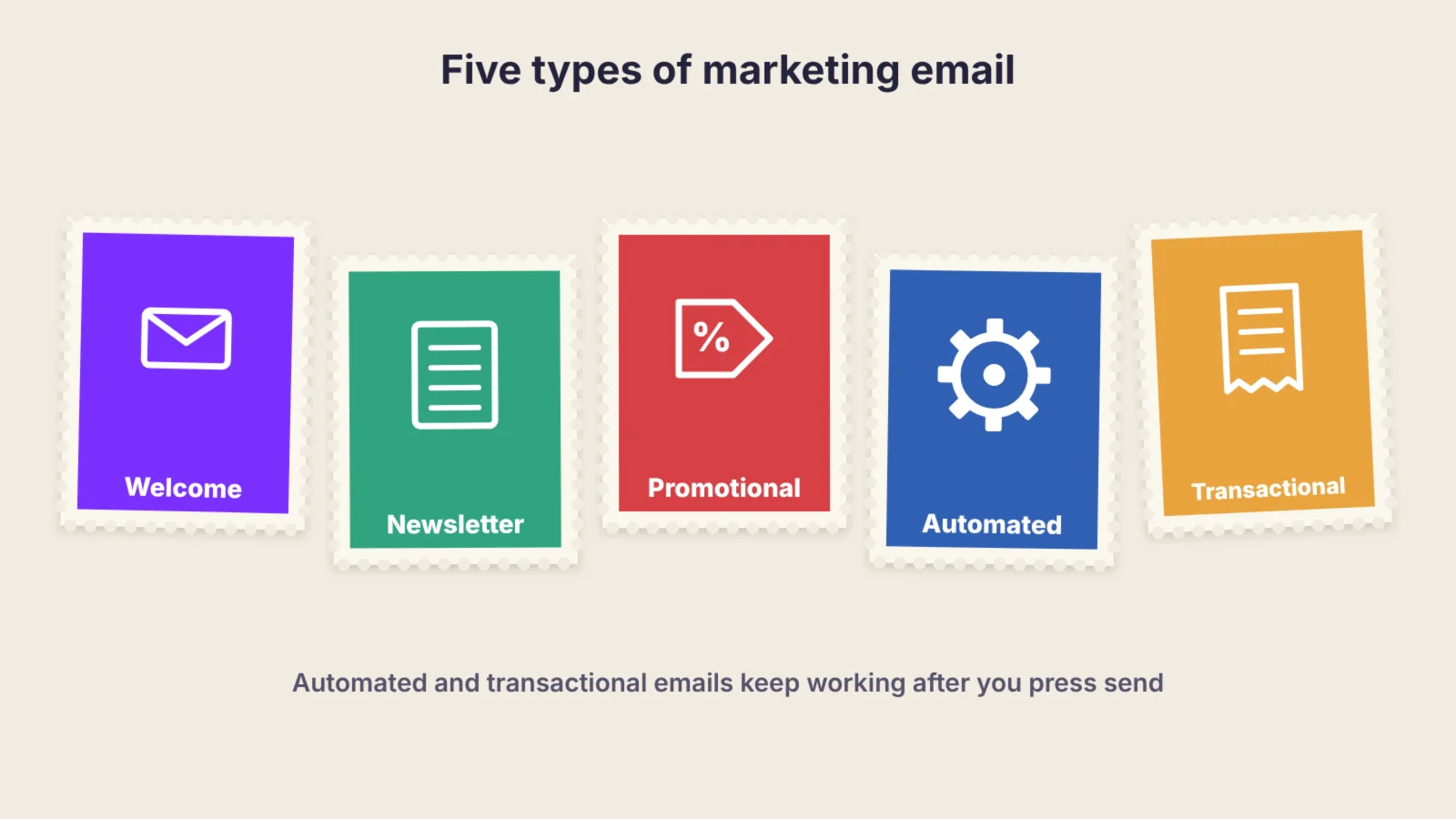
- Welcome emails. Sent straight after someone signs up. They usually get the highest engagement of anything you send, so use them to deliver what you promised, explain what to expect and point to your most useful content or products.
- Newsletters. Regular emails that share news, tips, stories or new content. They keep you in mind between purchases and work best when each issue gives subscribers something useful, not just a list of links.
- Promotional emails. Launches, offers, seasonal sales and events. They drive short bursts of revenue but wear out a list if they are all you send.
- Automated lifecycle emails. Triggered by behaviour, such as an abandoned basket, a first purchase, a lapsed customer or a renewal date. They reach people at the moment the message is most relevant.
- Transactional emails. Confirmations, receipts and delivery updates. They are not marketing, but they shape how customers feel about you.
How to build an email list the right way
A small list of people who chose to hear from you is worth far more than a large list of strangers. Bought or scraped lists break UK law for most uses, damage your sender reputation and rarely produce sales.
- Put sign-up forms where people already are. Your homepage, blog posts, checkout, contact page and footer all work. A short form with one field (the email address) converts better than a long one.
- Offer a clear reason to join. Say what subscribers will get and how often. A lead magnet, such as a checklist, guide, discount or early access, gives a concrete reason to sign up.
- Ask at checkout. Customers who buy are your best subscribers. Under the soft opt-in (explained below) you can often market to them as long as you give them a chance to refuse when you collect the address.
- Collect consent properly. Use an unticked box or a clear action, record when and how each person signed up and say what you will send. Many businesses also use double opt-in, which asks people to confirm by clicking a link, to keep fake and mistyped addresses off the list.
- Use offline moments. Events, shops and phone calls can all collect addresses, as long as you capture consent at the same time.
Pages with sign-up forms deserve the same care as any other conversion point. Our guide to conversion rate optimisation covers how to test and improve them.
How to start email marketing in 7 steps
- Set a goal. Decide what email should do for the business: more repeat sales, more booked consultations or more people reading your content. The goal shapes everything else.
- Choose an email platform. Look for sign-up forms, automation, segmentation, good deliverability and fair pricing as the list grows. Check that it can connect to your website or shop so purchase data flows in.
- Set up your sending domain. Send from your own domain, not a free webmail address, and set up SPF, DKIM and DMARC records before the first send. Your platform will show you how.
- Build your first sign-up points. Add a form to the pages with the most traffic and a checkbox at checkout, with clear wording about what people will receive.
- Write a welcome sequence. Two to four emails over the first week or two: deliver the promise, introduce your business, share your best content and make a first offer if it fits.
- Plan a regular rhythm. Decide how often you will send and what each email will cover, then add it to your content calendar. Monthly is a sensible start for most small businesses; weekly works if you have enough to say.
- Test, send and learn. Preview every email on mobile, send a test to yourself and a colleague, then review results after each send and adjust the next one.
How to write emails people open and read
- Make the subject line specific. Tell people what is inside or why it matters to them. “Three ways to cut your heating bill this winter” beats “November newsletter”.
- Use the preview text. The line shown after the subject in most inboxes is free space to add a second reason to open.
- Send from a real name. A recognisable sender, such as a person at your business, builds trust and is more likely to be opened.
- Give each email one main job. One message and one clear call to action usually beat a crowded email asking for five things.
- Write for mobile. Most email is read on phones. Use short paragraphs, a single column, large buttons and text that still makes sense if images do not load.
- Sound like a person. Write the way you would talk to a customer. Plain, friendly language outperforms corporate copy.
- Personalise with care. Using someone’s name is easy; sending them content based on what they bought or clicked is what makes a difference. Segmentation by interest, purchase history or location keeps emails relevant.
Proof helps emails as much as web pages. Reviews, customer stories and numbers, as covered in our post on social proof, give subscribers a reason to act.
How to make sure your emails arrive
Deliverability is whether your email reaches the inbox rather than the spam folder or nowhere at all. It depends on your technical setup, your sending reputation and how subscribers react to what you send.
Since February 2024, Gmail and Yahoo have required anyone sending around 5,000 or more emails a day to their users to authenticate with SPF, DKIM and DMARC, offer one-click unsubscribe and keep spam complaints low. Google’s email sender guidelines set a spam complaint rate ceiling of 0.3% and advise staying well below it. Microsoft has introduced similar rules for Outlook. Even if you send less than this, following the same rules gives your emails the best chance of arriving.
- Authenticate your domain. SPF, DKIM and DMARC prove that you are allowed to send from your domain.
- Make unsubscribing easy. A visible link in every marketing email and a one-click unsubscribe header. People who cannot find it mark you as spam instead.
- Clean your list. Remove hard bounces straight away and stop sending to people who have not opened or clicked for a long time, after a last attempt to win them back.
- Warm up new domains. If you are starting from scratch or moving platforms, increase sending volume gradually rather than emailing everyone on day one.
- Send what people expect. Sudden changes in frequency or content trigger complaints.
Email automations worth setting up first
Email automation sends the right message when someone takes an action, without you having to press send. For most small businesses, five automations do most of the work.
- Welcome sequence. Starts when someone joins the list. Covered above, and the first one to build.
- Abandoned basket. For online shops, a reminder within a few hours of someone leaving items behind, often followed by a second email the next day. It works because people dislike losing something they had nearly chosen, an idea explored in our guide to loss aversion.
- Post-purchase. A thank you, tips on using the product, a request for a review and later a suggestion for what to buy next.
- Win-back. Sent to customers who have not bought for a while, with a reason to come back.
- Enquiry follow-up. For service businesses, a short sequence after someone downloads a guide or requests a quote, answering common questions and showing examples of your work.
Map these against your customer journey map to spot where a timely email would help someone take the next step.
UK email marketing rules
In the UK, marketing emails are covered by the Privacy and Electronic Communications Regulations (PECR) and UK GDPR, and enforced by the ICO. The ICO’s guide to electronic mail marketing explains the detail. The main points are:
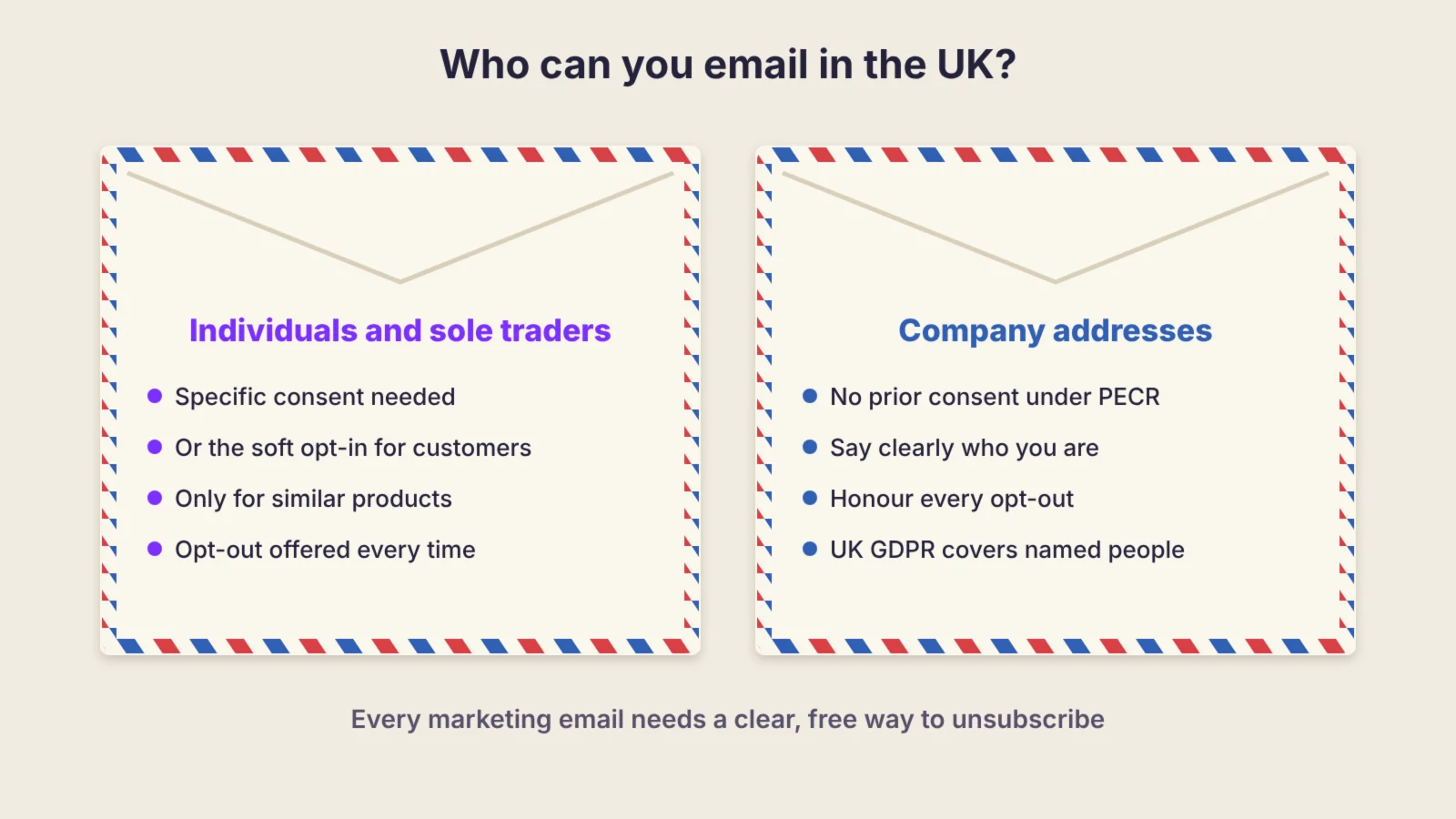
- Individuals need to have opted in. To send marketing emails to individuals, including sole traders and some partnerships, you generally need their specific consent.
- The soft opt-in for existing customers. You can email people without consent if you got their details during a sale or negotiations for a sale, you are marketing your own similar products or services and you gave them a simple way to refuse when you collected the details and in every message since.
- Charities can now use a soft opt-in too. The Data (Use and Access) Act 2025 extended a version of the soft opt-in to charities for people who have supported or expressed an interest in their work. The ICO explains the conditions in its guidance on the charitable purpose soft opt-in.
- Business addresses are treated differently. PECR’s consent rule does not apply to “corporate subscribers” such as limited companies and LLPs, so B2B emails to company addresses are allowed without prior consent. You must still identify yourself, give a valid address and honour opt-outs, and UK GDPR still applies to named people such as [email protected].
- Every marketing email needs an opt-out. Tell people who you are and give them an easy, free way to unsubscribe, then act on it promptly.
- Fines are now much higher. The same Act raised maximum PECR penalties to UK GDPR levels, up to £17.5 million or 4% of global annual turnover, whichever is higher.
Keep a record of how and when each person joined your list. If someone complains, that record is your evidence.
How to measure email marketing
Open rate used to be the headline email metric, but it is no longer reliable. Since Apple introduced Mail Privacy Protection in 2021, Apple Mail preloads images for many users, which registers an open whether or not the person read the email. Opens are still useful for spotting sudden drops that point to a deliverability problem, but not for judging content.
Focus on these instead:
- Click rate. The share of recipients who clicked a link. It shows whether the content and call to action worked.
- Conversions and revenue. Sales, bookings or enquiries from each email, tracked with UTM parameters in Google Analytics 4 or your shop platform.
- Revenue per email sent. Total revenue from a campaign divided by the number of emails delivered. It lets you compare campaigns of different sizes.
- List growth. New subscribers minus unsubscribes and removals each month.
- Unsubscribe and spam complaint rates. Rising figures warn that you are sending too often or the wrong content.
Choose two or three of these as the measures that matter for your goal, as described in our guide to marketing KPIs, and review them monthly.
Common email marketing mistakes
- Buying a list. It is usually unlawful for individuals, and it damages deliverability for everyone else on your list.
- Only sending offers. A list that only hears from you when you want money stops listening. Mix help, stories and offers.
- No welcome email. New subscribers forget why they signed up within days if they hear nothing.
- Sending irregularly. Long silences followed by a burst of emails lead to complaints and unsubscribes.
- Hiding the unsubscribe link. People will hit the spam button instead, which hurts every future send.
- Ignoring mobile. An email that looks good on a laptop can be unreadable on a phone.
- Judging success by opens. Clicks, sales and replies tell you far more.
Frequently asked questions
What is email marketing?
Email marketing is using email to promote your business and build relationships with people who have agreed to hear from you. It includes welcome emails, newsletters, promotional campaigns and automated emails triggered by what subscribers do.
Is email marketing still effective?
Yes. Email reaches people directly without an algorithm in the way, costs little per message and works especially well for repeat sales. UK marketers consistently rank it among their highest-return channels.
Do I need consent to send marketing emails in the UK?
Usually, for individuals. Under PECR you need consent unless the soft opt-in applies, which covers existing customers receiving marketing about similar products who were given a chance to opt out. Emails to company addresses do not need prior consent, but must include an opt-out.
How often should a small business send marketing emails?
Start with a frequency you can sustain with useful content, which for most small businesses is monthly or fortnightly. Watch unsubscribes and complaints and adjust; consistency matters more than volume.
What is a good email open rate?
Open rates are no longer a reliable benchmark because Apple Mail Privacy Protection records many automatic opens. Compare click rates, conversions and revenue per email across your own campaigns instead.
Which emails should I automate first?
Start with a welcome sequence for new subscribers. Online shops should add abandoned basket and post-purchase emails next, while service businesses benefit most from a follow-up sequence after an enquiry or download.
On this page
Back to topTurn your email list into a reliable source of sales
Kutola helps you plan what to send, build the sequences that work in the background and connect email to the rest of your content. See how it fits into our content strategy work, or get in touch to talk through your list.