When AI agents do the shopping: a retailer’s guide to agentic commerce
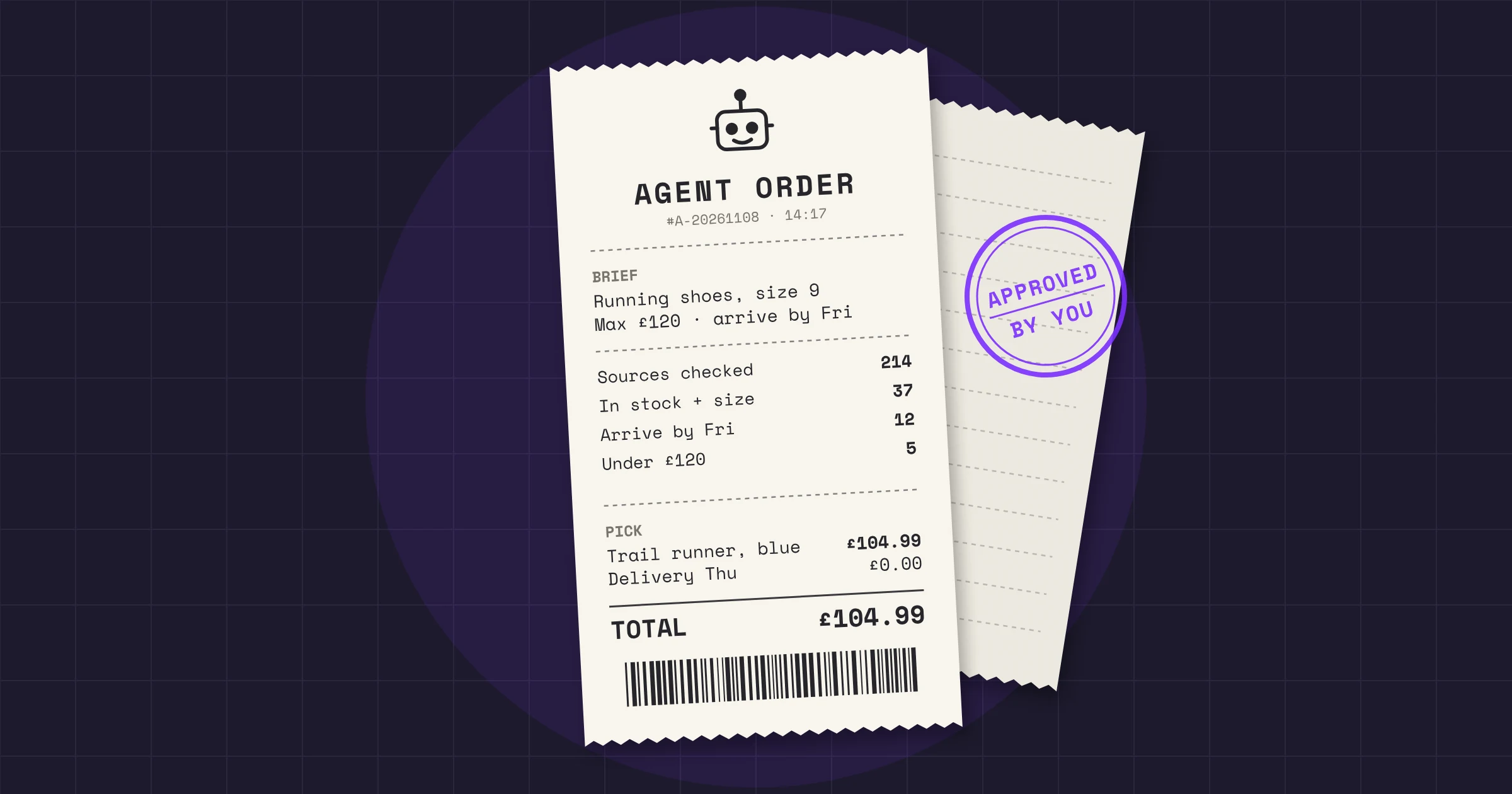
Agentic commerce is shopping in which an AI agent does some or all of the buying work for a person. The shopper sets the goal and the limits, such as “running shoes under £120 that arrive by Friday”, and the agent searches, compares, fills the basket and, with permission, pays. The retailer still sells the product, but the first visitor to read the product page may be software rather than a person.
This guide is for online retailers and the marketers who work with them. It explains how AI shopping agents work, which companies are building the systems behind them, where things stand in the UK and what is worth doing now. Agentic commerce is the shopping side of generative engine optimisation: before an agent can buy from you, it has to find, read and trust your site.
What is agentic commerce?
The word “agentic” comes from AI agents, systems that can plan and carry out tasks rather than only answer questions. A chatbot that recommends three kettles is AI-assisted shopping. An agent that picks one, checks it is in stock, applies your saved address and completes the order after you approve it is agentic commerce.
Most shopping today sits somewhere between those two points. The table shows how the work moves from the shopper to the agent at each stage.
| Stage | Traditional ecommerce | AI-assisted shopping | Agentic commerce |
|---|---|---|---|
| Finding products | The shopper searches and browses | An AI answer suggests a shortlist | The agent searches many sources against the shopper’s brief |
| Comparing | The shopper opens tabs and reads reviews | The AI summarises differences | The agent weighs price, delivery, reviews and fit |
| Buying | The shopper checks out on the retailer’s site | The shopper clicks through and checks out | The agent checks out, usually after the shopper approves |
| Who reads your product page | A person | A person, after an AI summary | Software first, sometimes only software |
The last row is the one that matters for marketing. In agentic commerce, product data, policies and reviews are read by machines that do not respond to a hero image or a clever headline. They respond to clear, complete and consistent information.
How AI shopping agents work
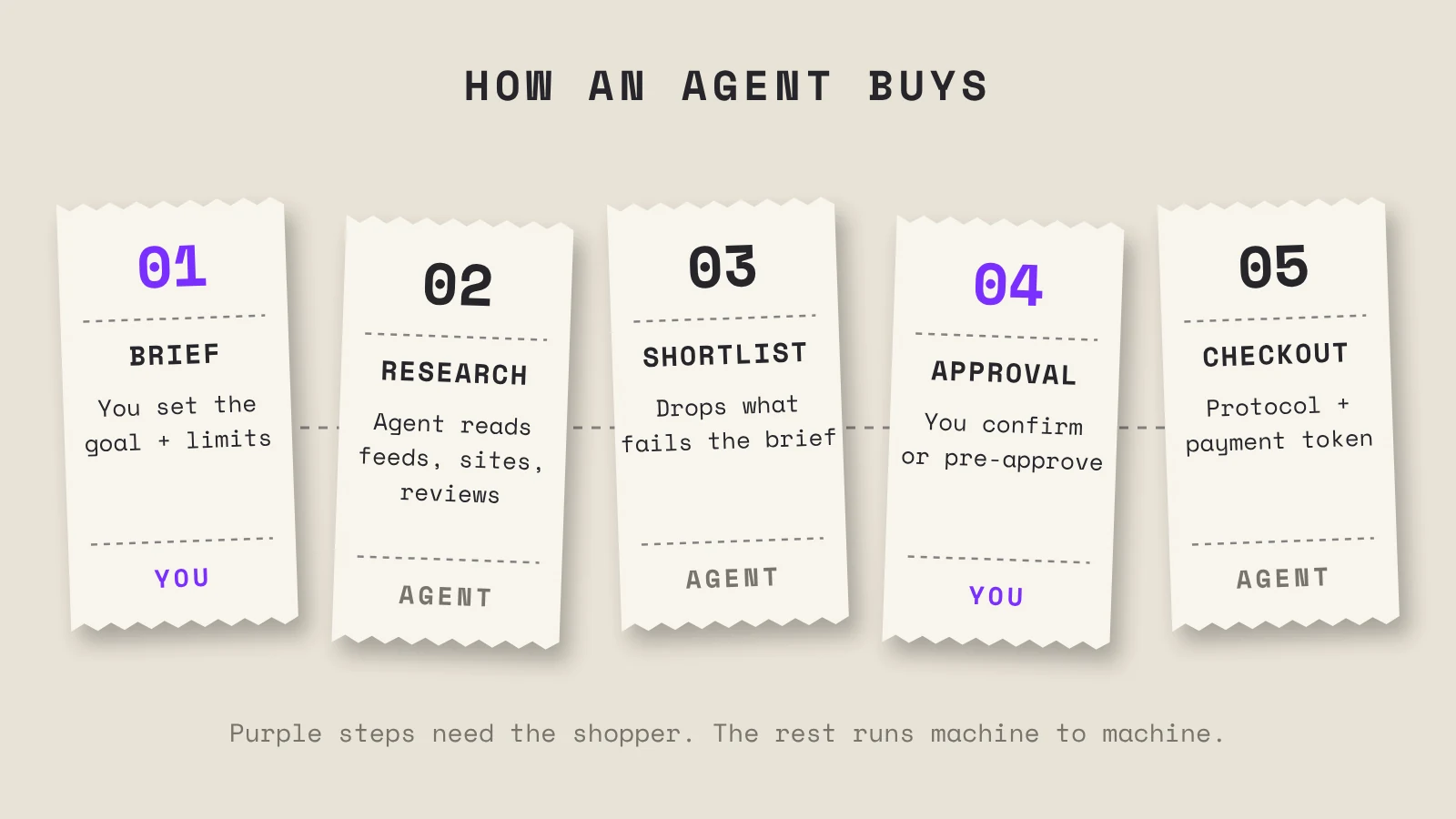
Every agent works differently in detail, but a purchase usually passes through the same five steps.
- The brief. The shopper describes what they want and sets limits on price, brand, delivery date or spending.
- The research. The agent reads product feeds, retailer websites, reviews and comparison content, often running several searches at once.
- The shortlist. It filters out products that fail the brief, such as items out of stock or arriving too late, and ranks the rest.
- The approval. The shopper confirms the choice, or has already given the agent permission to buy within set limits.
- The checkout. The agent places the order through a commerce protocol and pays with a tokenised card or wallet, so it never holds the real card details.
Steps four and five depend on shared standards, so that an agent can buy from thousands of shops without a custom connection to each. Three open protocols lead so far:
- Agentic Commerce Protocol (ACP): built by OpenAI and Stripe and released in September 2025 alongside Instant Checkout in ChatGPT. It defines how an agent passes an order and payment token to a merchant.
- Universal Commerce Protocol (UCP): launched by Google in January 2026 and developed with Shopify, Etsy, Wayfair, Target and Walmart. Google describes it as an open standard for the whole shopping journey, with the retailer remaining the merchant of record.
- Agent Payments Protocol (AP2): Google’s payment layer from September 2025, which records the shopper’s instructions as signed mandates so that everyone in the chain can see what the agent was allowed to buy.
Who is building agentic commerce?
The race involves AI platforms, ecommerce platforms and payment networks, and the picture has changed quickly. One early lesson came from OpenAI. Its Instant Checkout let people pay inside ChatGPT from late 2025, but in March 2026 OpenAI scaled the feature back after weak uptake and moved its focus to product discovery, with purchases completed in retailers’ own apps and websites. People were happy to research in a chat but less willing to hand over the final step.
| Company | What it offers | Where it stands |
|---|---|---|
| Checkout in AI Mode and the Gemini app through UCP, plus Universal Cart, a cart that follows the shopper across Search, Gemini and YouTube | Universal Cart was announced at I/O in May 2026; checkout so far covers eligible US retailers | |
| OpenAI | Product results in ChatGPT and the ACP standard | ChatGPT shows product results in its answers; OpenAI says product results are not ads and merchants can apply to send a direct product feed |
| Shopify | Agentic storefronts that list a shop’s catalogue in AI channels such as ChatGPT, Copilot and Google AI Mode | Google has enrolled eligible Shopify merchants in native AI checkout in the US, with an option to opt out |
| Visa and Mastercard | Card tokens that identify an agent and the limits the shopper set | Santander and Mastercard completed a payment made by an AI agent in Europe in 2026 |
| Amazon | Its own assistant inside its store, and tight control over outside agents | A US court blocked Perplexity’s Comet agent from buying on Amazon in March 2026, then the Ninth Circuit lifted the block in August 2026 |
The Amazon case shows the open question underneath all of this: whether a shop has to let outside agents buy on behalf of its customers. The appeal court found that the user, not Perplexity, was the one accessing Amazon, but it limited the ruling to the facts of that case. For now, each platform is setting its own rules.
Agentic commerce in the UK
Most of the buying features above launched in the US first. Google’s agentic checkout and Universal Cart announcements so far cover US retailers, and in the UK the agent’s job usually ends with a shortlist and a link to your site. UK shoppers already use AI to research products, which is why being found and recommended by AI matters today, even where checkout has not arrived.
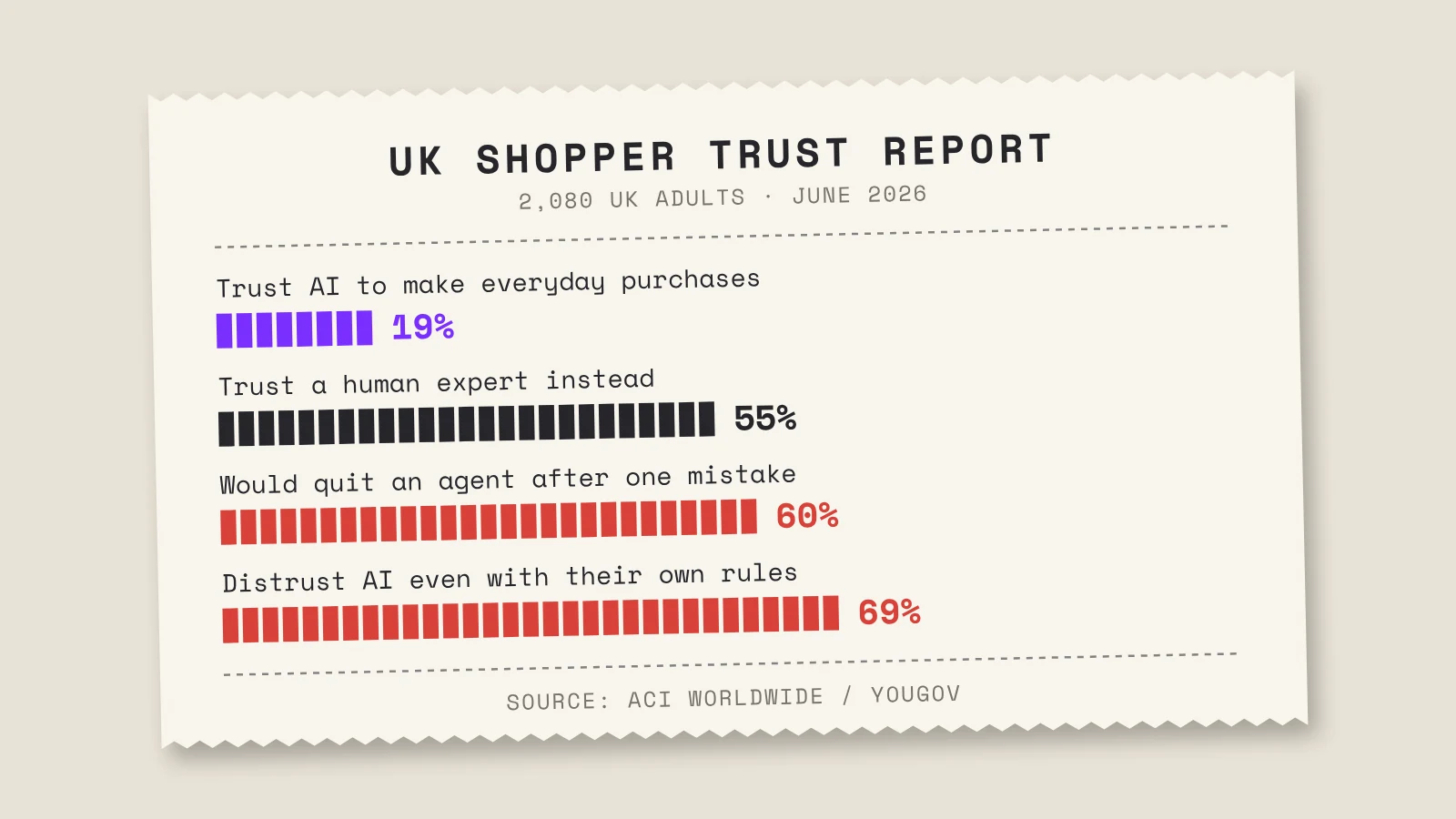
Trust is the main brake. In a YouGov survey of 2,080 UK adults for ACI Worldwide, only 19% said they trust AI assistants to make everyday purchasing decisions, against 55% who trust a human expert. Six in ten said they would stop using an AI shopping agent after a single mistake, and 69% said they would not trust AI even when it follows rules they had set.
The rules are clearer than many retailers assume. In March 2026 the Competition and Markets Authority published guidance on complying with consumer law when using AI agents. Its message is that existing consumer law applies whether a customer deals with a person or an agent, and that a business stays responsible for what its agents do. Prices, product information, refunds and cancellation rights all have to hold up, and the Digital Markets, Competition and Consumers Act lets the CMA fine businesses up to 10% of global turnover for breaches.
What it means for online retailers
The size of the shift is uncertain. McKinsey estimates that agents could orchestrate up to $1 trillion of US retail revenue by 2030, and $3 trillion to $5 trillion globally, while other forecasters give far lower figures because they define “agentic” more narrowly. The direction is easier to see. Adobe found AI-referred traffic to US retail sites rose 393% year on year in the first quarter of 2026. Four changes follow for retailers.
- Fewer visits, more decided visitors. When an agent compares on the shopper’s behalf, fewer people browse category pages. Those who do arrive have usually chosen, so conversion matters more than sessions.
- Sales without a site visit. When checkout happens inside an AI surface, a sale can be completed without the shopper ever loading your website. Upsells, email sign-ups and loyalty prompts on the site never get seen.
- Data becomes the shop window. An agent cannot judge a product it cannot read. Missing sizes, vague delivery times or a price that differs between your feed and your page are reasons to drop you from the shortlist.
- Brand still decides close calls. Agents lean on reviews and on what other sites say about you. A brand people search for by name, and that independent sources recommend, is more likely to make the shortlist when products are similar.
There are also risks to plan for. Agents make mistakes, such as choosing the wrong size or reordering when the customer did not want to, and under the CMA guidance an error by the AI platform is not something a retailer can simply point to when a customer complains. Returns, disputes and fraud checks all need a process that works when the buyer is software.
How to get your shop ready for AI agents
None of the following depends on agentic checkout reaching the UK. Each step makes your products easier to find in AI answers today and ready to buy when agents can.
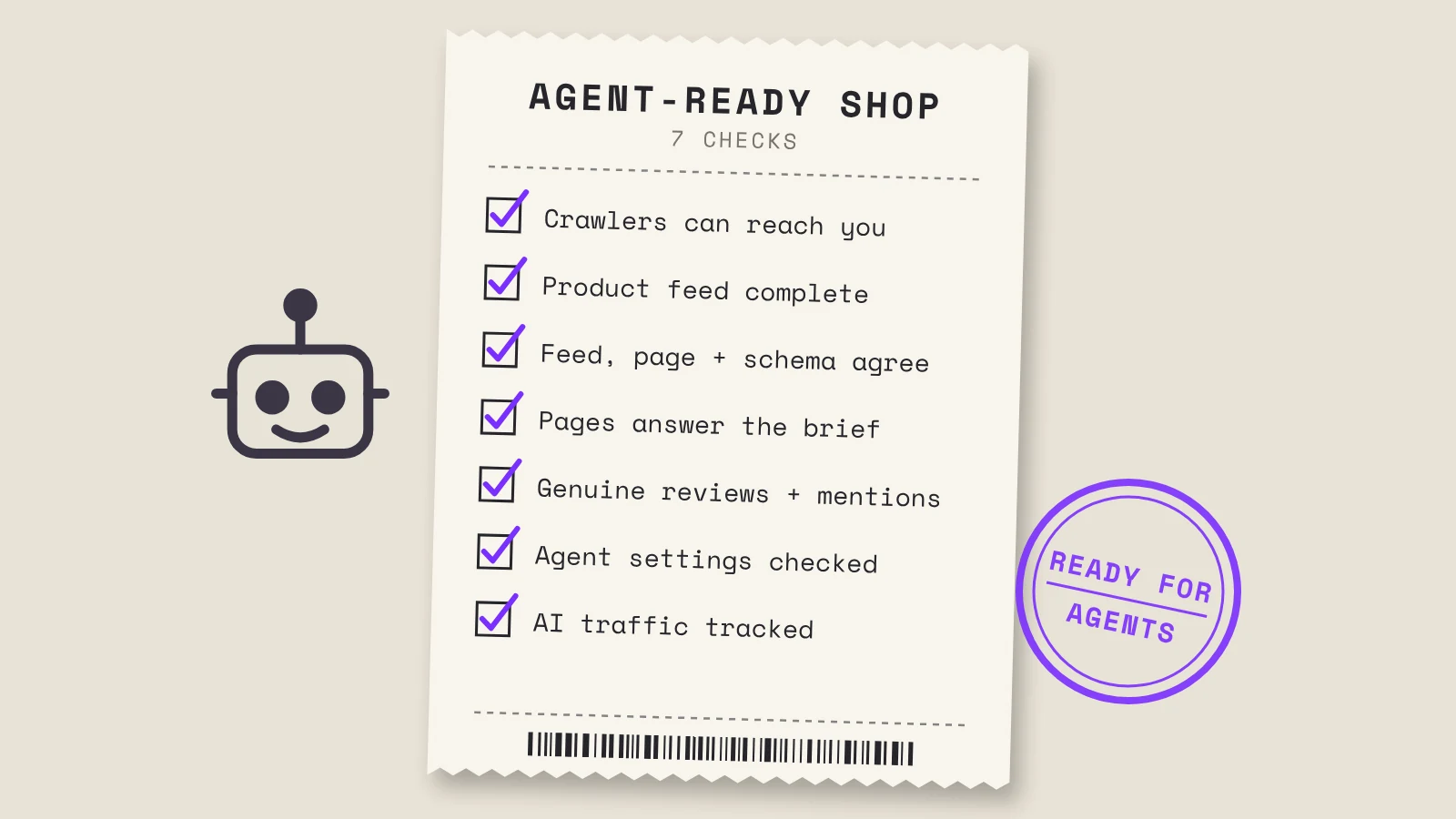
- Let the right crawlers in. ChatGPT search finds pages through OAI-SearchBot and Google through Googlebot, so a robots.txt rule written to block AI training can also keep your products out of shopping answers. The AI Crawler Checker shows which AI bots can reach your site.
- Complete your product feed. Keep a Google Merchant Center feed with GTINs, prices, stock, shipping costs and return windows. Fill the optional fields too, such as material, size and compatibility, because these are the details a shopper’s brief tends to include.
- Make every source agree. The price, stock and delivery promise in your feed, on the product page and in your structured data should match. Product and Offer markup with shipping and returns details lets an agent read them without guessing.
- Answer the questions behind the brief. Write product pages and buying guides that cover what shoppers ask in a conversation: “will it fit”, “how long does it last”, “how does it compare with”. The approach in getting cited in AI Mode works for products as well as services.
- Build genuine reviews and mentions. Collect reviews on your site and on third-party platforms, and earn coverage in the guides and comparison pages agents read. Fake reviews, and incentivised reviews that are not disclosed, are banned under UK law and would undo the trust you are building.
- Check your platform’s agent settings. Shopify merchants can choose which AI channels show their catalogue. Others can follow Google’s UCP integration steps in Merchant Center and ask their payment provider which agent protocols it supports.
- Measure AI traffic separately. Track referrals from ChatGPT, Gemini, Perplexity and Copilot as their own channel in your analytics, and watch the conversion rate of those visits. The methods in measuring GEO performance apply here too.
Start with the first three steps. They are cheap, they help ordinary search as much as AI search and they fix the gaps that most often keep a product off an agent’s shortlist.
Frequently asked questions
What is agentic commerce in simple terms?
Agentic commerce is shopping where an AI agent does the work for you. You say what you want and set limits, and the agent searches, compares and, with your approval, buys the product.
How is agentic commerce different from ecommerce?
In ecommerce a person browses a website and checks out. In agentic commerce an AI agent reads product data, compares options and can complete the purchase, so the retailer’s first reader is often software.
What is the Agentic Commerce Protocol?
The Agentic Commerce Protocol (ACP) is an open standard from OpenAI and Stripe, released in September 2025. It defines how an AI agent sends an order and a secure payment token to a merchant. Google’s Universal Commerce Protocol (UCP) does a similar job across Google’s AI surfaces.
Is agentic commerce available in the UK?
Partly. UK shoppers can already use AI tools such as ChatGPT and Google AI Mode to research and compare products, but agentic checkout features from Google so far cover US retailers. In the UK, purchases usually finish on the retailer’s own site.
Who is responsible if an AI agent buys the wrong thing?
The CMA’s guidance says UK consumer law applies in the same way when a customer deals with an AI agent, and businesses stay responsible for what their agents do. Normal rights to accurate information, refunds and cancellation still apply.
How can I prepare my online shop for AI shopping agents?
Let AI search crawlers reach your site, keep a complete product feed, make prices and stock match across your feed, pages and structured data, and earn genuine reviews. Then track AI referrals as a separate channel.
On this page
Back to topMake your shop readable to AI
Agents choose the shops they can read and trust. Kutola helps online retailers fix crawler access, product data and structured data, and track how often AI tools recommend their products. Check how ready your site is, or get in touch to talk it through.