How much Google Ads cost a small business, and when the spend pays off
Google Ads has no minimum spend. You set a daily budget, bid for the searches you want to appear on and, on most search campaigns, pay only when someone clicks. In the UK a click can cost well under £1 for a local service with little competition and more than £25 for searches such as divorce solicitors or small business accountants, so the real Google Ads cost depends far more on your market than on any platform fee.
This guide explains how Google sets the price of a click, what common UK searches cost, how to work out a starting budget from the number of customers you need and how to tell whether the spend is paying off. It also covers what Google’s move to AI Max means for your costs. Where Google Ads sits among your other channels is covered in the wider guide to paid media strategy.
How Google Ads pricing works
Every time someone searches, Google runs an auction among the advertisers whose keywords match the search. You set the highest amount you are willing to pay for a click, or let an automated bid strategy set it for you, and Google combines that bid with the quality of your ad and landing page to decide whether your ad shows and where. Google calls this combined score Ad Rank.
You rarely pay your full bid. Google’s definition of actual cost per click is the amount needed to keep your position, which is often well below the maximum you set. A relevant ad that leads to a useful page can therefore win a higher position than a competitor bidding more, and that is where Quality Score earns its place in day-to-day management.
Three billing rules shape what you see on your invoice:
- Daily budgets are averages. Google’s budget rules let a campaign spend up to twice its average daily budget on a busy day, but never more than the daily budget multiplied by 30.4 in a calendar month.
- A UK surcharge applies. Google adds a 2% UK Digital Services Tax fee to the cost of ads served in the UK, shown as a separate line on the invoice.
- Management is a separate cost. Google charges only for the media. Time spent running the account, or an agency or freelancer fee, comes on top and belongs in your sums.
What a click costs in the UK
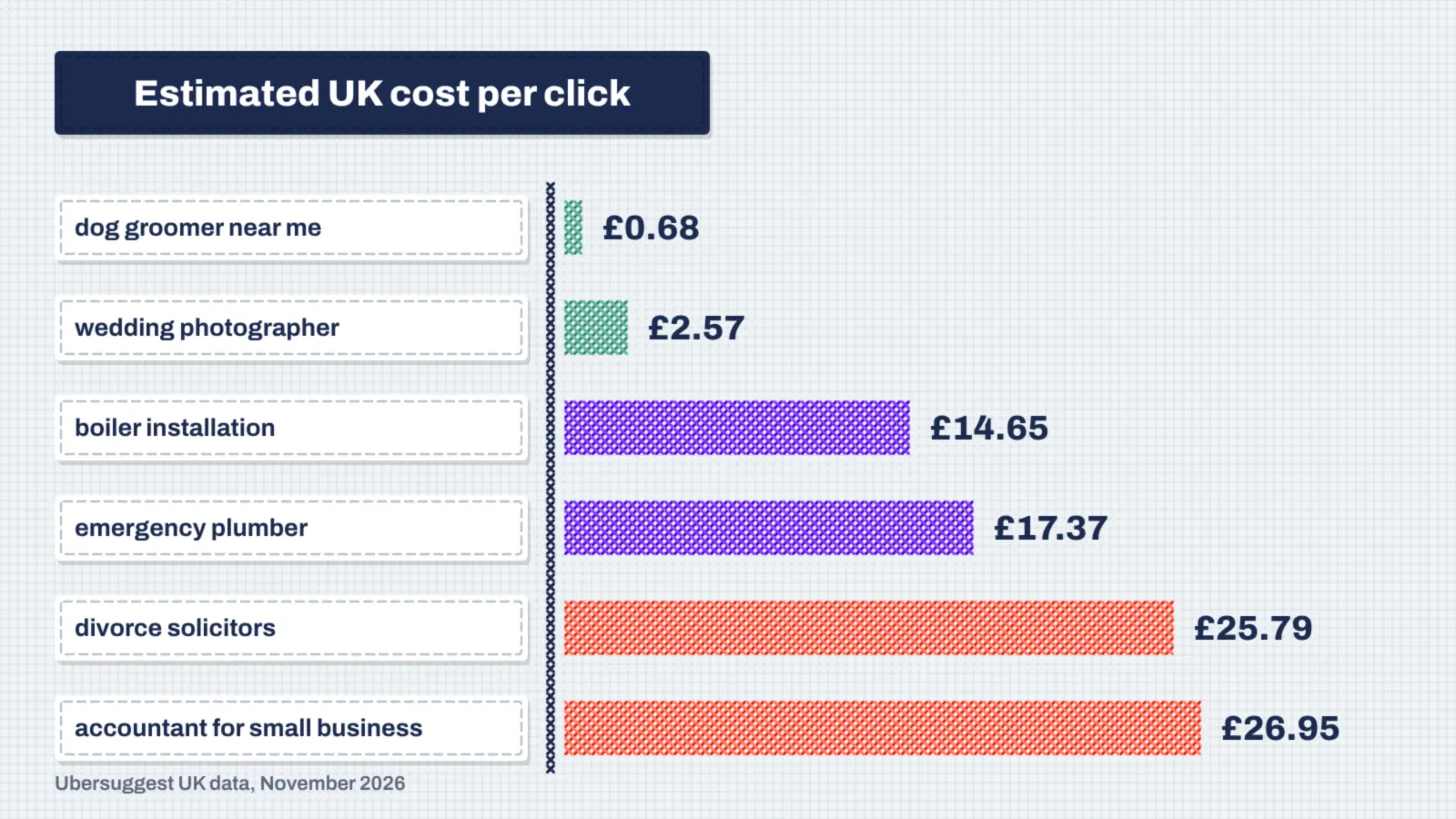
The price of a cost per click (CPC) follows what a customer is worth to the businesses competing for them. A solicitor who earns thousands from one divorce case can afford to pay far more for a click than a dog groomer earning £50 a visit, and the auction reflects that. The estimates below come from Ubersuggest’s UK data for November 2026.
| Search | UK searches a month | Estimated cost per click |
|---|---|---|
| dog groomer near me | 74,000 | £0.68 |
| wedding photographer | 8,100 | £2.57 |
| boiler installation | 4,400 | £14.65 |
| emergency plumber | 12,100 | £17.37 |
| divorce solicitors | 2,400 | £25.79 |
| accountant for small business | 3,600 | £26.95 |
Treat these as a starting range rather than a quote. Your own cost per click will move with your location, the time of day, your Quality Score and how many rivals are bidding that week. For a more direct estimate, enter your own keywords into Keyword Planner inside a Google Ads account. Its “top of page bid” columns show a low and high range, roughly the 20th and 80th percentile of what advertisers have paid for a place at the top of the page.
Benchmarks help you judge the wider picture. The 2026 LocaliQ and WordStream search advertising benchmarks, based on more than 13,000 campaigns between April 2025 and March 2026, put the average cost per click at $5.42 and the average cost per lead at $66.69, the first fall in cost per lead in five years. Most of those campaigns ran in the US, so use them to compare industries with each other, not to set a UK budget.
How to set a Google Ads budget
A useful budget starts from the number of customers you want, not from a round figure. Work backwards through four numbers: customers needed, the share of enquiries that become customers, the share of clicks that become enquiries and the cost per click.
- Set the target. Decide how many new customers a month the campaign should bring in.
- Convert it to enquiries. If one in three quotes becomes a sale, you need three enquiries per customer.
- Convert enquiries to clicks. Divide by your landing page conversion rate. If you have no history, a cautious 5% is a sensible planning figure.
- Price the clicks. Multiply the clicks by the cost per click from Keyword Planner, then divide the monthly total by 30.4 to get the daily budget Google asks for.
Take a heating engineer who wants five extra boiler installations a month. Winning one job in three means 15 enquiries. At a 5% conversion rate that is 300 clicks, and at around £14.65 a click the campaign needs about £4,400 a month, or a daily budget of roughly £145. If that is more than the business can carry, the answer is not a smaller budget spread across the same keywords. It is a narrower campaign: fewer, more specific searches, a tighter area or fewer hours, so the money still buys enough clicks to learn from.
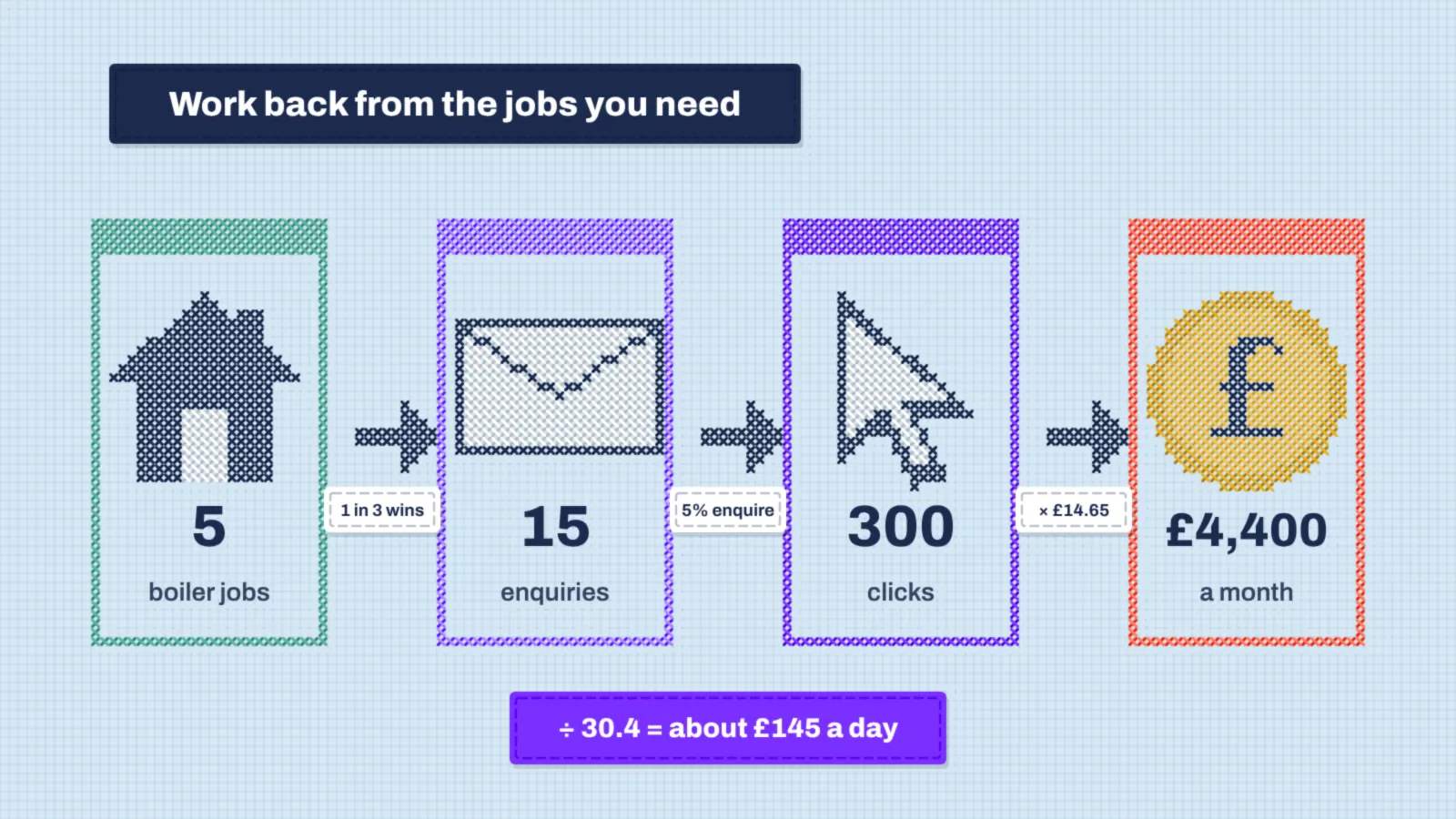
The same sum also shows where to improve. Raising the landing page conversion rate from 5% to 8% cuts the clicks needed from 300 to under 190, which saves more money than most bidding changes. The paid media guide’s section on splitting a budget across channels explains how Google Ads fits into a wider plan.
Are Google Ads worth it?
Google Ads is worth it when the cost of winning a customer stays below what that customer is worth to you. The figure that settles it is your break-even cost per acquisition: the gross profit from a first sale, or from the whole relationship if customers come back.
In the heating engineer example, £4,400 for five installations is £880 per job. If each installation leaves £1,200 of gross profit, the campaign pays. If it leaves £600, it loses money on every job, however busy the diary looks. For businesses with repeat customers, such as accountants or dog groomers, use customer lifetime value instead of the first sale, because a client who stays for five years can justify a far higher cost per click.
| Usually pays off when | Usually struggles when |
|---|---|
| People search for what you sell, in words you can predict | Your product is new and nobody searches for it yet |
| A customer is worth many times the cost per click | Margins are thin and the sale is a one-off |
| You can track enquiries, calls or sales back to the ad | Results cannot be measured beyond clicks |
| Your landing page answers the search and makes contact easy | Ads send people to a general homepage |
| The budget buys enough clicks each month to see a pattern | A small budget is spread across dozens of keywords |
Measure the result with the figures that matter to the business, not the ones the platform shows first. Clicks and impressions describe activity. Cost per acquisition and return on ad spend describe whether the money came back, and the guide to choosing marketing KPIs shows how to link them to revenue.
What AI Max means for your costs
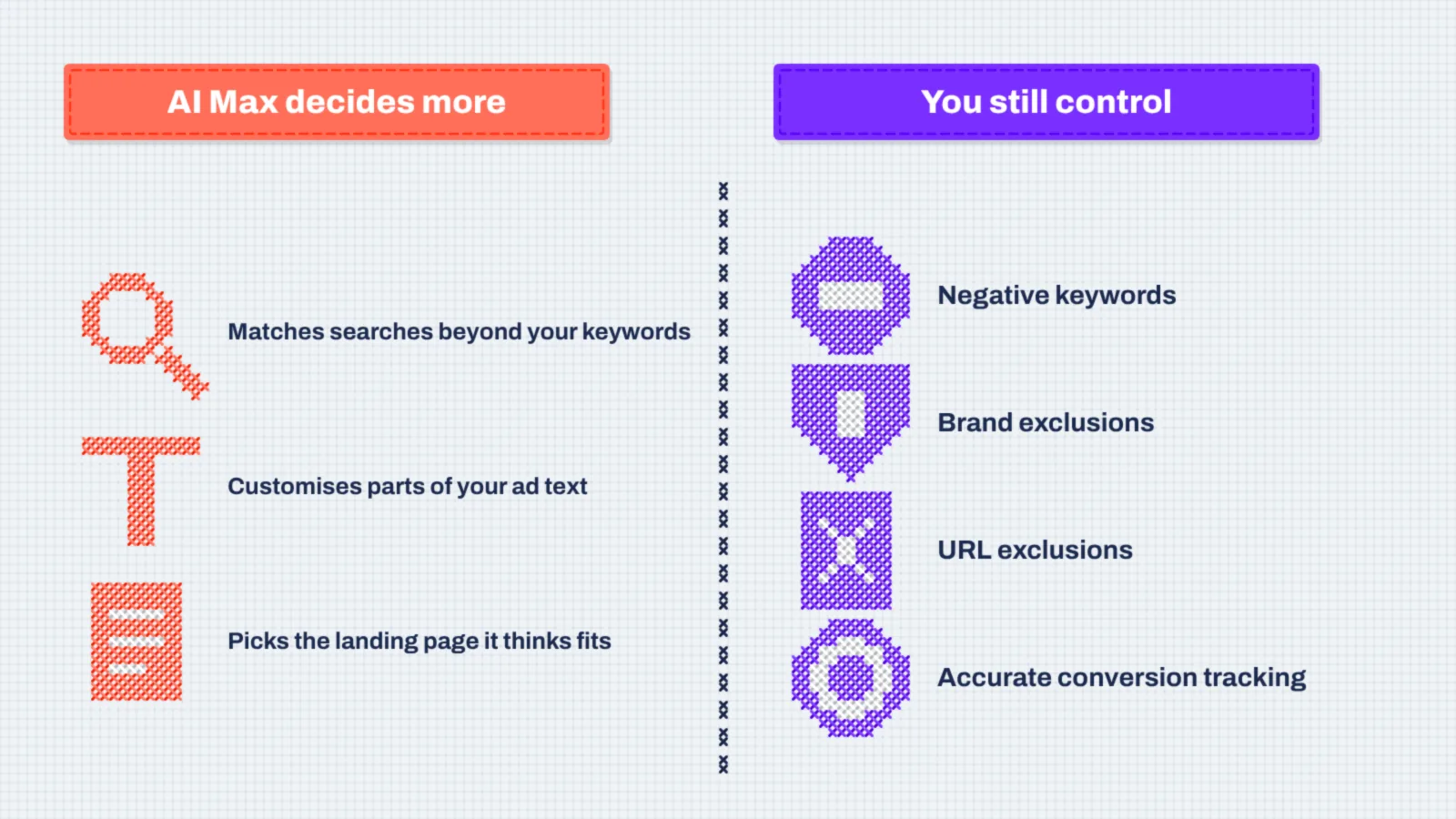
AI Max for Search is a set of features that lets Google match your ads to searches beyond your keywords, rewrite parts of the ad text and send people to the page on your site it judges most relevant. Google launched it in May 2025, saying advertisers who switch it on typically see 14% more conversions or conversion value at a similar cost per acquisition. That figure comes from Google’s own data, and early independent tests were more mixed.
Since 1 September 2026, Google has moved Search campaigns automatically into AI Max if they used the campaign-level broad match setting or automatically created assets. Broad match campaigns received search term matching only, with text customisation and final URL expansion left off. Dynamic Search Ads follow from February 2027, according to Google’s announcement.
For a small budget, wider matching can spend money on searches you would never have chosen. If your campaign was moved, four checks keep it under control:
- Read the search terms report weekly for the first month and add irrelevant searches as negative keywords.
- Use brand exclusions if you do not want to appear for competitors’ names, and URL exclusions for pages such as careers or blog posts that should never receive ad traffic.
- Compare cost per acquisition for the month before and after the change, not clicks or conversions alone.
- Keep conversion tracking accurate, because AI Max learns from the conversions you count. Counting page views or button clicks as conversions teaches it to buy the wrong traffic.
AI Max is not a reason to avoid Google Ads, and for accounts with solid conversion data it can find profitable searches a keyword list misses. The broader shift to automated buying is covered in the paid media guide’s section on paid media and AI.
How to lower your Google Ads cost
Most wasted spend in small accounts comes from showing ads to the wrong people rather than from paying too much per click. These changes usually make the biggest difference:
- Target buying searches. “Boiler installation in Leeds” signals a customer, while “how does a combi boiler work” signals a reader. Long-tail keywords are often cheaper and closer to a decision.
- Build a negative keyword list early. Words such as “free”, “jobs”, “course” and “DIY” filter out searches that will never buy.
- Limit where and when ads run. Show ads only in the areas you serve and, if you answer calls, during the hours someone can pick up.
- Send each ad to a matching page. A landing page that repeats the promise in the ad and makes contact easy improves Quality Score and conversion rate together.
- Track real outcomes. Count calls, forms and sales as conversions so automated bidding pays for customers, not visits.
- Check for a new advertiser offer. Google often gives new accounts promotional credit once they reach a set level of spend, usually within 60 days of starting.
Frequently asked questions
How much does Google Ads cost per month?
There is no minimum or fixed monthly fee. You set an average daily budget and Google spends no more than that figure multiplied by 30.4 in a month, plus a 2% UK Digital Services Tax fee on ads served in the UK.
How much does a Google Ads click cost in the UK?
It depends on the search. Ubersuggest’s UK estimates range from about £0.68 for “dog groomer near me” to almost £27 for “accountant for small business”. Keyword Planner shows ranges for your own keywords.
Are Google Ads worth it for a small business?
They are worth it when the cost of winning a customer stays below the gross profit that customer brings. Work out your break-even cost per acquisition before you start and compare it with real results after the first month.
What is a good starting budget for Google Ads?
Work back from the customers you need: divide by your close rate and landing page conversion rate to get clicks, then multiply by the cost per click. If the total is too high, narrow the keywords or area rather than cutting the budget across everything.
Why am I paying less than my maximum bid?
Google charges only what is needed to keep your ad’s position, which is often well below your maximum bid. A higher quality ad and landing page can lower the price further.
Does AI Max increase Google Ads costs?
It can, because wider matching shows your ads on searches you did not choose. Check the search terms report, add negative keywords and compare cost per acquisition before and after the change.
On this page
Back to topMake every click count
A Google Ads budget works best when it starts from what a customer is worth. Kutola helps you work out a budget you can defend, decide which searches deserve it and check whether the spend is turning into customers. Get in touch to talk through your Google Ads.