Paid media strategy: channels, budgets and how to measure what your ads return
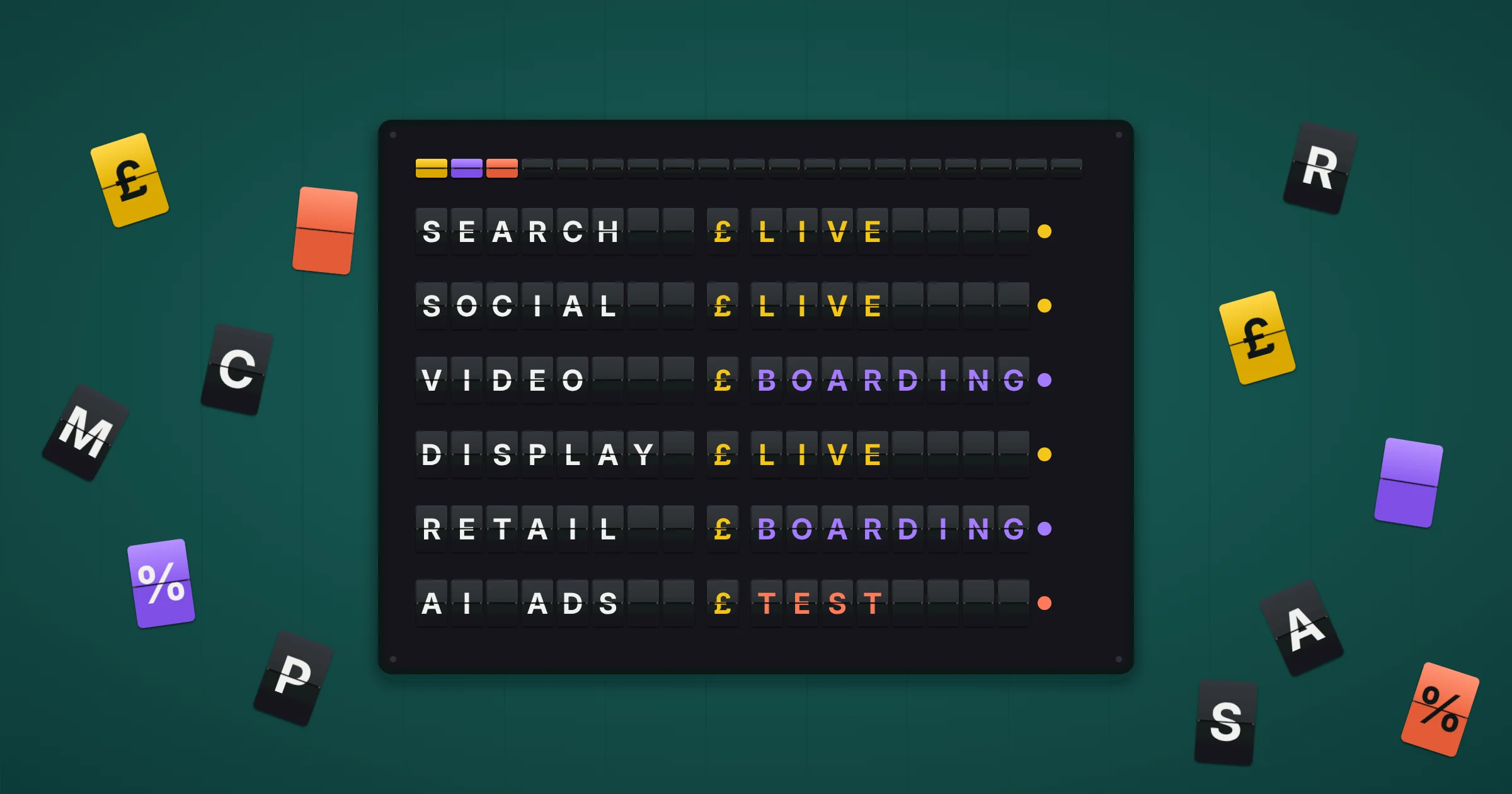
Paid media is any advertising you pay a platform or publisher to show, from Google search ads and sponsored Instagram posts to YouTube video ads, display banners and the new ads inside AI assistants. A paid media strategy decides which of those channels you use, what job each one does, how much budget each gets and how you will judge whether the money came back.
This guide explains how paid media differs from owned and earned media, sets out the main channels and how each is bought and covers when advertising is worth paying for. It then walks through seven steps to build a paid media strategy, with a worked example, before looking at how AI is changing ad buying, how to measure results honestly, the UK rules that apply and the mistakes that waste the most budget.
Key takeaways
- Paid media buys speed, reach and control. It also stops working the day the budget stops, so it works best alongside owned and earned channels.
- Search ads capture people who are already looking. Social, video and display ads create demand among people who are not looking yet. Most strategies need to know which of the two jobs they are paying for.
- Start from your numbers: margin, customer lifetime value and the cost per acquisition you can afford. Those figures decide channels and budget more reliably than any benchmark.
- Platforms now automate targeting and bidding, so your strategy shows up in the inputs you control: conversion data, creative, landing pages and budget rules.
- Judge paid media on profit and incremental results, not on the return each platform reports for itself.
What is paid media?
Paid media covers every placement you buy. You pay for the space or for a result, and in return you choose the message, the audience, the timing and the spend. That control is its main advantage over organic channels: a new business can appear at the top of Google tomorrow, and a brand can put a product in front of a precise audience the week it launches.
Much paid media is bought as pay-per-click (PPC) advertising, where you pay only when someone clicks. Many placements are bought per thousand impressions (CPM) instead, and some platforms let you optimise towards a cost per acquisition while still charging for clicks or impressions. The buying model matters because it tells you what risk you carry: with CPM you pay whether or not anyone acts, with CPC you pay for interest and with commission-based deals you pay only for sales.
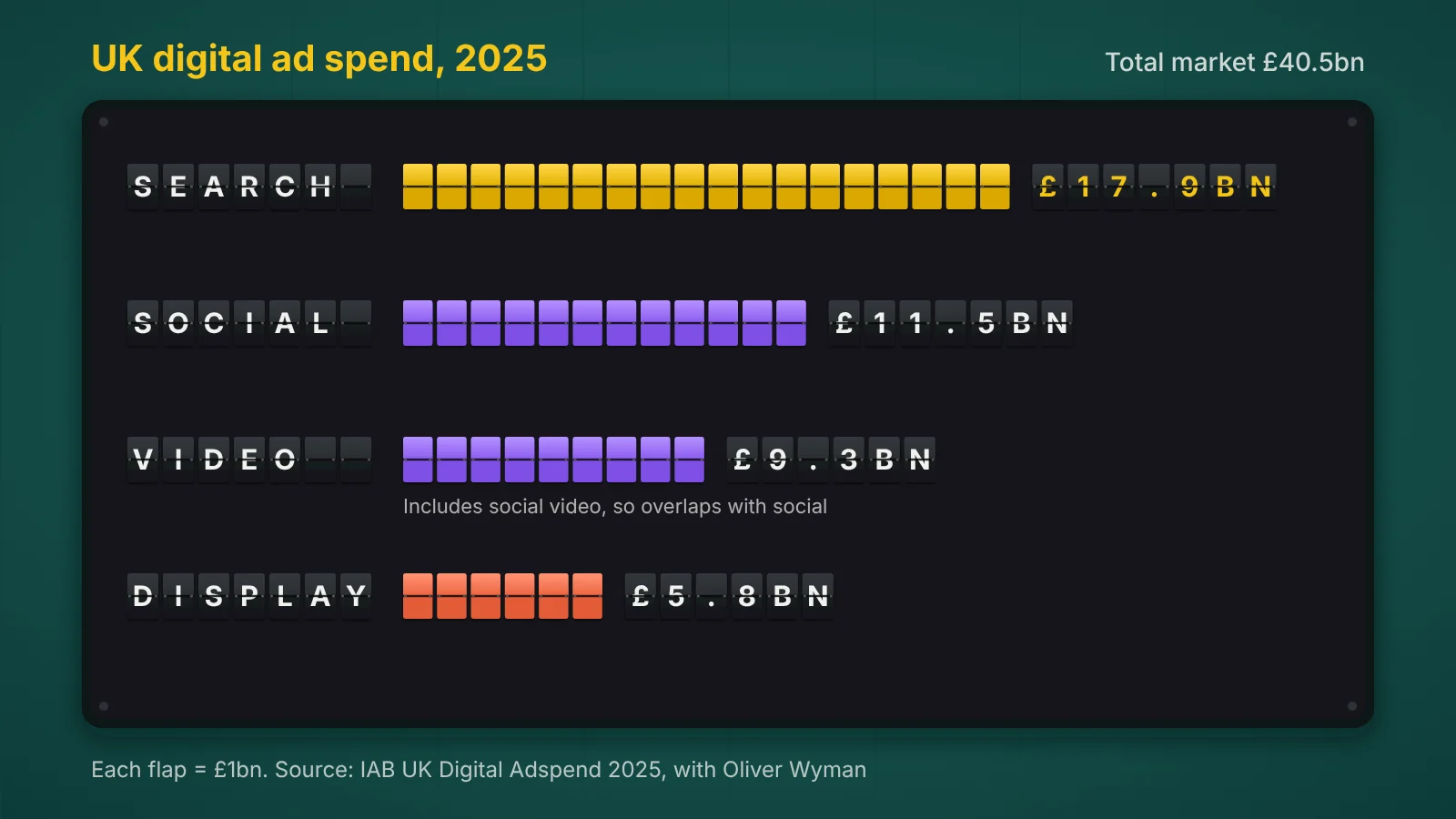
Paid media is also where most UK advertising money now goes. The Advertising Association and WARC put UK ad spend at a record £46.7bn in 2025, with growth of 6.6% forecast for 2026. IAB UK’s separate Digital Adspend study valued the UK digital ad market at £40.5bn, with search still the largest channel and social growing fastest.
A paid media strategy sits above individual campaigns. It sets what advertising should achieve for the business, which audiences and moments matter, which channels earn a place, how the budget is split and protected for testing, what creative each channel needs and how results will be measured. Keywords, bids and audience settings are tactics that follow from those decisions.
Paid, owned and earned media
Marketers usually group channels into three types. Each does a different job, and paid media works best when it feeds the other two rather than replacing them.
| Type | What it is | Examples | Strength | Limit |
|---|---|---|---|---|
| Paid | Placements you buy | Search ads, paid social, display, video ads, sponsorships | Fast, controllable and easy to scale | Stops when spending stops; costs rise as competition grows |
| Owned | Channels you control | Website, blog, email list, app, your social profiles | Builds value over time at a low running cost | Slow to grow; reaches mostly people who already know you |
| Earned | Attention other people give you | Reviews, press coverage, shares, word of mouth, citations in AI answers | The most trusted form of exposure | Hard to control or predict |
The three overlap in practice. A search ad sends people to a page you own, so a weak website wastes the click you paid for. Reviews and ratings, which are earned, raise the response to ads that display them. A sponsored post that people share turns paid reach into earned reach. The main digital marketing channels section of the strategy guide explains how to choose the mix across all three.
Paid social and organic social are different disciplines too. Organic reach on TikTok or Instagram depends on how the platform’s search and recommendation systems read your content, which the guide to social media SEO covers. Paid social buys a guaranteed audience regardless of how the post performs organically.
The main paid media channels
Each channel reaches people in a different frame of mind, and that matters more than its audience size.
| Channel | Examples | Usually bought by | Best at |
|---|---|---|---|
| Paid search | Google Ads, Microsoft Advertising | CPC | Capturing people who are already looking for what you sell |
| Shopping and retail media | Google Shopping, Amazon Ads, supermarket ad networks | CPC | Winning the sale at the point of choice, with price and image shown |
| Paid social | Meta (Facebook and Instagram), TikTok, LinkedIn, Pinterest, Snapchat | CPM, optimised for a chosen result | Creating demand among people who were not looking yet |
| Online video and streaming TV | YouTube, ITVX, Channel 4 streaming | CPM or cost per view | Reach and brand memory, often at lower cost than broadcast TV |
| Display and programmatic | Google Display Network, programmatic exchanges | CPM | Low-cost reach and reminding past visitors |
| AI assistants | ChatGPT ads, ads in Google’s AI search features | CPM or CPC | Reaching people while they research a purchase (still early) |
| Creators, sponsorships and affiliates | Creator partnerships, newsletter sponsorships, affiliate networks | Flat fee or commission | Borrowing the trust of a niche audience |
The most useful split is between channels that capture demand and channels that create it. Paid search and shopping ads reach people who already have a need and are typing it into a box. Paid social, video and display reach people before they are looking, so they have to earn attention with creative and plant the brand for later. A business that runs only search ads can grow no faster than the number of people already searching for it.
Search ads also share a results page with organic listings. An SEO strategy builds visibility you do not pay for per click, but it takes months. Paid search buys the same position immediately and is often used to cover important terms while organic rankings grow.
AI assistants are the newest paid channel. ChatGPT has carried ads in the UK since June 2026, and the guide to ChatGPT ads covers how they are chosen and priced and how early results compare with Google. For most businesses they belong in the test budget rather than the core plan for now.
When paid media makes sense
Paid media is worth the money when it solves a problem organic channels cannot solve quickly enough. The clearest cases are:
- You need results on a deadline. A launch, a seasonal peak such as Christmas or the January sales or an event with a fixed date will not wait for organic reach to build.
- Demand exists but you cannot reach it organically yet. If people search for what you sell and your site is not on the first page, search ads put you there while SEO catches up.
- You need to reach people beyond your current audience. Your email list and followers already know you. Paid reach is the fastest way to introduce the brand to people who do not.
- The numbers work. If a customer is worth more than it costs to win one through advertising, every pound spent returns more than a pound.
It is the wrong tool when the basics are not in place. Advertising magnifies what already exists: if the website converts badly, the offer is unclear or there is no way to track sales, paid media buys more visitors to a leaking bucket. A digital marketing audit is a sensible first step if you are not sure which of these applies.
Paid media is often treated purely as sales activation, but video, social and display ads build brand memory too. Les Binet and Peter Field’s work for the IPA points to a long-run balance of around 60% brand building and 40% activation, which the digital marketing strategy guide explains in more detail. A paid plan made only of retargeting and branded search ads harvests demand without creating any.
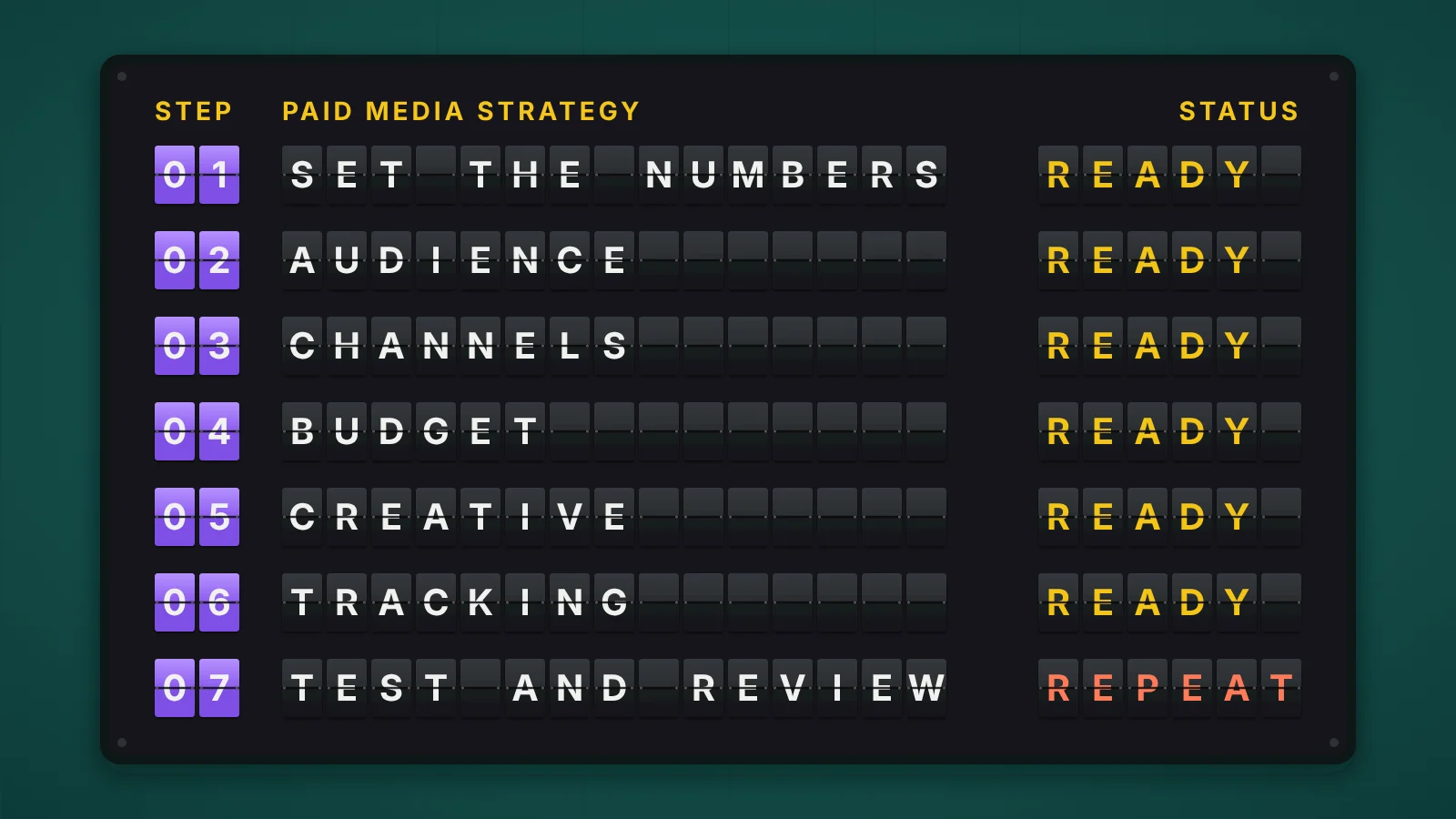
How to build a paid media strategy in 7 steps
The steps below work for a small business with one channel and for a larger advertiser running five. The order matters: each decision depends on the one before it.
1. Start from the business numbers
Work out what a customer is worth before deciding what to pay for one. Two figures do most of the work: the gross margin on a first order and the customer lifetime value. If an average order is £80 at a 40% gross margin, the first sale earns £32, so any cost per acquisition above £32 loses money on that order. The same margin gives a break-even return on ad spend of 2.5, because £1 of ad spend needs £2.50 of sales to cover itself. If customers come back three or four times a year, you can afford a higher target, as long as the business can wait for the repeat orders.
Turn those figures into one objective with a number and a date, such as 600 new customers in the next six months at an average cost under £30. Every later choice is tested against it.
2. Define the audience and the moments that matter
Describe who you want to reach and, more usefully, what they are doing when an ad could help. Someone comparing boiler quotes after a breakdown needs a different message and channel from someone idly scrolling past a new kitchen. A customer journey map shows where people look for information and where they hesitate. The stages of the marketing funnel give a simple way to decide which ads aim at awareness, which at consideration and which at the final decision.
3. Choose channels by the job they do
Match each channel to a job rather than to habit. If people already search for your product, start with search and shopping ads, using keyword research to size the demand. If they do not know they need it yet, start with social or video, where creative can introduce the problem and the product together. B2B advertisers selling to a defined job title often find LinkedIn’s targeting worth its higher prices.
Smaller budgets should start with one or two channels. Each platform needs enough spend and conversions to learn who responds, and a budget spread across five channels often teaches none of them anything.
4. Set the budget and split it
Build the budget up from the objective rather than down from a percentage. Multiply the number of customers you want by the cost per acquisition you can afford, then check the total against the minimum each channel needs to work. Meta, for example, says an ad set leaves its learning phase once it records about 50 optimisation events within a week. At a £30 cost per acquisition, that means around £1,500 a week for a single ad set optimised for purchases. If that is out of reach, combine ad sets or optimise for a more frequent action such as adding to basket.
A practical split keeps most of the budget on what already works, a smaller share on scaling the next most promising option and a fixed slice, often around a tenth, for tests of new channels, audiences or formats. Protect the test budget in writing, or it disappears the first month results dip.
5. Plan the creative and landing pages
Platforms now automate much of the targeting, so creative does more of the work of finding the right people. A video that speaks plainly to a specific problem attracts the people who have it. Plan a set of creative routes per channel, built around clear benefits and proof such as reviews or ratings, and use the principles of behavioural science in marketing to frame offers. Social proof works particularly well in ads because it answers the doubt people feel about an unknown brand.
Every ad needs a landing page that continues the same conversation. Someone who clicks an ad for waterproof walking boots should land on waterproof walking boots, not on the homepage. On Google, landing page experience is one of the factors in Quality Score, which affects what you pay per click.
6. Set up tracking before launch
Decide what counts as a conversion, then make sure every platform and your analytics record it the same way. That usually means conversion tracking in GA4 and in each ad platform, server-side tools such as Google’s enhanced conversions and Meta’s Conversions API to recover sales that browsers miss and UTM parameters on every link so traffic is labelled consistently. Feed the platforms the value of each sale where you can, not just the fact that one happened, so automated bidding can favour profitable customers. Advertising pixels and cookies need consent in the UK, so check the consent set-up as part of the same job.
7. Launch, test and review on a fixed rhythm
Agree a review calendar before launch and stick to it. Daily changes reset the learning that automated bidding depends on and make results impossible to read.
- Weekly: spend against budget, obvious waste such as irrelevant search terms and creative that has stopped working.
- Monthly: cost per acquisition and return on ad spend by channel and campaign, compared with the targets from step 1.
- Quarterly: budget moves between channels, results of tests and at least one check of whether a channel is adding sales you would not otherwise have had.
Change one thing at a time and write down what you changed and why. A simple log turns a year of campaigns into evidence about what works for your business.
Paid media strategy example
Leafline is a fictional online loose-leaf tea retailer in Bristol. Its average first order is £32 at a 55% gross margin, and customers who return order about four times a year. It wants to grow beyond its existing email list and Instagram following.
| Element | Leafline’s decision |
|---|---|
| Objective | 1,200 new customers in 12 months at an average cost per acquisition under £25 |
| Why £25 | A first order earns about £17.60 in gross margin, so £25 loses money on day one. A customer who orders four times in a year earns around £70, so the business accepts the gap and tracks repeat rates monthly |
| Budget | £2,500 a month (1,200 customers at £25), reviewed every quarter |
| Search and shopping (50%) | Google Shopping and search ads on product terms such as loose leaf tea gifts and tea subscription, to capture existing demand |
| Paid social (35%) | Instagram and Facebook video ads showing how the tea is made and brewed, run as one broad campaign so all purchases feed a single ad set |
| Remarketing (5%) | Reminders to visitors who added to basket but did not buy, capped at a few views a week |
| Test (10%) | A three-month TikTok test with creator-made videos, judged against the same £25 target |
| Measurement | GA4 and platform conversions, a monthly report on cost per new customer and a quarterly check of total sales against total ad spend |
The plan shows how the numbers shape the choices. Meta’s share comes to about £200 a week, enough for only around eight purchases at the target cost, far below the 50 a week its learning phase prefers. Leafline therefore runs a single broad campaign rather than splitting audiences, and judges it monthly rather than weekly. Its remarketing share stays small because people who added to basket are close to buying anyway.
Paid media and AI
AI has changed paid media in two ways: how ads are bought and where they appear. On the buying side, the major platforms now automate targeting, bidding and much of the creative. Google’s Performance Max campaigns run across all of its inventory from one set of assets, and Meta’s Advantage+ campaigns choose audiences and placements themselves. In September 2026 Google began moving Search campaigns that use campaign-level broad match or automatically created assets into AI Max for Search, which matches ads to queries beyond the keywords an advertiser chose.
Automation shifts the strategist’s job rather than removing it. The levers that remain are the ones covered in the steps above:
- Conversion data: automated bidding optimises towards whatever you tell it is a conversion, so a form spam submission counted as a lead teaches it to find more spam.
- Values and goals: passing real order values or lead quality lets the system favour profitable customers over cheap ones.
- Creative and assets: the system can only show what you give it, and varied, specific creative gives it more to work with.
- Exclusions and guardrails: brand safety lists, negative keywords and budget caps keep automation inside limits you set.
On the placement side, ads are moving into AI answers. Alongside ChatGPT’s ads, Google shows ads in AI Overviews in a dozen countries, in English, though not yet in the UK, and ads in AI Mode are due to reach the UK. Buying these ads does not get your brand cited in the answer itself. Being recommended in AI answers depends on generative engine optimisation, so paid and organic AI visibility need separate plans.
How to measure paid media
Choose metrics that match the job each channel was given. Judging a YouTube awareness campaign on cost per sale makes it look like a failure, and judging a search campaign on reach misses the point.
| Goal | Main metrics | Watch out for |
|---|---|---|
| Awareness | Reach, frequency, CPM, video completion rate, growth in branded searches | Cheap impressions that nobody notices |
| Consideration | Click-through rate, cost per click, engaged sessions, landing page conversion rate | Clicks from people who leave straight away |
| Conversion | Cost per acquisition, conversion rate, return on ad spend | Platforms claiming the same sale twice |
| Profit | Profit after ad spend, total revenue divided by total ad spend, lifetime value against acquisition cost | Targets that ignore margin and repeat purchases |
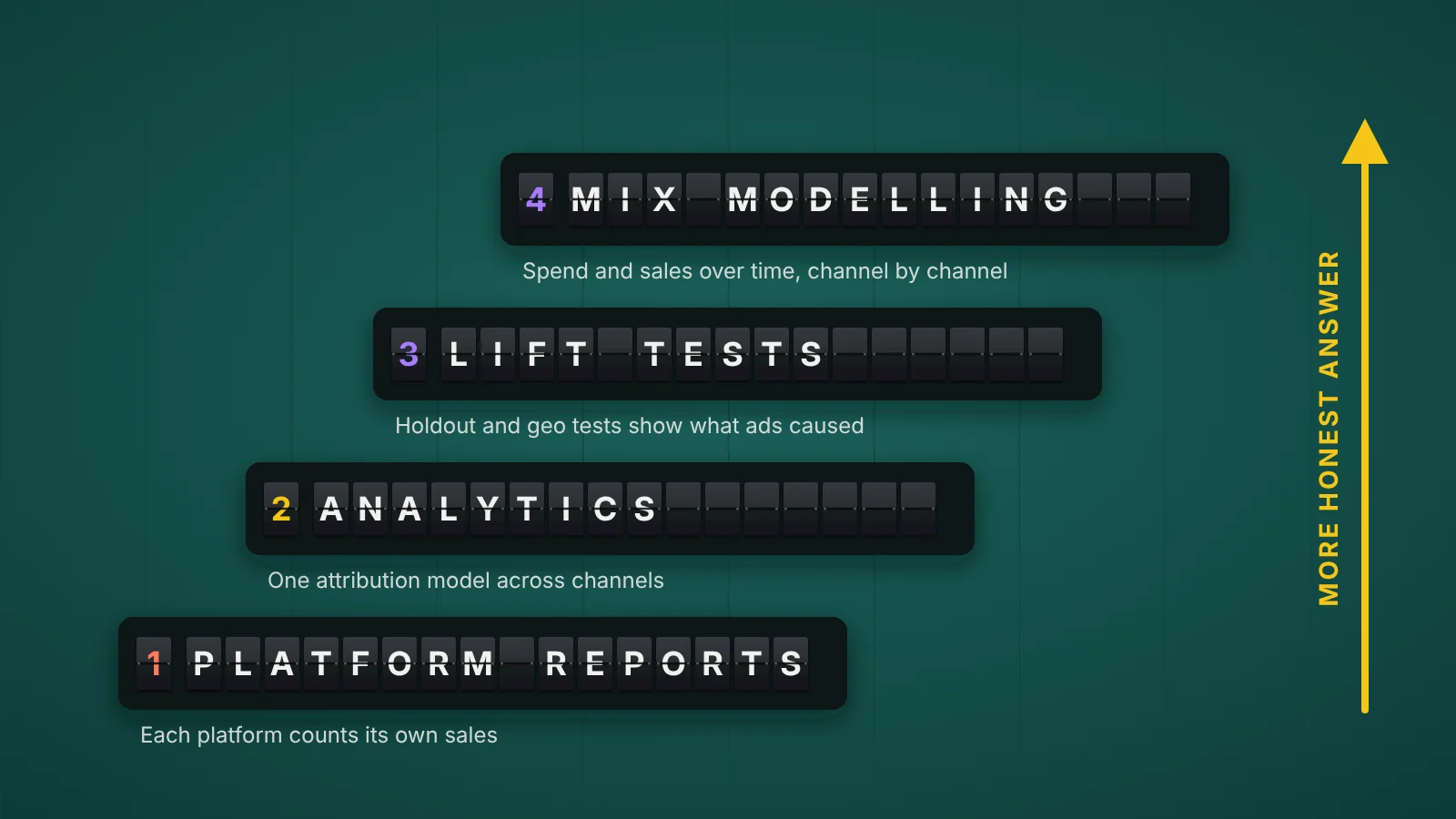
Platform reports are the starting point, not the verdict. Each platform counts the sales it touched, so Google, Meta and TikTok can each claim the same order, and their combined totals often add up to more sales than the business actually made. Analytics tools such as GA4 apply one attribution model across all channels, which gives a fairer comparison but still credits ads for sales that might have happened anyway.
The real question is incrementality: how many sales happened because of the ads. A well-known experiment at eBay, published in Econometrica, found that paying for search ads on its own brand name had no measurable short-term benefit, because people simply clicked the organic link instead. For non-brand terms, ads mainly influenced new and infrequent customers, while most of the spend went on regular users who would have bought anyway.
You can test incrementality in several ways. Most large platforms offer lift studies that compare people who saw ads with a held-out group who did not. A geographic test switches spend off in some regions and compares sales with similar regions. Larger advertisers use marketing mix modelling to estimate each channel’s contribution from sales and spend data over time, and Google made its Meridian model open source and free for everyone in January 2025. A small business can start more simply: pause one campaign for a few weeks and watch whether total sales move.
UK rules for paid advertising
Paid ads in the UK must follow the same rules whatever the channel. The main ones to plan for are:
- The CAP Code: enforced by the Advertising Standards Authority, it requires ads to be legal, decent, honest and truthful, with evidence for objective claims. Ads must also be obviously identifiable as ads, so paid creator content needs a clear label such as “Ad” at the start.
- Consumer law: since 6 April 2025 the Digital Markets, Competition and Consumers Act lets the CMA fine businesses directly for unfair practices. Its unfair commercial practices guidance covers prices that leave out unavoidable fees, fake reviews and pressure selling, all of which appear in ads.
- Less healthy food and drink: since 5 January 2026, paid online advertising of identifiable less healthy food and drink products is banned across the UK, including paid social, display, video and sponsored listings. Brand-only ads are exempt.
- Tracking and consent: the ICO’s guidance on storage and access technologies covers advertising cookies and tracking pixels. They are not strictly necessary, so they need consent before they run.
- Sector rules: gambling, alcohol, financial promotions and medicines carry extra restrictions, and each ad platform adds its own policies on top.
The wider set of UK rules to build into your strategy, including data protection and email marketing, applies to paid media as it does to every other channel.
Common paid media mistakes
- Starting with a channel. Choosing TikTok because competitors use it, before working out what a customer is worth, leads to budgets that cannot be judged.
- Spreading a small budget too thin. Five channels at £200 a month each rarely give any of them enough data to learn.
- Trusting platform-reported returns. Each platform marks its own homework. Check total sales against total spend.
- Paying for sales you would get anyway. Brand search and remarketing often look like the best performers because they reach people who were already going to buy. Test them before you scale them.
- Sending every ad to the homepage. A landing page that does not match the ad wastes the click you paid for.
- Changing settings every day. Frequent edits restart the learning that automated bidding needs and hide the effect of each change.
- Running one creative until it wears out. When frequency climbs and click-through rate falls, the audience has stopped noticing the ad.
- Cutting all brand activity when sales dip. Shifting everything into short-term activation can lift this month’s numbers while shrinking next year’s demand.
Frequently asked questions
What is paid media?
Paid media is any advertising a business pays a platform or publisher to show, such as search ads, paid social posts, video ads, display banners and sponsored content. You pay for the space or the result and control the message, audience and timing.
What are examples of paid media?
Common examples are Google search and shopping ads, sponsored posts on Instagram, TikTok and LinkedIn, YouTube video ads, display banners, sponsored newsletter placements, paid creator partnerships and, more recently, ads in AI assistants such as ChatGPT.
What is the difference between paid, owned and earned media?
Paid media is exposure you buy, owned media is channels you control such as your website and email list and earned media is attention others give you, such as reviews, press coverage and shares. Most strategies use paid media to feed the other two.
What is PPC advertising?
PPC (pay-per-click) advertising is a buying model where you pay each time someone clicks your ad rather than each time it is shown. Google Ads search campaigns are the best-known example, and the price of each click is set by an auction.
How much should a small business spend on paid media?
There is no universal percentage. Multiply the number of customers you want by the cost per acquisition you can afford, then check that each channel gets enough budget to learn. The seven steps in this guide show how to work it out.
How do you measure paid media success?
Match metrics to each channel’s job: reach and frequency for awareness, cost per acquisition and return on ad spend for sales. Then check incrementality with lift or holdout tests, because platform reports often credit ads for sales that would have happened anyway.
On this page
Back to topPut your ad budget where it pays back
Kutola helps you build a paid media strategy around your own numbers: which channels earn a place, how to split and protect the budget, what to test and how to measure what your spend really returns. It often starts with a channel review of what you already run. Get in touch to talk through your paid media mix.