ChatGPT ads: how they work and whether your business should use them
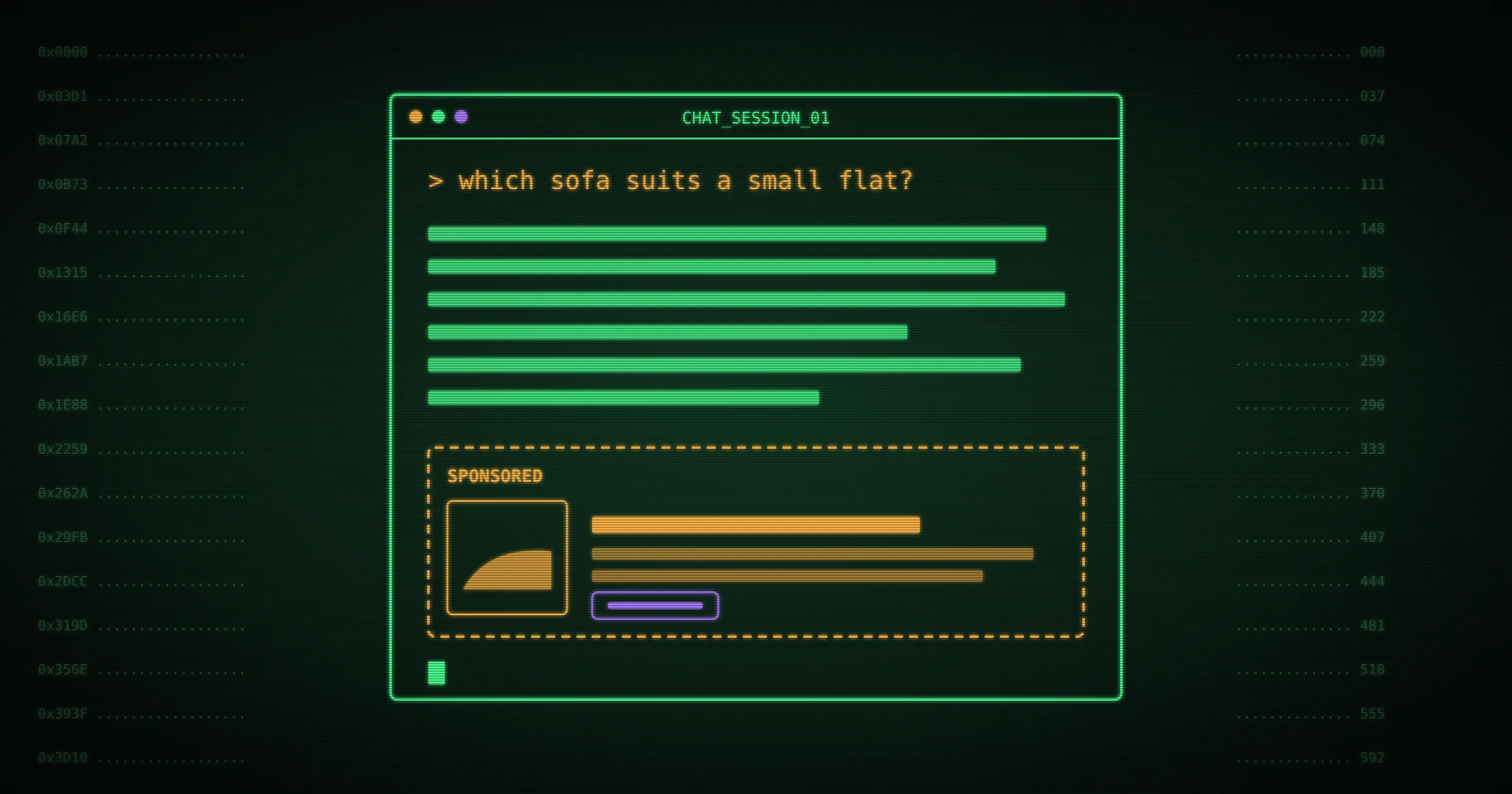
ChatGPT ads are paid placements that appear underneath ChatGPT’s answers, labelled as sponsored and chosen to match the conversation a person is having. OpenAI started testing them in the US in February 2026, brought them to the UK in June and now runs them in 89 countries. They only appear to adults on the Free and Go plans, and paying subscribers on Plus, Pro and business plans do not see them.
This guide is for businesses deciding whether ChatGPT belongs in their media plan. It explains how the ads are chosen and priced, what the early performance data says, how they compare with Google Ads and with earning organic citations through generative engine optimisation, and which UK rules apply. It finishes with a simple way to run a first test without betting a large budget on a channel that is still in beta.
What are ChatGPT ads?
A ChatGPT ad is a single sponsored unit shown below an answer when OpenAI’s systems judge that a product or service is relevant to the conversation. According to OpenAI’s help centre, each ad carries the advertiser’s name and favicon, a title, a short piece of copy, an image and a link to a landing page. It sits apart from the answer and is labelled as sponsored, a form of native advertising built for a chat window rather than a feed.
Who sees the ads matters as much as what they look like. The Ads in ChatGPT help article says ads are shown only on the Free and Go plans, never to accounts identified as belonging to under-18s and never next to sensitive conversations such as personal health, mental health or politics. Temporary chats carry no ads either. In practice, your audience is the large group of people who use ChatGPT without paying for it, and Ofcom’s 2026 media research found that 54% of UK adults now use AI tools such as ChatGPT, up from 31% a year earlier.
The platform has grown quickly. When OpenAI added 26 countries in October 2026, it said more than 100,000 advertisers had already run campaigns. The UK was its first European market: ads launched in June 2026 through OpenAI’s sales team, and the self-serve Ads Manager beta opened to UK businesses on 19 June.
How do ChatGPT ads work?
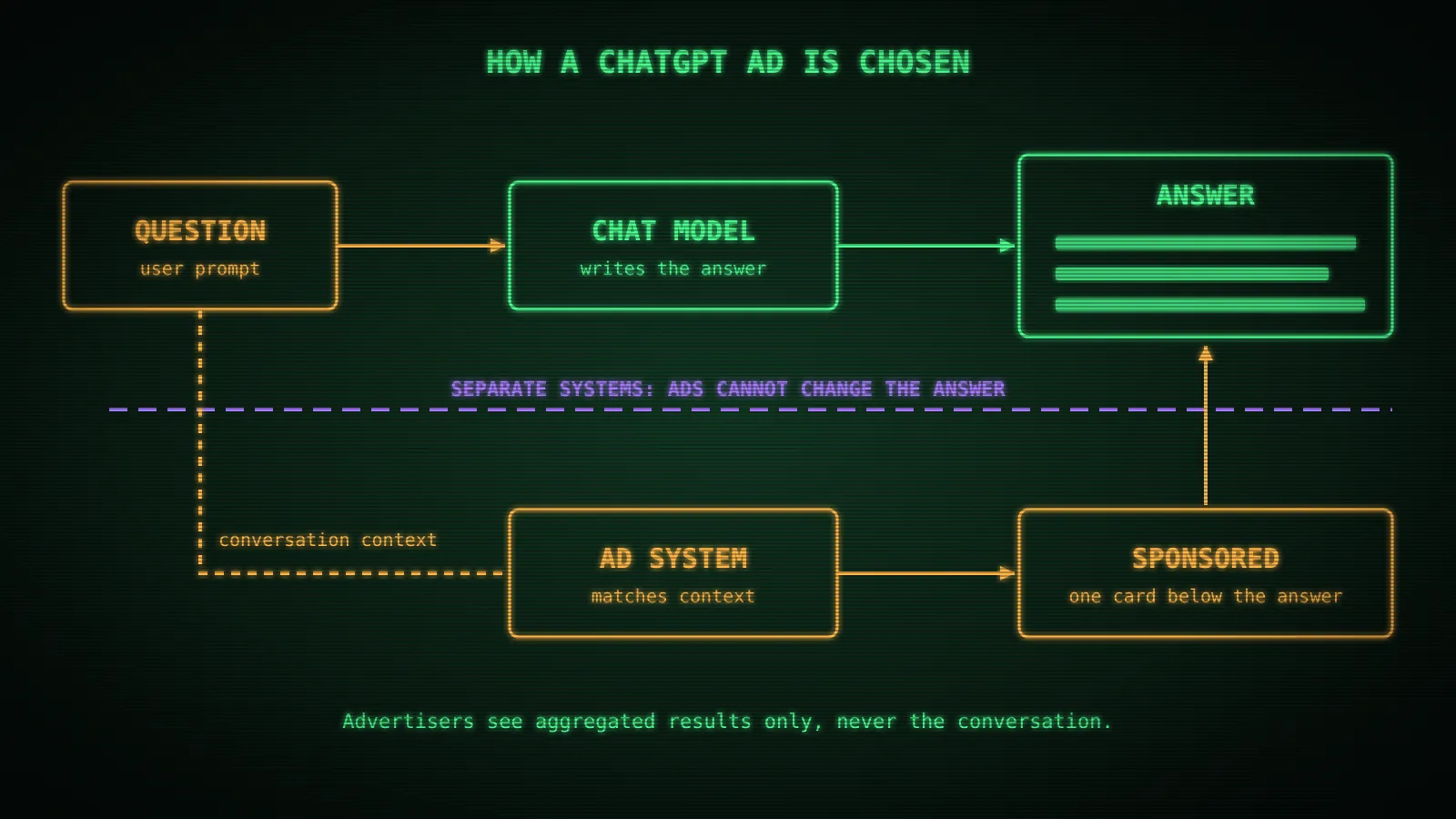
ChatGPT ads are not bought on keywords. Advertisers describe in plain language the situations their ad suits, and OpenAI matches the ad to conversations where it fits. Search Engine Land’s review of early campaigns notes that advertisers cannot see the individual prompts or conversations that triggered their ads. Four rules shape what happens next.
- The answer comes first. OpenAI’s advertising principles promise “answer independence”: ads run on separate systems from the chat model, and advertisers cannot shape, rank or change what ChatGPT says.
- Context decides relevance. Every eligible user can see ads based on the current conversation. Personalised ads, which can also draw on past chats, memory and how someone has interacted with ads before, are a separate setting.
- UK personalisation runs on consent. Digiday reports that OpenAI serves personalised ads in the UK only to users who opt in. Everyone else still sees ads, but only contextual ones based on the current chat and rough location.
- Advertisers get aggregates, not conversations. The help centre says advertisers have no access to chats, chat history, memories or personal details, only aggregated reporting on how their ads performed.
There are two main formats: a static ad for a single offer, and a product ad built from a product feed that shows items with prices and star ratings.
How much do ChatGPT ads cost?
ChatGPT ads run on an auction, so there is no fixed price. You set a daily budget and a maximum bid, and what you pay depends on how many other advertisers want the same conversations. OpenAI’s help article on creating campaigns sets the minimum daily budget at £15 for accounts billed in pounds. The budget works as a seven-day average, so spend on a single day can reach twice the daily figure as long as the week stays within seven times it.
| Campaign objective | You pay for | Best suited to |
|---|---|---|
| Views | Every thousand impressions (CPM) | Awareness and being seen during research |
| Clicks | Each click to your site (CPC) | Traffic to a page that answers the question well |
| Conversions | Clicks or impressions, optimised for conversions | Sales and leads, once tracking is in place |
Prices have fallen fast as the platform has opened up. During the early US pilot, Digiday reported that CPMs started at $60 and dropped to around $25 within about nine weeks, while the minimum commitment for launch partners fell from $250,000 to $50,000. For click campaigns, OpenAI’s own bidding guidance suggests starting with a maximum bid of $3 to $5 per click. OpenAI has not published UK benchmarks, so treat any UK figure you see as one advertiser’s experience rather than a market rate.
For conversion campaigns, the bill is still based on clicks or impressions. OpenAI’s guide to conversion-optimised campaigns says the cost per acquisition you enter is a target for the system to optimise towards, not a charge per sale, so your real cost per acquisition can land above or below it.
What the early data shows
Independent data is still thin, but two studies give a useful first picture. SE Ranking ran 50,006 US commercial prompts through ChatGPT in July 2026 and found an ad on 25.94% of them, close to the 29.45% rate it measured for Google AI Mode. Every ad sat below the answer as a single offer with no competitor beside it. About 14% of the ads were judged unrelated to the prompt, so contextual matching is still imperfect.
The second study looked at what happens after the click. A working paper by researchers at WU Vienna and Frankfurt School of Finance and Management, covering nearly 1,900 websites, found that paid ChatGPT visits earned $0.89 per session in US traffic, against $2.45 for Google Search ads. ChatGPT ad visitors converted at 0.37%, compared with 1.17% from Google. By the researchers’ estimate, a ChatGPT click would need to cost about $0.26 to match Google’s return.
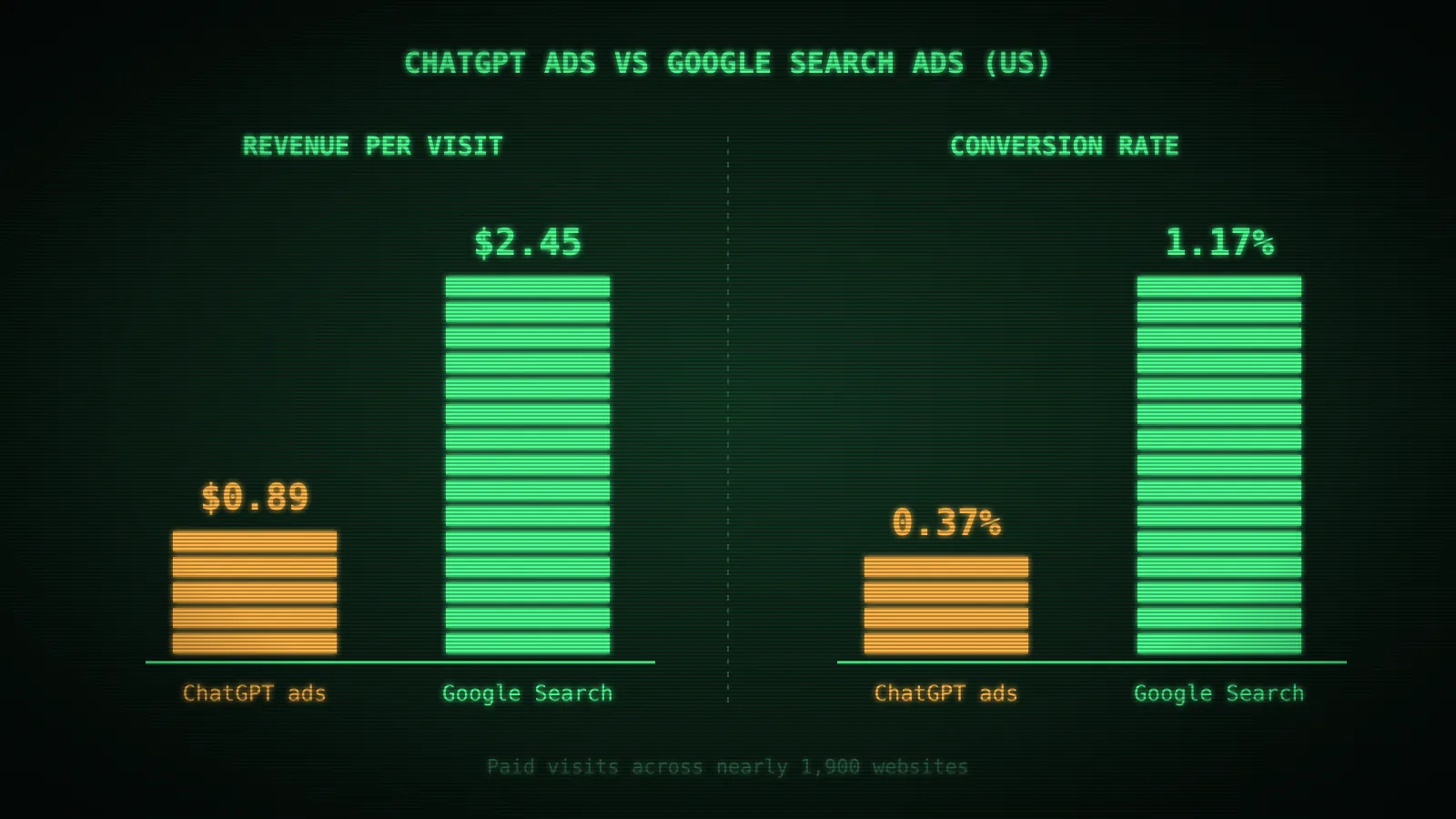
The study is observational and may miss people who bought later, but the direction is clear. ChatGPT ads reach people earlier, while they are still comparing options, and that traffic converts less often than a Google search for a product name. Judge the channel on return on ad spend and assisted conversions, not on clicks alone.
ChatGPT ads vs Google Ads
Both channels reach people while they look for something, but they target, price and report in very different ways.
| ChatGPT ads | Google Ads (Search) | |
|---|---|---|
| Targeting | Conversation context described in plain language | Keywords, audiences and AI-led matching |
| Where the ad appears | One sponsored unit below an answer | Several ads above and below results, plus AI Overviews |
| Audience | Adult Free and Go users only | Nearly everyone who searches on Google |
| Reporting | Impressions, clicks, spend, CTR, conversions; no prompt data | Search terms, auction insights and detailed conversion data |
| Maturity | Beta, with features changing month to month | More than 20 years of tools, benchmarks and specialists |
| Typical role | Test budget for research-stage reach | Core channel for capturing existing demand |
The gap is closing from Google’s side too. Ads are coming to Google’s own conversational search, and the guide to AI Mode in the UK covers what that means for UK businesses. For most advertisers, the sensible order is still to get Google working first and treat ChatGPT as an experiment funded from a small slice of the budget.
ChatGPT ads and organic AI visibility
Buying an ad does not make ChatGPT mention you in its answer. The ad and the answer are separate, and SE Ranking found that the advertiser’s own domain appeared among the answer’s cited sources in only 3.63% of ad placements.
That is why ads and organic visibility do different jobs. Being cited in AI answers depends on the groundwork described in the GEO guide’s section on how generative engines choose what to cite: clear answers, evidence and a brand that other sites talk about. Ads buy a slot next to the conversations you care about, but only while you keep paying. The comparison of GEO vs SEO vs AEO sets out how organic search and AI visibility fit together. A business that already earns citations gets more from ChatGPT ads, because the ad reinforces a name the reader has just seen in the answer.
Who should use ChatGPT ads?
ChatGPT ads suit businesses whose customers ask questions before they buy. A considered purchase such as a sofa, a holiday, accounting software or a home improvement often starts with a conversation like “what should I look for in…”, and that is where a well-matched ad can appear. They tend to work best for:
- Online retailers with a clean product feed and clear prices, who can use product ads.
- Brands in competitive categories that want to appear during research, before buyers settle on a shortlist.
- Software and service businesses with landing pages that answer detailed questions rather than just asking for a sign-up.
- Advertisers that already track conversions properly and can compare channels on the same measures.
Some businesses should wait. OpenAI’s ad policies currently ban ads for gambling, alcohol, dating, sexual content, health claims and political content, while financial services and some health products are restricted. Local businesses that depend on people nearby may find the targeting too broad for now, and a business without conversion tracking will not be able to tell whether the spend worked.
UK rules for ChatGPT ads
There is no special rulebook for ads in AI chatbots. The Advertising Standards Authority says the CAP Code has no AI-specific rules, but its existing rules apply however an ad is made, edited or targeted. A ChatGPT ad has to be legal, decent, honest and truthful, with evidence for any objective claim, just like a search or social ad.
Responsibility stays with the advertiser even when a platform’s tools write or adapt the ad, and the ASA has upheld complaints against advertisers whose ads were assembled by automated tools. If you use AI to write ad copy or create images, the ASA also warns that adding a note saying AI was used will not fix a misleading ad. The wider set of UK rules to build into your strategy, including consumer protection and data law, applies here as it does to every other channel.
OpenAI handles consent for personalised ads inside ChatGPT, but the conversion tracking on your own website still has to meet UK GDPR and the cookie rules.
How to run a first ChatGPT ads test
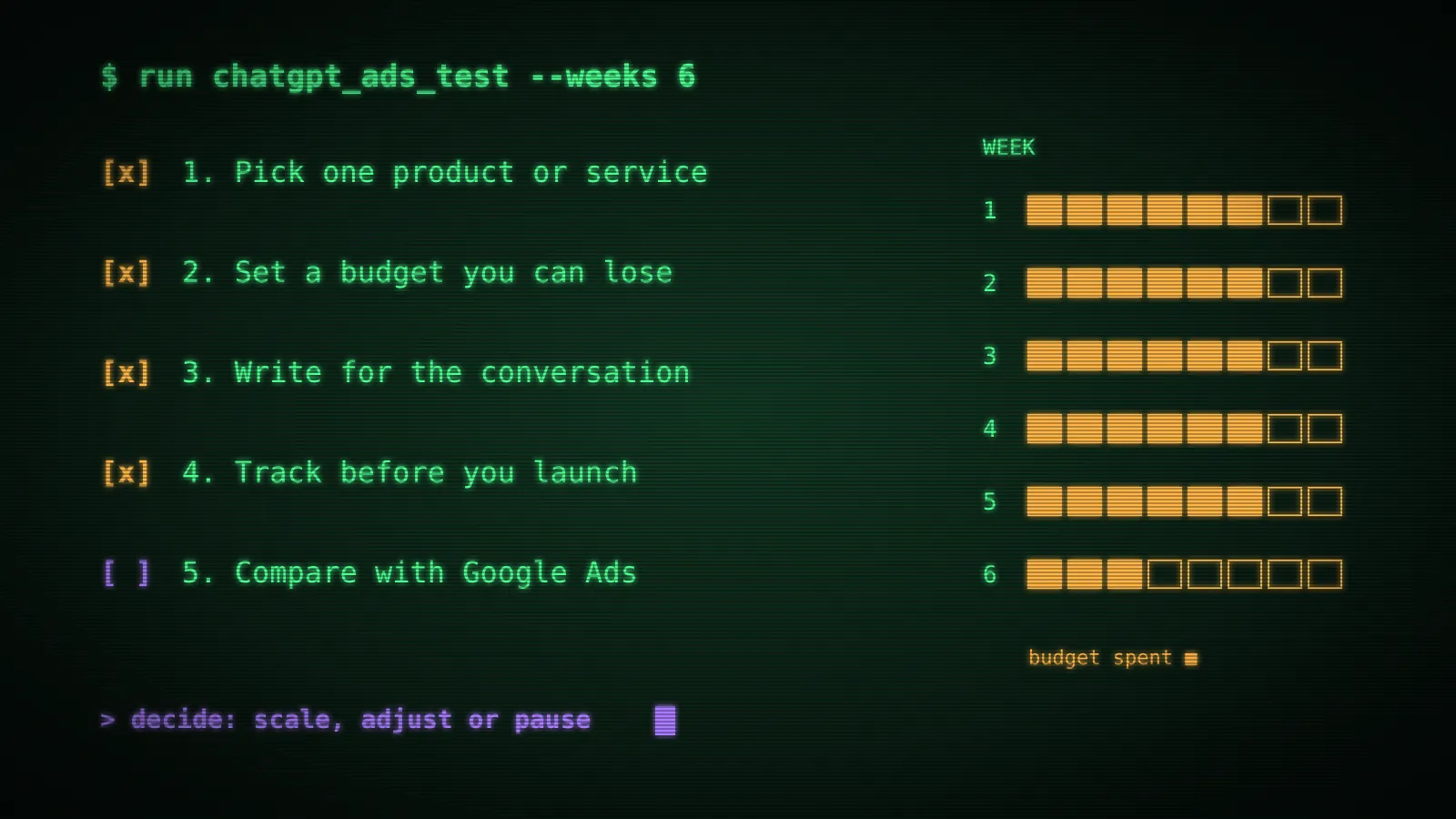
A first test should answer one question: does this channel bring customers at a cost you would accept? Five decisions settle most of that before any money is spent.
- Pick one product or service. Choose something people research in conversation and where you already know your margin and conversion rate from other channels.
- Set a budget you are prepared to lose. A few hundred pounds over four to six weeks, taken from your experimental budget rather than a campaign that already works, is enough to see a pattern.
- Write for the conversation, not the keyword. Describe the situations where your offer helps and send people to a page that continues that conversation, such as a comparison or buying guide.
- Track before you launch. Set up conversion tracking and tagged links so ChatGPT traffic shows up separately in your analytics, then agree in advance what result would justify a second round.
- Compare like with like. Judge results against your Google Ads and paid social figures on revenue per visit, cost per acquisition and return on ad spend, and allow for longer journeys by checking assisted conversions too.
If the numbers fall short, look again in six months. OpenAI is adding formats, buying options and measurement quickly, and the channel may look very different once reporting matures.
Frequently asked questions
What are ChatGPT ads?
ChatGPT ads are sponsored placements shown below ChatGPT’s answers when a product or service matches the conversation. They are labelled as sponsored and only appear to adults on the Free and Go plans.
Can UK businesses advertise on ChatGPT?
Yes. ChatGPT ads launched in the UK in June 2026, and UK businesses can buy them through the self-serve Ads Manager beta or through OpenAI’s partners, as long as their category is allowed under OpenAI’s ad policies.
How much do ChatGPT ads cost?
Pricing is set by auction. The minimum daily budget is £15 for accounts billed in pounds, and OpenAI suggests starting click campaigns with a maximum bid of $3 to $5 per click. OpenAI has not published UK benchmarks.
Do ChatGPT ads affect ChatGPT’s answers?
No. OpenAI says ads run on separate systems from the chat model and advertisers cannot shape, rank or change the answers. Paying for an ad does not get your brand mentioned in the answer itself.
Are ChatGPT ads better than Google Ads?
Not yet for most businesses. Early research found ChatGPT ad visits earned about a third of the revenue of a Google Search ad visit, so ChatGPT ads work best as a small test alongside Google Ads rather than a replacement.
Do ChatGPT ads use my conversations?
Ads are matched to the current conversation, and personalised ads can also use past chats and memory if you allow it. In the UK, personalisation depends on your consent, and advertisers never see your chats.
On this page
Back to topTest new channels without wasting budget
ChatGPT ads can reach people while they are still making up their minds, but the channel is young and the numbers are still settling. Kutola helps you decide whether it fits your plan, design a test with clear success measures and compare it fairly with the channels you already use. Get in touch to talk through your paid media mix.