How much do Meta ads cost in the UK, and what should you spend?
There is no fixed price for Meta ads. You set the budget, from a few pounds a day, and Meta’s auction decides what each impression, click or lead costs, based on your audience, your ad’s quality and how many other advertisers want the same people. Published UK benchmarks disagree widely, so the reliable way to plan is to start from what a customer is worth to you and work backwards to a test budget.
Meta ads run across Facebook, Instagram, Messenger, Threads and Meta’s partner network. This guide explains how Meta charges, what drives your costs, how to work out a budget for a first test, how to judge whether the spend is paying off and how to bring costs down. It follows the same approach as our guide to Google Ads costs, so you can compare the two.
How Meta charges for ads
You set a daily or lifetime budget for each campaign or ad set, and Meta will not spend more than that over the period. Within the budget, you pay in one of two ways:
- Per impression: the default for most objectives. Costs are reported as CPM, the cost of 1,000 impressions, even when the campaign is optimised for clicks or sales.
- Per click: available for some objectives, where you pay only when someone clicks a link in the ad.
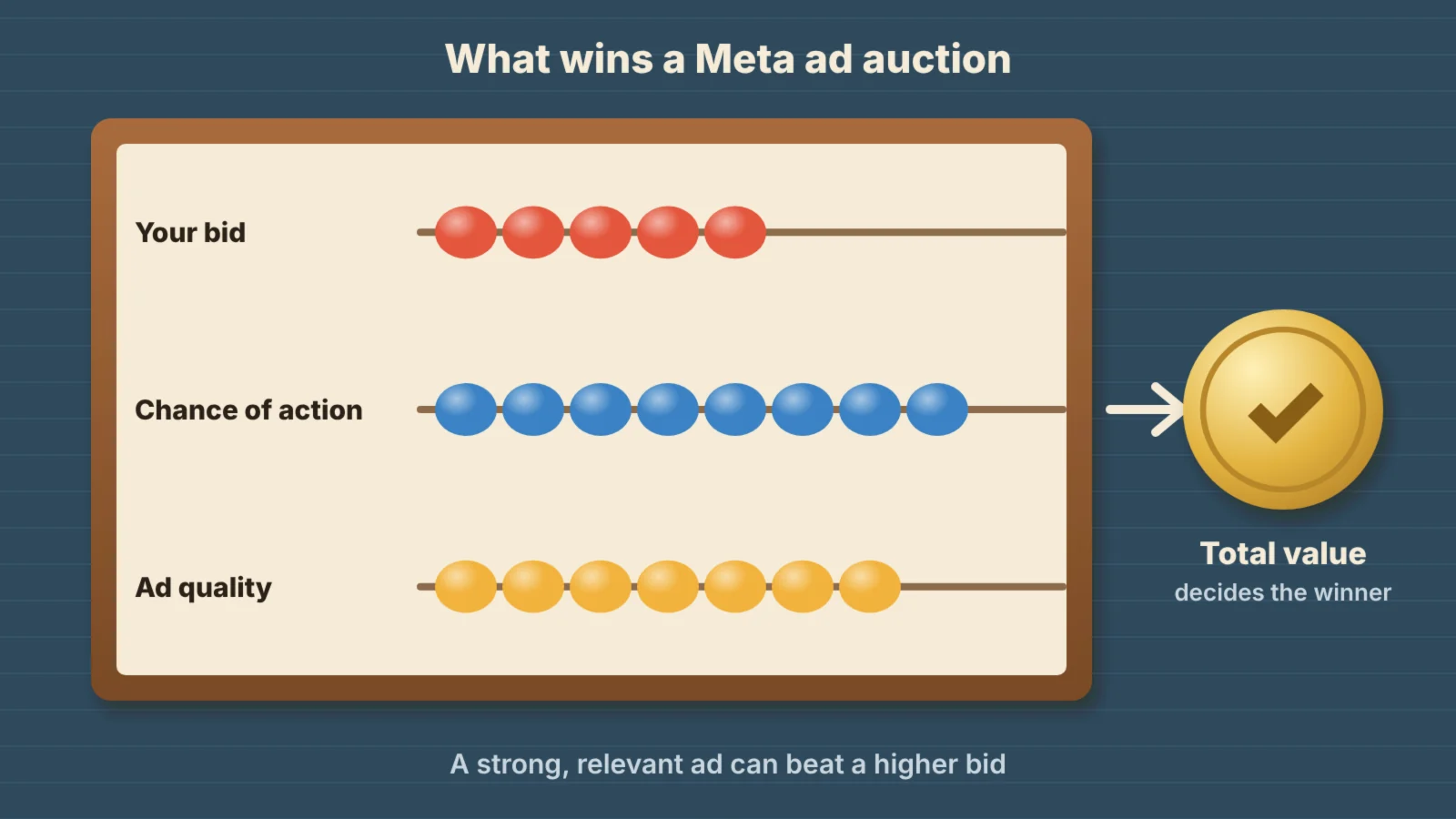
Whichever you choose, Ads Manager also shows cost per click, cost per lead and cost per purchase, which are more useful for judging results. Meta’s ad auction picks which ad to show each person based on three factors: your bid, the estimated chance that the person takes the action you want and the quality of the ad. A well-targeted, engaging ad can win auctions at a lower cost than a weak ad with a higher bid.
What drives your Meta ads cost
- Audience: narrow or highly sought-after audiences, such as business owners or homeowners in London, cost more to reach than broad ones.
- Objective: optimising for purchases or leads usually costs more per impression than optimising for reach or video views, because Meta shows the ad to people more likely to act.
- Time of year: costs rise in the run-up to Black Friday and Christmas, when large retailers increase spend. January is often cheaper.
- Creative quality: ads people engage with and do not hide tend to cost less. Tired creative that people have seen too often gets more expensive.
- Placement: Reels, Stories and Feed have different costs. Letting Meta choose placements automatically usually lowers the average cost.
- Industry: sectors where a customer is worth a lot, such as legal, finance and home improvement, attract more competition and higher costs than low-value retail.
These factors explain why published benchmarks vary so much. Agency surveys of UK costs for 2026 differ by a factor of three or more for the same metric, depending on sector, objective and the accounts they sampled. Treat any benchmark as a rough guide and rely on your own test data.
How to work out a Meta ads budget
The most useful starting point is not what others pay but what you can afford to pay for a customer.
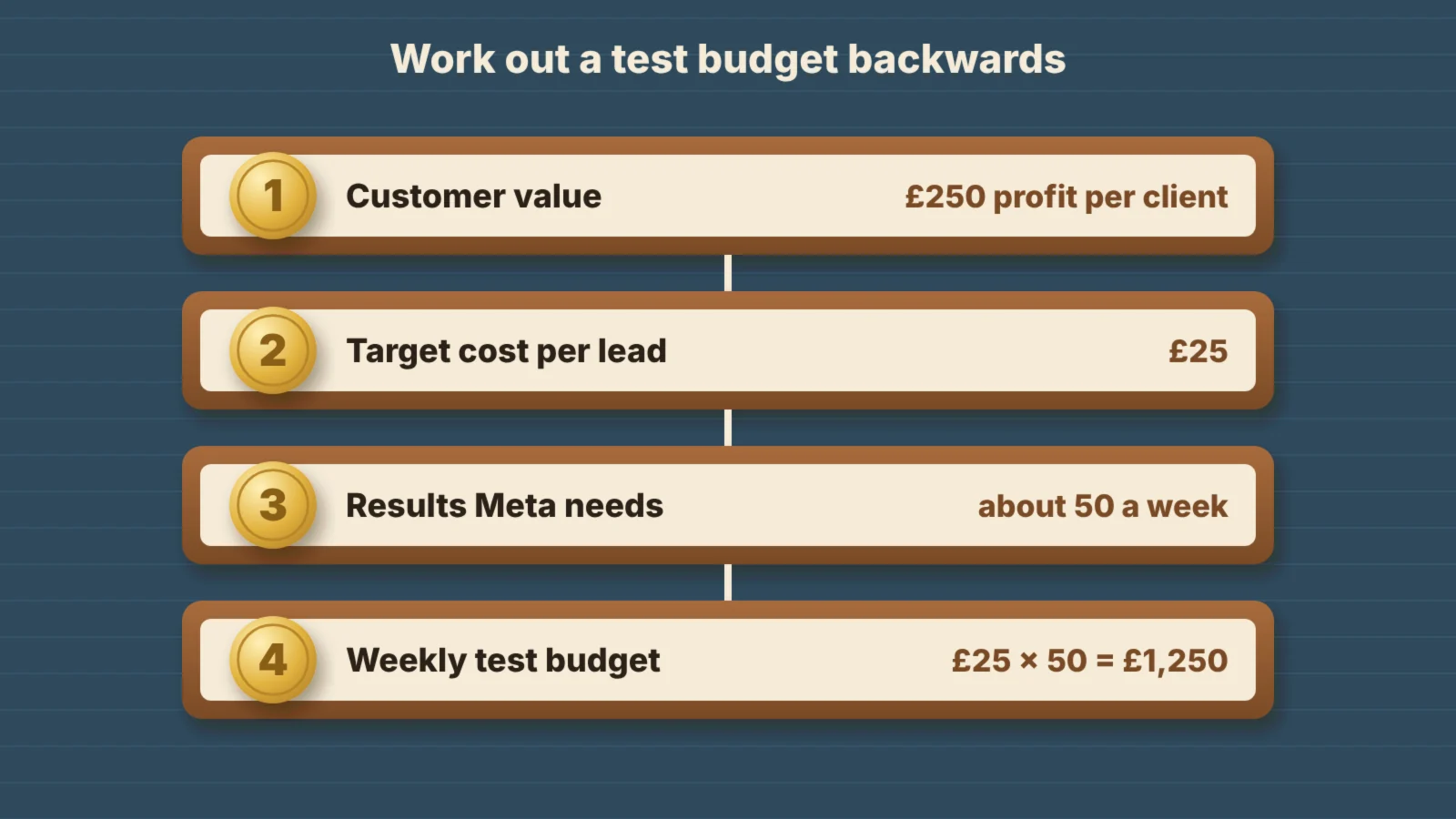
- Work out what a customer is worth. Use average order value and margin, or the profit from a typical client over a year.
- Set a target cost per result. Decide the most you can pay for a sale or lead and still make money. For leads, allow for the share that turn into customers.
- Estimate the volume you need. Meta’s system learns best when an ad set gets around 50 results a week, which is what it needs to leave what it calls the learning phase. Multiply your target cost per result by 50 to see the weekly budget that allows this.
- Adjust to your goal. If that figure is too high, optimise for a more frequent action, such as leads instead of sales or landing page views instead of leads, then judge real sales separately.
- Plan a test period. Run for at least two to four weeks before judging, and avoid big changes during the first week, because large edits restart the learning.
Suppose a typical client brings in £250 of profit and one in four leads becomes a client. Each lead is then worth about £62, so a target of £25 per lead leaves a healthy margin. Getting 50 leads a week at that price needs about £1,250 a week from one ad set. If that is out of reach, the business could optimise for a more frequent action at first, then compare the cost per lead it actually gets with its target.
Are Meta ads worth it?
Meta ads tend to work well when:
- The product is visual or easy to demonstrate, such as fashion, food, home, beauty, fitness and many apps.
- People do not search for it yet. Meta can create demand for something new, while search ads only reach people already looking.
- You can make creative regularly. Results usually depend more on the ads themselves than on targeting, so you need a steady supply of new videos and images.
- You can measure results. The Meta pixel and the Conversions API send website actions back to Meta, so it can optimise and report accurately.
They are harder to make pay when the product is highly specialised, the buying decision is long and complex with few people involved or the business cannot follow up leads quickly. In those cases, search ads, LinkedIn or direct outreach may be a better first step. Our comparison of social media advertising platforms covers the alternatives.
Judge Meta on cost per customer and profit, not on CPM or clicks. A campaign with expensive clicks can still be the most profitable if those clicks buy. Compare Meta with your other channels using the same measures, as described in our paid media strategy guide.
UK rules that affect Meta ads
Meta ads follow the same UK advertising rules as any other ad. The CAP Code requires ads to be legal, decent, honest and truthful, with evidence for claims. Prices must include compulsory fees, and urgency claims must be genuine.
Some products have extra restrictions. Since January 2026, brands cannot pay for online ads for identifiable less healthy food and drink products. Alcohol and gambling ads must not appeal strongly to under-18s, and financial promotions must follow FCA rules. Meta also has its own advertising standards, and some categories, such as credit, employment, housing and political ads, have limited targeting options.
How to lower your Meta ads cost
- Improve the creative first. Test several different ideas, not small variations. Short videos that show the product and the benefit in the first few seconds often perform best.
- Keep the account simple. Fewer campaigns and ad sets with more budget each give Meta more data to learn from.
- Use broad targeting and let the system work. Advantage+ audiences and placements often lower costs compared with narrow manual targeting, provided tracking is in place.
- Set up the Conversions API. Sending conversion data from your website server, alongside the pixel, helps Meta find the right people despite browser privacy limits.
- Fix the landing page. A faster, clearer page turns more clicks into customers, which lowers your cost per result without changing the ad. Our guide to landing pages that convert explains what to check.
- Refresh before fatigue sets in. Watch frequency and cost per result. When costs climb and the same people keep seeing the ad, introduce new creative.
- Retarget with care. Ads to recent website visitors and customers usually cost less per result, but small audiences tire quickly.
Frequently asked questions
How much do Meta ads cost per day?
You choose the daily budget yourself. Meta allows very small budgets, but most businesses need enough each day for the ad set to get regular results. Working backwards from your target cost per result and the roughly 50 results a week Meta needs to learn is a sensible way to set it.
Is it cheaper to advertise on Instagram or Facebook?
It depends on your audience, objective and creative. Costs differ by placement, so letting Meta choose placements automatically across Facebook and Instagram usually gives a lower average cost than forcing one platform.
Why are my Meta ads so expensive?
Common reasons are a narrow audience, creative people do not engage with or have seen too often, too many small ad sets and missing conversion tracking. Seasonal competition before Black Friday and Christmas also pushes costs up.
How long should I run Meta ads before judging them?
Give a new campaign at least two to four weeks, and avoid major changes in the first week while Meta’s system learns. Judge it on cost per customer and profit rather than on early click costs.
Are Meta ads better than Google Ads?
They do different jobs. Google search ads reach people already looking for what you sell, while Meta ads reach people based on interests and behaviour before they search. Many businesses use both, with Meta to create demand and search to capture it.
On this page
Back to topFind out what Meta ads could do for you
Kutola plans Meta campaigns around what a customer is worth to you, builds the tracking, creative tests and landing pages that keep costs down and reports on profit rather than clicks. See how it fits into our social media strategy work, or get in touch to talk through your budget.