What makes a landing page convert?

A landing page converts when it keeps the promise that brought the visitor there, makes one clear offer and removes every reason to hesitate. The best landing pages match the ad or link that sent people, explain the benefit in the first screen, show proof and ask for a single action with as little effort as possible.
Landing pages are where a lot of conversion rate optimisation work pays off fastest, because every paid click and campaign email lands on one. This guide explains what a landing page is, the elements that make one convert, what a good conversion rate looks like and how to build and improve your own.
What is a landing page?
A landing page is a page built for visitors arriving from a specific campaign, such as an ad, an email or a social post, with one goal: getting them to take a single action. That action might be booking a consultation, downloading a guide, signing up for an event or buying a product.
It differs from a homepage in focus. A homepage serves everyone, from job seekers to existing customers, so it offers many paths. A landing page serves one audience with one offer, so it removes distractions such as the full navigation menu and links to unrelated pages.
In practice, any page where a campaign sends traffic is acting as a landing page, including product pages and service pages. The principles below apply to all of them.
Why landing pages matter
- They decide what your traffic is worth. If a page converts 2% of visitors and you raise that to 3%, every pound spent on ads produces half as many customers again.
- They lower ad costs. Google Ads rates landing page experience as part of Quality Score, so a relevant, fast page can lower what you pay per click. Our guide to how Google Ads pricing works explains the link.
- They make results measurable. One page, one offer and one action give you a clean conversion rate for each campaign.
- They let you test. A dedicated page can be changed and tested without affecting the rest of the site.
What makes a landing page convert
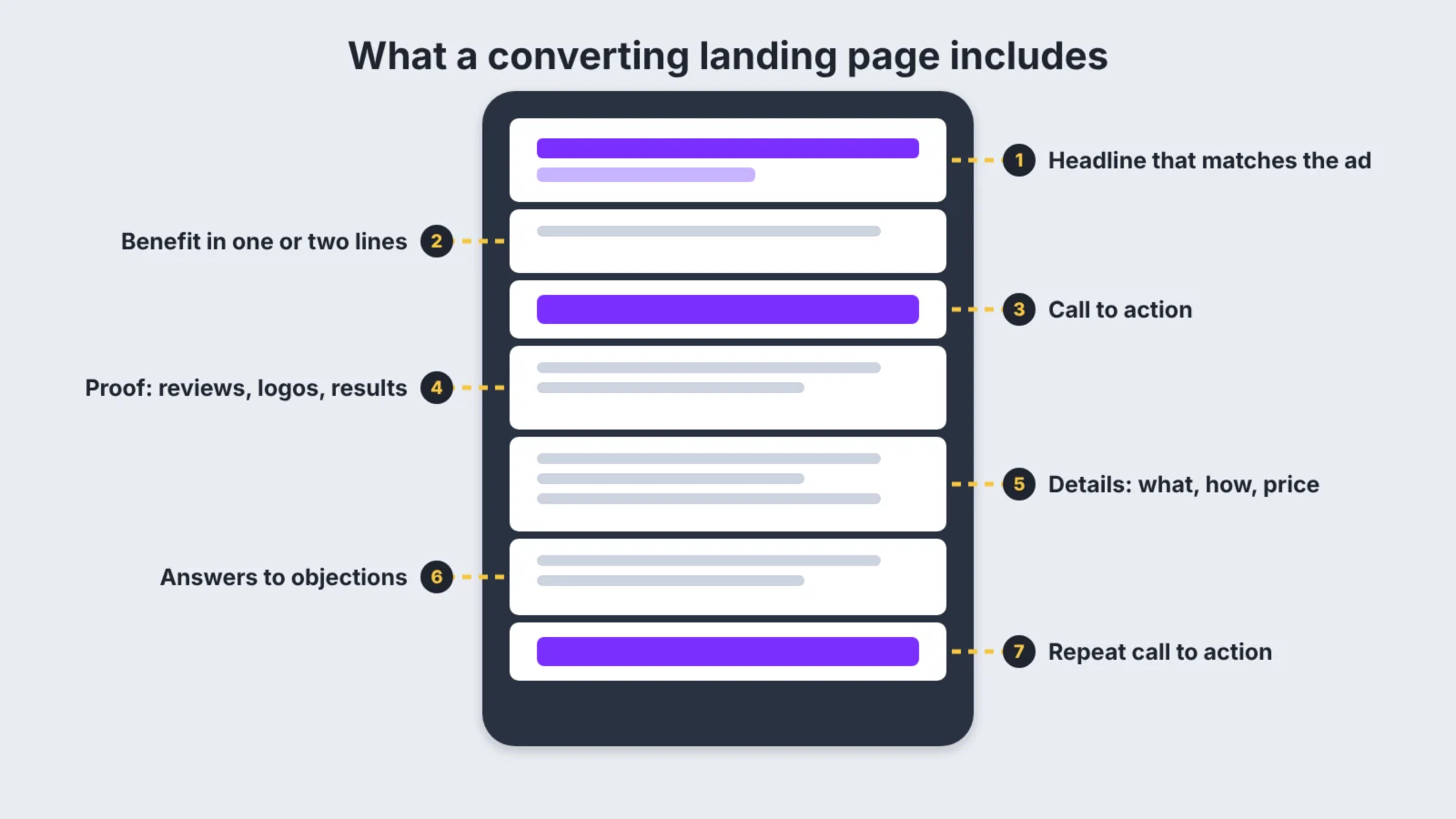
Strong landing pages share the same building blocks, arranged to answer the visitor’s questions in the order they ask them.
A headline that matches the promise
If the ad said “Free boiler service quote in 24 hours”, the headline should say the same thing. This message match reassures visitors that they are in the right place. A mismatch is one of the fastest ways to lose them.
A clear benefit in the first screen
Under the headline, say what the visitor gets and why it matters to them, in one or two sentences. Your value proposition belongs here. On mobile, the headline, benefit and call to action should all be visible without scrolling.
One call to action
Choose one action and make the button say what happens next, such as “Get my quote” or “Download the checklist”, rather than “Submit”. Repeat the same button further down the page for people who need more information before they act.
Proof
Reviews, ratings, client logos, case study results, accreditations and guarantees reduce the risk of saying yes. Place proof close to the call to action, where doubt is highest. Our guide to types of social proof covers which kinds work best where.
The details people need to decide
Explain what is included, how it works, what it costs and what happens after they convert. Short sections with clear subheadings work better than long blocks of text. Show prices including VAT for consumers, and avoid surprises later in the process.
Answers to objections
A short FAQ near the bottom handles the questions that stop people acting: cost, timing, cancellation, delivery, data use. Sales calls and support emails tell you which questions to answer.
A short form
Ask only for what you need to take the next step. Every extra field adds effort, so leave out anything you can collect later. Make forms work well on phones, with large fields and the right keyboard for each input.
Speed and clarity
A slow page loses visitors before they read the headline, especially on mobile data. Compress images, avoid heavy scripts and test the page on a real phone.
What is a good landing page conversion rate?
Unbounce’s Conversion Benchmark Report, based on around 41,000 landing pages and 57 million conversions, found a median conversion rate of 6.6% across industries. The spread is wide: rates depend on the industry, the offer, the traffic source and what counts as a conversion. A free download converts far more visitors than a high-priced purchase, and visitors from a targeted email convert better than cold social traffic.
Benchmarks are useful for spotting a page that is badly underperforming, but the most useful comparison is with yourself. Track each page’s rate by traffic source and device, then aim to beat your own figures. Our guide to calculating your conversion rate explains how to set this up consistently.
Landing page examples by goal
The structure stays similar, but the emphasis changes with the goal.
| Goal | What the page must do | Key elements |
|---|---|---|
| Service enquiry (for example, a solicitor or a heating engineer) | Build trust quickly and make contact easy | Local proof, accreditations, clear pricing or price ranges, a short form and a phone number |
| Lead magnet (a guide or checklist) | Show the value of what people get in exchange for an email address | A preview of the content, three or four bullet benefits, a one-field form and a clear privacy note |
| Product sale | Answer buying questions and reduce risk | Product images, delivery and returns information, reviews and a price with all mandatory fees |
| Event or webinar | Make the date and value clear and reduce no-shows | Date and time, speaker details, what attendees will learn, a short sign-up form and a calendar reminder |
How to build a landing page in 6 steps
- Define the audience and the action. Write down who the page is for, where they come from and the one thing you want them to do.
- Collect their questions. List what this audience needs to know before acting, using sales calls, reviews, enquiry emails and searches.
- Write the page before designing it. Start with the headline and call to action, then answer the questions in order of importance. Design works best when it presents copy that already makes sense.
- Build for mobile first. Most campaign traffic arrives on phones. Check that the first screen shows the headline, benefit and button.
- Set up tracking. Record the conversion as a key event in Google Analytics 4 and in any ad platform that sends traffic, and use UTM parameters on every link.
- Launch, watch and improve. Review the conversion rate, scroll depth and form drop-off after a week or two of traffic, then fix the biggest problem first.
How to test and improve a landing page
Start with research rather than guesses. Session recordings, heatmaps and form analytics show where people stop, and a short on-page survey asking “What’s stopping you from booking today?” often reveals the answer directly.
When you have enough traffic, test one meaningful change at a time, such as a new headline, a different offer or a shorter form, and run the test for at least two full weeks. Bold changes are more likely to produce a clear result than small tweaks such as button colour. If traffic is too low for a reliable test, make the change, compare results over a longer period and keep an eye on lead quality as well as volume. Our CRO guide explains when A/B testing works and what to do when you can’t test.
Common landing page mistakes
- Sending all campaigns to the homepage. Visitors have to find the offer themselves, and many will not.
- A headline that ignores the ad. Message mismatch makes people doubt they are in the right place.
- Several competing offers. More choices usually mean fewer decisions.
- Long forms. Asking for company size, budget and phone number before you have earned trust costs conversions.
- Proof hidden at the bottom. Put reviews and results where the visitor is deciding.
- Fake urgency. Countdown timers that reset and “only two left” claims that are not true break UK consumer law, and the CMA can now fine businesses directly for them.
- Never looking at it again. A landing page should be reviewed whenever the campaign, offer or audience changes.
Frequently asked questions
What is a landing page?
A landing page is a web page built for visitors from a specific campaign, such as an ad or email, with one goal: getting them to take a single action like booking, signing up or buying. It has fewer distractions than a homepage.
What makes a good landing page?
A good landing page matches the ad or link that brought the visitor, states a clear benefit in the first screen, shows proof, answers common objections and asks for one action with a short form. It also loads quickly on mobile.
What is a good landing page conversion rate?
Unbounce’s benchmark data puts the median at about 6.6% across industries, but rates vary widely with the offer, industry and traffic source. Compare each page against its own past performance and against similar campaigns.
Should a landing page have navigation?
Usually not. Removing the main menu and unrelated links keeps attention on the one action you want. Keep essential links such as your privacy policy and contact details.
How long should a landing page be?
As long as it needs to be to answer the visitor’s questions. A simple, low-risk offer can work on a short page, while an expensive or complex service usually needs more detail, proof and FAQs.
On this page
Back to topTurn more of your campaign traffic into customers
Kutola reviews and rebuilds landing pages around what your visitors need to see, from the headline and offer to proof, forms and tracking. See how it fits into our brand and digital experience work, or get in touch to talk through your campaigns.