Social media advertising: which platform suits your business?
Social media advertising means paying platforms such as Facebook, Instagram, TikTok, LinkedIn, YouTube and Pinterest to show your ads to people chosen by interest, behaviour, location or job. Unlike organic posts, which reach only a fraction of your followers, paid social puts a message in front of the exact audience you choose, on a budget you control. It also reports what happened.
This guide is part of our wider paid media strategy guide and focuses on paid social. It explains how social media ads work, compares the main platforms and gives you four questions for choosing between them. It then covers what changes for small businesses with small budgets, what makes a social ad work, how to measure results and the UK rules that apply.
Key takeaways
- Social ads create demand among people who are not searching yet. Search ads catch people who already are. Know which job you are paying for.
- Choose platforms by where your customers spend time and what they are in the mood for, not by which platform is fashionable.
- Small budgets work best on one platform, one campaign and broad targeting, so the algorithm gets enough data to learn.
- The creative is now the main targeting lever. The first three seconds decide whether anyone sees the rest.
- In the UK, ads must be obviously identifiable as ads, and some products face strict limits on paid social.
What is social media advertising?
Social media advertising, often called paid social, is any content a business pays a social platform to show. It includes sponsored posts in the feed, short video ads between stories or reels, carousel ads that show several products, lead forms that open inside the app and messages that start a chat with your business.
Every major platform runs its own advertising system. Meta Ads Manager covers Facebook, Instagram, Messenger and Threads. TikTok, LinkedIn, Pinterest, Snapchat, Reddit and X each have their own, and YouTube ads are bought through Google Ads. Each works in a similar way: you pick an objective, an audience, a budget and an ad, and the platform’s auction decides when and to whom the ad is shown.
Paid social is a big and growing share of UK marketing. IAB UK’s Digital Adspend study put UK social ad spend at £11.5bn in 2025, second only to search, and social was the fastest growing of the main digital channels.
Organic vs paid social: what each one does
Organic social is what you post for free. It builds a relationship with people who already follow you, shows your personality and gives customers somewhere to ask questions. Its reach is limited, because platforms show each post to only a share of your followers, and it grows slowly.
Paid social buys reach and speed. It can put a message in front of thousands of new people this week, test which offer works best or bring back visitors who left your website. It stops the moment you stop paying, which is why the two work best together.
The strongest accounts use organic content to find out what resonates, then put money behind the posts that already perform. Organic content is also discoverable in social search, as we explain in our guide to social media SEO, while paid content buys attention on top. Your overall social media strategy should decide the role of each before any money is spent.
How social media ads work
Four decisions shape every social campaign.
- Objective. You tell the platform what you want: awareness, traffic, engagement, leads, app installs or sales. The platform then shows your ad to the people most likely to take that action, so choosing “traffic” when you want sales usually brings clicks that do not buy.
- Audience. You can target by location, age, interests and behaviour, upload a customer list, retarget website visitors or build lookalike audiences of people similar to your customers. Platforms increasingly push broad targeting and let their algorithms find buyers.
- Budget and bidding. You set a daily or lifetime budget and the platform bids in an auction for each impression. You pay per thousand impressions (CPM), per click or per result, depending on the setup.
- Creative. The image, video and text. Because targeting has become broader, the creative now does much of the targeting work: an ad that speaks clearly to new parents will mostly be shown to, and clicked by, new parents.
Behind all four sits tracking. A platform pixel on your website and a server-side connection such as Meta’s Conversions API tell the platform which ads led to sales or leads. Without them, the algorithm optimises blind and your reports undercount results, particularly as more people decline cookies.
Which social media platform suits your business?
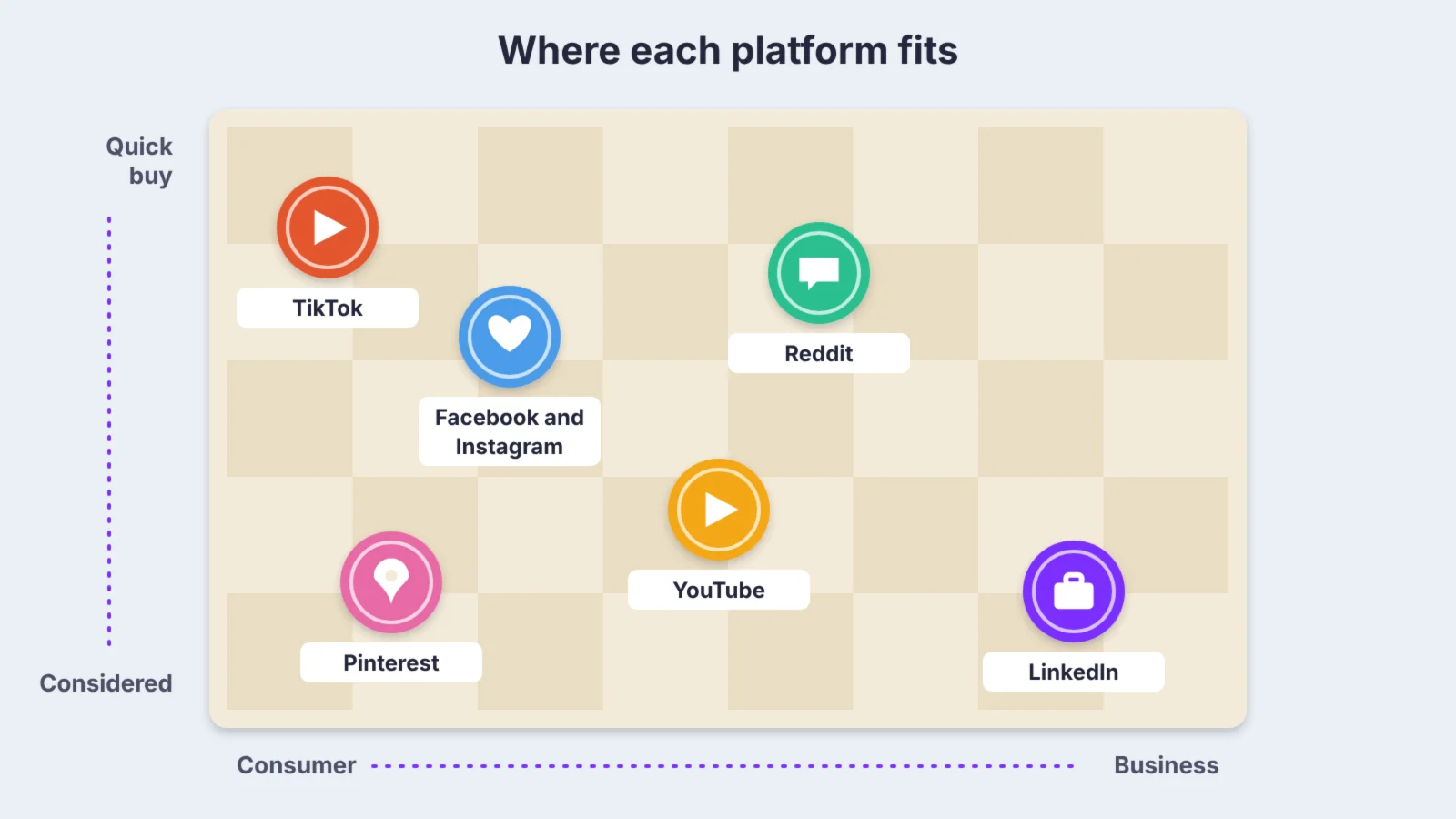
No platform is best for everyone. The right choice depends on who you sell to, what you sell and how people make the decision to buy. The table below summarises the main options.
| Platform | Best for | Main strengths | Watch out for |
|---|---|---|---|
| Facebook and Instagram (Meta) | Most consumer businesses, local services, ecommerce | Huge reach, mature targeting and tracking, many formats | Creative fatigue sets in fast; results depend on good tracking |
| TikTok | Products that show well on video, younger audiences, impulse buys | Cheap attention, strong discovery, TikTok Shop | Needs a steady supply of native-looking video |
| B2B services, recruitment, high-value deals | Targeting by job title, company and industry | Much higher cost per click than other platforms | |
| YouTube | Products that need explaining, longer consideration | Video reach on TV screens and mobile, search intent | Bought through Google Ads, which has its own learning curve |
| Home, fashion, food, weddings, gifts | People arrive planning purchases | Smaller audience, slower results | |
| Snapchat, Reddit and X | Specific audiences and niches | Lower competition in some sectors | Smaller reach and less mature tools |
Facebook and Instagram
Meta’s platforms are the default starting point for most consumer businesses because almost everyone is there. Ofcom’s Online Nation research found that Facebook and Messenger reached 93% of UK online adults in May 2025. One campaign can run across Facebook, Instagram feeds, stories, reels and Messenger, and Meta’s Advantage+ campaigns automate much of the targeting and placement. The trade-off is that you hand more decisions to the algorithm, so good tracking and a steady flow of fresh creative matter more than clever audience settings.
TikTok
TikTok rewards ads that look and sound like TikTok: people talking to camera, quick demonstrations and trends, rather than polished brand films. It is strong for discovery and for products that can be shown working in a few seconds, and TikTok Shop lets people buy without leaving the app. Its audience skews younger than Facebook’s but is far broader than many assume. The challenge is supply: you need several new videos every few weeks, so it suits businesses that can film regularly or work with creators.
LinkedIn is the only platform where you can reliably target by job title, seniority, company size and industry. That makes it valuable for B2B services, software and recruitment, where one client can be worth thousands of pounds. Clicks cost several times more than on Meta, so it pays when the deal size justifies it and when the offer is useful to a professional, such as a guide, an event or a free assessment, rather than a hard sales pitch.
YouTube
YouTube reaches almost everyone in the UK: the same Ofcom research put its reach at 94% of online adults, with an average of 51 minutes a day. Its ads work well for products that need explaining or comparing, and people increasingly watch on TV screens. Because YouTube is part of Google Ads, you can also target people by what they have searched for, which mixes some search intent into a video channel. For more on how Google charges, see our guide to Google Ads costs.
Pinterest, Snapchat, Reddit and X
Pinterest is a planning tool more than a social network: people save ideas for homes, outfits, recipes and weddings, so ads can reach them before they decide. Snapchat reaches younger audiences, and Reddit lets you target specific communities where people discuss products in depth. X has lost reach in the UK in recent years. These platforms are usually second or third choices, worth testing once your main platform is working.
How to choose: four questions
Answer these four questions before you open any ad account.
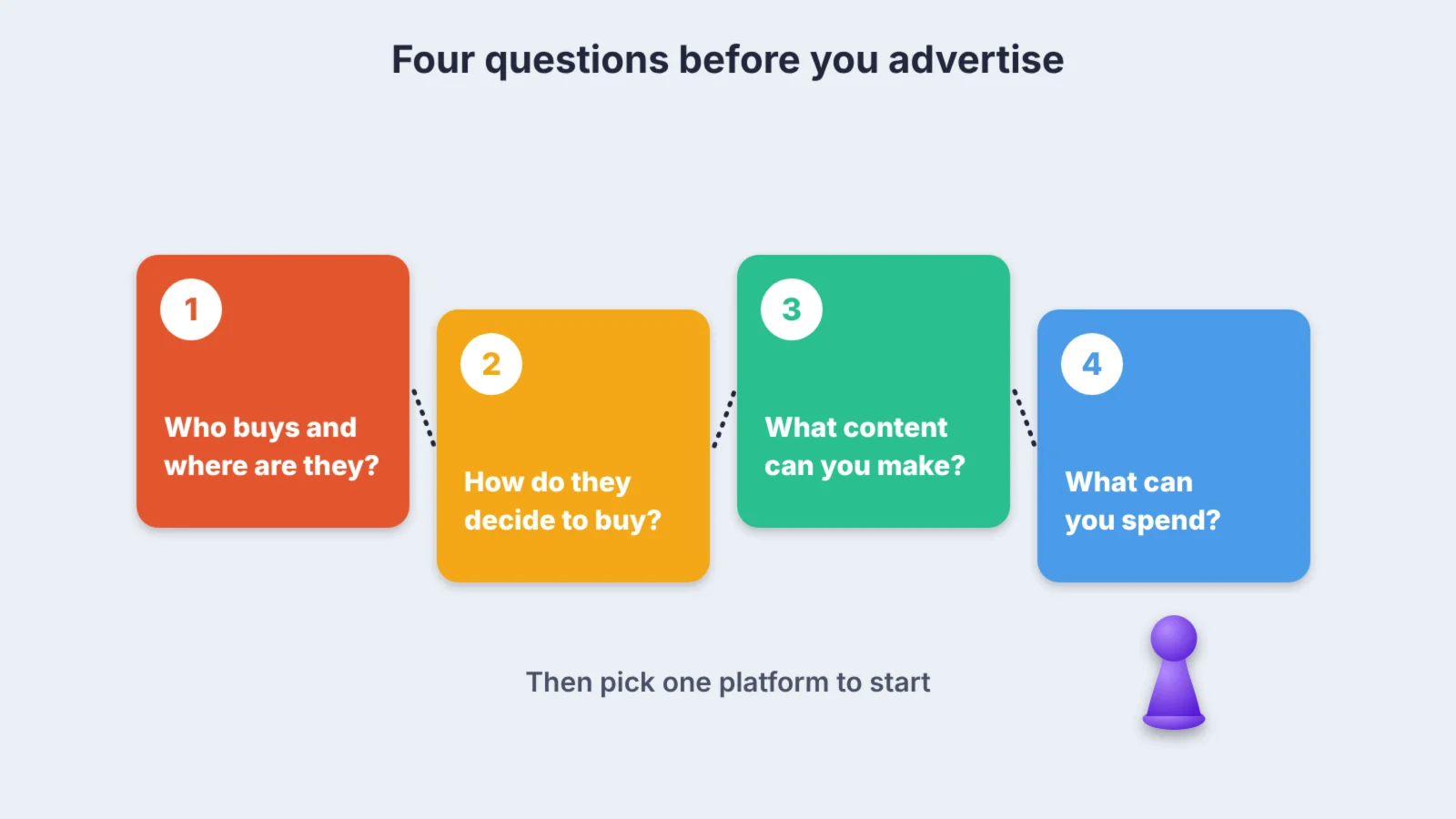
- Who are your customers and where do they spend time? Start with real data: ask customers, check which social sites send traffic in your analytics and look at where competitors advertise. Meta’s Ad Library and TikTok’s Creative Center show the ads other businesses are running.
- How do they decide to buy? A £20 impulse product can sell from one good video. A £20,000 service needs trust built over weeks, so it suits platforms where you can share expertise and retarget people who engaged. Mapping the stages, as described in our marketing funnel guide, shows where social ads fit.
- What content can you make? Be honest about this. If you cannot produce short video regularly, TikTok will be hard work. If you have strong product photos, Meta and Pinterest are easier places to start.
- What can you spend? Each platform needs enough budget to learn. Meta says an ad set leaves its learning phase after about 50 optimisation events in a week. If your budget cannot buy anywhere near that many results, start with one platform rather than spreading thinly across three.
Social media advertising for small businesses
Small businesses can do well on social ads, because the platforms let you start with a few pounds a day and stop at any time. The risk is not overspending; it is spreading a small budget so thinly that nothing gets enough data to work.
- Start with one platform. For most local and consumer businesses that is Meta, because it covers both Facebook and Instagram with one campaign. For B2B, it may be LinkedIn or a small Meta test aimed at business owners.
- Run fewer, simpler campaigns. One campaign with broad targeting and three or four ads usually beats five tightly targeted campaigns with tiny budgets each.
- Optimise for an action that happens often enough. If you only get a few sales a week, optimise for a step that happens more often, such as adding to basket or starting a booking, until volume grows.
- Use what you already have. Customer reviews, behind-the-scenes clips and user-generated content often outperform expensive productions, because they look native to the feed.
- Retarget your warmest audiences. People who visited your site, watched your videos or engaged with your page are cheaper to convert. Keep this budget small, because the audience is small.
- Give it time. Judge a campaign over two to four weeks, not two days. Daily results swing widely on small budgets.
Before spending, check that the page your ads send people to is ready. A slow page or an unclear offer wastes paid clicks faster than any setting in the ad account, which is why our guide to conversion rate optimisation is worth reading alongside this one.
What makes a social media ad work
People scroll past most ads in under a second. The ads that work earn attention quickly and then make one clear point.
- Hook in the first three seconds. Open with the problem, the result or something unexpected. Do not save the interesting part for the end.
- Design for sound off. Many people watch without sound, so add captions and make sure the visual tells the story on its own.
- Look native. Ads that look like posts from a real person usually beat polished adverts, especially on TikTok and Instagram reels.
- Show proof. Reviews, numbers, recognisable customers and demonstrations build trust. Our post on social proof explains why this works.
- One message, one action. Each ad should make one promise and ask for one thing.
- Refresh often. Performance falls as the same people see an ad again and again. Watch frequency and add new creative before results drop, not after.
Plan creative the way you plan organic posts. The themes and formats that do well in your social media content strategy are often the best starting point for ads.
How to measure social media advertising
Platform dashboards are useful but generous. Each one counts conversions it can link to its own ads, often including people who saw an ad and bought later without clicking, so the totals across platforms usually add up to more sales than you actually made.
Measure at three levels:
- In the platform: cost per result, click-through rate, frequency and how quickly creative wears out. These tell you what to change in the account.
- In your analytics: add UTM parameters to every ad link so Google Analytics 4 shows the visits, behaviour and conversions from each campaign.
- In the business: compare total sales, new customers and cost per acquisition before and during campaigns. If platforms claim more sales than actually arrived, trust the business numbers.
For sales, the key figure is return on ad spend or cost per acquisition compared with the profit each customer brings. For awareness campaigns, look for lifts in branded searches, direct visits and engagement. Our guide to marketing KPIs covers how to choose the few that matter.
UK rules for social media advertising
UK social ads follow the same rules as other advertising, plus some platform-specific limits.
- Ads must be identifiable as ads. The ASA requires paid content, including influencer posts, to be obviously identifiable as ads. Labels such as “#ad” should be clear and upfront.
- Claims must be honest and provable. The CAP Code applies to social ads, so prices, savings, reviews and “best” claims need evidence. The CMA can now fine businesses directly for misleading practices such as fake reviews and hidden fees.
- Less healthy food and drink. Since 5 January 2026, paid online ads for identifiable less healthy food and drink products are banned across the UK, including on social media.
- Special categories. Meta and other platforms restrict targeting for ads about jobs, housing, credit and financial services, and require authorisation for political and social issue ads. Financial promotions must also follow FCA rules.
- Young people. Platforms limit how advertisers can target under-18s, and ads for products such as alcohol and gambling must not target or appeal strongly to them.
- Tracking and consent. Pixels and similar tags rely on cookies, so your website needs a consent banner that meets UK GDPR and PECR rules.
Common social media advertising mistakes
– Boosting posts instead of running campaigns. The boost button is quick, but it offers fewer objectives and controls than a proper campaign in Ads Manager. – Choosing the wrong objective. Asking for clicks brings clickers, not buyers. Choose the action you actually want. – Spreading too little budget across too many platforms. Nothing gets enough data to learn, so everything looks like it fails. – Running one ad for months. Creative fatigue quietly raises costs. Plan new ads every few weeks. – Skipping tracking. Without a pixel and server-side connection, the platform cannot learn who buys and you cannot prove results. – Judging on platform numbers alone. Check sales and leads in your own systems as well. – Sending traffic to the homepage. Send people to the page that matches the ad’s promise.
Frequently asked questions
What is social media advertising?
Social media advertising is paying platforms such as Facebook, Instagram, TikTok, LinkedIn, YouTube or Pinterest to show your content to a chosen audience. You pick an objective, audience, budget and ad, and the platform’s auction decides when and to whom it is shown.
Which social media platform is best for advertising?
It depends on your customers. Meta suits most consumer and local businesses, TikTok suits products that show well on short video, LinkedIn suits B2B services and Pinterest suits planned purchases such as home, fashion and weddings.
How much should a small business spend on social media ads?
Start with what you can afford to test for a month on one platform, then judge results over two to four weeks. The budget should buy enough results for the platform to learn; Meta, for example, looks for about 50 optimisation events a week per ad set.
Is social media advertising worth it for small businesses?
Often, yes, because you can start small, target locally and stop at any time. It works best with clear tracking, a landing page that converts and a steady supply of simple, native-looking creative.
What is the difference between boosting a post and running an ad?
Boosting promotes an existing post with a few simple settings. A campaign in Ads Manager gives you more objectives, placements, audiences and testing options, so it usually performs better for sales and leads.
Do social media ads need to be labelled in the UK?
Ads in a normal ad format are labelled by the platform. Paid content that looks like an ordinary post, such as influencer content, must be clearly labelled, for example with “#ad” at the start, under ASA rules.
On this page
Back to topPut your social ad budget where your customers are
Kutola helps you choose the right platforms, plan campaigns around your goals and build creative and tracking that show what your spend returns. See how paid social fits into our social media strategy work, or get in touch to talk through your plans.