

An SEO strategy is a long-term plan for growing a business through organic search: which audiences and topics to target, which pages to create or improve, how to keep the site technically sound, how to earn authority and how to measure the results. Where SEO describes the work itself, the strategy decides which parts of that work matter most for your goals and in what order to do them.
This guide explains what an SEO strategy includes and why it matters now that AI answers sit at the top of many results pages. It then shows how to build one in eight steps, with content planning through topic clusters, a worked example, a one-page template, the KPIs worth tracking and the mistakes that hold most strategies back.
Key takeaways
- An SEO strategy links search activity to business goals. It decides which topics, pages and fixes come first, and which can wait.
- Four areas carry most strategies: technical health, on-page optimisation, content and authority. Weakness in one limits the others.
- Plan content around topics and search intent, not single keywords. Topic clusters linked to a pillar page make your expertise easy to see.
- AI Overviews and AI Mode draw on the same index and quality signals as organic results, so strong SEO is also the base for AI search visibility.
- SEO compounds slowly. Expect months rather than weeks, and judge progress by leads and sales as well as rankings.
What is an SEO strategy?
An SEO strategy is the set of decisions that guides how a website earns visibility in search engines over time. It takes a business objective, such as more qualified enquiries or more online sales, and turns it into choices about audience, topics, pages, technical work and links.
Most SEO activity is easy to list: fix broken pages, write blog posts, improve title tags, earn backlinks. The hard part is choosing. A small team cannot do everything at once, and a site with 40 pages has different needs from one with 40,000. A good strategy answers four questions:
- What should search do for the business? The commercial goal and how organic search contributes to it.
- Who are we trying to reach, and what do they search for? The audience, their questions and the search intent behind them.
- Where can we realistically win? The topics where your expertise, your site’s authority and the competition give you a fair chance.
- What do we do first, and how will we know it worked? A prioritised roadmap and the measures that show progress.
SEO strategy sits inside the wider digital marketing strategy. The marketing strategy sets the goals, audience and position for every channel. The SEO strategy works out how organic search, one of those channels, will contribute.
SEO strategy vs SEO tactics
The difference between strategy and tactics explains why two businesses can do the same amount of SEO work and get very different results.
| Level | What it decides | Time frame | Example |
|---|---|---|---|
| SEO strategy | Goals, audience, priority topics and how success is measured, plus the balance of technical, content and authority work | Twelve months or more, reviewed quarterly | Become the most useful UK source on employment law for small employers, measured by enquiries from organic search |
| SEO roadmap | Which projects happen in which order, who owns them and what they need | One quarter at a time | Fix indexing problems in month one, publish a pillar page and six supporting guides by month three |
| SEO tactics | Individual tasks | Days to weeks | Rewrite a title tag, add internal links, pitch a data story to a trade publication |
Tactics without a strategy tend to chase whatever a tool flags as urgent. A strategy gives each task a reason, and makes it easier to say no to work that would not move the numbers that matter.
Why an SEO strategy matters
Search is still where most buying journeys start or pass through. In the UK, Google held just over 91% of the search engine market across all devices in June 2026, according to Statcounter, with Bing a distant second at around 6%. People who search are telling you what they need at the moment they need it, which makes organic search one of the few channels that captures existing demand without paying for every click.
Being on the web is not the same as being found, though. An Ahrefs analysis of around 14 billion pages found that 96.55% received no organic traffic from Google at all. Ahrefs points to three usual causes: no backlinks, topics nobody searches for and pages that do not match what searchers want. Each of those is a strategic failure rather than a technical one.
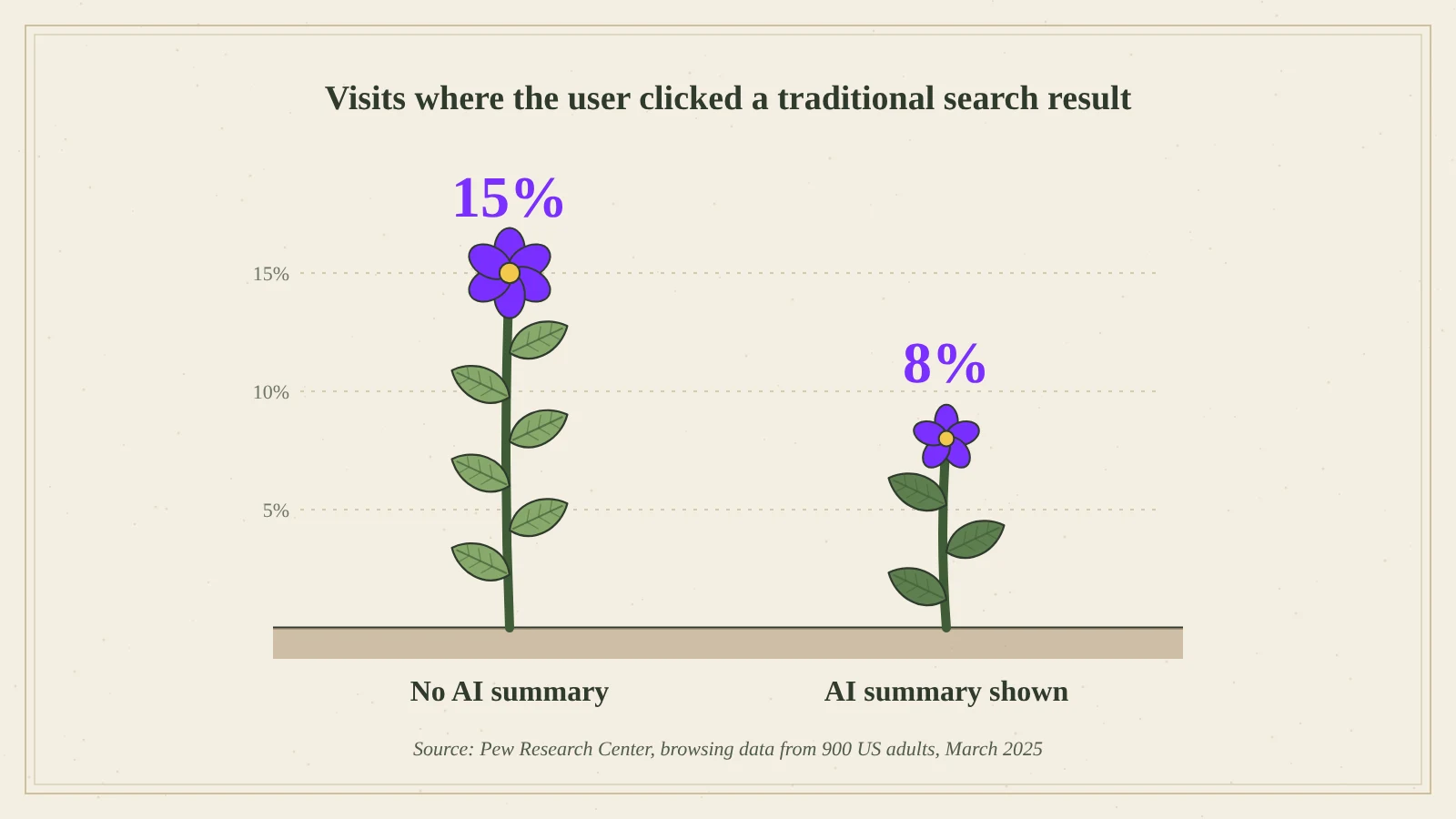
The results page itself is also changing. When Pew Research Center tracked the Google searches of 900 US adults in March 2025, users clicked a traditional result on 8% of visits when an AI summary appeared, compared with 15% when it did not. Ahrefs found that an AI Overview now correlates with a 58% lower click-through rate for the top-ranking page, based on December 2025 data. A strategy that only counts traffic will misread what is happening. One that targets the right queries and measures leads, sales and brand visibility will not.
Finally, SEO takes time, which makes direction more valuable. Google’s own guidance on hiring an SEO says that in most cases it takes four months to a year to implement improvements and then see the benefit. Months spent on the wrong priorities are hard to win back.
The four building blocks of an SEO strategy
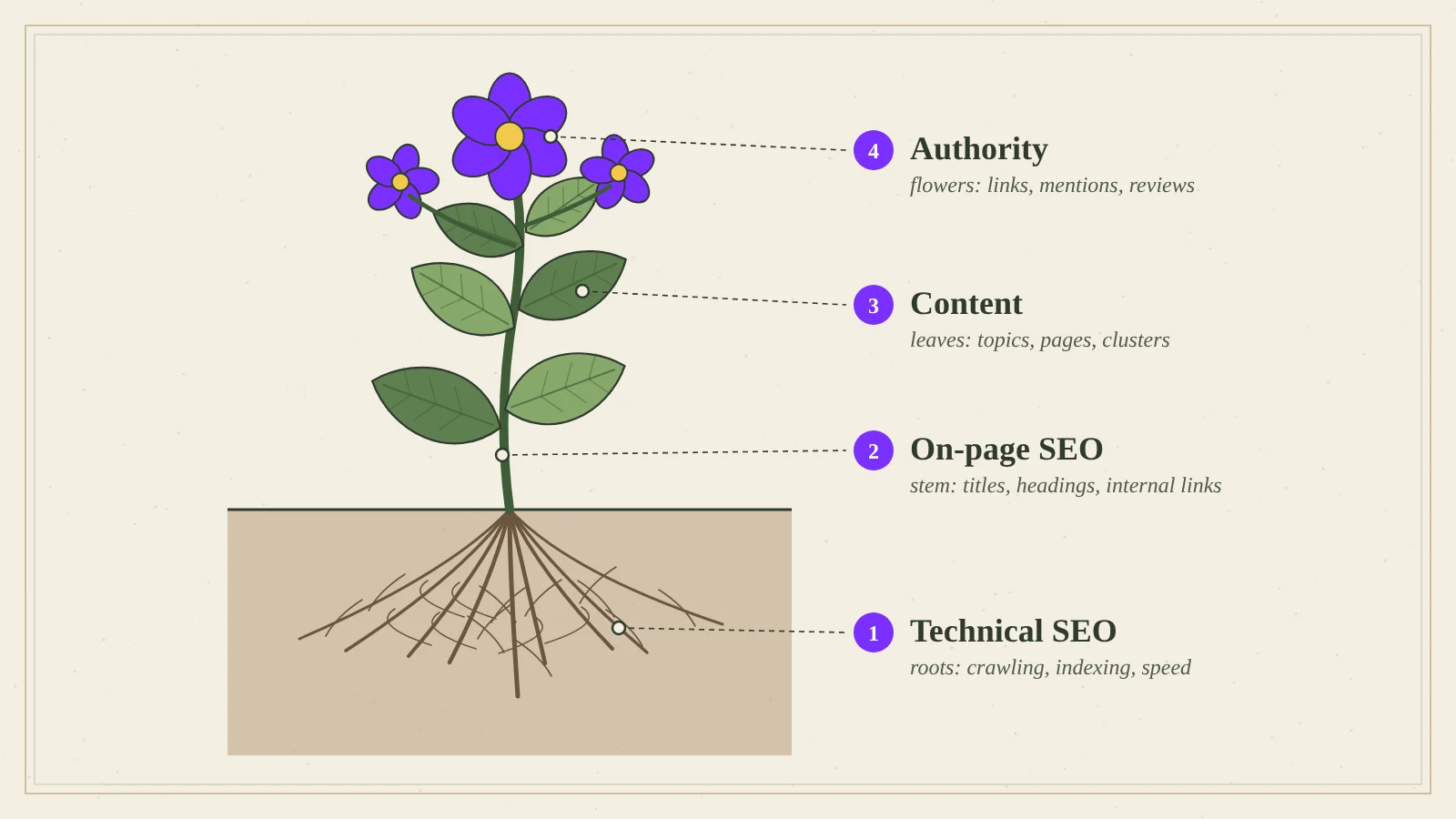
Every SEO strategy balances four areas of work. The mix changes from site to site, but leaving one out usually caps what the other three can achieve.
| Building block | What it covers | The strategic question |
|---|---|---|
| Technical SEO | Crawling, indexing, site structure, speed, mobile experience, structured data, redirects | Can search engines and AI crawlers find, read and trust every important page? |
| On-page SEO | Title tags, headings, meta descriptions, internal links, how each page answers its query | Does each page clearly match one search intent better than the alternatives? |
| Content | The topics you cover, the formats you use, how pages are grouped and kept up to date | Which topics will bring the right people, and where can we be genuinely more useful? |
| Authority | Backlinks, brand mentions, reviews, digital PR and visible expertise | Why should search engines and AI tools trust this site over its competitors? |
Authority overlaps heavily with E-E-A-T, the experience, expertise, authoritativeness and trust that Google’s quality raters look for. It is built partly on your own site, through author pages, evidence and accurate information, and partly off it, through what others say about you. Businesses that serve customers in a particular area add a fifth block, local SEO, which covers Google Business Profile, reviews and consistent contact details across directories.
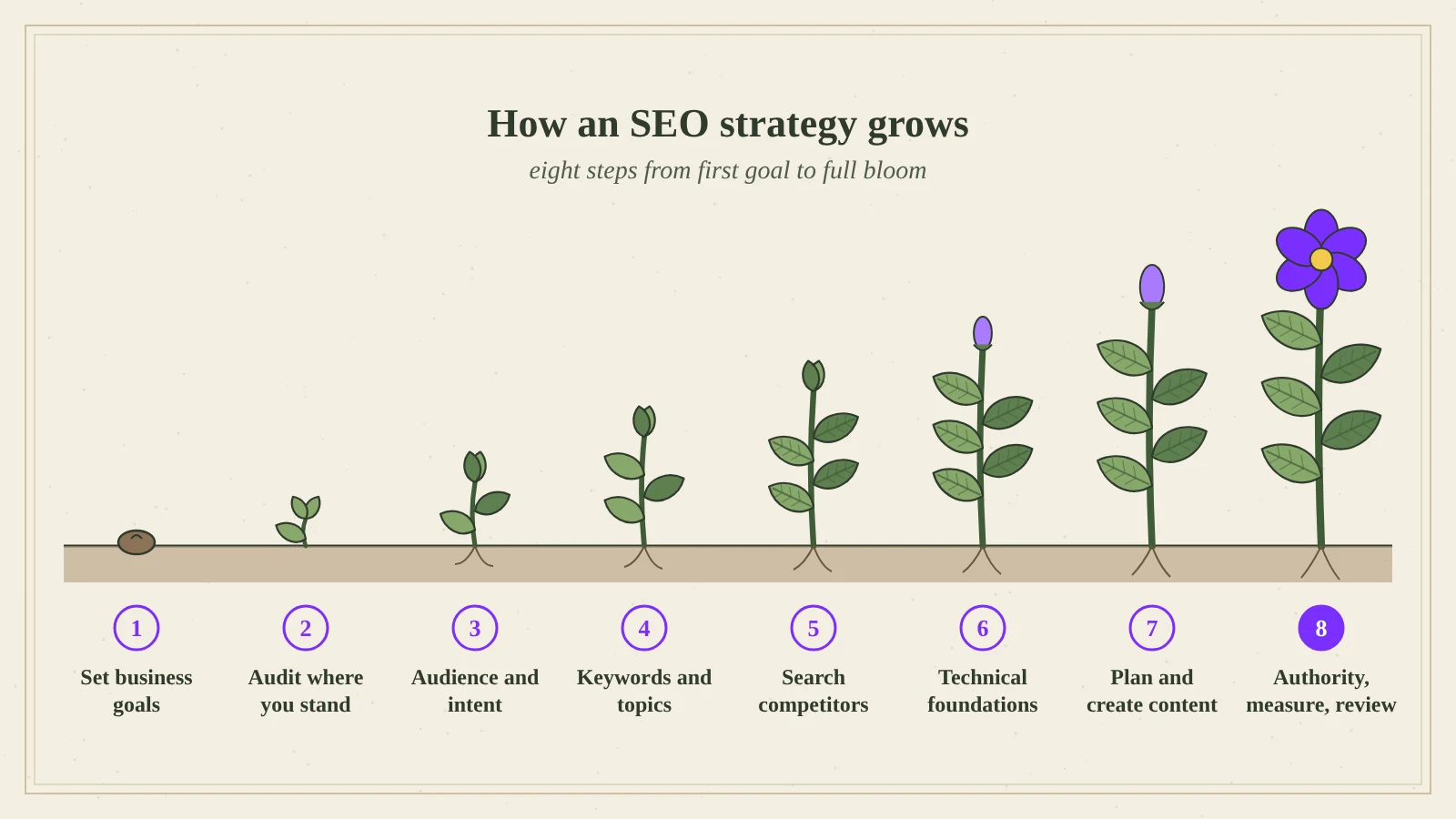
How to build an SEO strategy in 8 steps
The steps below work for a new site and an established one. The difference is how much time each step takes: an older site spends longer on the audit, a new one on research and authority.
1. Set business goals for search
Start with what the business needs, then decide what search can contribute. “Rank higher” is not a goal. “Increase enquiries from organic search for our commercial cleaning service by 30% within twelve months” is. The goal should name the service or product, the outcome and a time frame, because each of those changes which keywords and pages you prioritise.
Check the goal against your margins and capacity. Doubling enquiries for a low-margin service you can barely staff is a poor use of a year’s SEO effort.
2. Audit where you stand
Before planning new work, find out what already exists and what is holding it back. A useful SEO audit covers three things:
- Performance. Which pages and queries already bring clicks, impressions and conversions. The Performance report in Google Search Console is the best free starting point.
- Technical health. Pages that are not indexed, broken links, redirect chains, slow templates and accidental blocks in robots.txt.
- Content inventory. Which pages are useful, which are outdated and which compete with each other for the same query.
If you are reviewing every channel at once, a broader digital marketing audit puts the SEO findings in context alongside paid media, social and email.
3. Understand your audience and their search intent
Map the questions your customers ask at each stage of a purchase. Sales calls, support tickets, reviews and forums such as Reddit are richer sources than any keyword tool, because they show the language people actually use.
Then group those questions by intent. Someone searching “what is a commercial lease” wants an explanation. Someone searching “commercial lease solicitor Leeds” wants to hire someone. The two need different pages, and only the second is likely to convert straight away.
4. Research keywords and map them to topics
Keyword research turns those questions into searchable terms with data attached: monthly volume, keyword difficulty and what currently ranks. For each important term, look at the results page itself. If the top results are all product pages, a blog post will struggle. If they are guides, a sales page will.
Group related keywords into topics, assign each topic one primary page and note which supporting pages it needs. Mapping keywords to pages early prevents keyword cannibalisation, where several of your own pages compete for the same query and none ranks well. Newer sites usually get faster results from specific long-tail keywords than from broad, competitive terms.
5. Analyse your search competitors
Your search competitors are whoever ranks for your priority topics, which may include publishers, directories and marketplaces as well as rival businesses. For each topic, note what the leading pages cover, how they are structured, how recent they are and how much authority their sites carry.
The aim is to find gaps you can fill, not pages to copy: questions nobody answers well, outdated advice, missing UK detail or a format that suits the topic better. That gap becomes the reason your page deserves to rank.
6. Fix the technical foundations
Technical work rarely wins rankings on its own, but problems here can cancel out everything else. Prioritise issues by the number of important pages they affect:
- Important pages that are not indexed, or are blocked by robots.txt, noindex tags or a CDN rule.
- A site structure where key pages are buried more than three or four clicks from the homepage.
- Slow, unstable pages on mobile, measured through Core Web Vitals.
- Duplicate versions of the same page without clear canonical tags.
- Missing or inaccurate structured data on products, articles, FAQs and the organisation itself.
7. Plan, create and improve content
With the topic map in place, decide what to create, what to update and what to merge or remove. Updating a page that already ranks on page two is often faster than publishing a new one. Each piece of content needs a clear target query, a reason to exist that competitors lack and a place in your internal linking.
Google describes the standard it rewards as helpful, reliable, people-first content: written to serve a reader rather than to rank, showing first-hand expertise and leaving the reader feeling they have what they came for. The next section explains how to organise that content into topic clusters.
8. Build authority, then measure and review
Authority comes from being worth citing. Original data, expert commentary, useful tools and strong customer reviews earn links and mentions that paid link schemes cannot match, and Google’s spam policies treat bought links as a violation in any case. Digital PR, partnerships, industry associations and speaking at events are the usual routes for smaller businesses.
Set a review rhythm from the start: rankings and technical alerts weekly or monthly, content and conversions quarterly, the strategy itself once a year or after a major algorithm or market change. A strategy that is never compared with results slowly drifts away from them.
Content SEO strategy: topic clusters and pillar pages
A content SEO strategy decides which topics your site will cover and how those pages fit together. The most widely used model is the topic cluster: one broad pillar page covers a subject from end to end, and a group of narrower cluster pages each answer one specific question in depth. Every cluster page links to the pillar, and the pillar links back out to each cluster.
The structure helps in three ways. Search engines can see the full scope of what you know about a subject, which builds topical authority. Readers can move from an overview to the detail they need. And each page has one clear job, which keeps your own pages from competing with each other.
Clusters also give you a way to cover search terms at scale without creating thin pages. Wise is a well-known example: its currency converter has a dedicated page for each currency pair, such as pounds to euros, and each one answers that exact search with a live rate, a calculator and a route into sending money. The pages work because every one of them gives a searcher something useful, not because there are many of them.
To plan your own clusters:
- Choose three to five core topics that match your services and your audience’s biggest questions.
- For each topic, define one pillar page that targets the broad term.
- List the specific questions, comparisons and how-to searches that sit beneath it. Each one that deserves more than a paragraph becomes a cluster page.
- Publish the pillar first, then add cluster pages and link each one back to it with descriptive anchor text.
- Review the cluster every six to twelve months, updating facts and adding pages where new questions appear.
SEO strategy and AI search
AI Overviews, AI Mode, ChatGPT and Perplexity now answer many questions before anyone clicks a link. That changes what a strategy should aim for, but much less than it might seem.
Google’s guidance on AI features and your website says there are no additional requirements for appearing in AI Overviews or AI Mode. A page needs to be indexed and eligible to appear in Search with a snippet, and the usual SEO best practices still apply. The same guidance notes that these features may use query fan-out, running several related searches across subtopics to build one answer. Sites that cover a topic thoroughly, through a pillar and its clusters, give those searches more to draw on.
What does change is the shape of success. Simple informational queries bring fewer clicks, so a strategy should:
- Weight commercial and complex queries. Comparisons, pricing, local and decision-stage searches still send visitors who are ready to act.
- Write answers that can be quoted. A clear answer straight after each question heading, followed by detail, works for featured snippets, AI summaries and human readers.
- Invest in brand signals. AI tools mention brands that the wider web describes consistently, so reviews, press coverage and accurate directory listings matter more than before.
- Measure visibility as well as visits. Track impressions, AI referral traffic and how often your brand appears in answers to your most important prompts.
Our guide to generative engine optimisation covers the AI side in depth, and the comparison of GEO, SEO and AEO explains how to prioritise all three. Search also happens beyond Google and AI assistants: younger audiences in particular look for products and advice on TikTok, Instagram and YouTube, which social media SEO addresses.
SEO strategy example
Here is how the eight steps might come together for a hypothetical business: a Leeds company that sells refurbished office furniture to small and medium-sized businesses across the UK, with an online shop and a team that plans office fit-outs.
- Goal. Grow organic revenue from online orders by 40% and double fit-out enquiries from organic search within twelve months.
- Audit findings. About 300 discontinued product pages are still live and indexed, category pages carry only a heading and a product grid and almost all organic traffic comes from brand searches.
- Audience and intent. Office managers comparing prices (“refurbished office chairs”), finance directors asking about value (“is refurbished office furniture worth it”) and growing teams planning a move (“how to plan an office fit-out”).
- Topic clusters. Three pillars: refurbished office furniture, office fit-out planning and sustainable offices. Each has six to ten cluster pages, from buying guides to a fit-out cost breakdown.
- Technical priorities. Redirect discontinued products to their closest category, add product and organisation structured data and fix slow image loading on category pages.
- Authority. Publish an annual survey on office furniture waste in the UK and pitch it to trade and business press, and ask fit-out clients for reviews and case studies.
- Measures. Organic revenue, fit-out enquiries from organic search, non-brand clicks in Search Console and brand mentions in AI answers to ten priority prompts, reviewed monthly.
Notice what the example leaves out. There is no plan to rank for “office furniture”, a broad term dominated by large retailers. The strategy picks fights the business can win and ties each one to revenue.
A one-page SEO strategy template
A strategy that fits on one page is easier to share with colleagues and easier to keep. Copy the structure below and fill in each row.
| Section | What to write | Example entry |
|---|---|---|
| Business goal | The outcome, the number and the date | Double fit-out enquiries from organic search by next October |
| Audience | The two or three segments that matter most and what they need | Office managers at firms with 20 to 200 staff, planning a move or expansion |
| Priority topics | Three to five pillar topics, each with its main keyword | Office fit-out planning (“office fit out”) |
| Current position | The main findings from the audit | Strong brand searches, weak category pages, 300 dead product URLs |
| Technical priorities | The fixes that unblock the most pages | Redirect discontinued products, fix image loading on category templates |
| Content plan | Pages to create, update and merge this quarter | One pillar, four cluster guides, rewrite eight category pages |
| Authority plan | How you will earn links, mentions and reviews | Annual industry survey, review requests after every project |
| KPIs and review | What you will track and when you will review it | Organic enquiries and revenue monthly, full strategy review each quarter |
How to measure an SEO strategy
Measure at three levels: whether search engines can see you, whether people find and choose you and whether that turns into business. Rankings alone sit at the first level and can rise while revenue stays flat.
| Level | KPI | Where to find it |
|---|---|---|
| Visibility | Indexed pages, impressions, average position for priority topics, brand mentions in AI answers | Google Search Console, Bing Webmaster Tools, rank trackers, AI visibility tools or manual prompt checks |
| Engagement | Clicks, click-through rate, non-brand organic sessions, AI referral sessions | Search Console, Google Analytics 4 |
| Business results | Enquiries, sales and revenue from organic search, cost per acquisition compared with paid channels | GA4 conversions, CRM data |
Separate brand from non-brand queries when you report. Growth in people searching your name says more about your marketing as a whole. Growth in non-brand clicks shows the SEO strategy reaching people who did not know you before.
Common SEO strategy mistakes
- Chasing volume over intent. A keyword with 10,000 searches and the wrong intent will bring less business than one with 200 searches from buyers.
- Publishing at scale without a reason. Google’s March 2024 core update and new spam policies targeted scaled, unoriginal content, and Google reported 45% less low-quality, unoriginal content in results once it had rolled out. Mass-produced pages, whether written by people or AI, are a risk rather than a shortcut.
- Ignoring existing pages. Updating, merging and redirecting what you already have is often the quickest win, especially on older sites.
- Buying links. Paid links that pass ranking value break Google’s spam policies, and the risk lasts long after the budget is spent.
- Reporting rankings instead of results. Leadership cares about enquiries and revenue. A report that stops at positions makes SEO easy to cut.
- Treating SEO as a one-off project. Competitors publish, algorithms change and content ages. A strategy needs owners, a budget and a review rhythm.
Frequently asked questions
What is an SEO strategy?
An SEO strategy is a long-term plan for growing a business through organic search. It sets the goals, target audience, priority topics, technical fixes, content and authority work that will improve visibility, along with the KPIs used to measure progress.
What should an SEO strategy include?
It should include a business goal for search, an audit of current performance, audience and search intent research, a keyword and topic map, competitor analysis, technical priorities, a content plan, an authority plan and a set of KPIs with a regular review.
How long does an SEO strategy take to work?
Google’s guidance on hiring an SEO says it usually takes four months to a year to implement improvements and see the benefit. Technical fixes can show results sooner, while new content and authority on competitive topics take longer.
What is the difference between an SEO strategy and a content strategy?
A content strategy covers all the content a business produces and why. An SEO strategy covers everything that affects organic search, including content, technical health and authority. The content SEO strategy is where the two overlap.
Is SEO still worth it with AI search?
Yes. Google says its AI Overviews and AI Mode have no extra requirements beyond being indexed and following SEO best practices, so strong SEO is the foundation for AI visibility. What changes is measurement: fewer clicks on simple questions, more weight on commercial queries and brand mentions.
Build an SEO strategy that grows your business
Kutola helps businesses build SEO strategies that start from commercial goals, from the audit and topic map to technical priorities, content and visibility in AI search. Get in touch to find out where search could take your business next.