
E-E-A-T stands for experience, expertise, authoritativeness and trust. It is the framework Google uses to describe credible, reliable content, and it comes from the guidelines that Google’s human search quality raters follow when they assess search results. E-E-A-T is not a score or a single ranking factor, but Google’s ranking systems look for a mix of signals that point to content with strong E-E-A-T, and the same qualities shape which sources AI search tools choose to cite.
This guide explains what each part of E-E-A-T means, how Google actually uses it, why it carries more weight on some topics than others and the practical steps that help you show it on your own website. It also covers how E-E-A-T connects to AI search, a theme we explore further in our guide to generative engine optimisation.
What is E-E-A-T?
E-E-A-T is a set of four qualities that Google asks its raters to look for when they judge whether a page is useful and can be relied on. The concept is set out in Google’s Search Quality Rater Guidelines, a public handbook that ran to 182 pages in its September 2025 edition.
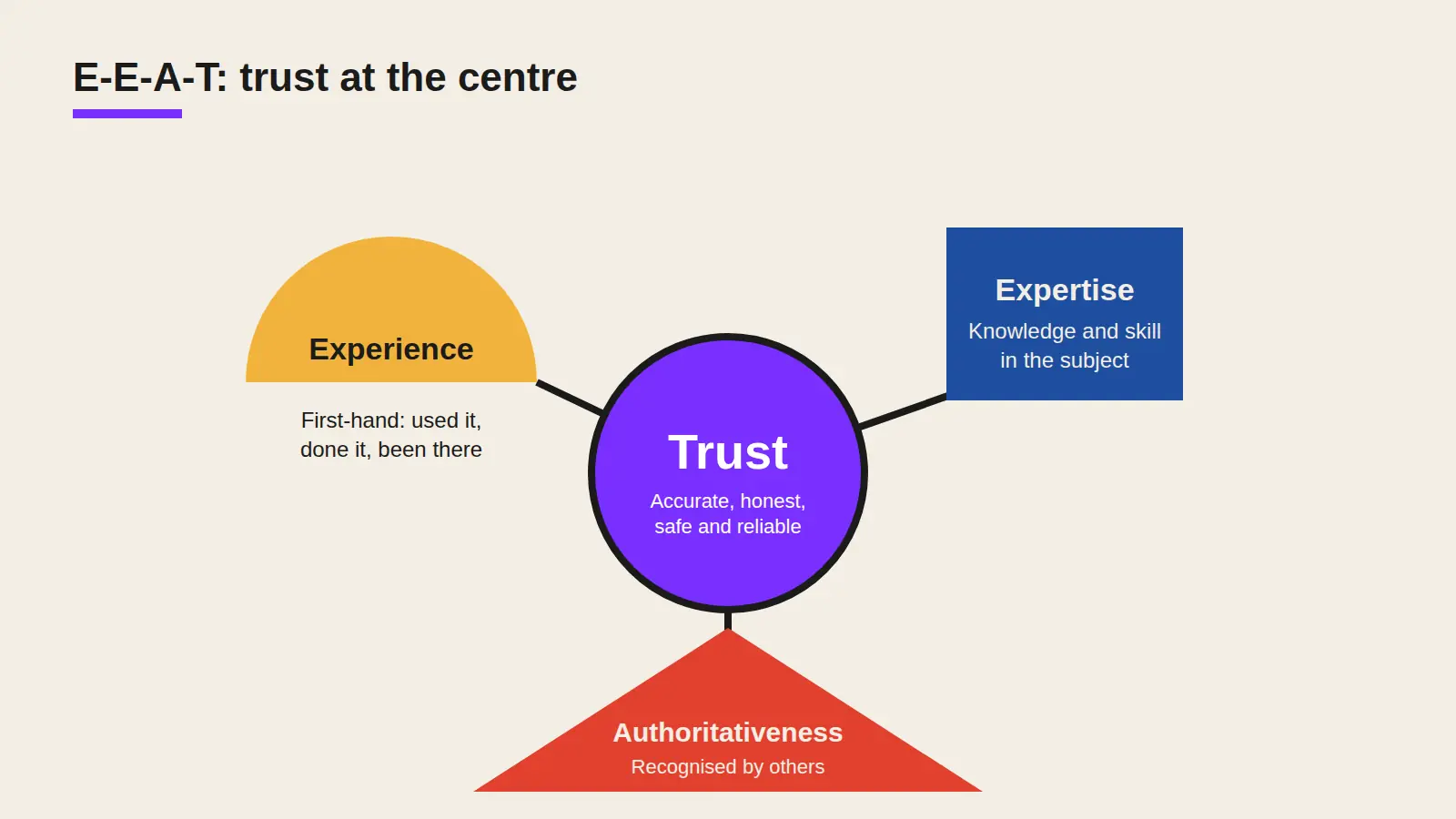
The framework was originally called E-A-T. In December 2022, Google added a second E for experience, so that first-hand knowledge of a topic counts alongside formal expertise. Google’s overview of the guidelines describes the four elements like this:
| Element | What raters consider | Examples of how it shows |
|---|---|---|
| Experience | The first-hand experience of the creator | Original photos from testing a product, a case study with real results, a review written after an actual stay |
| Expertise | The expertise of the creator | Relevant qualifications, years of practice, accurate and detailed explanations |
| Authoritativeness | The authoritativeness of the creator, the main content itself and the website | Mentions and links from respected sites, citations in the press, recognition within an industry |
| Trust | The extent to which the page is accurate, honest, safe and reliable | Clear ownership and contact details, cited sources, secure payments, honest claims |
Trust sits at the centre. In its guidance on creating helpful, reliable content, Google says that “of these aspects, trust is most important. The others contribute to trust, but content doesn’t necessarily have to demonstrate all of them.” The rater guidelines put it more bluntly: untrustworthy pages have low E-E-A-T “no matter how Experienced, Expert, or Authoritative they may seem.”
Is E-E-A-T a ranking factor?
Not directly. Google states that “while E-E-A-T itself isn’t a specific ranking factor, using a mix of factors that can identify content with good E-E-A-T is useful.” There is no E-E-A-T score attached to your website, and Google does not publish the full list of signals its systems use to judge it.
The quality raters do not decide rankings either. Google works with around 16,000 external raters worldwide, and it says that no single rating or rater directly affects how a page ranks. Their aggregated ratings are used to measure how well Google’s systems are working and to give those systems positive and negative examples of search results.
The practical reading is simple. E-E-A-T describes the kind of content Google’s systems are built to reward. When raters consistently judge trustworthy, experienced sources as better results, Google tunes its systems to surface more of them. Working on E-E-A-T is therefore less about a single tactic and more about making the qualities Google looks for visible on the page and across the web.
E-E-A-T and YMYL topics
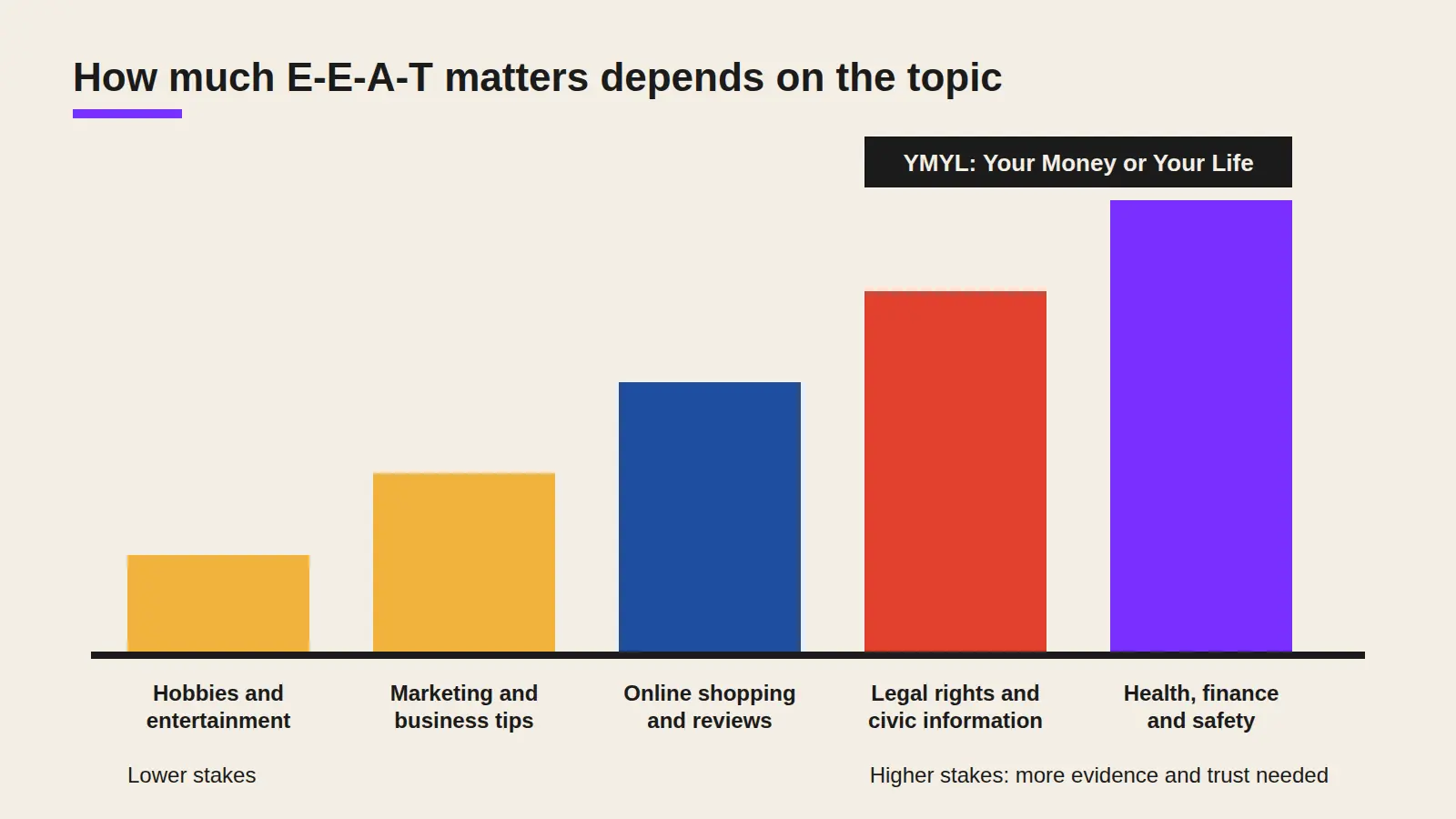
E-E-A-T matters on every topic, but it carries the most weight on YMYL pages. YMYL stands for “Your Money or Your Life”. Google defines these as topics that “could significantly impact the health, financial stability, or safety of people, or the welfare or well-being of society”, and says its systems “give even more weight to content that aligns with strong E-E-A-T” for them.
For a UK business, typical YMYL content includes pages about medical symptoms or treatments, mortgages, pensions and tax, legal rights, product safety and anything a shopper relies on before handing over payment details. Raters are told to apply very high quality standards to these pages, because poor information can cause real harm.
The category also keeps widening. The September 2025 update to the rater guidelines renamed the society category to “Government, Civics & Society” and added election and voting information to it explicitly.
Experience vs expertise: what’s the difference?
Expertise is knowledge or skill in a subject, often backed by training, qualifications or years of practice. Experience is having done the thing yourself: used the product, visited the place, run the campaign or lived through the situation. The two often overlap, but they answer different questions a reader has.
Take a page about choosing running shoes. A sports physiotherapist brings expertise in gait and injury risk. A runner who has worn the same pair for 500 miles brings experience of how the cushioning holds up. Both are useful, and the strongest content combines them.
Google’s guidance on writing high quality reviews shows how experience can be demonstrated: “Provide evidence such as visuals, audio, or other links of your own experience with what you are reviewing, to support your expertise and reinforce the authenticity of your review.”
On YMYL topics, experience rarely replaces expertise. A personal account of living with a health condition can be valuable for readers looking for support, but advice on treatment needs to come from, or be reviewed by, a qualified professional.
How to show E-E-A-T on your website
E-E-A-T cannot be added with a plugin. It is the sum of what your pages show and what others say about you. These seven steps cover the signals that matter most.
1. Make it clear who created the content
Google’s helpful content guidance asks: “Is it self-evident to your visitors who authored your content? Do pages carry a byline, where one might be expected? Do bylines lead to further information about the author?” Give each article a named author, link the byline to an author page and use that page to explain the person’s background, experience and other work.
Support this with structured data. Google’s Article markup guidelines recommend marking up every author shown on the page, using the Person type for individuals and adding a url or sameAs property that points to a page identifying them, such as an author profile.
2. Show first-hand experience
Use your own photos, screenshots, data and examples rather than stock images and generic statements. Explain what you tested, how long for and what happened. A case study with real numbers says more about experience than any claim of being “experts in the field”.
3. Back up your claims
Link statistics, quotes and factual claims to their original source, such as research papers, official documentation or government data. Readers can check your work, and it signals that the content was researched rather than assumed. Where advice depends on a date or a rule change, say when it applies.
4. Make your business easy to verify
Trust starts with knowing who is behind a website. A clear About page, a real contact page and visible business details all help. In the UK, limited companies are already required to show their registered number, registered office address and the part of the UK in which they are registered on their websites. Clear returns, delivery and privacy policies and secure payment matter most where money changes hands.
5. Build your reputation beyond your own site
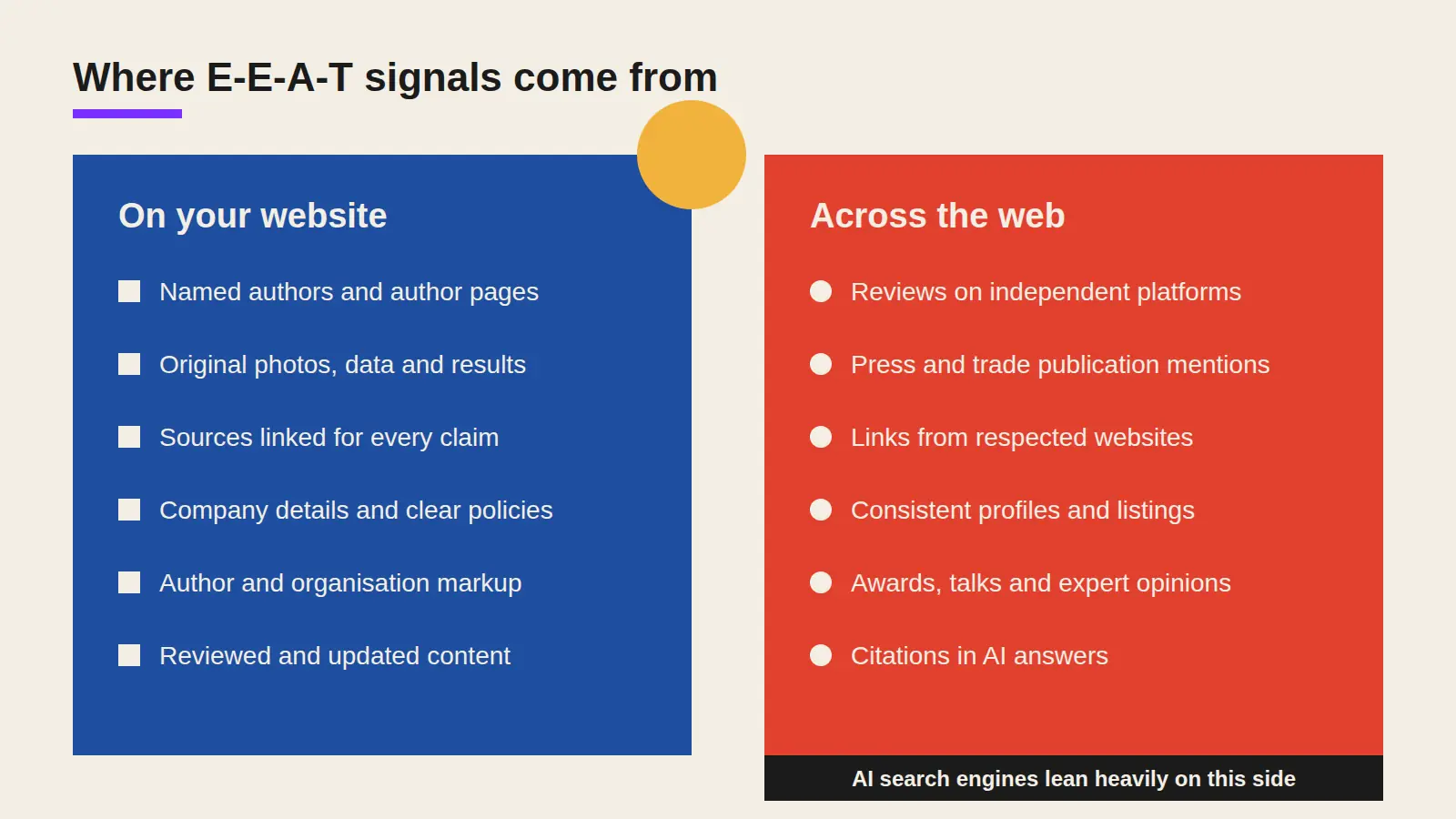
Raters are asked to look past your own claims. Google’s overview of the guidelines states that “a website’s reputation is based on the experience of real users, as well as the opinion of people who are experts in the topic of the website.” Reviews on independent platforms, mentions in trade and national press, awards, speaking slots and backlinks from respected sites all build that picture. Social proof and digital PR do much of this work.
6. Explain how content was produced
Google also asks about the “how” behind content. It notes that “sharing details about the processes involved can help readers understand any unique and useful role automation may have served.” If AI tools helped create a page, or a product was tested in a particular way, a short note on the process adds transparency rather than taking it away.
7. Keep content accurate and current
Outdated advice erodes trust quickly, particularly on topics where rules, prices or platform features change. Review important pages on a schedule, correct errors openly and show an updated date where readers would expect one. Thin or duplicated pages that no longer serve readers are better improved, merged or removed.
E-E-A-T and AI search
The same qualities that help in Google search also shape visibility in AI Overviews, AI Mode and AI assistants. Google’s guidance on AI search says that “optimizing for generative AI search is optimizing for the search experience, and thus still SEO”, and that its AI features rely on the core ranking and quality systems. It specifically recommends “unique expert or experienced takes that go beyond common knowledge.”
Outside Google, the off-site side of E-E-A-T appears to matter even more. A 2025 study of AI search engines found they show “a systematic and overwhelming bias towards Earned media (third-party, authoritative sources) over Brand-owned and Social content”, while Google’s traditional results drew on a more balanced mix. In practice, what reputable sites say about your brand can influence AI answers as much as what your own pages say.
Consistency also helps. AI systems connect content to a recognisable entity, a person or brand they can identify. The same author names, job titles, company details and profile links used everywhere make that connection easier. We cover the shift from ranking pages to building brands in more detail in our comparison of how GEO, SEO and AEO differ in practice.
E-E-A-T checklist
Use these questions to review an important page or a whole section of your site:
- Does every article show a named author, linked to a page about them?
- Does the author page explain relevant experience and expertise, with links to profiles elsewhere?
- Does the content include first-hand evidence, such as original images, data or results?
- Are statistics, quotes and claims linked to their original sources?
- Can visitors easily find who owns the site, how to contact them and the company’s registered details?
- Are policies, prices and terms clear, and is the site served over HTTPS?
- Do independent reviews, press mentions and links from respected sites back up your reputation?
- Is author and organisation structured data in place and accurate?
- Has the page been reviewed recently, with an updated date where it matters?
- Would a reader trust this page enough to act on it, especially if the topic affects their health, money or safety?
Common E-E-A-T mistakes
- Treating the author box as a box to tick. A byline only helps if the person behind it genuinely has relevant experience or expertise and the content reflects it.
- Inventing credentials or reviews. This destroys trust when it is discovered and can break consumer law. Since April 2025, UK law has prohibited fake reviews outright, as covered in our guide to social proof and the law.
- Chasing an E-E-A-T score. Some tools claim to measure E-E-A-T, but Google has no such score. Use them as prompts for review, not as a target.
- Ignoring what happens off your site. Your own pages describe you. Reviews, mentions and links show whether anyone else agrees.
- Hiding how content is made. Readers and search engines both value transparency about who wrote a page and how it was produced.
- Applying the same standard everywhere. A blog post about office culture needs less evidence than a page about pension tax. Put the most effort into the pages with the most at stake.
Frequently asked questions
What does E-E-A-T stand for?
E-E-A-T stands for experience, expertise, authoritativeness and trust. It comes from Google’s Search Quality Rater Guidelines and describes the qualities of credible, reliable content.
Is E-E-A-T a Google ranking factor?
Not directly. Google says E-E-A-T itself isn’t a specific ranking factor, but its systems use a mix of factors to identify content that shows good E-E-A-T, so improving it supports rankings indirectly.
What is the difference between E-A-T and E-E-A-T?
E-A-T covered expertise, authoritativeness and trust. In December 2022 Google added experience, so first-hand knowledge of a topic now counts alongside formal expertise.
Which part of E-E-A-T is most important?
Trust. Google says trust is the most important of the four, and that experience, expertise and authoritativeness all contribute to it.
What is YMYL in SEO?
YMYL stands for “Your Money or Your Life”: topics that could significantly affect people’s health, financial stability, safety or the well-being of society. Google gives even more weight to strong E-E-A-T on these topics.
Does E-E-A-T matter for AI search?
Yes. Google’s AI features rely on the same core ranking and quality systems, and research suggests AI search engines favour authoritative third-party sources, so trust and reputation shape which brands get cited.
Build trust that search engines and AI can see
Kutola helps brands strengthen the signals behind E-E-A-T, from author pages and content quality to the reputation that AI tools draw on. Get in touch to find out how your site looks to search engines and AI today.