
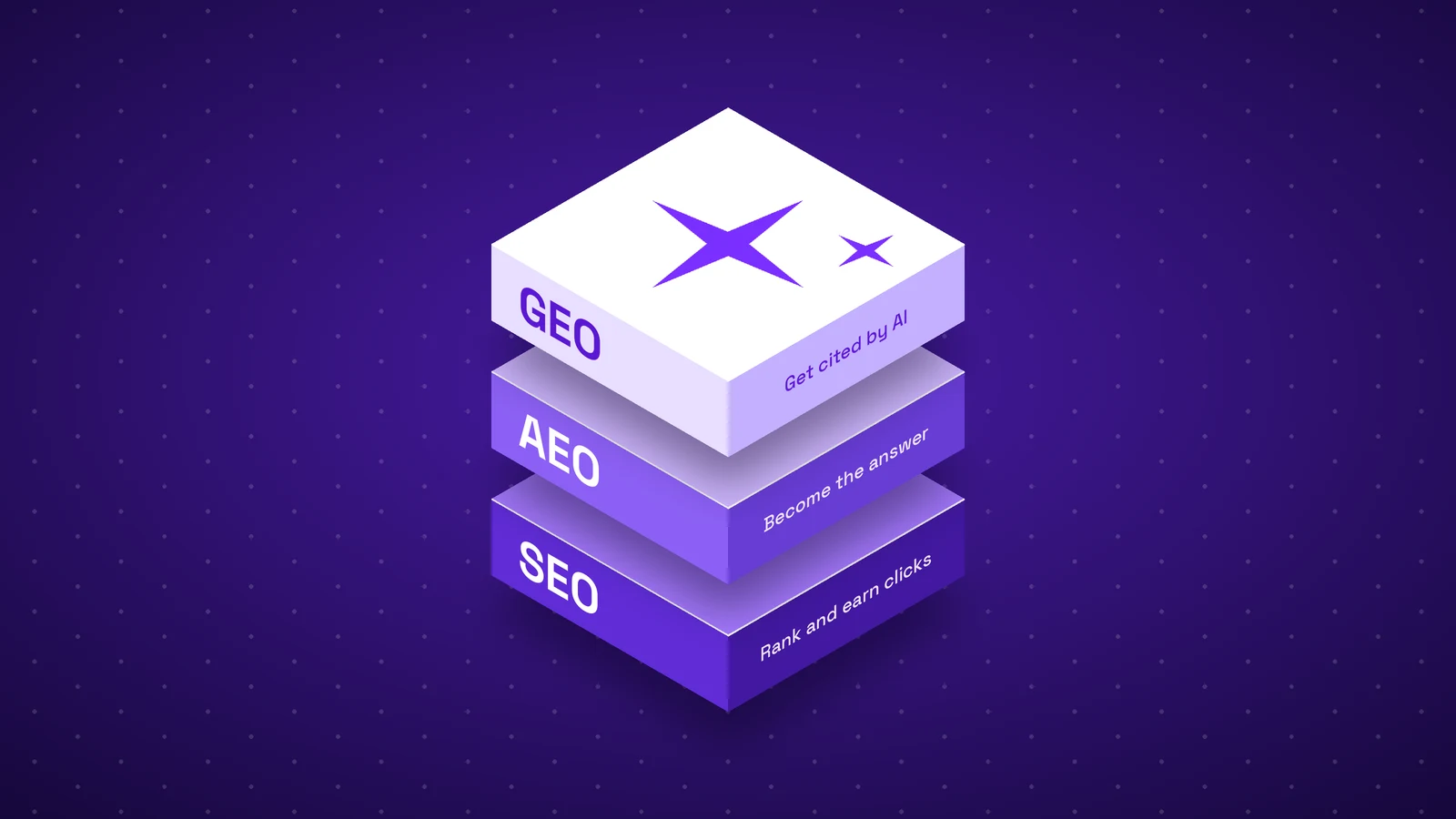
GEO vs SEO is one of the most searched questions in marketing right now, and AEO usually joins the debate soon after. All three describe ways of making a brand visible when people look for answers, but they target different places: search engine results, direct answers and responses written by AI.
This guide explains what search engine optimisation (SEO), answer engine optimisation (AEO) and generative engine optimisation (GEO) mean, how they compare side by side, where they overlap and how to decide where to put your effort. For a full walkthrough of GEO itself, see our generative engine optimisation guide.
GEO vs SEO vs AEO: the short answer
- SEO (search engine optimisation) helps your pages rank in search engine results so people click through to your site.
- AEO (answer engine optimisation) helps your content become the direct answer to a question, in a featured snippet, a voice assistant reply or an AI summary.
- GEO (generative engine optimisation) helps your brand get cited, mentioned and recommended in answers written by AI tools such as ChatGPT, Perplexity, Gemini and Google AI Overviews.
They are layers rather than rivals. SEO is the foundation, AEO shapes content into clear answers, and GEO extends that visibility into AI-generated responses. Most of the work that helps one also helps the others.
What is SEO?
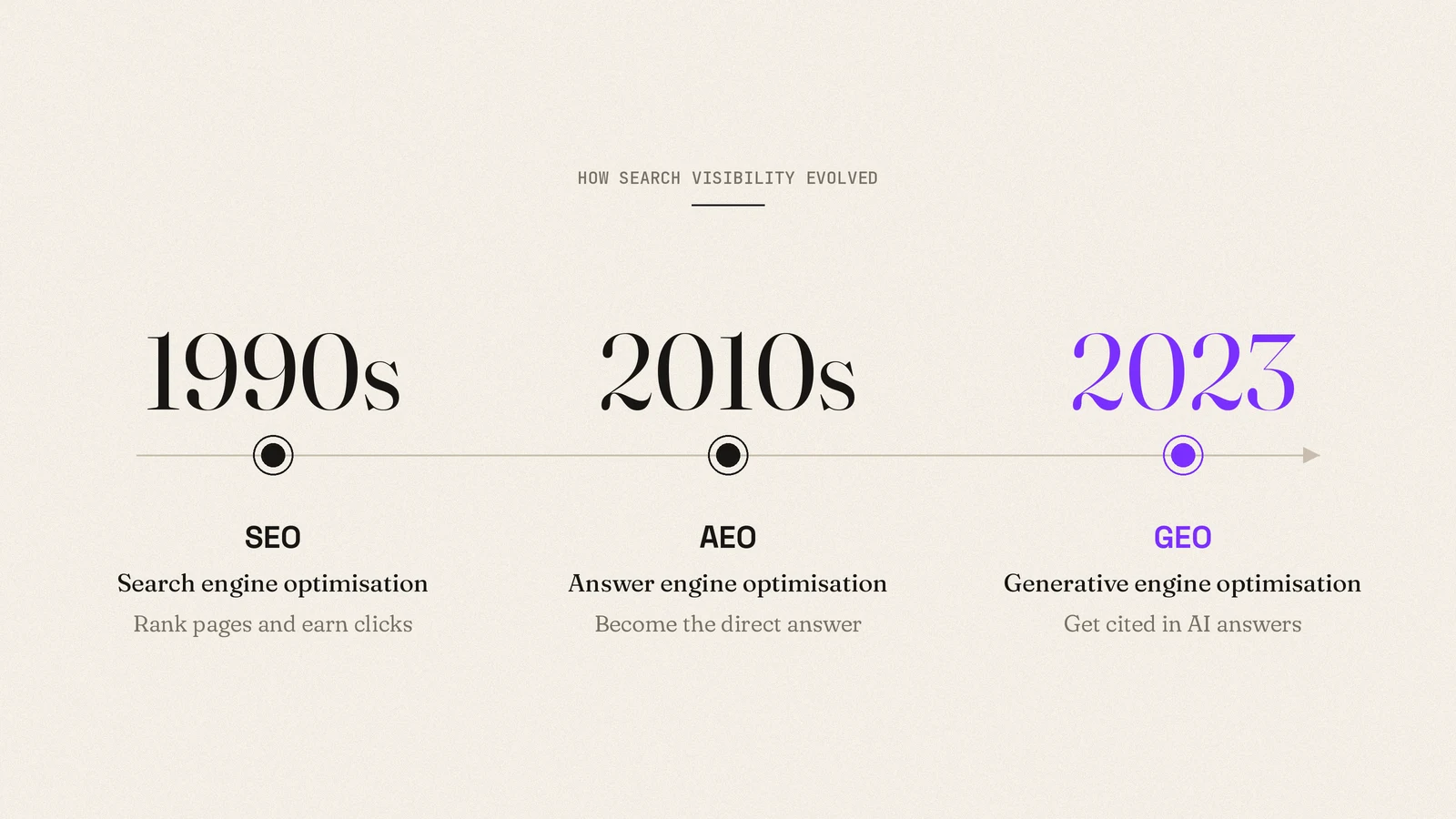
SEO is the practice of improving a website so that it ranks higher in search engines such as Google and Bing for relevant searches. The goal is organic traffic: people see your page on the search engine results page (SERP), click and land on your site.
It rests on three pillars: technical SEO (crawling, indexing and speed), on-page SEO (content, keywords and structure) and off-page SEO (backlinks and reputation). Success is measured in rankings, organic traffic and the conversions that traffic produces.
SEO has been around since the late 1990s and remains the base layer for everything else in this guide. AI search systems, including Google’s own, draw heavily on the same signals that decide rankings.
What is AEO?
AEO stands for answer engine optimisation. It is the practice of structuring content so that search engines and assistants can use it as a direct answer to a question, rather than simply listing your page among other results.
The term gained ground in the late 2010s, when featured snippets, People Also Ask boxes and voice assistants such as Alexa, Siri and Google Assistant began answering questions directly. The aim shifted from ranking a page to becoming the answer. Today the term is also widely used for optimising for AI answers, which is where it starts to overlap with GEO.
In practice, AEO means question-led headings, concise answers placed straight after them, clear definitions, lists and tables, FAQ sections and structured data where it helps. Success is measured by how often your content is chosen as the answer. Many of these answers are zero-click, so AEO is as much about visibility and authority as it is about traffic.
What is GEO?
GEO stands for generative engine optimisation. It is the practice of improving how often and how accurately a brand appears in responses written by generative AI tools, such as ChatGPT, Perplexity, Gemini, Microsoft Copilot and Google’s AI Overviews and AI Mode.
The term comes from a 2023 research paper by researchers at Princeton University and other institutions. It found that adding elements such as citations, quotations and statistics to content could increase its visibility in generative engine responses by up to 40%.
Unlike a search results page, a generative answer blends information from many sources into one response. GEO therefore focuses less on ranking a single page and more on being one of the sources an AI model trusts and draws on. That means clear, well-structured content, original data, consistent brand information across the web and mentions on third-party sites that AI systems read.
Success is measured in citations, brand mentions, the share of relevant prompts where you appear, how accurately you are described and referral traffic from AI tools. We cover the full approach, including an eight-step framework, in our guide to generative engine optimisation.
GEO vs SEO vs AEO compared
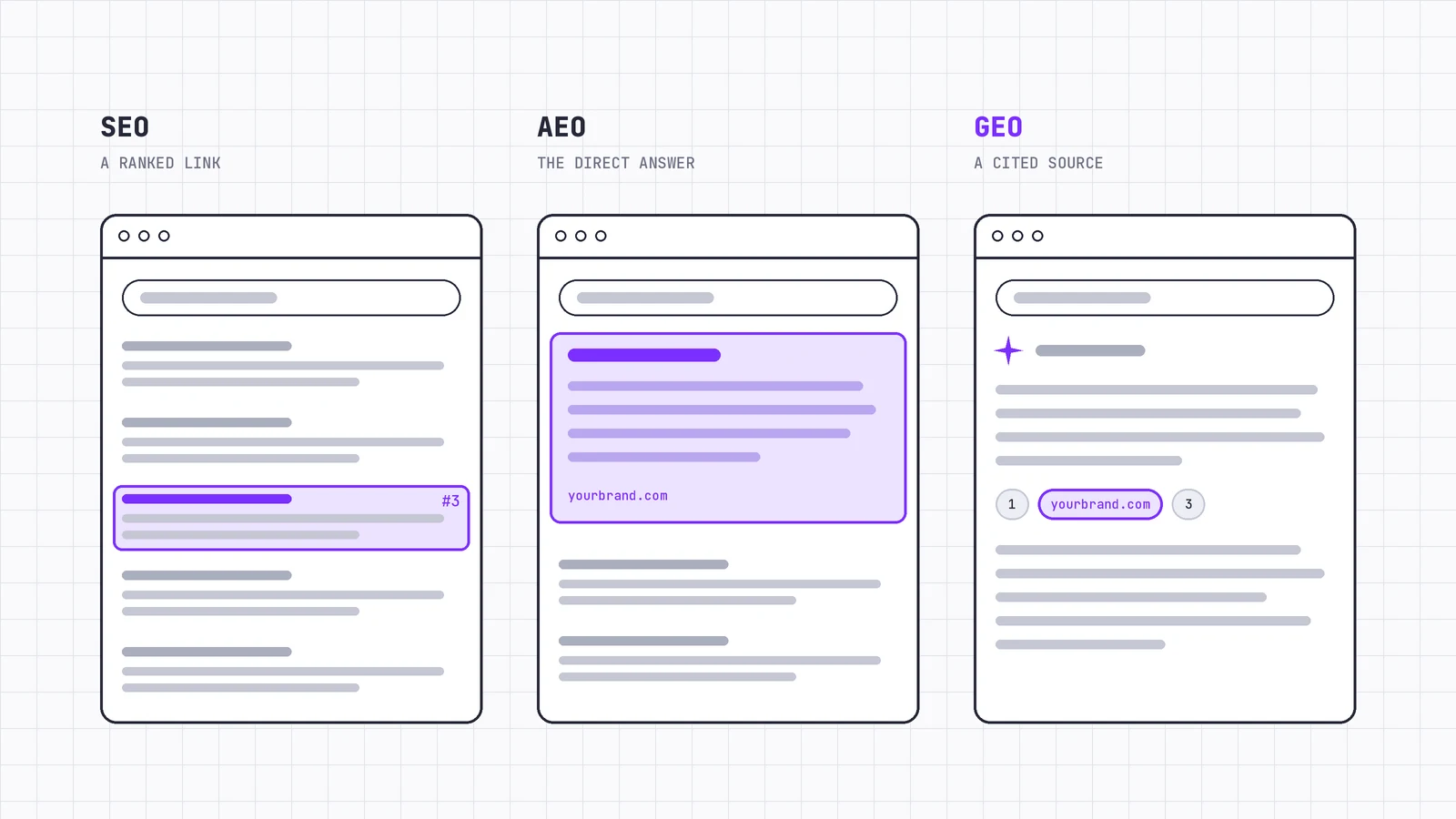
The table below sets the three side by side, in the order they emerged.
| SEO | AEO | GEO | |
|---|---|---|---|
| Stands for | Search engine optimisation | Answer engine optimisation | Generative engine optimisation |
| Emerged | Late 1990s | Late 2010s | 2023 |
| Main goal | Rank pages and earn clicks | Become the direct answer | Get cited and recommended in AI answers |
| Where you appear | Organic search results | Featured snippets, People Also Ask, voice assistants, AI summaries | ChatGPT, Perplexity, Gemini, Copilot, Google AI Overviews and AI Mode |
| Unit of success | A ranking position | A selected answer | A citation or brand mention |
| Key metrics | Rankings, organic traffic, conversions | Snippets won, answer appearances | Citations, share of voice in AI answers, AI referral traffic |
| Core tactics | Technical health, keywords, content, backlinks | Question-led structure, concise answers, FAQs, structured data | Authoritative content, original data, entity clarity, third-party mentions |
| Clicks | Depends on clicks | Often zero-click | Often zero-click; visibility happens inside the answer |
Are GEO and AEO the same thing?
Largely, yes, and the industry has not settled on one name. Both describe optimising for answers rather than rankings, and many practitioners use the terms interchangeably. Some AI visibility platforms prefer AEO, arguing it is clearer and avoids confusion with geography and geo-targeting. Others prefer GEO because it names the technology that changed search.
The useful distinction is one of scope. AEO started with direct answers in traditional search and voice, and its tactics focus on the format of an answer. GEO was born with large language models, and it adds concerns that only matter when an AI writes the response: how models understand your brand as an entity, which sources they trust and how accurately they describe you.
You will also see other names for the same territory:
- AIO: AI optimisation.
- AI SEO or AI search optimisation: a broad label for SEO adapted to AI search.
- LLMO: large language model optimisation.
Whatever the label, the work underneath is largely the same. That is why we cover all of it under SEO and AI search.
Where SEO, AEO and GEO overlap
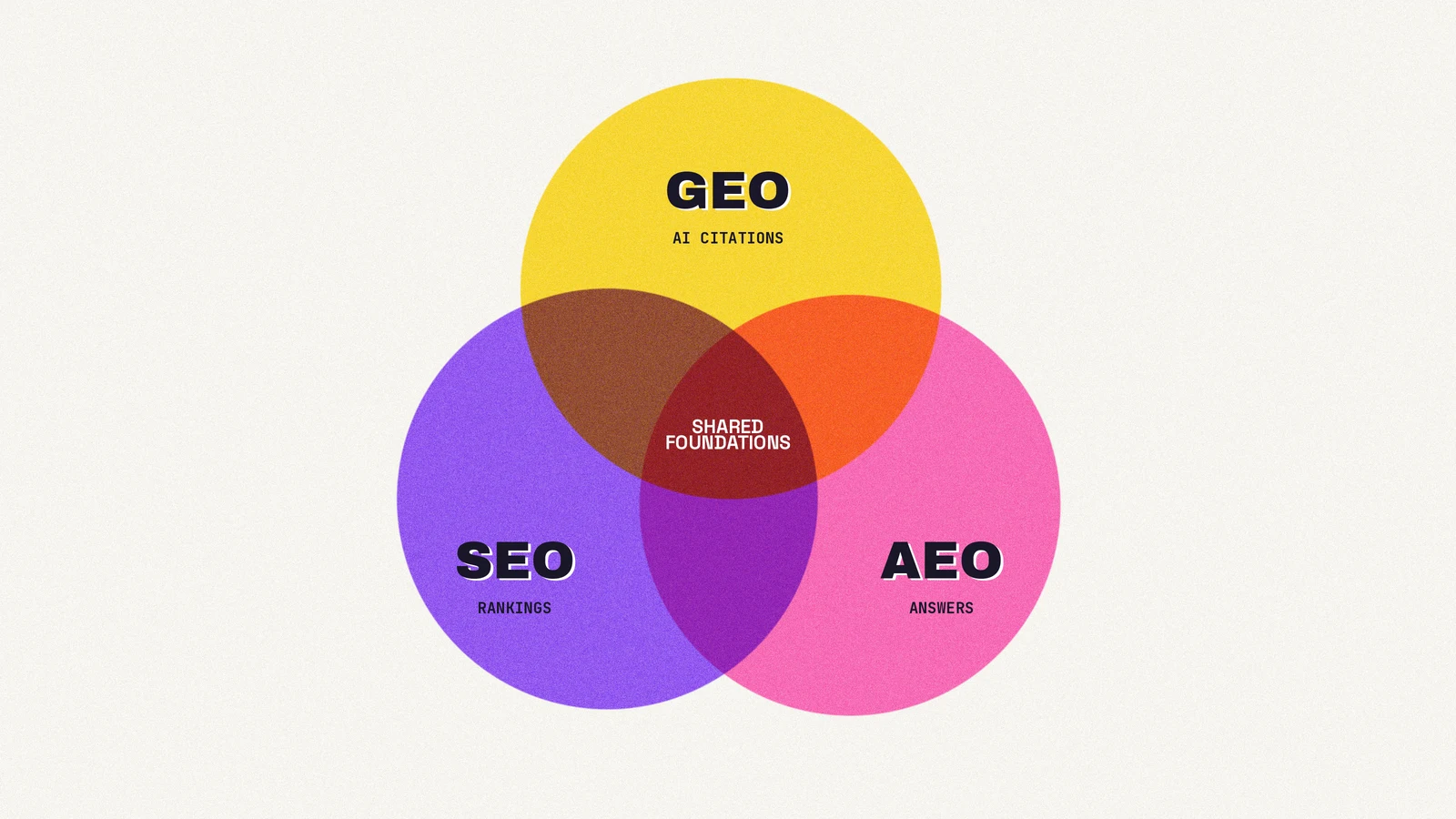
The overlap is bigger than the differences. Google says directly that “optimizing for generative AI search is optimizing for the search experience, and thus still SEO”, and that its AI features are rooted in its core ranking and quality systems.
Google also says you do not need special machine-readable files, such as llms.txt, or any special schema markup to appear in its AI features. That guidance covers Google Search only; other AI tools crawl and cite in their own ways, but they reward the same fundamentals:
- Crawlable, indexable pages. If search engines and AI crawlers cannot access your content, nothing else matters.
- Helpful, original content that demonstrates E-E-A-T: experience, expertise, authoritativeness and trust.
- Clear structure: descriptive headings, short paragraphs, lists and tables.
- Authority built through links, mentions and reviews on trusted sites.
- Consistent information about your brand everywhere it appears.
Where they differ in practice
From clicks to citations
SEO measures success by the click. AEO and GEO often deliver visibility without one: the answer appears on the results page or in the chat window, and the user may never visit your site. That changes how you judge performance. A page that is cited in AI answers every day may show modest traffic but still shape how buyers see your brand.
From pages to brands
SEO ranks individual pages for individual queries. Generative engines answer by combining sources and often mention brands without linking to them. GEO therefore pays more attention to what the wider web says about you, from reviews and forums to industry publications and directories.
From keywords to questions and prompts
Keyword research still matters, but people ask AI tools longer, conversational questions, and many AI search systems expand each one into several related searches behind the scenes, a process known as query fan-out. Content that covers a topic thoroughly, including the obvious follow-up questions, is more likely to be drawn on.
Different measurement
SEO has mature tools: Google Search Console, analytics platforms and rank trackers. AEO can be tracked through SERP feature reports. GEO measurement is still young: you can segment AI referral traffic in GA4, track citations and brand mentions across a set of prompts with AI visibility tools, and test your most important prompts manually.
Does GEO replace SEO?
No. GEO builds on SEO rather than replacing it. AI search systems use search indexes and ranking signals to find their sources, so a site that is weak in SEO is rarely strong in AI answers. What is changing is the shape of the results: fewer clicks for simple informational queries and more weight on brands that are cited and trusted.
How to prioritise SEO, AEO and GEO
- Fix the foundations. Make sure your site is crawlable, fast and indexed, and that AI crawlers are not blocked by accident in robots.txt or at your CDN.
- Build content around real questions. Use the questions your customers ask as headings and answer each one clearly in the first sentence or two beneath it.
- Structure for extraction. Use lists, tables, definitions and FAQ sections, and add schema markup where it accurately describes your content.
- Strengthen authority and entity signals. Keep your brand details consistent, show who is behind the content and earn mentions on trusted third-party sites.
- Add original value. Share data, examples and first-hand experience that AI tools cannot find anywhere else.
- Measure all three together. Track rankings and organic traffic, SERP features and AI citations side by side, so you see the whole picture rather than one channel.
For most businesses the choice is not SEO or GEO. It is SEO as the base, with AEO and GEO practices built into how every page is planned and written.
Frequently asked questions
What is the difference between GEO and SEO?
SEO aims to rank web pages in search engine results and win clicks. GEO aims to get a brand cited, mentioned and recommended in answers generated by AI tools such as ChatGPT, Perplexity and Google AI Overviews. GEO builds on SEO rather than replacing it.
What does AEO stand for?
AEO stands for answer engine optimisation: structuring content so that search engines, voice assistants and AI tools can use it as a direct answer to a question.
Are GEO and AEO the same thing?
Largely. Both focus on answers rather than rankings, and the terms are often used interchangeably. AEO grew out of featured snippets and voice search, while GEO was coined for generative AI and adds concerns such as how AI models understand and describe your brand.
Is SEO still important with AI search?
Yes. AI search systems rely on search indexes and ranking signals to find sources, and Google says that optimising for its AI features is still SEO. Strong SEO is the foundation for both AEO and GEO.
Should I focus on SEO, AEO or GEO first?
Start with SEO foundations, then shape your content into clear answers (AEO), then build the authority, original data and brand mentions that help AI tools cite you (GEO). In practice, the three work best when planned together.
Get found in search and AI answers
Kutola helps brands build visibility across search engines and AI tools, from technical SEO audits to GEO strategy. Get in touch to see where your brand stands today.