How loss aversion shapes what your customers buy
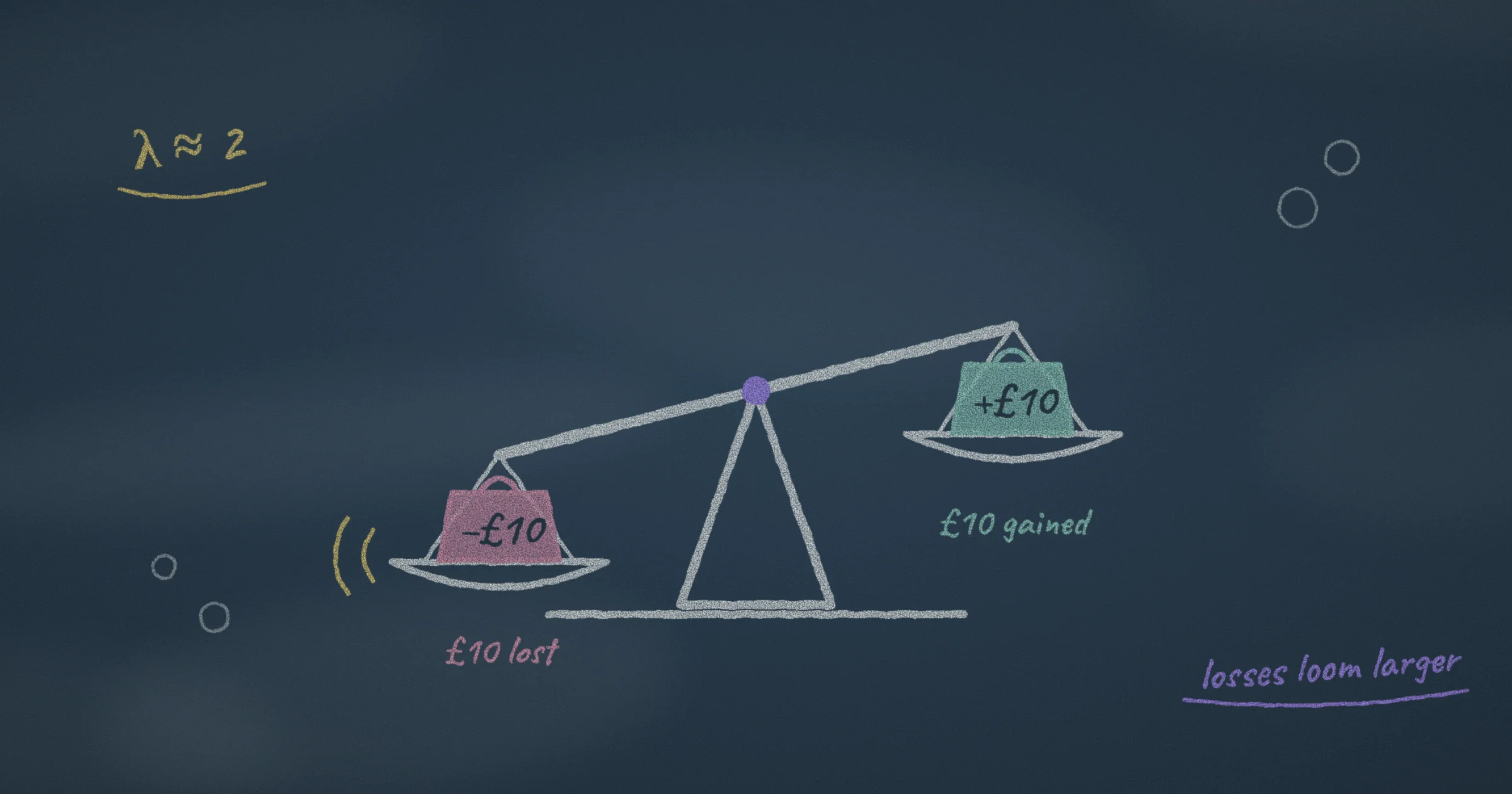
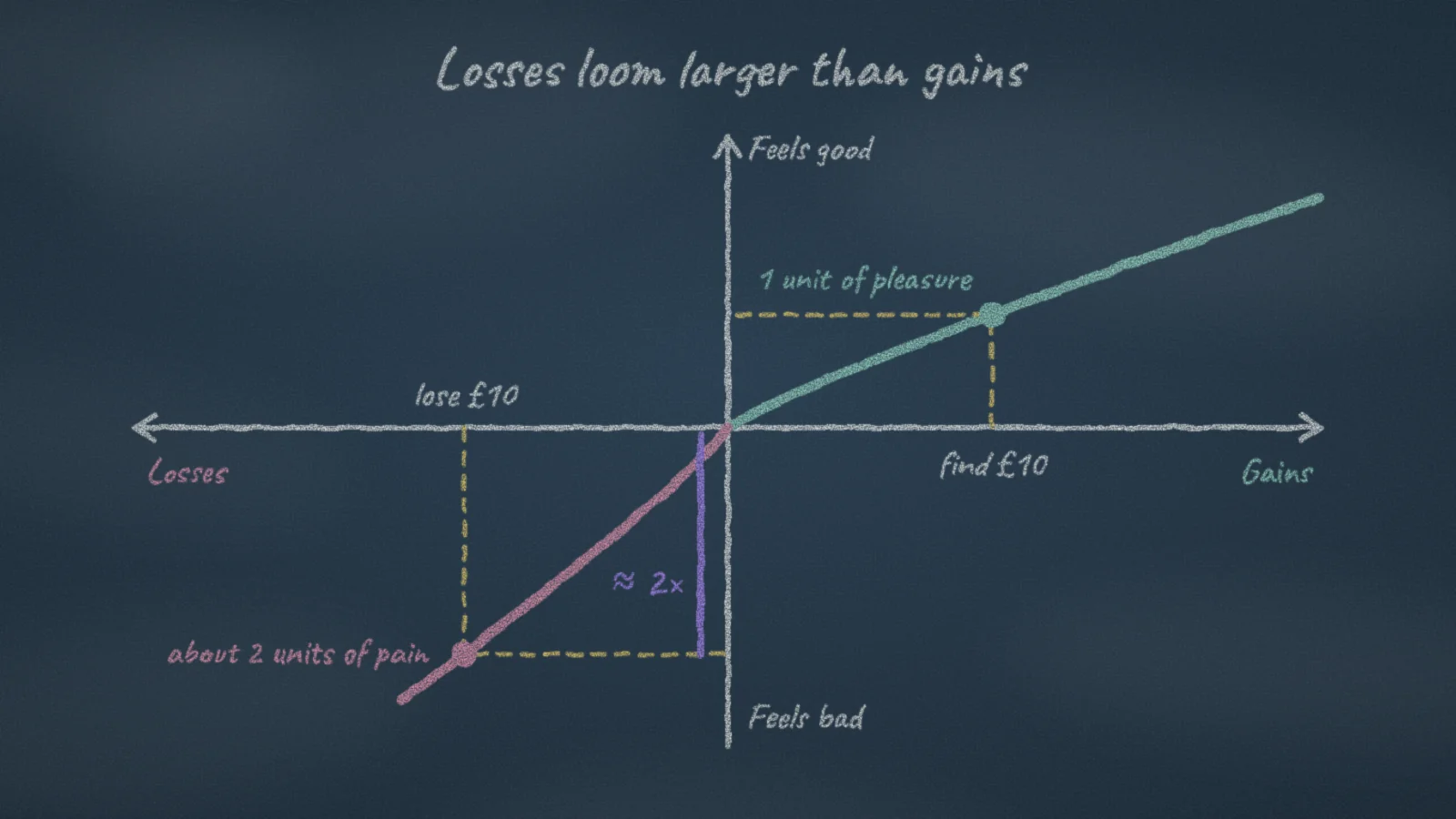
Loss aversion is the tendency to feel a loss more strongly than a gain of the same size. Losing £10 hurts more than finding £10 pleases, so people will often work harder to avoid a loss than to secure an equal gain. In marketing, it helps explain why free trials convert, why “keep your points” can beat “earn more points” and why a small charge changes behaviour more than a reward of the same value.
Loss aversion is one of the ten principles in the behavioural science in marketing guide. This article goes further: what the research actually shows, where loss aversion appears in everyday marketing, how it connects to scarcity, how to use it honestly and which UK rules apply when a loss message turns into pressure selling.
What is loss aversion?
Psychologists Daniel Kahneman and Amos Tversky described loss aversion as part of prospect theory, published in 1979. Their model says people judge an outcome as a gain or a loss from a reference point, usually what they already have or expect to get, rather than by their total wealth. The curve for losses is steeper than the curve for gains, so the same amount weighs more when it is taken away.
Researchers measure the strength of the effect with a loss aversion coefficient: how many times heavier a loss feels than an equal gain. A 2024 meta-analysis in the Journal of Economic Literature, which pooled hundreds of estimates from economics, psychology and neuroscience, put the average at 1.955. In plain terms, a loss feels roughly twice as strong as the same gain.
A close relative is the endowment effect: people value something more once they own it. In a 1990 experiment, Kahneman, Jack Knetsch and Richard Thaler gave coffee mugs to half a group of students. The median owner wanted about twice as much to sell a mug as the median buyer would pay for it. For the owners, selling meant losing something, while for the buyers it was only a possible gain.
What the research shows
Some of the most useful evidence for marketers comes from real purchases and real workplaces rather than laboratories.
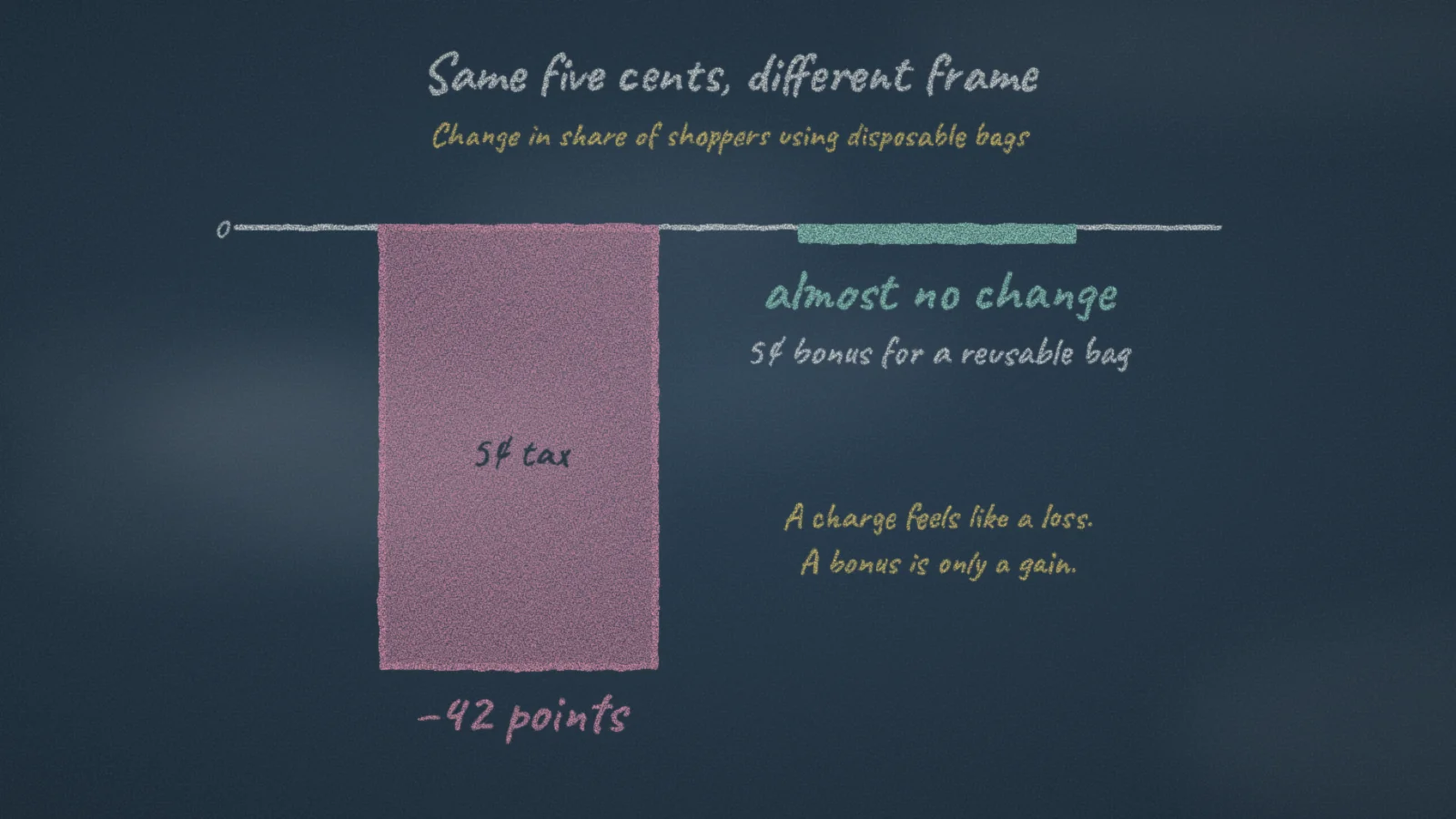
- Bag charges. Economist Tatiana Homonoff compared a five-cent tax on disposable bags in Montgomery County, Maryland, with a five-cent bonus for bringing a reusable bag. The tax cut the share of shoppers using disposable bags by 42 percentage points. The bonus, worth exactly the same, had almost no effect.
- Credit card letters. In a field experiment with a credit card company, lapsed cardholders received a letter that described the card’s benefits either as gains from using it or as losses from not using it. The loss version roughly doubled the share of customers who started using the card again.
- Factory bonuses. At a Chinese electronics factory, Tanjim Hossain and John List found that teams produced more when a bonus was framed as money they would lose for missing a target than when the same bonus was framed as money they would earn. The extra lift from the framing alone was about 1%.
That 1% is a useful reality check. Loss framing can shift behaviour, but the effect is often modest and it varies. David Gal and Derek Rucker argued in 2018 that the evidence does not show losses outweighing gains as a general rule. A 2020 study of 17,720 people answered that loss aversion is real across groups, though weaker among people with more knowledge and experience of a product area and stronger among older consumers.
For marketing, the practical reading is that loss aversion is strongest when people feel they already own or expect something, and weakest with confident, expert buyers. Treat it as a hypothesis to test, with no guaranteed uplift.
Loss aversion examples in marketing
Most uses of loss aversion follow the same logic. They set up something the customer already holds, such as progress, credit, a saved basket or their current costs, and then make clear what they would give up.
| Tactic | How loss aversion works | Example |
|---|---|---|
| Free trials | Using the product builds a sense of ownership, so ending the trial feels like losing something | A full-featured software trial that reminds users of the projects already saved in their account |
| Loss-framed messages | The cost of not acting is stated, alongside the benefit of acting | “Your current tariff costs you £120 a year more than this one” rather than “Save £120” |
| Streaks and progress | Progress the user has built becomes something to protect | Duolingo says learners who reach a seven-day streak are 3.6 times more likely to complete their course |
| Expiring rewards | Points or credit already earned feel owned, so an expiry date prompts action | “Your 1,200 points expire on 31 March” |
| Saved baskets and quotes | The customer has invested time in a choice and does not want to start again | An email showing the items still saved in a basket, at their real price |
| Removing options | Taking a feature away feels worse than adding it feels good | Showing the fully specified package first and letting buyers remove extras |
| Guarantees and free returns | They shrink the loss the buyer fears from a wrong decision | A long home trial for a mattress or a no-quibble money-back promise |
The “removing options” row has research behind it. In studies by Whan Park, Sung Youl Jun and Deborah MacInnis, people who started with a fully loaded product and deleted what they did not want ended up choosing more options, at a higher total price, than people who built up from a base model.
Guarantees work in the opposite direction from the other tactics. Instead of creating a loss, they remove one. That is often the more effective move, because many buyers hesitate less over price than over the risk of paying for something that turns out to be wrong for them.
Loss aversion and scarcity marketing
Scarcity marketing uses limited stock, limited time or limited places to make a product feel more valuable. It draws directly on loss aversion: once something might disappear, not buying stops feeling like a neutral choice and starts to feel like missing out.
The two are related but not identical. Loss aversion works with anything the customer already has or expects, such as their savings, their progress or a price they are used to. Scarcity adds a limit or a deadline, which makes it the strongest form of loss framing and also the most abused. A real limit is useful information for the buyer: a seasonal menu, a workshop with 20 places, an early-bird price that ends on a stated date. An invented one is what regulators look for first.
How to use loss aversion in your marketing
- Find the customer’s real reference point. What do they already have, pay or expect? Current costs, an existing supplier, saved work and progress are honest starting points.
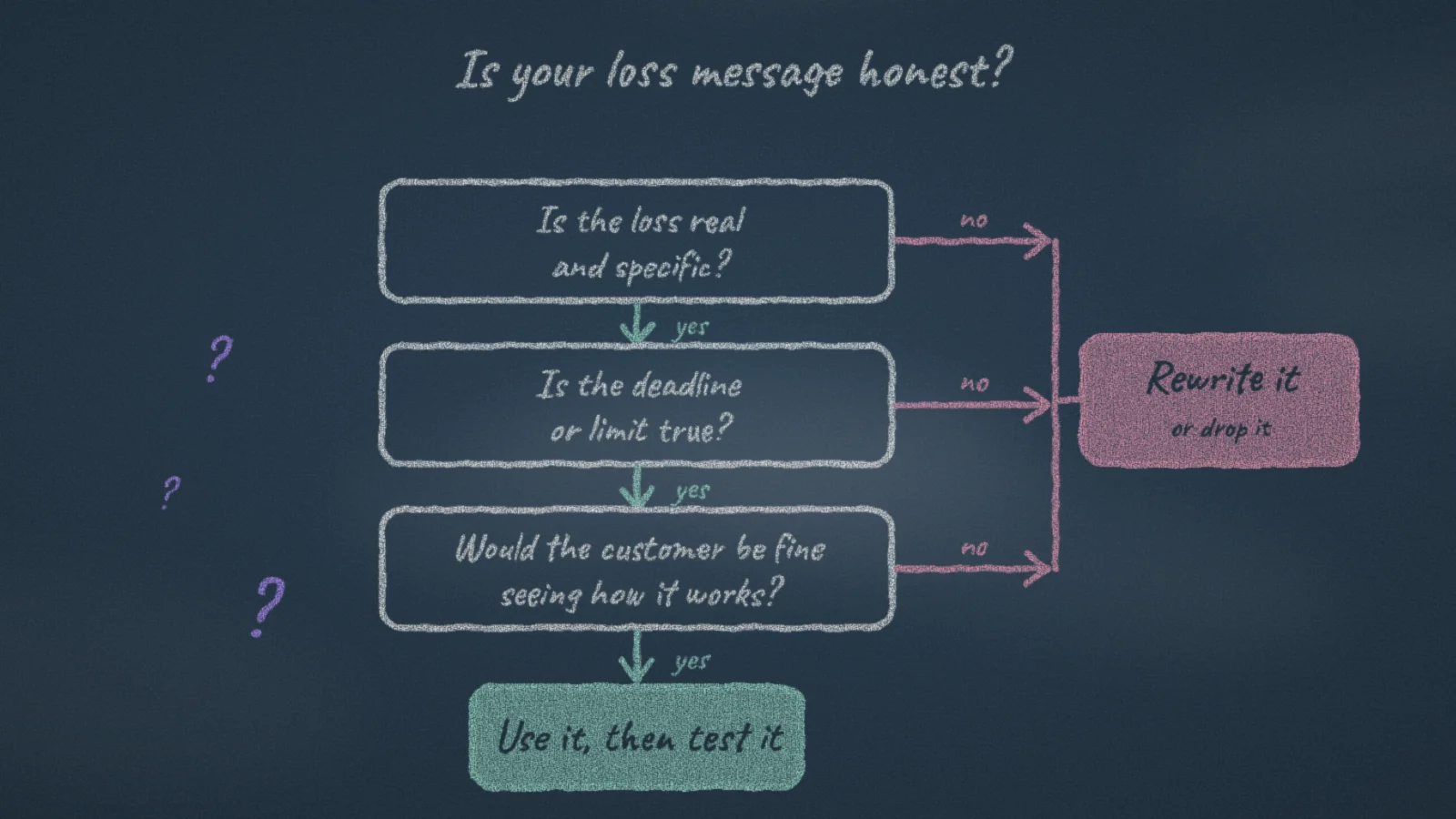
- Name a loss that is true and specific. “Your current plan charges £14 a month for features you do not use” can be checked. “Don’t miss out” cannot, and readers know it.
- Let people feel ownership early. Trials with full access, saved baskets, progress bars and personalised set-up all create something worth keeping.
- Remove the losses buyers fear. Free returns, easy cancellation and clear guarantees deal with the fear of a wrong decision, which blocks many sales before price does.
- Use deadlines only when they are real. If an offer ends on Sunday, say so and end it on Sunday. Never restart a timer or bring the same “final” sale back the next day.
- Match the frame to the audience. Loss frames tend to work less well on expert buyers and can feel pushy in B2B or high-trust sectors. Run an A/B test of a loss frame against a gain frame before rolling it out.
- Check the message from the customer’s side. If they would feel tricked once they saw how it works, rewrite it.
UK rules on urgency and loss messages
Loss-framed copy is legal as long as the loss is true. False pressure is a different matter. Since 6 April 2025, Schedule 20 of the Digital Markets, Competition and Consumers Act 2024 bans, in all circumstances, falsely stating that a product or its terms will only be available for a limited time to push people into an immediate decision. The CMA can now enforce consumer law directly and fine businesses up to 10% of global turnover.
- Countdown timers. In May 2026 a High Court order confirmed the CMA’s position that Emma Sleep’s pressure selling was illegal, including countdown clocks that restarted when the page was refreshed or the time ran out. The company agreed to undertakings the court can enforce.
- Availability claims. In 2019, six hotel booking sites including Booking.com and Expedia agreed to stop pressure selling, such as giving a false impression of how many rooms were left or how popular a hotel was.
- Free trials and subscriptions. New subscription rules under the same Act are due to apply from January 2027, with extra duties around trials, renewals and cancellation. A trial that relies on people forgetting to cancel turns loss aversion against the customer.
Popularity claims built on fake reviews fall under separate rules, covered in social proof and the law. For the wider line between a helpful nudge and a dark pattern, see the ethics section of the behavioural science guide.
Frequently asked questions
What is loss aversion in simple terms?
Loss aversion means a loss feels stronger than a gain of the same size. Losing £10 bothers most people more than finding £10 pleases them, so they often act to avoid a loss more readily than to secure an equal gain.
What is an example of loss aversion in marketing?
A free trial is a common example: once people have used a product and saved their work in it, ending the trial feels like losing something. Expiring loyalty points, streaks and messages such as “your current tariff costs you £120 a year more” use the same effect.
How strong is loss aversion?
A 2024 meta-analysis of hundreds of studies put the average loss aversion coefficient at about 1.96, meaning a loss feels roughly twice as strong as an equal gain. The effect varies with context and is weaker among experienced, knowledgeable buyers.
What is the difference between loss aversion and the endowment effect?
Loss aversion is the general tendency to weigh losses more than gains. The endowment effect is one result of it: people value something more once they own it, because giving it up would feel like a loss.
Is loss aversion the same as FOMO?
Not exactly. FOMO, the fear of missing out, is a social and emotional feeling about experiences others are having, while loss aversion is a broader bias in how people weigh any loss. Scarcity marketing often uses both at once.
Is it legal to use urgency and scarcity in UK marketing?
Yes, if the limit is real. Under the Digital Markets, Competition and Consumers Act 2024, falsely claiming that an offer is only available for a limited time is banned, and the CMA can fine businesses up to 10% of global turnover.
On this page
Back to topFrame your offer around what customers value
Kutola helps businesses apply behavioural science fairly, from pricing pages and trial emails to offer wording, and test which frame actually moves their customers. Get in touch to review where your marketing could show its value more clearly.