What is a value proposition? Examples and how to write yours

A value proposition is a short, customer-facing statement of the benefit your product or service delivers, who it is for and why it is a better choice than the alternatives. It is the answer to the question every buyer asks, often within seconds of landing on your website: why should I pick you?
It is where your brand positioning meets the customer. Positioning decides the place you want to own, and the value proposition turns that place into words people read on your homepage, in your ads and in sales conversations. This guide explains what a value proposition is, how it differs from a positioning statement, USP and tagline, how to use the value proposition canvas, six steps to write your own, real examples from UK brands and the mistakes that weaken most of them.
What is a value proposition?
The term comes from McKinsey consultants Michael Lanning and Edward Michaels, whose 1988 staff paper argued that every business should be built around a clear value proposition for each target segment: a simple statement of the benefits the customer will get and the approximate price they will pay for them. The idea has stayed close to that original meaning. A value proposition is a promise of value, written from the customer’s side of the table.
A useful value proposition answers three questions in plain language:
- What do you offer? The product or service, described in terms the customer recognises.
- Who is it for, and what does it do for them? The specific outcome a specific customer gets, such as saving time, avoiding a risk or earning more.
- Why you rather than the alternative? The difference that makes you the better choice, and the proof that makes it believable.
Value is not only about price or features. Bain & Company’s research, published in Harvard Business Review as The Elements of Value, identified 30 elements that customers value, arranged in a pyramid from functional needs such as saving time and reducing cost, through emotional needs such as reducing anxiety, up to life-changing and social impact. Companies that scored highly on four or more elements had, on average, three times the Net Promoter Score of companies that scored highly on only one. A strong value proposition usually combines a functional benefit with an emotional one.
The phrase is also used in HR, where an employee value proposition describes what an employer offers its staff. This guide covers the customer value proposition.
Value proposition vs positioning statement, USP and tagline
These terms overlap, and many businesses use them as if they were the same. Each has a different reader and a different job. The examples below use Paydock, the fictional invoicing app for freelance designers from our positioning statement guide.
| Term | Who reads it | What it does | Paydock example |
|---|---|---|---|
| Value proposition | Customers | Explains the benefit and why it beats the alternatives | Get paid on time without chasing clients. Paydock sends polite, automatic reminders in your own words. |
| Positioning statement | Internal teams and agencies | Defines the customer, category and difference the whole brand is built on | For freelance designers who lose hours chasing late invoices, Paydock is an invoicing app that… |
| USP | Customers and sales teams | Names one feature or claim competitors cannot make | Reminders written in the freelancer’s own tone of voice |
| Tagline | Customers and the public | Sums up the brand in a few memorable words | Paid, politely. |
| Brand promise | Customers and staff | States what customers can rely on every time they deal with the brand | Your client relationships stay friendly, even when money is late. |
The positioning statement comes first, and a positioning statement differs from a value proposition mainly in its audience: one is for the team, the other is for the customer. A USP is narrower than a value proposition. It is often the strongest proof inside it, while the value proposition also covers the customer, the outcome and the context. For how these ideas sit next to branding and messaging, see brand positioning vs branding, messaging and USP. The brand promise is part of a wider brand strategy and lasts longer than any single offer.
The value proposition canvas
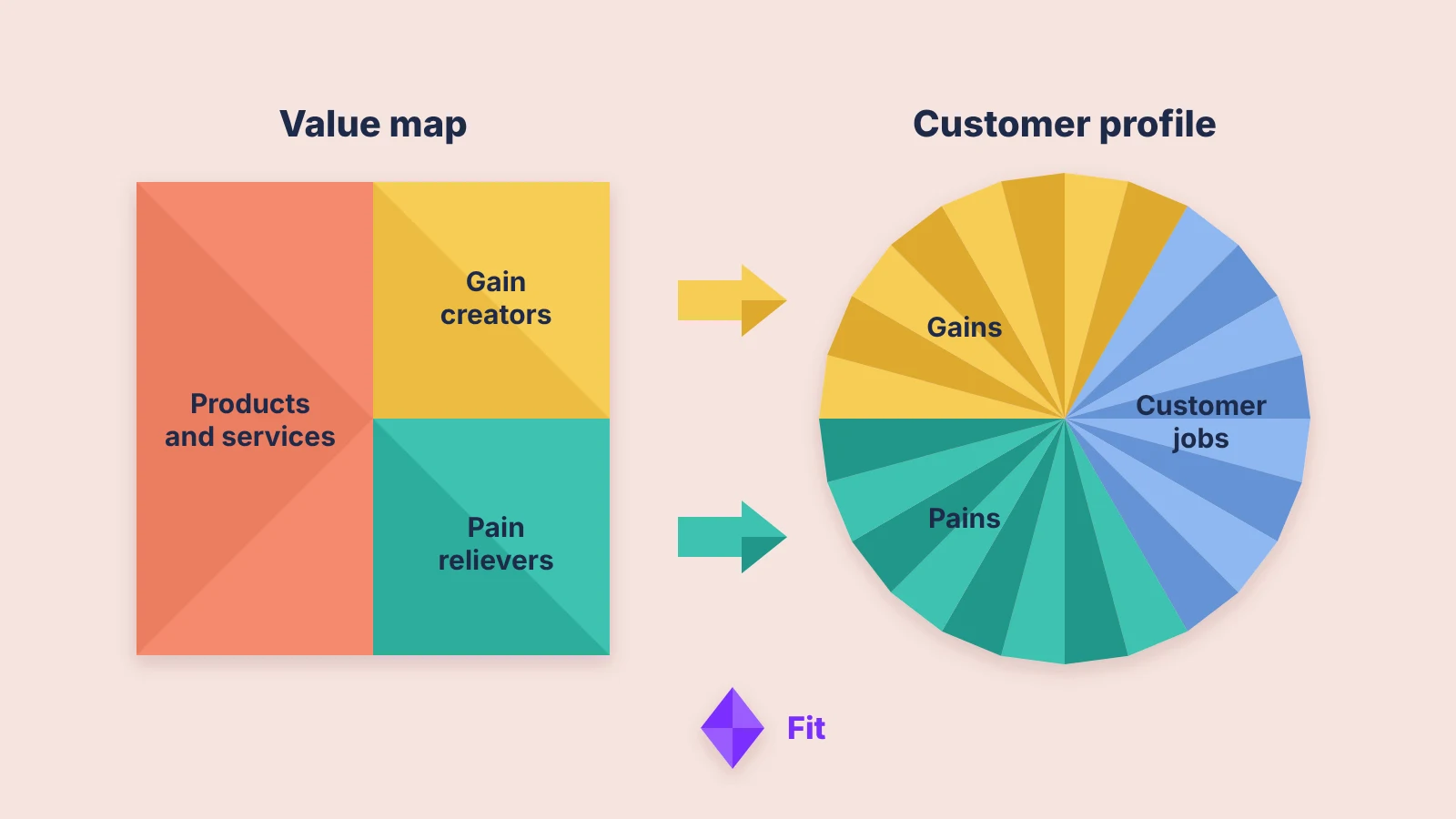
The value proposition canvas is a planning tool created by Alexander Osterwalder, Yves Pigneur and Alan Smith and set out in the 2014 book Value Proposition Design. Strategyzer describes it as a way to understand what customers really want before you decide what to say or build. It has two halves that you fill in separately and then compare.
The customer profile (the circle) describes one customer segment:
- Customer jobs: the tasks they are trying to get done. These can be functional (send an invoice), social (look professional to clients) or emotional (stop worrying about money).
- Pains: what annoys them, slows them down or puts them at risk while doing those jobs.
- Gains: the outcomes and benefits they want, including ones they would be pleased by but haven’t asked for.
The value map (the square) describes your offer:
- Products and services: what you actually provide.
- Pain relievers: how the offer removes or reduces specific pains.
- Gain creators: how the offer produces the gains customers want.
You have fit when your pain relievers and gain creators match the jobs, pains and gains that matter most to the customer. A long list of features that answer minor pains is not fit. A short list that solves the customer’s top two or three problems is.
Here is the canvas filled in for Paydock:
| Customer profile | Value map |
|---|---|
| Job: send invoices and get paid for finished work | Product: invoicing app with automatic follow-ups |
| Pain: chasing late payments feels awkward and risks the client relationship | Pain reliever: polite reminders sent automatically, written in the freelancer’s tone |
| Pain: hours lost to admin every month | Pain reliever: reminders scheduled once, then sent without further work |
| Gain: predictable income and fewer cash flow gaps | Gain creator: a dashboard showing what is due and when |
The pain worth leading with is the awkward chase, because it is the one competitors ignore. That becomes the headline of the value proposition.
How to write a value proposition
- Choose one customer. Write for one segment at a time. A value proposition that tries to speak to everyone ends up saying nothing to anyone. If you serve several groups, write one for each.
- Collect the customer’s own words. Read reviews, sales call notes, support tickets and survey answers. Note how customers describe the problem before they found you and what they say about the result. These phrases often make better headlines than anything written in a meeting.
- Fill in the canvas. List the jobs, pains and gains, then rank them by how much they matter to the customer. Map your offer against the top items and be honest about where it falls short.
- Pick the benefit you can win on. Choose the outcome that matters most to the customer and that you deliver better than the main alternative, which may be a competitor, a spreadsheet or doing nothing.
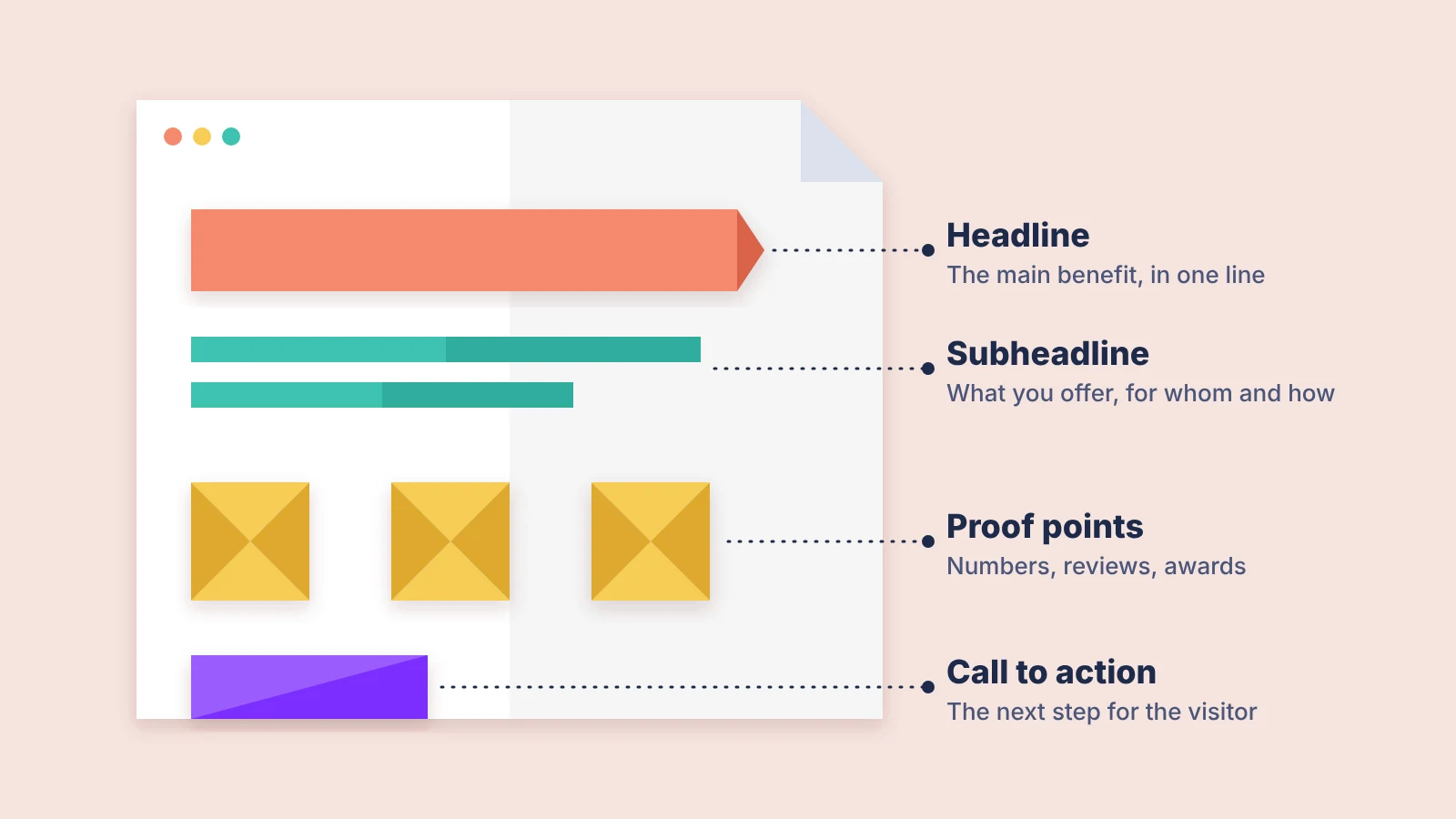
- Write the headline, subheadline and proof. The headline states the main benefit in one line. The subheadline, one or two sentences, explains what you do, for whom and how. Two to four proof points make it believable: numbers, reviews, awards or guarantees. A simple starting formula is: [Outcome] for [customer], without [main pain]. Then rewrite it until it sounds like a person talking.
- Test it with real people. Show the page to someone from your audience for five seconds and ask what you offer and who it is for. If they can’t tell you, rewrite. On a busy page, use A/B testing to compare two headlines on sign-ups or enquiries rather than on opinion.
Speed matters at step five. Jakob Nielsen’s analysis of visit times across more than 200,000 pages found that the first 10 seconds decide whether visitors stay or leave, and his advice was to communicate your value proposition within 10 seconds. If the headline needs the rest of the page to make sense, it is doing too little.
Value proposition examples
These UK brands show different ways of turning a benefit into a value proposition. The wording on their sites changes over time, so look at the structure rather than the exact copy.
Wise: transparency against hidden costs
Wise built its offer around a cost most people never saw: the margin many providers add to the exchange rate. Wise says it uses the mid-market exchange rate and shows its fee separately before you send. Its comparison pages then put its total cost next to other providers’. The value proposition is the benefit (more money arrives), and the comparison is the proof.
Monzo: one feature that changes a habit
Monzo’s instant spending notifications tell customers what they have spent the moment they pay, instead of leaving them to find out from a statement. The benefit is a feeling of control, which is an emotional gain delivered through one simple feature. It shows how a single, visible feature can carry a whole value proposition.
Gousto: a specific number as proof
Recipe boxes all promise easier dinners. Gousto’s food box page makes its claim concrete with a number: over 175 recipes to choose from every week. A specific figure is easier to believe and remember than “lots of choice”, and it answers the main worry of a meal kit customer, which is getting bored of the menu.
Octopus Energy: proof from someone else
Energy is the same product whichever supplier sends it, so suppliers compete on price and on how they treat customers. Octopus Energy can point to independent proof: Which? has named it a Recommended Provider for nine years in a row. A third-party award does more work than any claim a brand makes about itself.
Small businesses can use the same patterns. A local accountant might lead with a fixed monthly fee instead of hourly billing, a plumber with an arrival time, and a B2B software firm with the hours a customer saves each week. The structure stays the same: one benefit, one customer, one reason to believe it.
Where to use your value proposition
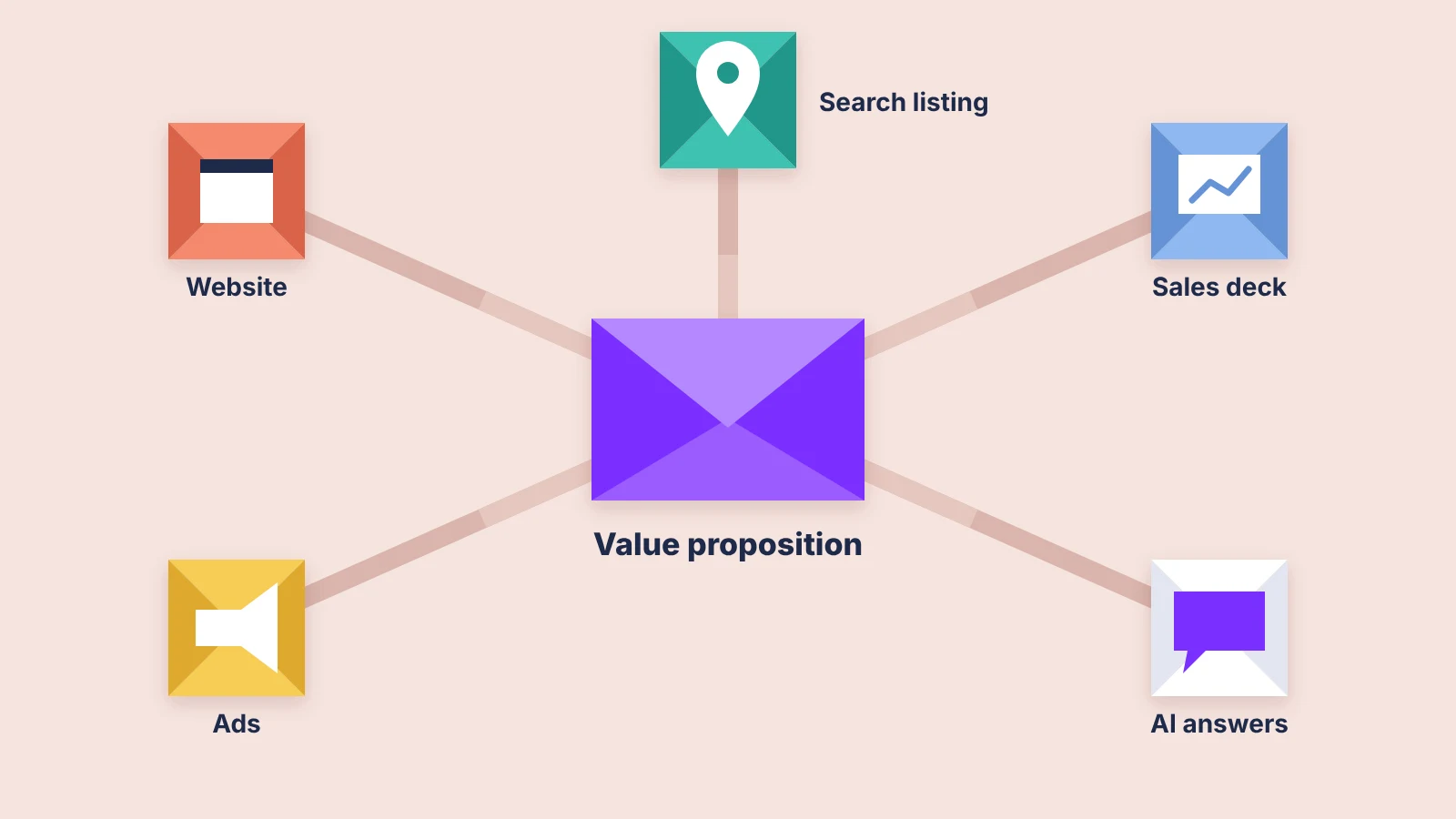
A value proposition only works if customers see it. Once it is agreed, put the same core message in every place where people compare you with others:
- Homepage and landing pages: the headline and subheadline in the first screen, with proof points close by. Each landing page can adapt it to one audience or offer.
- Ads and social bios: a shorter version of the same benefit, so the ad and the page it leads to tell one story.
- Google Business Profile and directory listings: the description field is often the first thing local customers read.
- Sales decks and proposals: the canvas helps here, because each pain reliever becomes a talking point for a specific objection.
- AI answers: tools such as ChatGPT and Google’s AI Overviews describe brands from what the web says about them. A value proposition repeated consistently on your site, profiles and reviews makes an accurate summary more likely, which is a core idea of generative engine optimisation.
In the UK, every factual claim in a value proposition also has to be provable. The Advertising Standards Authority expects marketers to hold documentary evidence for objective claims before they publish them, including claims such as “the fastest”, “the cheapest” or “rated number one”. Keep the evidence for every number and comparison you use.
Common value proposition mistakes
- Leading with features. “Cloud-based, AI-powered invoicing” describes the product. “Get paid on time without chasing” describes the result. Customers buy the result.
- Using words every competitor uses. Quality, innovative, trusted and best-in-class are claimed by almost everyone, so they give no reason to choose you.
- Making it about you. “We are a leading provider of…” talks about the business. A value proposition talks about the customer.
- Promising more than you deliver. A claim the product doesn’t live up to turns into bad reviews, and those reviews then shape how people and AI tools describe you.
- Writing it once and filing it. Markets, competitors and products change. Review the value proposition whenever they do, and at least once a year.
Frequently asked questions
What is a value proposition?
A value proposition is a short statement, written for customers, of the benefit a product or service delivers, who it is for and why it is a better choice than the alternatives. It usually appears as the main headline and subheadline on a homepage or landing page.
What is an example of a value proposition?
Wise is a well-known example. It promises to send money abroad at the mid-market exchange rate with the fee shown upfront, and backs the promise with side-by-side cost comparisons against other providers.
What are the key elements of a value proposition?
A headline that states the main benefit, a subheadline that explains what you offer and for whom, and two to four proof points such as numbers, reviews, awards or guarantees. A supporting image or product shot often helps.
What is the difference between a value proposition and a USP?
A USP is a single feature or claim that competitors cannot match. A value proposition is broader: it explains the customer, the outcome they get and why you are the better choice, and the USP is often its strongest proof point.
How long should a value proposition be?
Short enough to understand in about 10 seconds. In practice that means a headline of around ten words, a subheadline of one or two sentences and a few short proof points.
What is the value proposition canvas?
The value proposition canvas is a tool from Strategyzer that compares a customer profile (jobs, pains and gains) with a value map (products and services, pain relievers and gain creators). It helps you check that your offer solves the problems customers care about most.
On this page
Back to topSay clearly why customers should choose you
Kutola helps businesses find the benefit they can win on, turn it into a value proposition customers understand at a glance and carry it across their website, ads and search listings. Get in touch to sharpen what your homepage says in its first ten seconds.