Marketing funnel: stages explained with examples for B2C and B2B
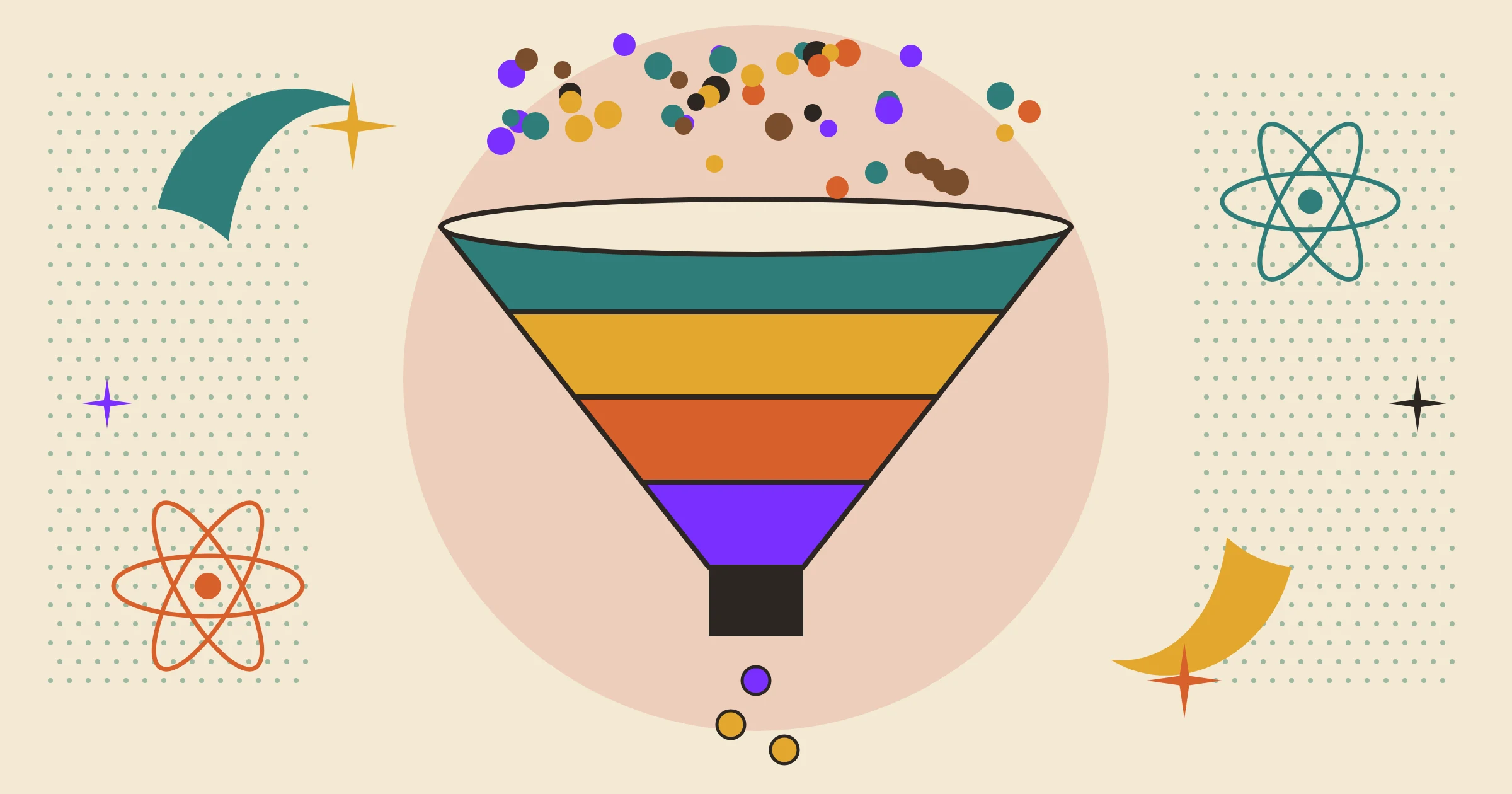
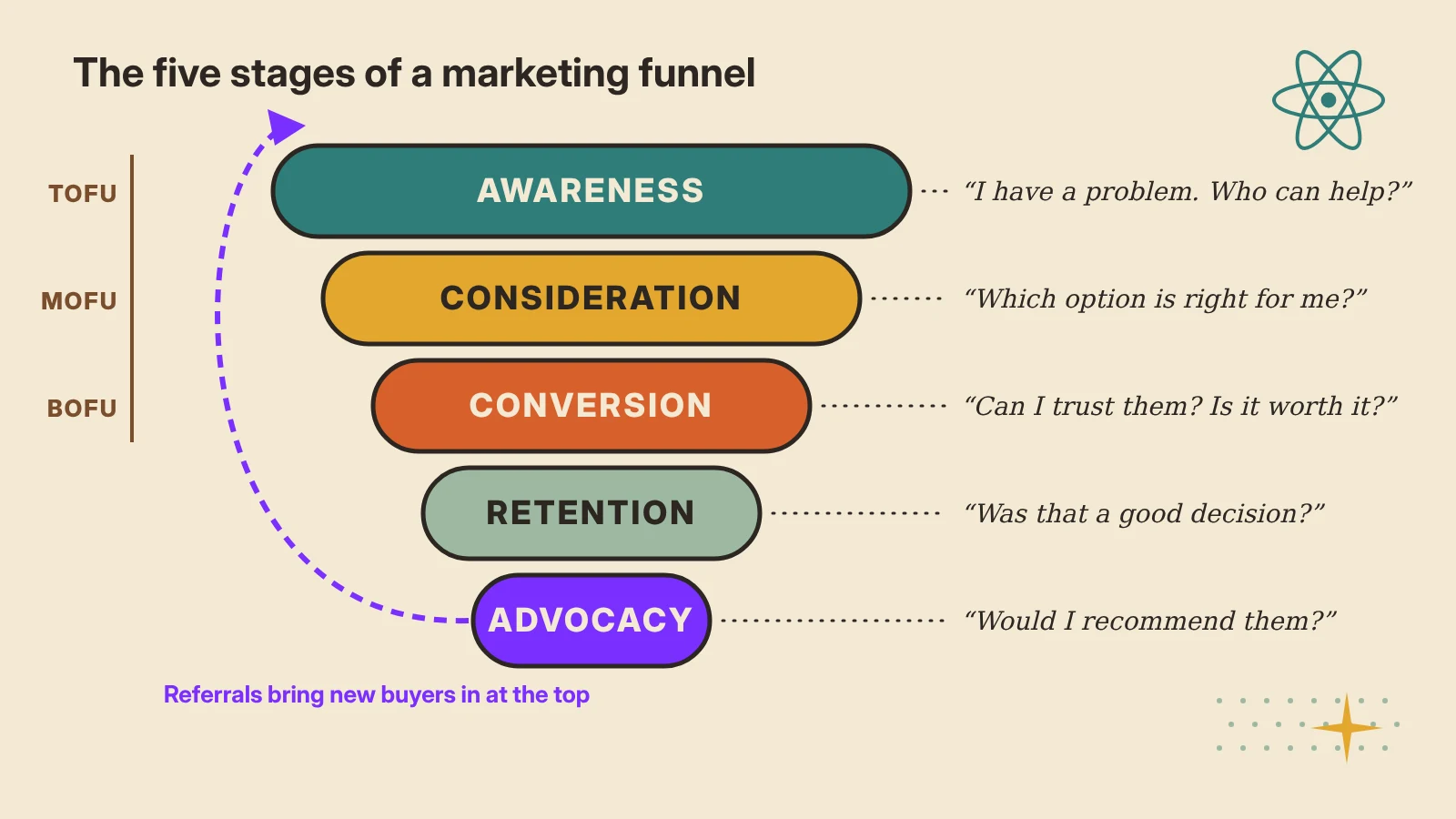
A marketing funnel is a model of the stages people move through between first hearing about a business and becoming a customer: usually awareness, consideration and conversion, followed by retention and advocacy. It is drawn as a funnel because many people enter at the top and fewer reach each stage after it, and every stage needs its own content, channels and measures.
The funnel is one of the simplest tools for shaping a digital marketing strategy, because it shows at a glance whether you have something for people at every stage or only for those already ready to buy. This guide explains each stage of the marketing funnel, how it differs from a sales funnel and what it looks like for an online shop, a B2B firm and a local business. It then covers where the model falls short, how to build your own and how to measure it.
What is a marketing funnel?
The idea grew out of early advertising models such as AIDA (attention, interest, desire, action). The modern funnel keeps that sequence but organises a whole marketing operation around it, and a digital marketing funnel applies it to search, social media, email and ads. Most teams split it into three parts:
- Top of the funnel (TOFU): people who have a need, or will have one, but do not know you yet.
- Middle of the funnel (MOFU): people comparing options.
- Bottom of the funnel (BOFU): people ready to act.
The shape is the point. If 10,000 people see a brand and 50 buy, the funnel shows where the other 9,950 dropped away and which stage to fix first.
The stages of the marketing funnel
Models use different labels, but most describe five stages. The first three win a customer. The last two keep that customer and turn them into a source of new ones.
| Stage | What the buyer is thinking | What works | What to measure |
|---|---|---|---|
| Awareness (TOFU) | “I have a problem” or “I’ve never heard of you” | Search content, social video, PR, podcasts, video ads, creator partnerships | Reach, new visitors, branded search volume |
| Consideration (MOFU) | “Which option is right for me?” | Guides, comparison pages, case studies, reviews, webinars, email series | Return visits, engaged sessions, email sign-ups, leads |
| Conversion (BOFU) | “Can I trust them and is it worth the price?” | Product and pricing pages, demos, free trials, offers, retargeting | Conversion rate, cost per acquisition, revenue |
| Retention | “Was that a good decision?” | Onboarding, customer service, useful emails, loyalty schemes | Repeat purchase rate, churn, customer lifetime value |
| Advocacy | “Would I recommend them?” | Review requests, referral schemes, user-generated content | Reviews, referrals, Net Promoter Score |
Awareness is about being found and remembered, not selling. It now includes AI answers: when someone asks ChatGPT which accountants suit a small charity, the brands it cites become the first shortlist, which is the job of generative engine optimisation.
Consideration is where most funnels leak. People look for evidence, so case studies, honest comparisons and social proof earn their place here. A useful lead magnet, such as a checklist or a price calculator, turns an anonymous visitor into someone you can follow up with.
Conversion is decided by friction. Hidden costs, long forms and slow pages lose people who had already made up their minds. Across 50 studies, Baymard Institute puts the average documented online basket abandonment rate at 70.22%, and extra costs at checkout are among the most common reasons people give.
Retention and advocacy are missing from many diagrams, which stop at the sale. Yet a returning customer does not need to be found again, and a happy one brings new people in at the top.
Marketing funnel vs sales funnel
The two terms are often used as synonyms, and for a small business without a separate sales team the difference hardly matters. Where marketing and sales are different jobs, the line usually sits at the hand-over:
| Marketing funnel | Sales funnel | |
|---|---|---|
| Covers | Awareness to a qualified lead or a first purchase, then retention and advocacy | A qualified lead to a signed deal |
| Owned by | Marketing | Sales |
| Typical activity | Content, search, social media, ads, email | Calls, demos, proposals, negotiation |
| Main measures | Leads, cost per lead, marketing qualified leads | Win rate, deal value, length of the sales cycle |
In B2B, the hand-over is usually the point where a marketing qualified lead (MQL) is accepted by sales. Agreeing what counts as qualified, in writing, prevents the familiar argument about lead quality.
A customer journey map is a different tool. The funnel counts how many people move between stages, while a journey map describes what one type of customer does, thinks and feels at each touchpoint, so it explains why people drop out where the funnel flags. Behavioural science helps too, since different biases and barriers are at work at each stage of the customer journey.
Marketing funnel examples
The same five stages look very different depending on what you sell. This is how three types of UK business might fill them:
| Stage | Online coffee roaster (B2C) | IT support firm (B2B) | Dental practice (local) |
|---|---|---|---|
| Awareness | Short brewing videos on TikTok and Instagram, a guide to the best coffee for a cafetière | LinkedIn posts from the founders, a guide to Cyber Essentials certification | Google Business Profile, local search results, a page on what Invisalign costs |
| Consideration | A “find your roast” quiz, reviews, a welcome email series | Case studies by sector, a page comparing in-house and outsourced IT, a webinar | Reviews, before-and-after photos, a clear price list |
| Conversion | Product pages with reviews, delivery costs shown upfront, a basket reminder email | A pricing page, a free IT health check, a call with an engineer | Online booking, a free first consultation |
| Retention | A subscription that is easy to pause, a brew guide with every order | Quarterly reviews, a monthly security update | Check-up reminders, a membership plan |
| Advocacy | A refer-a-friend discount, customer photos shared on social | Reviews and case studies with named clients | A follow-up message asking for a Google review |
A B2B marketing funnel is longer and involves more people, and buyers want to do most of the work alone. In a Gartner survey of 632 B2B buyers, 61% said they prefer a buying experience without a sales rep. That moves much of the consideration stage onto your website: pricing guidance, specifications and case studies need to be there before anyone books a call.
Most B2B buyers are not in the market at all at any given moment. The 95:5 rule, from research by the Ehrenberg-Bass Institute for the LinkedIn B2B Institute, suggests that around 95% of potential business buyers are not ready to buy today. The top of a B2B funnel is less about catching demand and more about being remembered when it arrives.
A local funnel is short and mostly happens in search and maps, where reviews help at three stages at once. Collect them honestly, because fake and incentivised reviews are now banned under UK consumer law.
Is the marketing funnel still relevant?
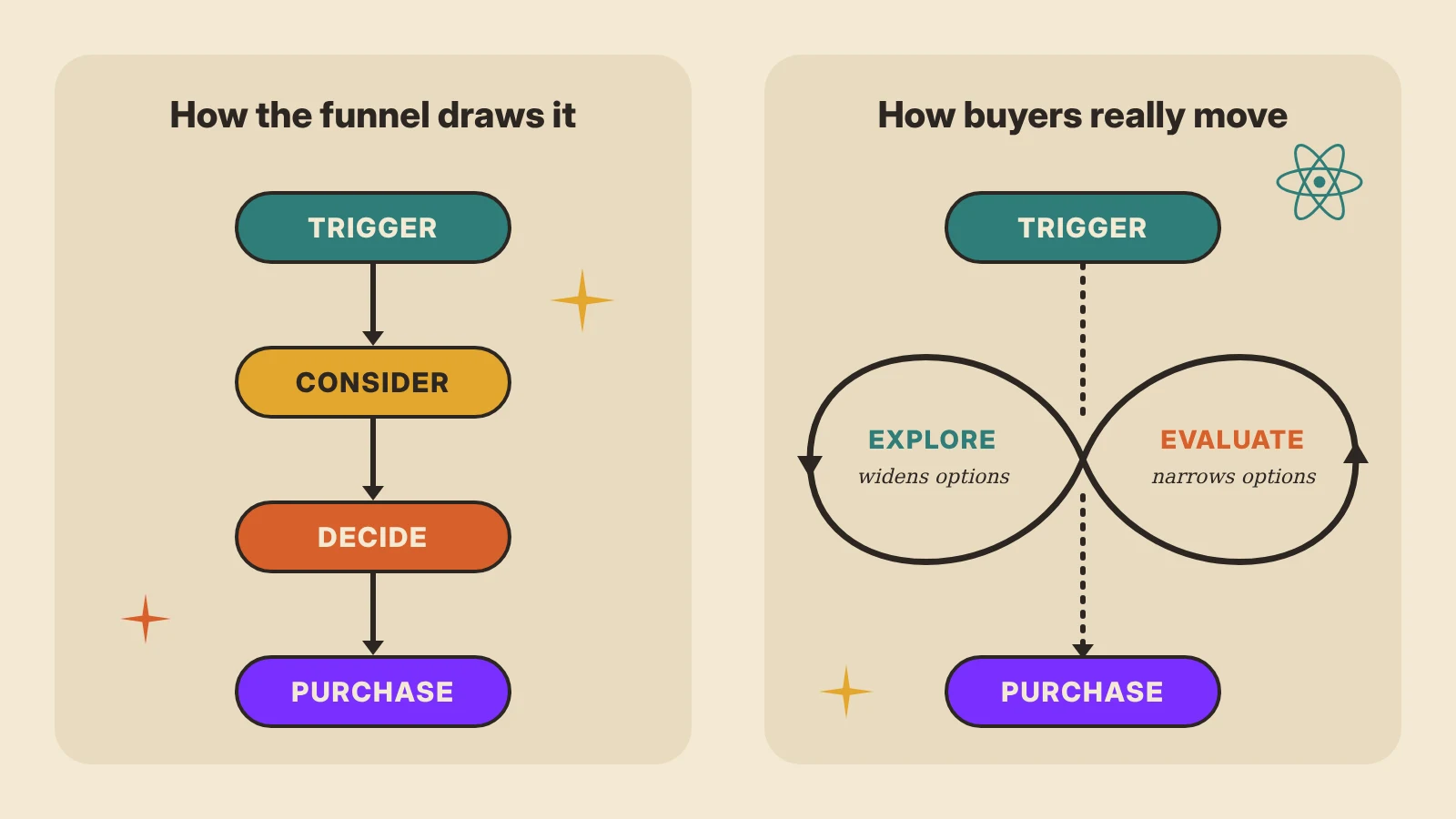
The funnel’s weakness is its shape. It implies a straight line, while real buyers loop back, pause for months and skip stages. Three well-known pieces of work make the point:
- McKinsey’s consumer decision journey. A 2009 study of almost 20,000 purchase decisions across five industries and three continents replaced the funnel with a loop of initial consideration, active evaluation, purchase and post-purchase experience. Brands could join the shortlist during research, not only at the start.
- Google’s messy middle. Research by Google and The Behavioural Architects, based on 310,000 simulated purchase scenarios with UK shoppers, describes the space between a trigger and a purchase as two repeating modes: exploration, which widens the options, and evaluation, which narrows them.
- HubSpot’s flywheel. In 2018 HubSpot swapped its funnel for a flywheel, arguing that a funnel treats customers as an end point when their recommendations are what drive new growth.
None of this makes the funnel useless. It was never a map of how people think but a planning and measurement tool: use it to check you have something for every stage and to see where people drop out, then use journey maps and customer research to understand why.
How to build a marketing funnel in 6 steps
- Define the conversion. Choose the one action that counts as success, such as a purchase, a booked call or a quote request.
- Map the questions at each stage. Talk to recent customers and read reviews and enquiries. Search queries follow the same pattern: “what is” near the top, “best” and “vs” in the middle, price and brand at the bottom.
- Audit what you already have. Tag every page, post, ad and email with a stage. Most businesses find plenty at the bottom and little in the middle. A digital marketing audit does this across every channel at once.
- Fill the biggest gap first. If people visit but never come back, the middle needs work: comparison pages, case studies and an email series. If they come back but do not buy, look at prices, trust signals and checkout.
- Connect the stages. Every piece should point to a next step, from guide to case study to pricing page. Retargeting and lead nurturing bring back people who left. Under PECR, marketing emails to individuals need consent, with a limited soft opt-in for existing customers, so build sign-up forms with that in mind.
- Set targets for each stage. Give each stage one or two numbers and an owner, and review them monthly.
Your guides and comparison pages are also what AI tools quote when buyers ask for recommendations. The AI Readiness Checker shows how easily those tools can reach, read and cite a page.
How to measure a marketing funnel
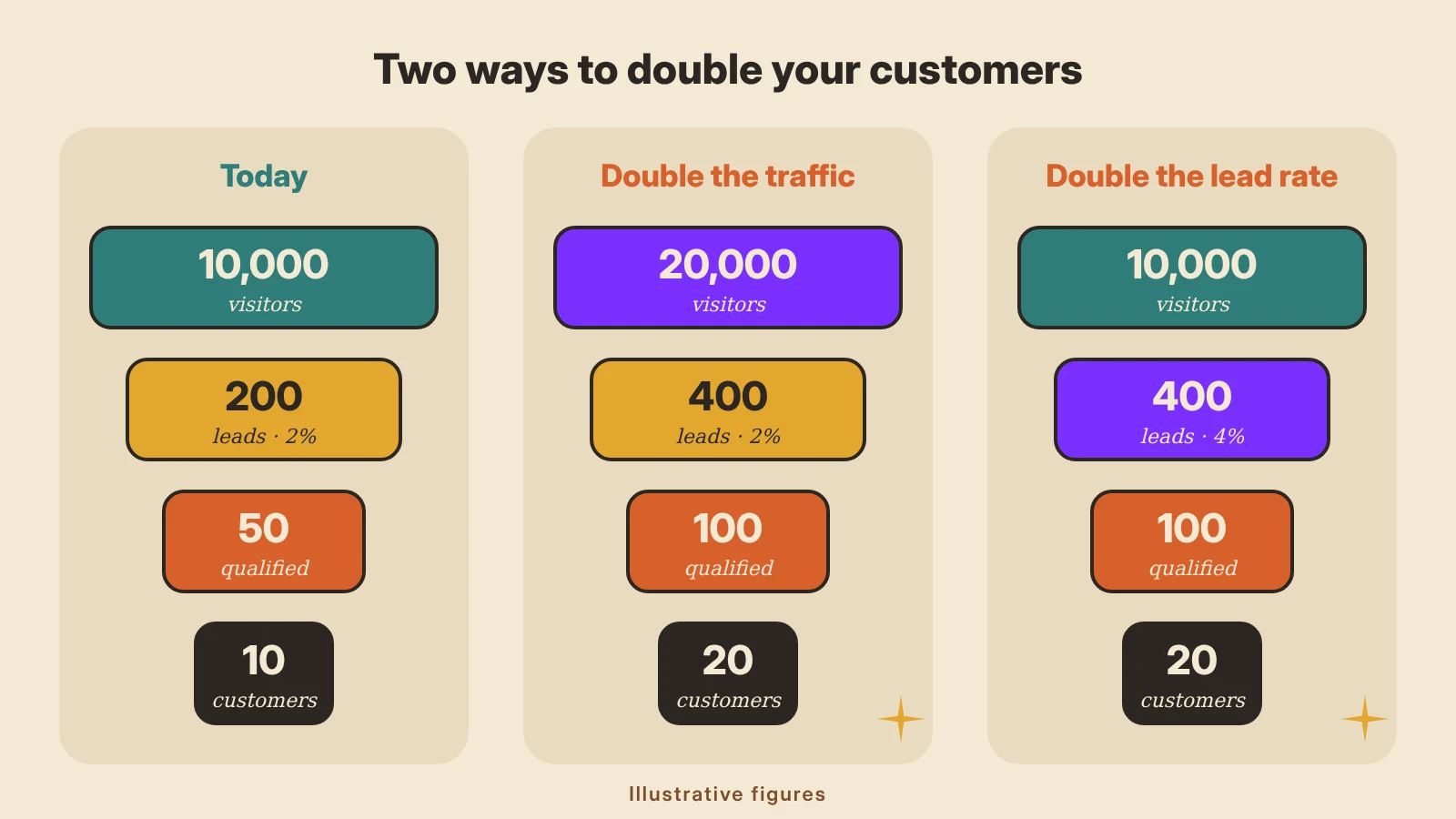
Measure the funnel as a chain of conversion rates between stages, not as separate totals. Planning and measuring every stage together is what people usually mean by full funnel marketing. A simple example for a B2B service:
| Stage | Number | Moves to the next stage |
|---|---|---|
| Website visitors | 10,000 | 2% become leads |
| Leads | 200 | 25% become qualified |
| Qualified leads | 50 | 20% become customers |
| Customers | 10 |
Doubling traffic to 20,000 visitors would bring in 10 more customers. So would raising the visitor-to-lead conversion rate from 2% to 4%, which is often cheaper than buying twice the traffic. Looking at the whole chain shows which lever to pull first.
In Google Analytics 4, a funnel exploration shows how many users complete each step you define and where they drop out. An open funnel also counts people who join part-way, which suits sites where many visitors land straight on a product page. Add CRM data for offline stages such as sales calls.
The top of the funnel is the hardest stage to credit, because someone who watched a video in March and searched your brand in June looks like a branded search conversion. Track branded search volume and the answer to “how did you hear about us?” as signs that awareness work is paying off.
Common marketing funnel mistakes
- Funding only the bottom. Search ads and retargeting capture demand that already exists but do not create it. When the top of the funnel dries up, the bottom follows a few months later.
- Asking for the sale too early. A “book a demo” pop-up on someone’s first visit to a blog post skips two stages.
- Stopping at the sale. Without retention and advocacy, every new customer has to be found from scratch.
- Reading stages in isolation. A rising number of leads means little if the share that become customers is falling.
- Copying someone else’s funnel. A coffee subscription and an IT support contract need different stages and content.
Frequently asked questions
What is a marketing funnel?
A marketing funnel is a model of the stages people go through from first hearing about a business to becoming a customer, usually awareness, consideration and conversion, then retention and advocacy. It helps you plan content for each stage and see where potential customers drop out.
What are the 5 stages of a marketing funnel?
The five stages most models use are awareness, consideration, conversion, retention and advocacy. The first three win a customer, and the last two keep them and turn them into a source of reviews and referrals.
What do TOFU, MOFU and BOFU mean?
They stand for top, middle and bottom of the funnel. TOFU covers people who do not know you yet, MOFU people comparing options and BOFU people ready to buy.
What is the difference between a marketing funnel and a sales funnel?
A marketing funnel runs from awareness to a qualified lead or first purchase and continues into retention and advocacy. A sales funnel starts where marketing hands over a qualified lead and ends with a signed deal, so it is mainly used where sales is a separate team.
Is the marketing funnel still relevant?
Yes, as a planning and measurement tool. Real buyers loop back and skip stages, as research by McKinsey and Google has shown, so pair the funnel with customer journey maps and research to understand why people drop out.
On this page
Back to topFind out where your funnel is leaking
Kutola’s digital marketing audits look at every channel against its stage in the funnel, show where buyers drop out and end with a short list of fixes in order of impact. Get in touch to talk about your funnel.