What is a PESTLE analysis? A worked UK example
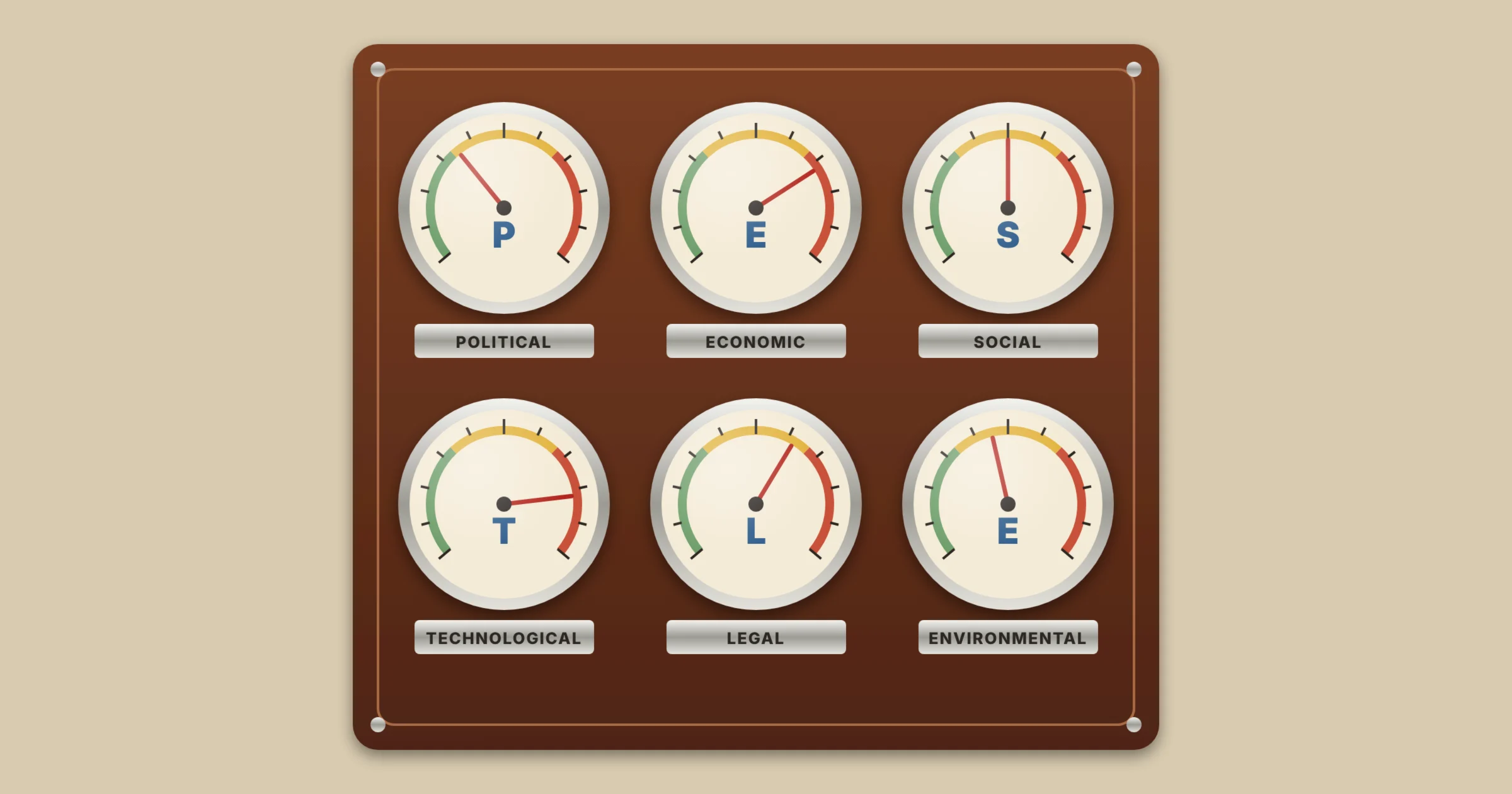
A PESTLE analysis is a structured way to scan the outside world for changes that could affect your business. It groups those changes into six areas: political, economic, social, technological, legal and environmental. Used well, it turns a vague sense of “the market is changing” into a short list of specific changes, how likely each one is and what you will do about it.
PESTLE is one of the research tools behind a digital marketing strategy, and it is often used alongside a SWOT analysis, where it feeds the opportunities and threats. This guide explains each factor, shows how to run the analysis in six steps and works through a full example for a UK business.
What is a PESTLE analysis?
PESTLE is a checklist for the external environment: the forces your business cannot control but has to respond to. It grew out of Francis Aguilar’s 1967 framework for scanning the business environment, and has picked up extra letters over the years as legal and environmental pressures became harder to ignore.
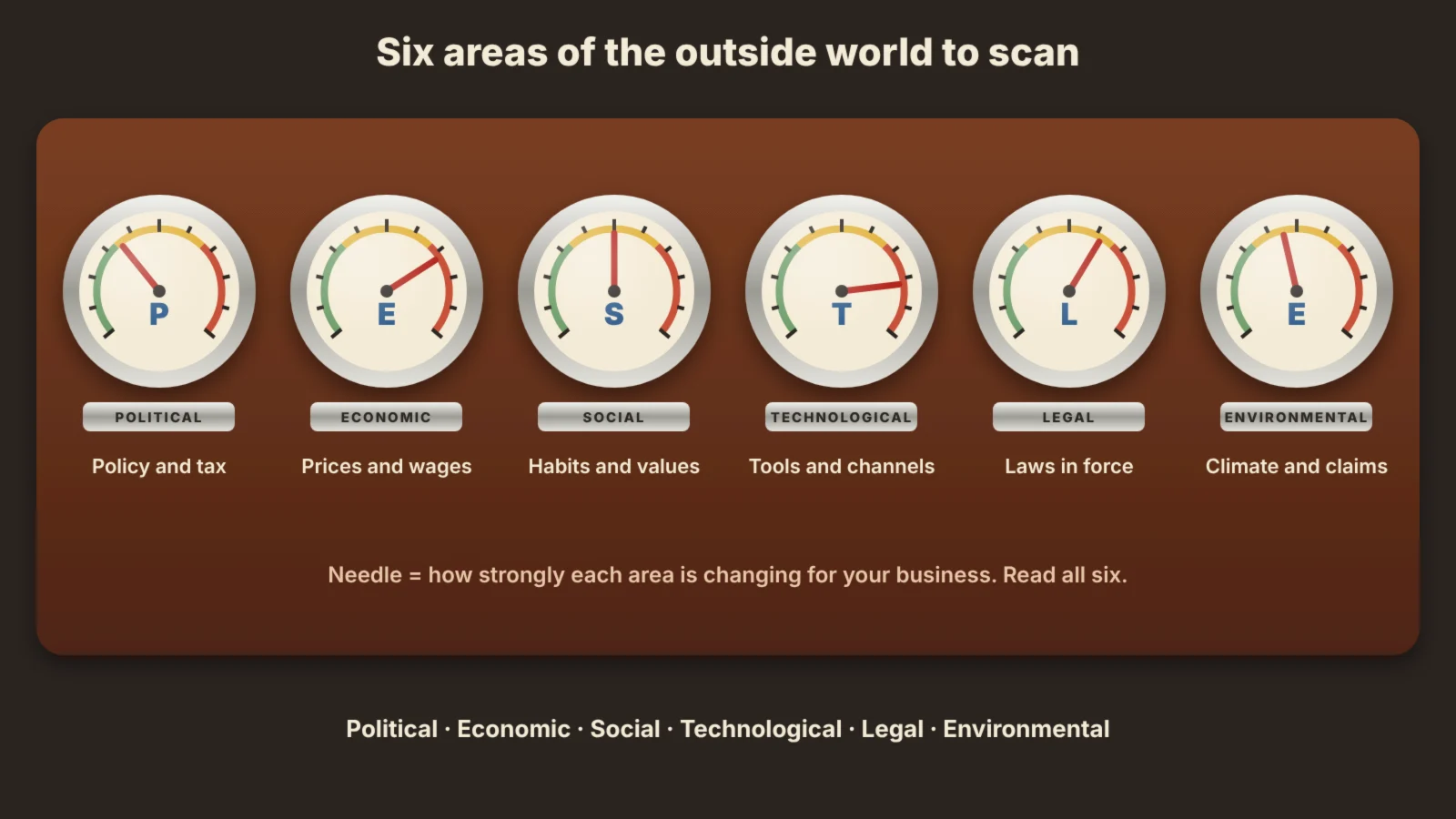
| Factor | What it covers | Questions to ask |
|---|---|---|
| Political | Government policy, taxation, public spending, trade and political stability | Which policy changes would change our costs or our customers’ priorities? |
| Economic | Inflation, interest rates, wages, employment and consumer confidence | How much do our customers have to spend, and what does it cost us to serve them? |
| Social | Demographics, habits, values, attitudes and how people spend their time | How are our customers’ lives and expectations changing? |
| Technological | New tools, platforms, channels and automation | How are people finding, comparing and buying what we sell? |
| Legal | Laws and regulation already passed or coming into force | What must we change to stay compliant, and what new rules help us? |
| Environmental | Climate, weather, resources, sustainability rules and expectations | How do environmental pressures affect our supply, costs and reputation? |
Political and legal factors often overlap. A simple way to split them: political covers what the government is debating or intends to do, and legal covers rules that have been passed. Economic and social factors overlap too, since spending habits are both. Where something fits in two boxes, put it in the one where you will act on it.
When to use a PESTLE analysis
PESTLE is most useful at moments when you are looking ahead rather than reacting:
- Annual planning. Before you set objectives and budgets in your marketing plan, so the plan reflects the year you are about to have.
- Entering a new market. A new region, country or customer group brings different rules, prices and habits.
- Launching a product. Check whether regulation, technology or customer attitudes are moving towards or away from it.
- After a shock. A sharp rise in costs, a new law or a change in how customers search is a reason to rerun the scan.
There are shorter and longer versions. PEST drops legal and environmental, which suits a quick scan. STEEPLE adds ethical factors, which can help where trust and reputation are central to the business. The six PESTLE areas suit most small and medium businesses.
How to do a PESTLE analysis in 6 steps
- Set the scope and time frame. Decide which business, market and customer group you are scanning, and how far ahead you are looking. One to three years works for most marketing decisions.
- Gather evidence. Use reliable sources: the ONS for economic and social data, GOV.UK and legislation.gov.uk for policy and law, regulators such as the CMA, ICO and ASA, industry bodies and your own sales and customer data.
- List the changes under each factor. Write each one as a specific change, such as “first-party analytics cookies no longer need consent”, rather than a broad topic such as “privacy”.
- Rate each change. Score impact and likelihood from one to five, and note whether it is an opportunity, a threat or both.
- Pick the few that matter. Keep the changes with high impact and high likelihood. Most businesses end up with five to eight.
- Turn them into actions. For each priority change, write what you will do, who owns it and when you will review it. Feed the results into your SWOT and your plan.
PESTLE analysis example: a UK garden centre
Oakfield is a fictional independent garden centre in Kent with a café, a small online shop and a loyal local customer base. Here is a shortened version of the PESTLE it might draw up for the coming year.
| Factor | Change | Impact on Oakfield | Response |
|---|---|---|---|
| Political | Changes to business rates relief for retail and hospitality | The rates bill for the shop and café could move by thousands of pounds | Check the new valuation and relief early and build it into the budget |
| Economic | CPI inflation rose to 3.5% in the year to September 2026, and the National Living Wage rose to £12.71 an hour in April 2026 | Higher staff and stock costs, while customers watch spending | Promote good value bundles and seasonal offers instead of cutting prices across the board |
| Social | Growing interest in wildlife-friendly gardening and growing food at home | Demand for native plants, seeds and practical advice | Run monthly workshops and publish how-to content for the season |
| Technological | More people ask AI tools and Google’s AI Overviews for gardening advice | Fewer clicks from simple questions, more weight on being cited and found locally | Publish clear seasonal guides, keep the Google Business Profile complete and track AI visibility |
| Legal | The Digital Markets, Competition and Consumers Act lets the CMA fine businesses directly and bans fake reviews and hidden fees | Review collection and online pricing must be clean | Ask every customer for reviews in the same way and show delivery costs upfront |
| Environmental | Hotter, drier summers and tighter scrutiny of green claims | Shifts in which plants sell and risk from vague claims such as “eco-friendly” | Stock drought-tolerant ranges and back every environmental claim with evidence |
Notice that each row names a specific change and a specific response. That is what makes the analysis useful: Oakfield’s marketing plan can now include workshops, seasonal guides, a review routine and a drought-tolerant range, each linked to a reason.
PESTLE factors UK marketers should watch now
Some changes affect almost every UK business that markets online. They make a good starting list for your own scan.
- Economic: rising prices. The ONS reported that CPI inflation rose to 3.5% in the 12 months to September 2026, up from 2.6% in June. Rising costs squeeze margins and make customers more price conscious, which affects offers, messaging and how much you can pay for a customer.
- Legal: data and cookies. The main data protection changes in the Data (Use and Access) Act 2025 came into force in February 2026. Some low-risk cookies, such as those used only for first-party analytics, no longer need consent, provided people are told and can object. Fines for breaking the rules on cookies and marketing emails can now reach the same level as UK GDPR fines.
- Legal: consumer protection. Since April 2025, the CMA can fine businesses up to 10% of global turnover for breaking consumer law. Fake reviews, hidden fees and false urgency are specific targets.
- Technological: AI search. AI Overviews, AI Mode and assistants such as ChatGPT answer more questions directly, changing how people find businesses. Our guide to AI visibility explains how to measure whether these tools mention you.
- Environmental: green claims. The CMA’s Green Claims Code requires environmental claims to be truthful, clear and backed by evidence, and the ASA regularly rules against vague claims such as “sustainable” or “carbon neutral” without proof.
PESTLE vs SWOT: how they work together
PESTLE looks only outward. SWOT looks both inward, at your strengths and weaknesses, and outward, at opportunities and threats. The two work best in sequence: run PESTLE first, then use its priority changes as the evidence for the opportunities and threats in your SWOT.
PESTLE also pairs well with competitor research. A change such as new cookie rules affects every business in your market, so the question is not only what it means for you but who will adapt fastest. If you then want to turn the combined picture into options, the TOWS matrix matches each external change with a strength to use or a weakness to fix.
Common PESTLE mistakes
- Listing topics instead of changes. “Technology” or “the economy” tells you nothing. Name the specific change and when it happens.
- Collecting everything. A list of forty factors is a research file, not an analysis. Rate them and keep the few that matter.
- Stopping at the list. Every priority change needs a response, an owner and a review date.
- Using old evidence. Inflation figures, laws and platform changes move quickly. Date your sources and refresh the analysis at least once a year.
- Ignoring the local picture. National trends can hide regional differences in wages, rents and demand. Look at data for the areas you actually serve.
- Doing it alone. Sales, customer service and operations staff often spot changes before managers do. Ask them.
Frequently asked questions
What does PESTLE stand for?
PESTLE stands for political, economic, social, technological, legal and environmental. These are the six areas of the external environment that the analysis checks for changes that could affect a business.
What is the difference between PEST and PESTLE?
PEST covers political, economic, social and technological factors. PESTLE adds legal and environmental factors, which matter more now that regulation and sustainability affect most businesses.
What is the difference between PESTLE and SWOT?
PESTLE scans only the external environment. SWOT covers internal strengths and weaknesses as well as external opportunities and threats. Many businesses run PESTLE first and use its findings in the opportunities and threats of their SWOT.
How often should you do a PESTLE analysis?
At least once a year, as part of annual planning, and again whenever something significant changes, such as a new law, a sharp rise in costs or plans to enter a new market.
Is PESTLE useful for small businesses?
Yes. A small business does not need a long report. A one-page table with the five to eight changes that matter most, each with a planned response, is enough to make planning decisions better informed.
On this page
Back to topPlan for the changes that will shape your year
Kutola helps you read the market around you, from regulation and costs to how customers now search, and turn it into marketing priorities you can act on. See how it fits into our digital audit and strategy work, or get in touch to talk through your plans.