How to do a SWOT analysis that actually shapes your plan
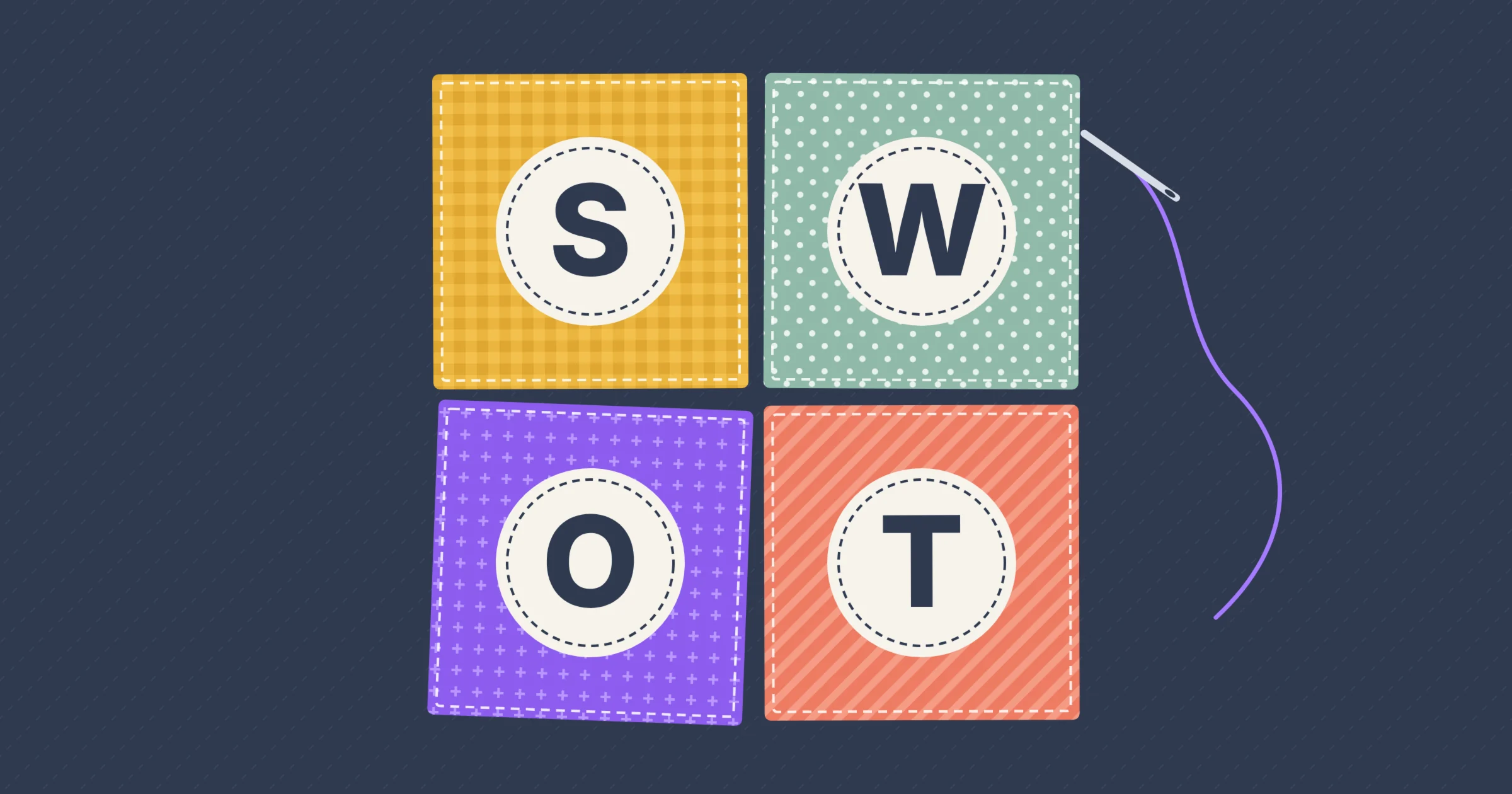
A SWOT analysis is a simple planning tool that lists an organisation’s strengths, weaknesses, opportunities and threats in a four-box grid. Strengths and weaknesses are internal: things you control, such as your product, team or reputation. Opportunities and threats are external: changes in the market, customers, competitors or rules that you cannot control but must respond to.
This guide explains how to do a SWOT analysis that leads to decisions rather than a list nobody reads again. It covers the six steps, a worked example for a small UK business, a template you can copy and the TOWS matrix that turns the four boxes into strategy, before looking at where SWOT usually goes wrong. A SWOT is one of the inputs to a digital marketing strategy, and it is most useful when it is done as part of one.
What is a SWOT analysis?
SWOT stands for strengths, weaknesses, opportunities and threats. The grid places helpful factors on the left and harmful factors on the right, with internal factors on the top row and external factors on the bottom. That layout makes one question unavoidable: given what we are good and bad at, what should we do about what is happening around us?
| Helpful | Harmful | |
|---|---|---|
| Internal (you control it) | Strengths: what you do better than competitors, and what customers value you for | Weaknesses: what holds you back, or where competitors are better |
| External (you respond to it) | Opportunities: changes you could benefit from | Threats: changes that could hurt you |
The method is older than its usual textbook story. Research published in Long Range Planning traces it to corporate planning work at Lockheed and the Stanford Research Institute in the 1950s and 1960s, where an earlier approach called SOFT became SWOT in 1967. It has lasted because it is quick, needs no data to start and works for a whole company, a single brand, a product or a marketing channel.
Internal and external factors
Most weak SWOTs put things in the wrong box. The test is control. If you could change it next quarter with enough effort or money, it is internal. If it would happen whether or not your business existed, it is external.
- Internal examples: product quality, prices, margins, team skills, customer reviews, website speed, brand awareness, email list size, cash available for marketing.
- External examples: new competitors, changes in search and AI answers, shifts in customer habits, new regulations, supplier costs, the economy, seasonal demand.
A common slip is writing “launch a TikTok channel” as an opportunity. That is an action. The opportunity is the external change behind it, such as “more of our audience searches for product reviews on TikTok”, and the action comes later, when you match it to a strength.
How to do a SWOT analysis in 6 steps
- Set the question. Decide what the SWOT is for: a new product launch, next year’s marketing plan or whether to enter a new market. A SWOT of “the business in general” produces general answers.
- Gather evidence first. Pull together sales and channel data, customer reviews and survey answers, and what competitors are doing. A digital marketing audit gives you most of the internal evidence, and a perceptual map shows how customers see you against rivals.
- List factors with the right people in the room. Include someone who talks to customers every day, such as sales or customer service. Write each factor as a specific, checkable statement: “4.8 average rating from 600 Google reviews” rather than “good reputation”.
- Judge each factor relative to competitors. Fast delivery is only a strength if it is faster than the alternatives customers compare you with. If everyone offers it, it is a minimum requirement.
- Cut and rank. Keep three to five factors per box and put the most important first. A short list forces the team to agree what actually matters.
- Turn it into actions. Use the TOWS matrix below to pair factors into strategies, then give each one an owner, a deadline and a measure in your marketing plan.
SWOT analysis example
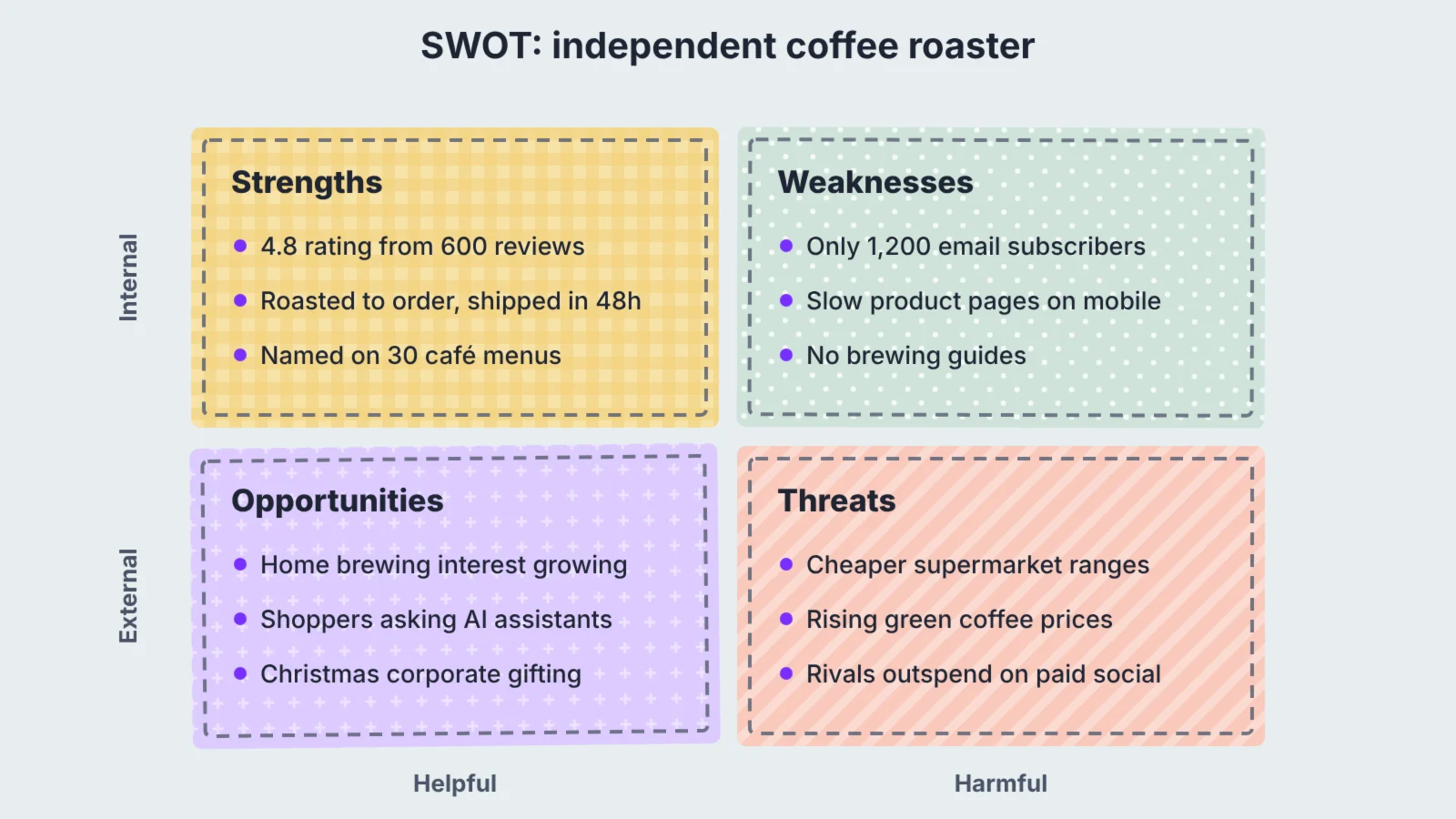
Here is a SWOT for a fictional independent coffee roaster in Bristol that sells beans online and to local cafés, and wants to grow its online subscriptions next year.
| Strengths | Weaknesses |
|---|---|
| 4.8 average rating from 600 reviews Roasts to order, beans shipped within 48 hours Supplies 30 local cafés, which name it on their menus | Only 1,200 email subscribers Product pages load slowly on mobile No content that answers brewing questions |
| Opportunities | Threats |
|---|---|
| Growing interest in home brewing equipment Customers asking AI assistants for coffee recommendations Corporate gifting demand before Christmas | Supermarket own-label specialty ranges at lower prices Rising green coffee prices squeezing margins Larger roasters outspending it on paid social |
Notice what the example avoids. “Great coffee” is missing from the strengths because every roaster claims it; the reviews and café list are the evidence that customers agree. “Start an Instagram account” is missing from the opportunities because it is an action, not a change in the market.
A SWOT analysis template
Copy this table into a document or spreadsheet. The prompts in each box help you find factors that are specific and backed by evidence.
| Box | Questions to ask | Evidence to use |
|---|---|---|
| Strengths | Why do customers choose us over the alternatives? What do we do that competitors find hard to copy? Which channels already work well? | Reviews, win and loss reasons from sales, best-performing channels, repeat purchase rate |
| Weaknesses | Why do people choose a competitor instead? Where do we lose customers? What do we lack in skills, budget or tools? | Complaints, lost deals, funnel drop-offs, audit findings |
| Opportunities | What is changing in our customers’ habits, our market, technology or regulation that could help us? Which needs are competitors ignoring? | Search trends, industry reports, customer interviews, competitor gaps |
| Threats | What could reduce demand or raise our costs? Who could take our customers? Which rules or platforms could change against us? | Competitor moves, cost data, regulatory updates, platform announcements |
For the external boxes, a structured scan of political, economic, social, technological, legal and environmental changes (often called PESTLE) stops you from missing whole areas. Research into customer needs helps too: a customer journey map often reveals both weaknesses and opportunities at the points where people get stuck.
From SWOT to strategy: the TOWS matrix
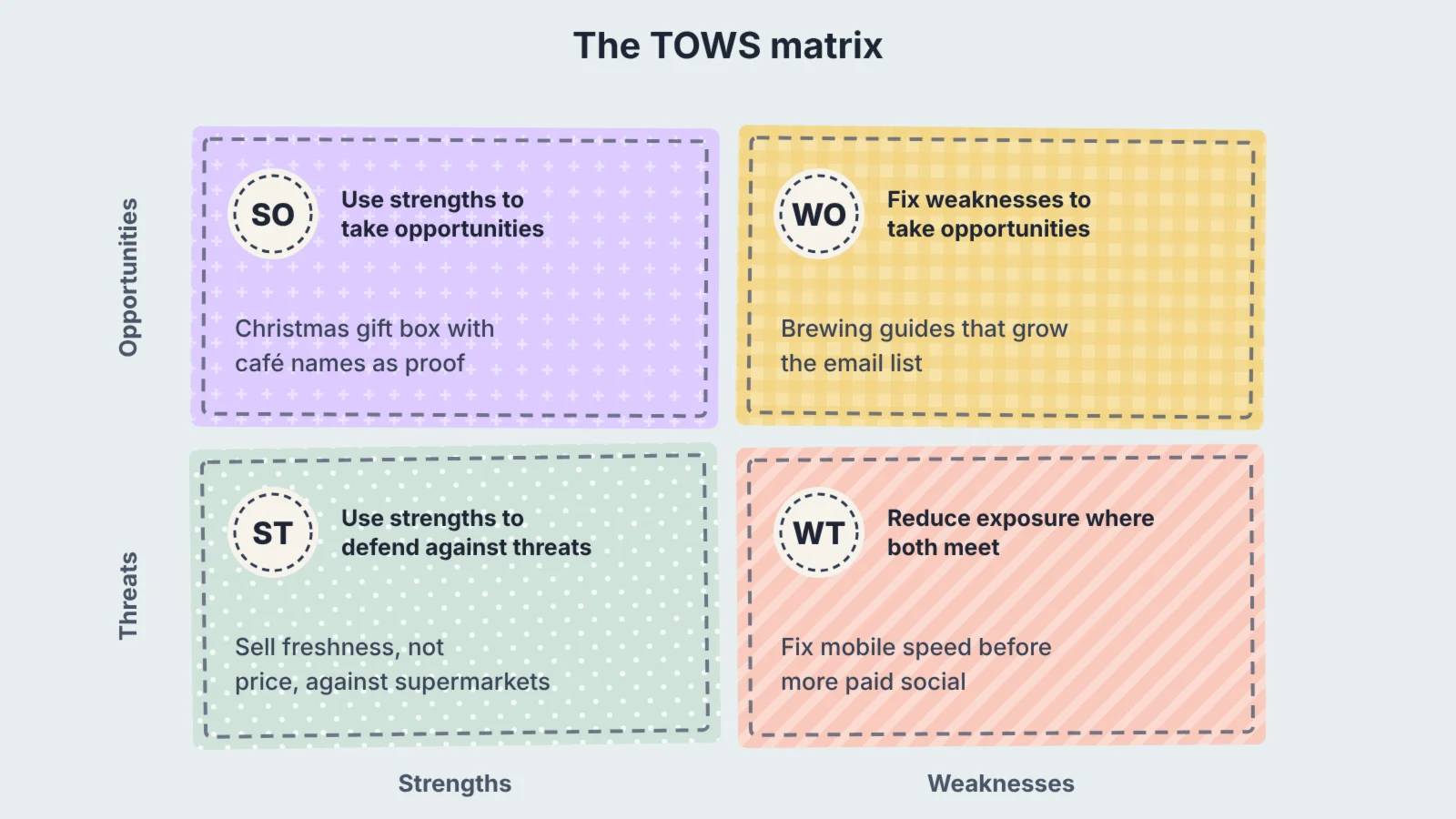
A SWOT describes a situation. The TOWS matrix, introduced by Heinz Weihrich in Long Range Planning in 1982, turns it into options by pairing internal factors with external ones. Each pairing produces a different type of strategy:
| Pairing | Question | Coffee roaster example |
|---|---|---|
| SO (strengths with opportunities) | How can we use our strengths to take this opportunity? | Launch a corporate gift box for Christmas, using the café names and reviews as proof |
| WO (weaknesses with opportunities) | Which weakness stops us taking this opportunity, and how do we fix it? | Publish brewing guides for home equipment, which builds the email list and answers the questions AI assistants draw on |
| ST (strengths against threats) | How can our strengths reduce this threat? | Promote freshness (“roasted to order, with you in 48 hours”) against supermarket ranges rather than competing on price |
| WT (weaknesses and threats together) | Where are we most exposed, and what should we stop or protect? | Fix mobile page speed before spending more on paid social, so each click costs less to convert |
You will not act on every pairing. Pick the two or three strategies with the biggest expected impact, then check that they fit your brand positioning. A strategy that wins short-term sales but contradicts what you want to be known for usually costs more later.
Where SWOT goes wrong
SWOT has a poor record when it is done badly. In a study of companies in a UK Department of Trade and Industry planning scheme, Terry Hill and Roy Westbrook found that the SWOTs consultants produced had over 40 factors on average, used general descriptions, set no priorities and verified nothing. Most strikingly, no one used the results in the later stages of planning. Their paper was titled “SWOT analysis: it’s time for a product recall”.
The same mistakes still appear:
- Lists that are too long. Forty factors cannot all matter. Ranking forces the real discussion.
- Vague statements. “Strong brand” or “competitive market” cannot be checked or acted on. Add the evidence or remove the line.
- Opinions without evidence. Teams tend to overrate their strengths. Customer reviews and lost-deal reasons are a better guide than internal belief.
- Actions in the opportunity box. Keep the market change and your response separate, or you will skip the step of checking whether the response suits your strengths.
- Doing it once. Markets move. Review the SWOT when you plan each year and whenever something significant changes, such as a new competitor or a platform change that affects your traffic.
- Stopping at the grid. A SWOT without TOWS, owners and KPIs is a description, not a plan.
Frequently asked questions
What does SWOT stand for?
SWOT stands for strengths, weaknesses, opportunities and threats. Strengths and weaknesses are internal factors you control, while opportunities and threats are external changes you need to respond to.
How do you write a SWOT analysis?
Set a clear question, gather evidence, list specific factors in each of the four boxes, judge them against competitors and keep the top three to five per box. Then pair them in a TOWS matrix to decide what to do.
What is the difference between SWOT and PESTLE?
PESTLE scans the external environment across political, economic, social, technological, legal and environmental factors. Its findings usually feed the opportunities and threats boxes of a SWOT, which also covers your internal strengths and weaknesses.
What is a TOWS matrix?
A TOWS matrix pairs SWOT factors to create strategies: strengths with opportunities (SO), weaknesses with opportunities (WO), strengths against threats (ST) and weaknesses with threats (WT). It turns a SWOT description into options you can act on.
How often should you do a SWOT analysis?
Review it at least once a year as part of planning, and again when something significant changes, such as a new competitor, a price shift or a change in how customers find you.
On this page
Back to topTurn your SWOT into a plan
Kutola helps you build the evidence behind each box, from channel data to customer research, and turn the findings into priorities you can act on. Most projects start with an audit of where you stand today. Get in touch to talk through yours.