Marketing plan: the 8 sections to include, with an example and a one-page template

A marketing plan is a document that sets out the marketing work a business will do over a fixed period, usually twelve months: what it wants to achieve, who it is aiming at, which channels and activities it will use, when each one happens, what it costs, who owns it and how results will be measured. It is the working version of your strategy, written so that a team can follow it week by week.
If your digital marketing strategy says where you are going and why, the marketing plan says how you will get there this year. This guide explains what a marketing plan is, the eight sections it should contain and the order to write them in. It includes a worked example for an independent garden centre, a one-page template you can copy and the mistakes that leave most plans unused by March.
What is a marketing plan?
A marketing plan turns broad choices into dated, costed actions. “Win more local families” is a strategic choice. “Run a spring half-term workshop series, promoted to 3,000 email subscribers and through Facebook ads in a ten-mile radius, budget £1,800, owned by the events manager” is a line in a marketing plan.
Three documents are often confused with it. The difference between strategy, plan and tactics is covered in detail in the strategy guide, so here is the short version:
| Document | Question it answers | Time frame |
|---|---|---|
| Marketing strategy | Where are we going, for whom and why will they choose us? | One to three years |
| Marketing plan | What will we do, when, with what budget and who owns it? | Twelve months, in quarters |
| Business plan | How will the whole business make money, including finance and operations? | Three to five years |
| Content calendar | What will we publish, on which channel and on which day? | Weeks to a quarter |
A business plan usually contains a marketing section, and GOV.UK’s guide to writing a business plan links to free templates that include one. That section is a summary. The marketing plan is where the detail lives, and a content calendar sits underneath it for the day-to-day publishing.
Why write a marketing plan?
Marketing money is under scrutiny. Gartner’s 2025 CMO Spend Survey found that marketing budgets had flatlined at an average of 7.7% of company revenue, so most teams are expected to do more with the same money. In the UK the picture has improved since: in the third quarter of 2026, 25.6% of IPA Bellwether panellists raised their marketing budgets and 11.3% cut them, the third quarter of growth in a row. Whether your budget is rising or flat, a plan is how you show where it goes and what it returns.
A written plan also does four practical jobs:
- It makes decisions once. Without a plan, every new idea, sales call and agency pitch reopens the question of what you should be doing.
- It fixes the timing. Seasonal peaks, launches and events need preparation weeks in advance. A plan puts that lead time in the diary.
- It gives everyone an owner. Named owners turn “we should do more email” into work that actually happens.
- It makes results comparable. When targets are written down at the start, a quarterly review becomes a comparison, not a debate.
The 8 sections of a marketing plan
Formats vary, but most good plans contain the same eight sections. For a small business each one can be a few lines. For a larger team it may run to a page.
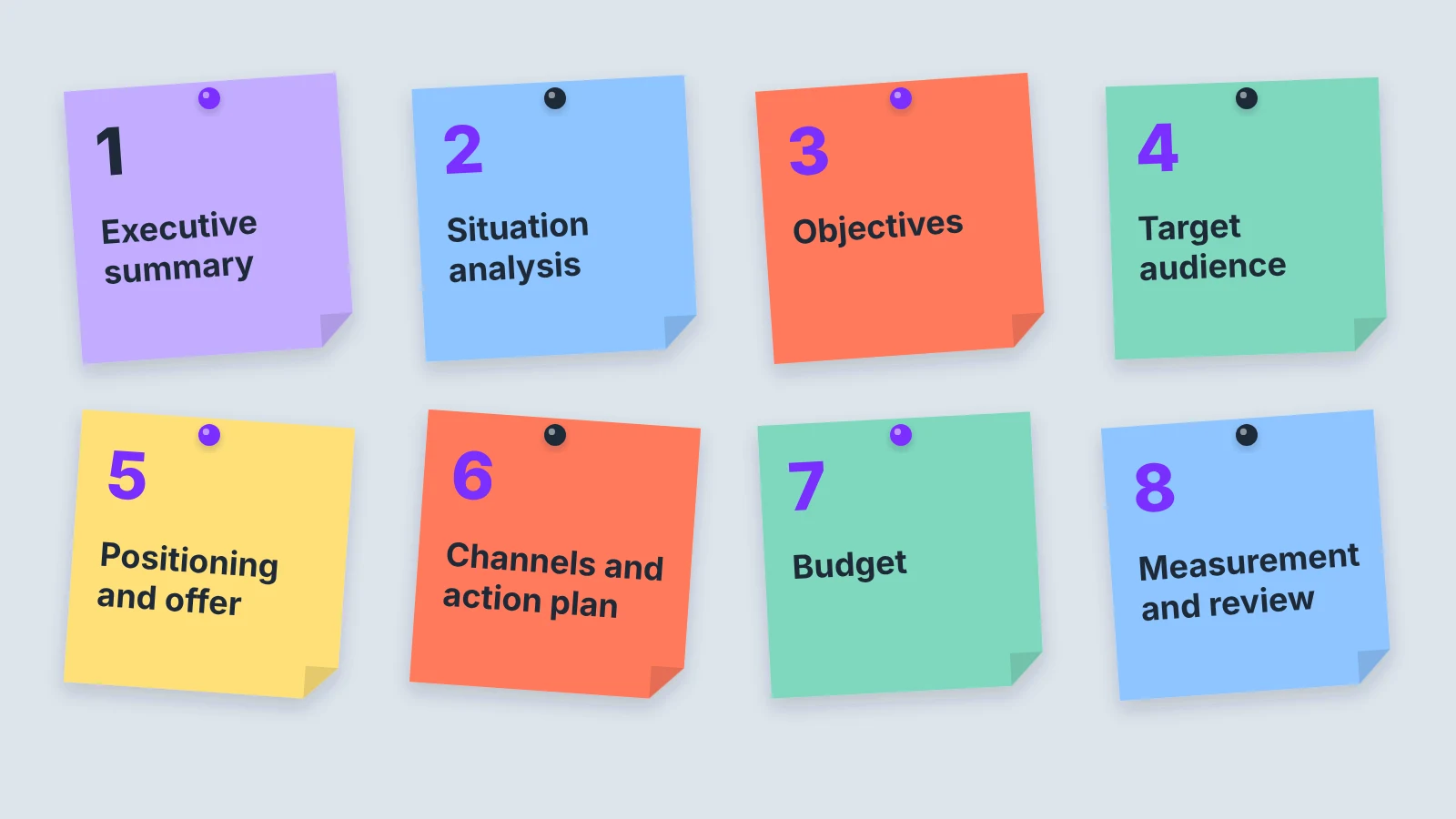
1. Executive summary
Half a page that a director could read in two minutes: the main objective, the headline activities, the total budget and the three numbers you will report on. Write it last, once everything else is settled.
2. Situation analysis
Where you stand today: last year’s results by channel, what customers say, what competitors are doing and any changes in the market. A SWOT (strengths, weaknesses, opportunities and threats) is a common way to summarise it. If you have not reviewed your channels recently, the digital marketing audit guide shows how to gather this evidence in a few days. Keep only the findings that change what you will do.
3. Objectives
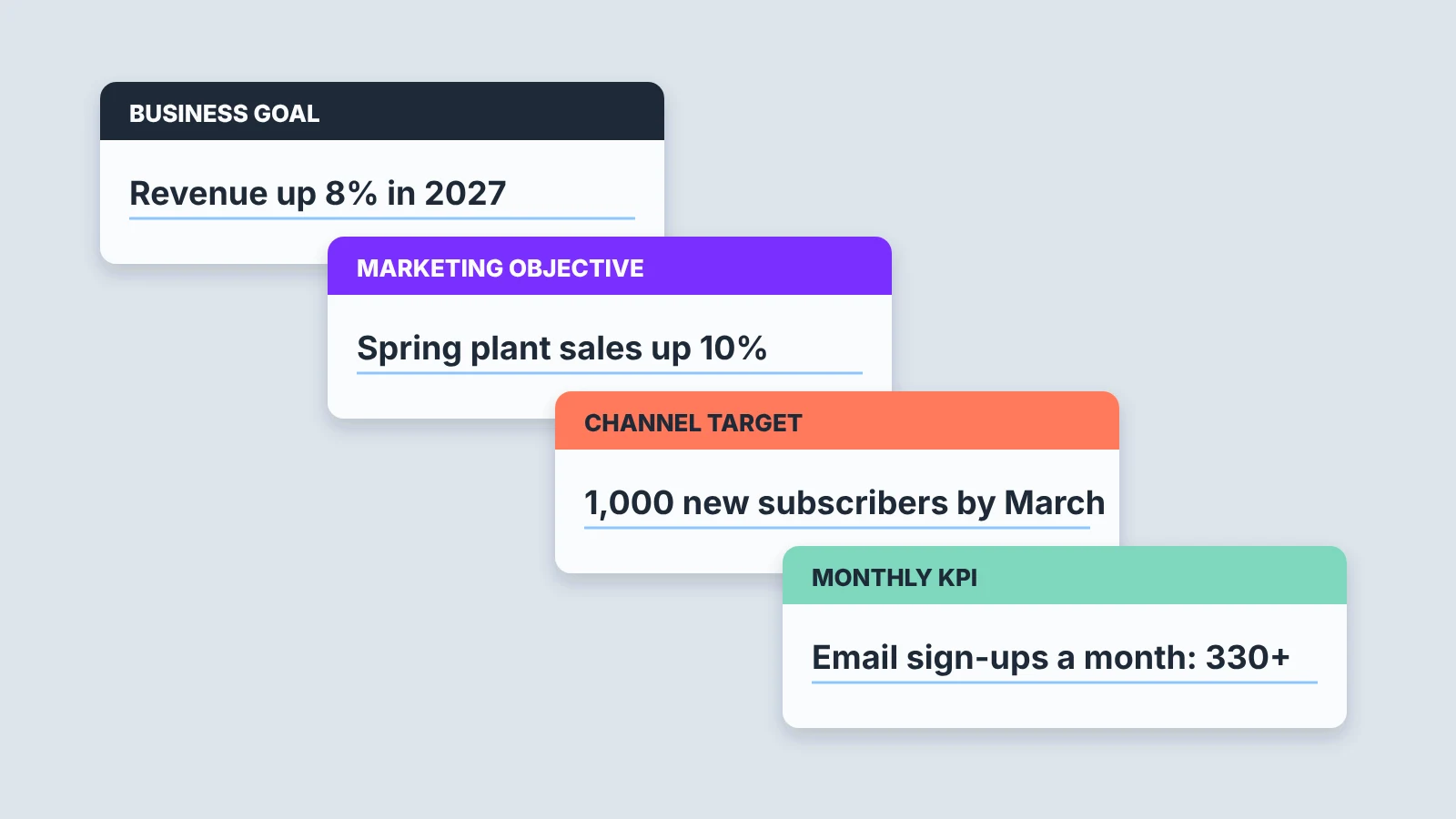
Two to four marketing objectives, each tied to a business goal and written with a number and a deadline. The common test is SMART: specific, measurable, achievable, relevant and time-bound. Then break each objective into channel targets, so every activity in the plan can be traced back to it.
4. Target audience
The one to three segments this year’s plan focuses on, with what they need, where they look for it and what stops them buying. If you have a customer journey map, its pain points are a ready-made list of things the plan should fix.
5. Positioning and offer
Why the audience should choose you, and what you are actually selling them this year. Paste in your positioning statement rather than rewriting it; if you do not have one, a positioning statement template takes an hour to complete. Many plans also review the marketing mix here. The Chartered Institute of Marketing describes the 7Ps (product, price, place, promotion, people, process and physical evidence) as a tool for planning and checking that every part of the offer fits customer expectations.
6. Channels and action plan
The core of the document. List the channels you will use and, for each one, the campaigns and always-on activity planned by quarter, with an owner and a start date. Check the mix against the stages of the marketing funnel: a plan made entirely of offers and retargeting will run out of new customers, and one made entirely of awareness work will struggle to show sales.
7. Budget
The cost of each activity, including people, agencies, tools and media, totalled by quarter. Build it from the objectives backwards: how many customers you need, what you can afford to pay for each one (your customer acquisition cost) and what each channel is likely to cost. Hold back around 10% for tests and for the opportunities no plan predicts.
8. Measurement and review
The KPIs for each objective, where the numbers come from and when they are reviewed. A simple rhythm works for most businesses: channel metrics monthly, the plan quarterly and the strategy once a year. Name the person who prepares the report, or it will not exist.
How to write a marketing plan in 6 steps
The sections above are the finished document. This is the order that gets you there with the least rewriting:
- Collect last year’s numbers. Sales by month, enquiries or orders by channel and what each channel cost. Seasonality in these figures will shape the whole calendar.
- Agree the business goals with whoever signs off the budget. A plan built on goals nobody agreed to will be rewritten in February.
- Set objectives and channel targets. Work backwards from the goal to the number of leads, visits or orders each channel needs to deliver.
- Map the year. Mark peaks, launches, events and quiet months, then place campaigns so that preparation starts six to eight weeks before each peak.
- Cost it and cut it. Add up the activities. If the total is over budget, drop the activities that serve no objective first, not the ones that are hardest to measure.
- Write the summary and share it. Send the one-page version to everyone who has a task in it, and book the four quarterly reviews in the diary now.
Start-ups writing their first plan can also use the Start Up Loans Essential Guide to Marketing, which covers market research, channels and creating a marketing plan.
Marketing plan example: an independent garden centre
This example is illustrative. It shows how a plan follows the shape of a real trading year. For garden centres that shape is extreme: the Horticultural Trades Association reports that May is traditionally the busiest month for garden centre sales, and Christmas brings a second peak.
The business: a family-run garden centre with a café on the edge of a market town in Kent. Objective: grow revenue 8% in 2027, mainly by lifting spring plant sales and café visits on weekdays. Audience: local homeowners aged 35 and over, and young families looking for a weekend outing. Budget: £30,000 for campaigns, a £3,000 reserve for tests and staff time.
| Quarter | Focus | Main activity | Budget | KPI |
|---|---|---|---|---|
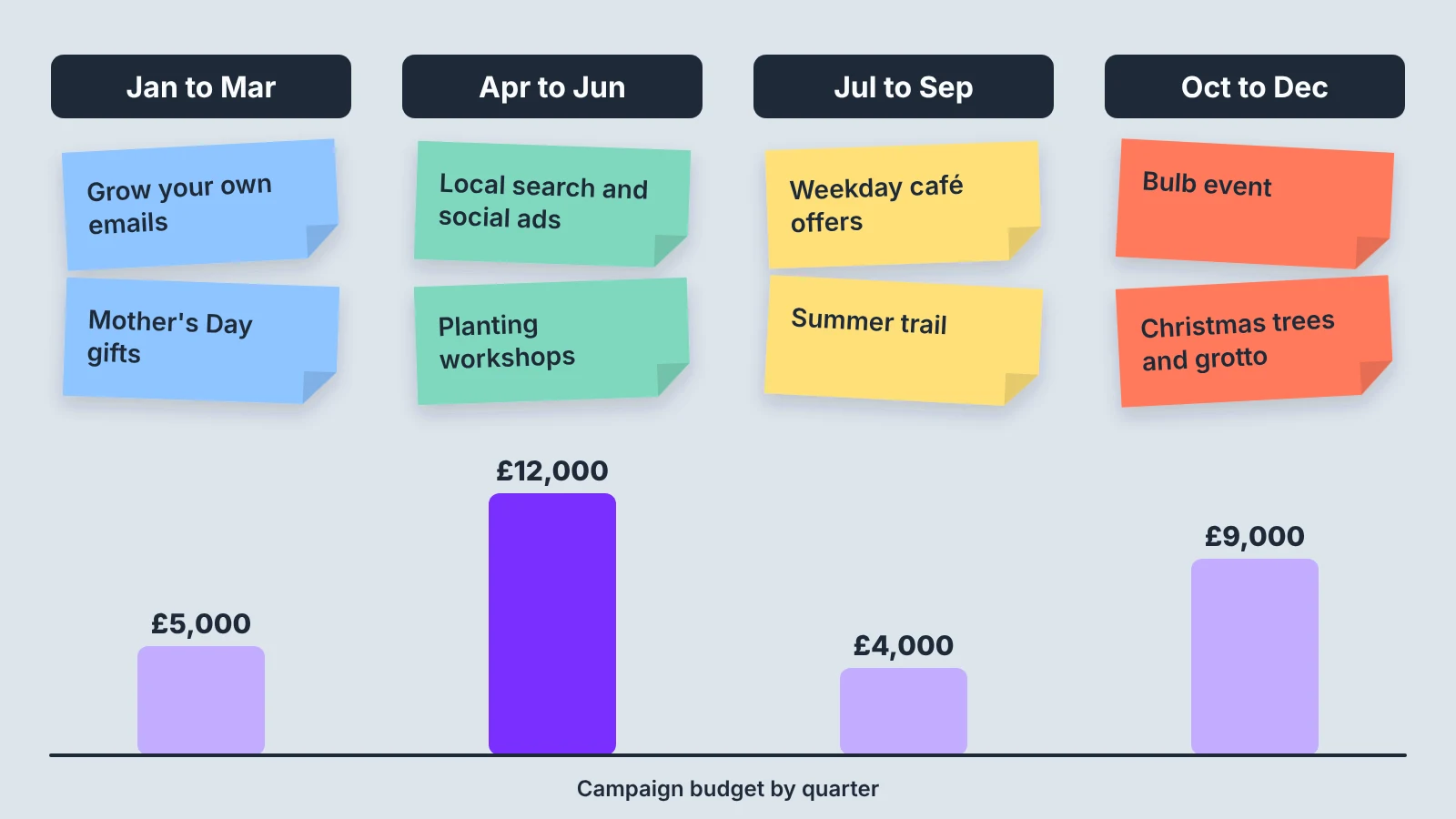
| January to March | Prepare for spring | “Grow your own” email series, Mother’s Day gift campaign, refresh Google Business Profile photos and opening hours | £5,000 | 1,000 new email subscribers |
| April to June | Win the peak | Local search and Facebook ads within ten miles, weekend planting workshops, weekly stock emails during May | £12,000 | Spring plant sales up 10% on 2026 |
| July to September | Fill the quiet months | Weekday café offers for retirees, summer holiday trail for families, review requests after workshops | £4,000 | Weekday café covers up 15% |
| October to December | Second peak | Autumn bulb event, Christmas tree pre-orders, grotto bookings and gift cards | £9,000 | Christmas revenue up 6%, plan review in January |
Two decisions make this plan work. Forty per cent of the campaign budget goes into the spring quarter, because that is where most of the year’s plant revenue is earned. And the email list built from January to March is the cheapest channel for the May rush, so the plan invests in it before the peak rather than during it.
One-page marketing plan template
Copy this into a document or spreadsheet. If a section does not fit in the space of a few sentences, the thinking behind it probably is not finished.
| Section | What to write | Prompt |
|---|---|---|
| Summary | Main objective, headline activities, total budget | What would a director need to know in two minutes? |
| Situation | Three to five findings from last year and the market | What has changed, and what worked? |
| Objectives | Two to four targets with numbers and dates | Which business goal does each one serve? |
| Audience | One to three segments and their main barrier | Who are we focusing on this year, and who are we not? |
| Positioning and offer | Positioning statement, key products, pricing changes | Why should this audience choose us now? |
| Channels and actions | Activities by quarter, each with an owner and start date | Which objective does this activity move? |
| Budget | Cost per activity and per quarter, plus a test reserve | What is the most we can pay for a new customer? |
| Measurement | KPIs, data sources, review dates and report owner | How will we know by the end of March if this is working? |
Common marketing plan mistakes
- Writing a plan without a strategy. A list of activities with no agreed audience or position becomes a list of things competitors are doing.
- Objectives with no numbers. “Grow brand awareness” cannot be planned against or reviewed. Decide how it will be measured, or replace it.
- Spreading the budget evenly across the year. Demand is rarely even. Put the money where and when your customers buy.
- Planning activity, not capacity. A plan that needs two extra days a week from a team that does not have them will fail by the second quarter.
- Ignoring the rules. Email consent, ad labelling and review collection all have legal requirements in the UK. The UK rules to build into your strategy apply to every campaign in the plan.
- Never opening it again. A plan without booked quarterly reviews becomes a record of what you once intended to do.
Frequently asked questions
What is a marketing plan?
A marketing plan is a document that sets out the marketing activities a business will carry out over a set period, usually a year. It covers objectives, target audience, channels, timing, budget, owners and how results will be measured.
What are the main sections of a marketing plan?
Most marketing plans have eight sections: an executive summary, a situation analysis, objectives, target audience, positioning and offer, channels and action plan, budget, and measurement and review.
What is the difference between a marketing plan and a marketing strategy?
A marketing strategy decides the goals, audience, position and channel mix, usually over one to three years. A marketing plan sets out what will be done, when, by whom and at what cost, usually over twelve months. See strategy vs plan vs tactics for more.
How long should a marketing plan be?
A small business can fit its marketing plan on one or two pages, with a quarterly action list attached. Larger teams often need more detail on budget and ownership, but the summary should still fit on one page.
How much should a small business spend on marketing?
There is no fixed rule. Work out how many customers you need and what you can afford to pay for each one, then cost the activities that will win them. Gartner’s 2025 survey of mostly large companies put average marketing budgets at 7.7% of revenue.
How often should you update a marketing plan?
Review results monthly, update the plan every quarter and write a new one each year. Update it sooner if a major change hits your market, product or budget.
On this page
Back to topTurn next year’s goals into a plan your team will use
Kutola helps businesses build marketing plans that start from real objectives, put the budget where customers actually buy and come with a review rhythm that keeps the plan alive. Get in touch to plan your next twelve months.