Is AI recommending your business? How to track AI visibility

AI visibility is how often AI tools such as ChatGPT, Gemini, Copilot, Perplexity and Google’s AI Overviews mention, recommend or cite your business when people ask them about your market. You track it in two ways: by asking those tools your customers’ questions on a fixed schedule and recording what they say, and by reading the few reports the platforms now share with site owners in Google Search Console, Bing Webmaster Tools and Google Analytics.
This guide covers what to measure, which free reports exist and what each one misses, how to build a prompt list you can repeat every month and when a paid AI visibility tool is worth the money. Why AI tools choose some sources over others is explained in the guide to generative engine optimisation.
What is AI visibility?
AI visibility has two layers. The first is a mention: the answer names your brand, perhaps in a list of suppliers worth considering. The second is a citation: the answer links to a page on your site as one of its sources. You can be mentioned without being cited, when the tool knows you from reviews or press coverage, and cited without being recommended, when your article explains the topic but a competitor gets the recommendation.
Mentions decide whether a buyer puts you on a shortlist. Citations bring the occasional visitor and show which of your pages AI systems trust. A useful tracking routine records both, along with what the answer actually says about you.
The audience is already large. Ofcom’s Online Nation 2025 report counted 1.8 billion UK visits to ChatGPT in the first eight months of 2025, up from 368 million in the same period a year earlier. Many of those visits are people asking which accountant, software or holiday company to choose.
Why AI visibility is hard to measure
A search ranking is a single position you can check. AI visibility is harder to pin down for three reasons.
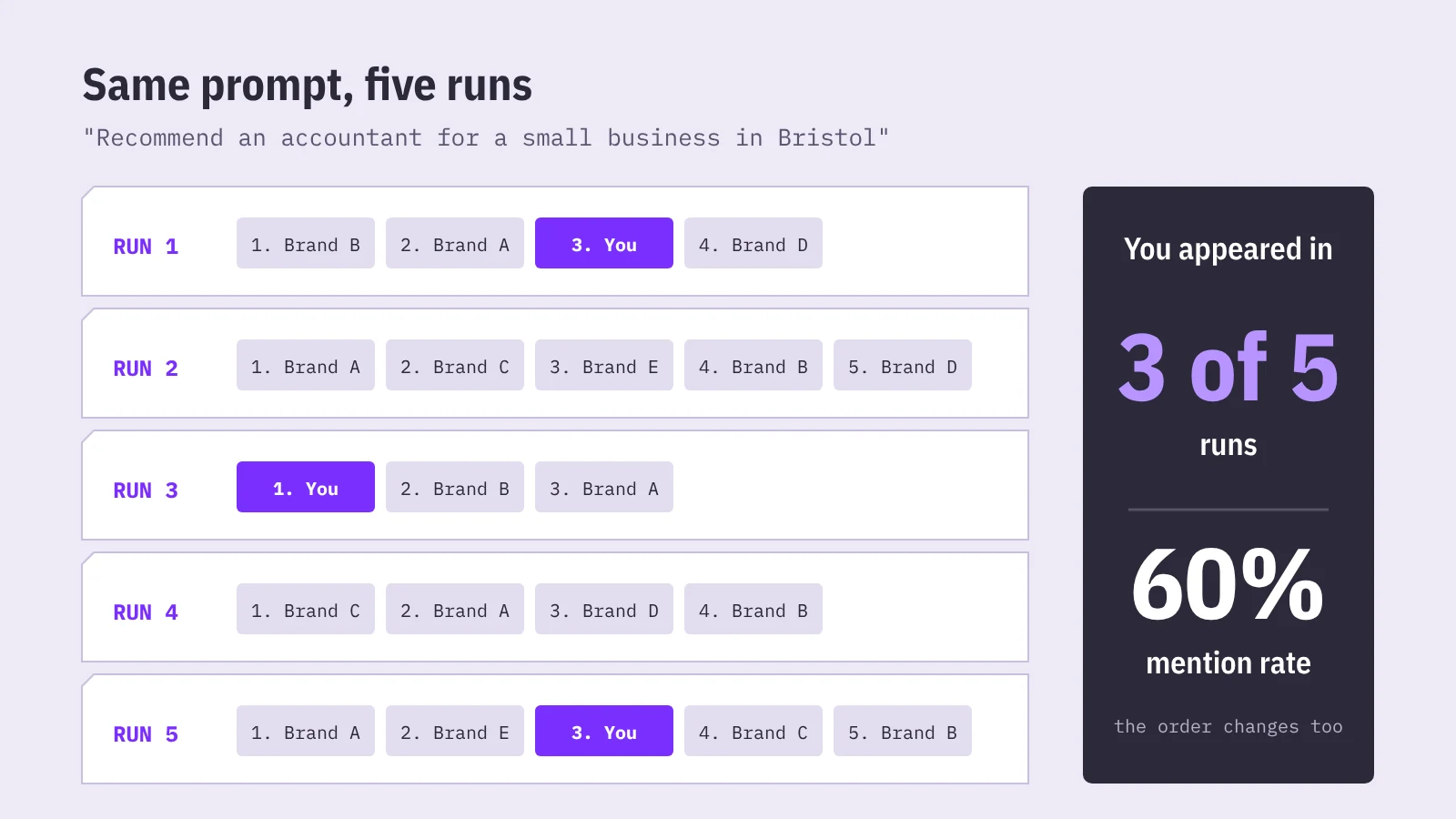
- Answers change every time. In a SparkToro and Gumshoe study of nearly 3,000 responses, ChatGPT and Google’s AI tools returned the same list of brands less than once in 100 runs of the same prompt, and the same list in the same order about once in 1,000. Your position in one answer tells you little. How often you appear across many answers is the number that holds up.
- Most answers send no visit. In Conductor’s 2026 AEO / GEO benchmarks, based on US data from 13,770 enterprise domains, AI referrals made up 1.08% of website traffic. SE Ranking’s traffic study put the share at 0.32% in 2026, with Google search sending about 134 times more visitors. Counting visits alone badly undercounts how often you are seen.
- Each platform reports only on itself, if at all. Google and Microsoft now share some data with site owners. At the time of writing, ChatGPT, Perplexity and Claude offer no report on how often they cite your site, so for them you rely on referral traffic and your own tests.
What to measure
No single figure captures AI visibility, so most businesses track a small set of signals side by side.
| Metric | What it tells you | Where to find it |
|---|---|---|
| Mention rate | The share of your test prompts where the answer names you | Your prompt list or a tracking tool |
| AI share of voice | Your mentions compared with named competitors on the same prompts | Your prompt list or a tracking tool |
| Citations | Which of your pages AI answers link to, and on which topics | Search Console, Bing Webmaster Tools, Microsoft Clarity |
| Accuracy | Whether prices, services, locations and opening hours are described correctly | Reading the answers |
| AI referral traffic | Visits, engagement and conversions from AI assistants | Google Analytics 4 |
| Branded search | Whether more people search for your name after meeting it in answers | Search Console queries, Google Trends |
For most small businesses, mention rate and accuracy come first. A wrong price or a service you stopped offering does more damage than a missing mention, because the buyer believes it. Share of voice matters once you know who you compete with in answers, which is not always the list of rivals you see in Google. Branded search moves slowest, but it is the closest to revenue, and it works well alongside share of search and other brand KPIs.
Free AI visibility reports
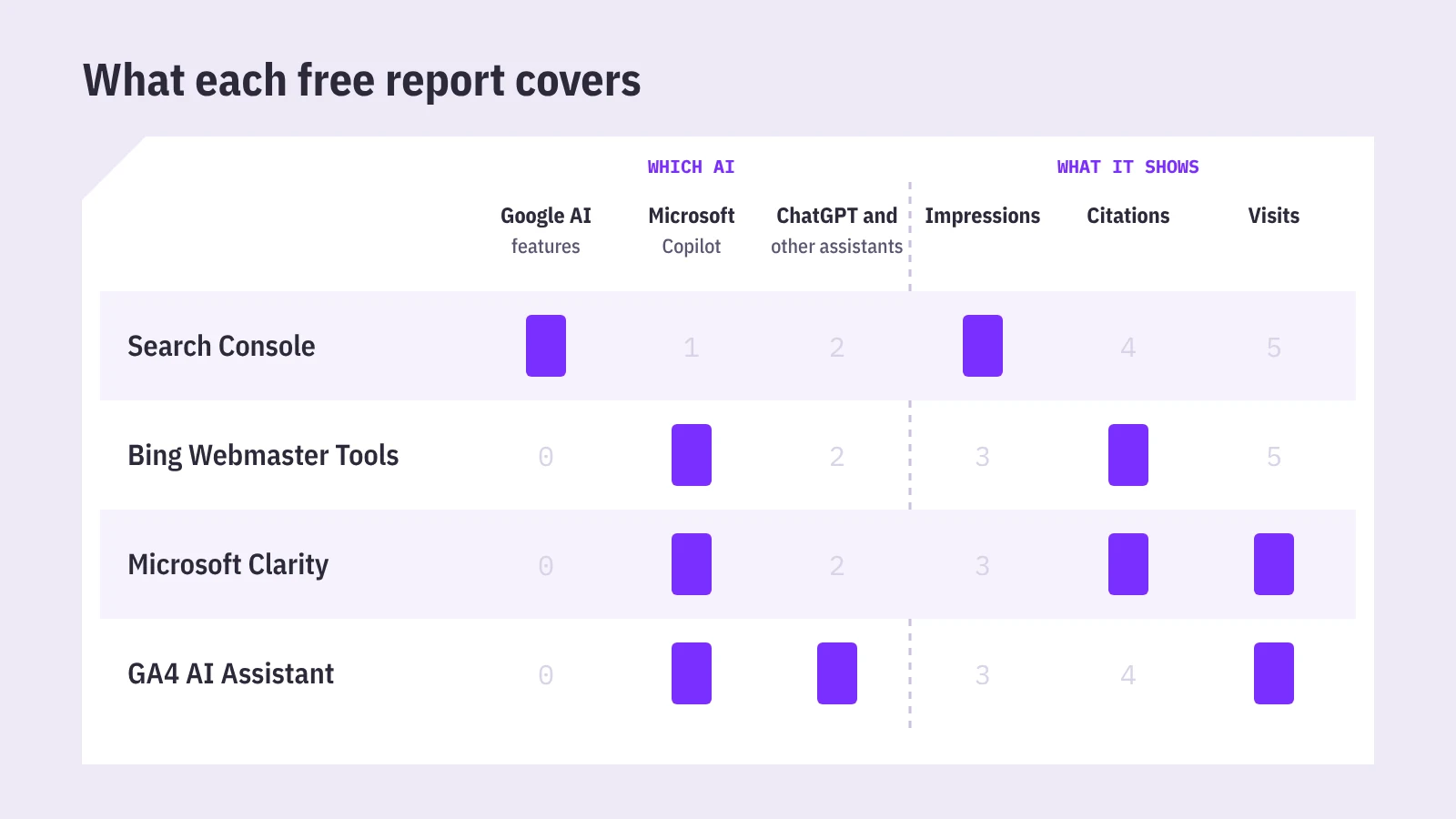
Four free reports now cover part of the picture. Each is worth setting up, and each has a gap.
| Report | Covers | Shows | Missing |
|---|---|---|---|
| Search Console generative AI report | AI Overviews and AI Mode | Impressions by page, country, device and date | Clicks, queries and a split between the two features |
| Bing Webmaster Tools AI Performance | Copilot, Bing’s AI summaries and some partners | Citations, cited pages and grounding queries | Clicks, and any AI outside Microsoft |
| Microsoft Clarity Citations | Microsoft’s AI answers | Cited pages, grounding queries and AI-referred visits next to on-site behaviour | Other AI tools’ citations |
| GA4 AI Assistant channel | Visits from recognised AI assistants | Sessions, engagement and conversions | Visits that arrive without a referrer |
Google Search Console. Google introduced its generative AI performance reports in June 2026 and they are now available to every property. Clicks from AI features stay in the standard Performance report. Both Search Console reports for AI features are explained step by step in the AI Overviews guide.
Bing Webmaster Tools. Microsoft opened AI Performance as a public preview in February 2026. Grounding queries are the search phrases the AI used to find your page, not the question the user typed, so read them as topics rather than prompts. The query list is a sample, not a full count.
Microsoft Clarity. The Citations dashboard, under Dashboards and AI Visibility, puts citation data in the same free tool that records how visitors use your pages. It is useful for seeing what people do once an AI answer sends them to you.
Google Analytics 4. Since May 2026, GA4 has grouped visits from AI assistants such as ChatGPT and Gemini into an AI Assistant channel, defined in Google’s traffic-source dimensions as sessions with the medium “ai-assistant”. Detection relies on the referrer, so visits from apps that pass none still appear as Direct. Treat the channel as a minimum, and compare its conversion rate with organic search before deciding how much effort AI deserves.
How to track AI visibility with a prompt list
A prompt list is a fixed set of questions you put to AI tools every month. It is the only method that covers every assistant, and a spreadsheet is enough to start.
- Collect real questions. Use enquiry forms, sales calls, emails, Search Console queries written as questions and People Also Ask boxes. The section on keyword research for AI search shows how to turn short keywords into the longer questions people type into AI tools.
- Write 20 to 30 prompts across the buying journey. Include early research questions, requests for recommendations, comparisons with named competitors and questions about your brand itself. Add a town or region wherever your customers would.
- Choose the tools your customers use. ChatGPT is the obvious start for most UK audiences, followed by Google’s AI Overviews and AI Mode, Gemini and Copilot. Add Perplexity or Claude if your buyers work in technology or research.
- Run each prompt in a clean session. Use a private window, log out or turn memory off, because your own history changes the answers. Given how much answers vary, run each prompt three to five times per tool rather than once.
- Record the same fields every time. Note whether you were mentioned, which of your pages was cited, which competitors were named and anything wrong or out of date.
- Work out the rates. Mention rate is the share of runs that named you. Share of voice is your mentions divided by all brand mentions across the same runs. Compare each tool with last month, not with each other.
Here is how the start of a list might look for an accountancy firm in Bristol:
| Prompt | Stage |
|---|---|
| How much does an accountant cost for a sole trader in the UK? | Research |
| Do I need an accountant for Making Tax Digital? | Research |
| Recommend accountants for small businesses in Bristol | Shortlist |
| [Firm] or [competitor] for limited company accounts? | Comparison |
| Is [Firm] a good accountant for freelancers? | Brand |
Keep the list unchanged for at least three months. If the prompts change every month, a rise or fall tells you about the new questions, not about your visibility. Add new prompts as a separate group and compare them only with themselves.
AI visibility tools: when to pay
Running prompts by hand works up to a few dozen questions. Beyond that, AI visibility tools run your prompts automatically, repeat them, track competitors and keep the history. They fall into three groups:
- Free checkers such as Ahrefs’ AI visibility checker give a quick snapshot of how AI tools describe a brand. They suit a first look, not monthly trends.
- AI modules in SEO suites such as Semrush’s AI Visibility Toolkit and SE Ranking’s AI search tracking make sense if your team already pays for the suite.
- Dedicated platforms such as Profound and Peec AI focus only on AI answers and suit brands tracking hundreds of prompts.
Before you pay for any of them, check:
- Which assistants it covers, and whether it asks them as a UK user.
- Whether each prompt runs several times, so a mention rate is an average and not one lucky answer.
- Whether it shows the sources each answer cites, not only brand mentions.
- Whether you can add your own prompts and competitors.
- How it shows change over time, and whether you can export the data.
A tool reports what a careful spreadsheet would, faster and at a larger scale. It will not tell you why an answer leaves you out.
What to do when AI leaves you out
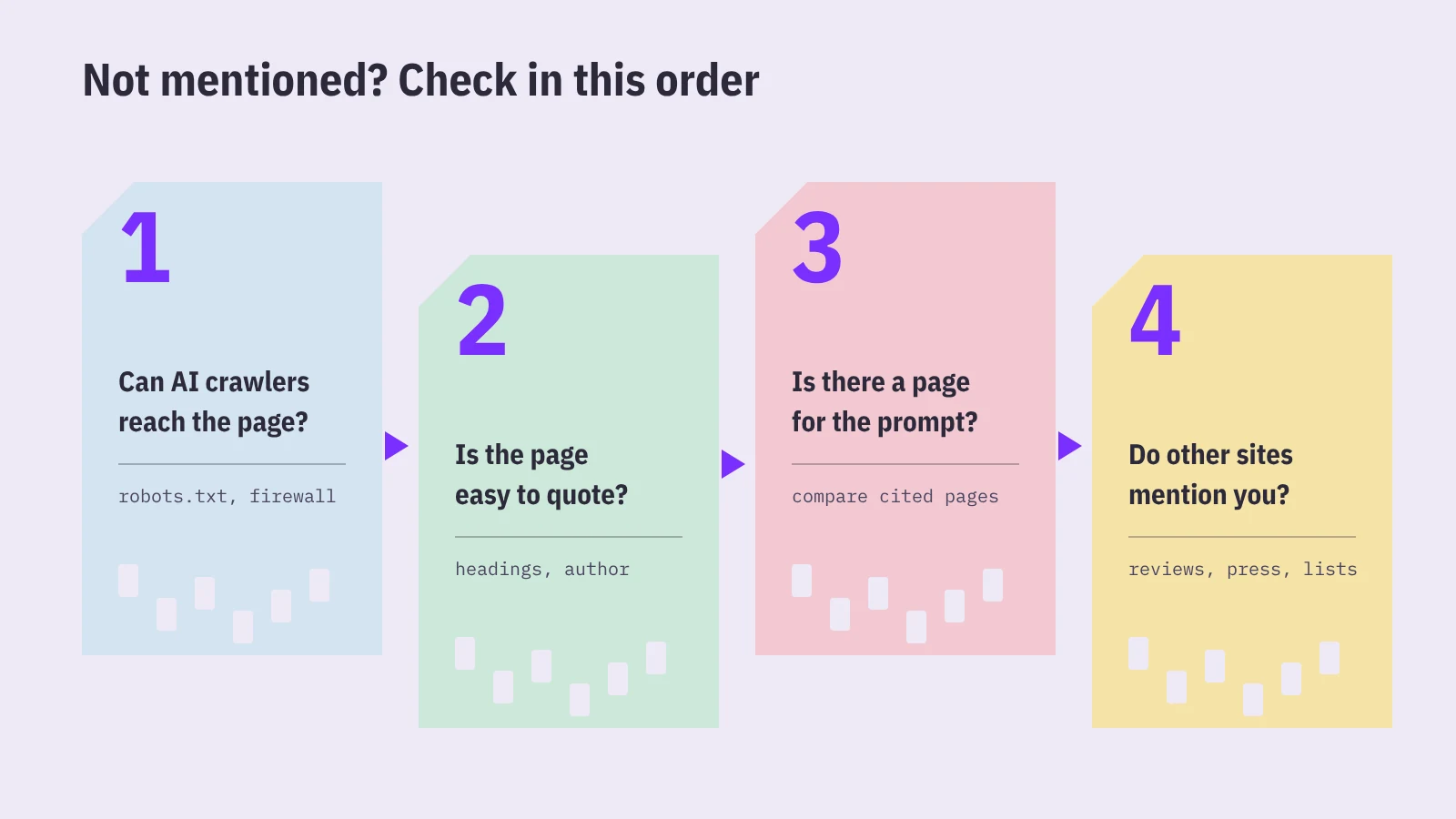
A low mention rate usually has one of four causes, and they are worth checking in this order.
- AI crawlers cannot reach your pages. A robots.txt rule or a firewall setting can block the bots that fetch pages for answers. The AI Crawler Checker shows which of 15 AI bots your robots.txt allows on a given page.
- Your pages are hard to quote. Long blocks of text, missing headings and no visible author or date make a page less useful as a source. The AI Readiness Checker scores a page out of 100 across access, structure, structured data and trust signals.
- No page answers the prompt. Open the pages the answer cites and note what they cover that your site does not, such as prices, a comparison or a clear list of who the service suits.
- Too few people talk about you elsewhere. Recommendations lean on reviews, directories, press and forums. The practical GEO framework covers how to build those mentions.
If an answer gets your details wrong, correct them where the AI is likely to read them: your own pages, your Google Business Profile and the directories that list you. Then keep a light monthly routine:
- Run the prompt list in the first week of the month and update the sheet.
- Check the Search Console and Bing reports for pages that gained or lost AI impressions and citations.
- Review AI Assistant sessions and conversions in GA4.
- Note which competitors gained ground and which of their pages were cited.
- Choose one fix for the month and check its effect on the next run.
Once a year, review the results in your digital marketing audit, so AI visibility is judged against the same goals as search, social and paid media.
Frequently asked questions
What is AI visibility?
AI visibility is how often AI tools such as ChatGPT, Gemini and Google’s AI Overviews mention, recommend or cite your business when people ask about your market. It covers both brand mentions and links to your pages.
How do I check if ChatGPT mentions my business?
Ask ChatGPT the questions your customers ask, in a private window or with memory turned off, and run each one several times. Record whether you are named, which pages are cited and which competitors appear, then repeat the same list every month.
Does Google Search Console show AI Overviews data?
Yes. The generative AI performance report shows impressions in AI Overviews and AI Mode by page, country, device and date, and clicks from both are counted in the standard Performance report. It does not show the queries behind each appearance or separate the two features.
How do I track ChatGPT traffic in Google Analytics?
GA4 groups visits from recognised AI assistants, including ChatGPT, into the AI Assistant channel in its default channel group. Visits that arrive without a referrer still appear as Direct, so treat the figure as a minimum.
Are AI visibility tools accurate?
They are only as reliable as their sampling. AI answers change with every run, so choose a tool that repeats each prompt several times and judge the trend over months rather than a single ranking.
How often should you track AI visibility?
Monthly suits most businesses, because answers vary from day to day and one-off checks mislead. Check more often after a site launch, a rebrand or a major content change.
On this page
Back to topFind out what AI says about you
Your customers may already be asking AI tools to compare you with your competitors. Kutola builds prompt lists from your real customer questions, tracks how AI answers describe your business and turns the gaps into a plan for your site and your reputation. Get in touch to see where you stand.