How to do a competitor analysis in a day

A competitor analysis for digital marketing compares how your rivals attract and convert customers online: their positioning, prices, website, search visibility, ads, social media, reviews and presence in AI answers. The goal is not a long report but a short list of gaps you can use and threats you need to answer. A focused analysis of three to five competitors, using free tools, can be done in a day.
Competitor analysis is one of the first steps in a digital marketing strategy, alongside understanding your customers and auditing your own channels. This guide explains how to identify your real competitors, what to compare, which free tools to use, a seven-step process with a worked example and how to turn the findings into decisions.
What is a competitor analysis?
A competitor analysis is a structured look at the businesses your customers could choose instead of you. In digital marketing it focuses on what customers can see: how competitors present themselves, where they appear, what they offer and how people respond to them.
It answers three practical questions:
- Where do we stand? How your offer, prices, visibility and reputation compare with the alternatives.
- What are they doing that works? The channels, messages and offers that seem to win customers.
- What are they missing? Customer needs, searches, channels or audiences that nobody serves well.
It is not about copying. The most useful findings are usually the gaps, because they show where you can be different rather than slightly better.
Identify your real competitors
Most businesses can name their obvious rivals. Online, the list is usually longer.
- Direct competitors: businesses selling the same thing to the same customers, such as two independent gyms in the same town.
- Indirect competitors: different solutions to the same problem, such as a home workout app competing with that gym.
- Search competitors: the websites ranking for the searches your customers make. They often include directories, marketplaces, comparison sites and publishers rather than businesses like yours.
- AI answer competitors: the brands that ChatGPT, Gemini and Google’s AI answers recommend when someone asks for options in your category. Our guide to AI visibility explains how to check which brands appear.
Ask customers who else they considered, check who appears for your ten most important searches and ask two or three AI tools for recommendations. Then pick three to five competitors to study in depth. More than that and the analysis rarely gets finished.
What to compare
Positioning and messaging
Read each competitor’s homepage, about page and main service or product pages. Note who they say they serve, the main promise in their headline, the proof they offer and the tone they use. If every competitor makes the same claim, such as “quality service at fair prices”, that claim will not set you apart.
Products, prices and offers
Compare the range, prices, packages, guarantees, delivery and returns, free trials and introductory offers. For services, look at how they describe the process and whether they publish prices at all.
Website and customer experience
Go through each site as a customer would on a phone. How quickly does it load? How easy is it to find prices, book or buy? Is there live chat, a clear phone number or online booking? Sign up for their emails and note what arrives.
Search visibility
SEO tools such as Semrush, Ahrefs and Ubersuggest estimate which searches each competitor ranks for, how much traffic they get and which sites link to them. A keyword gap report shows searches they rank for that you do not. Treat the traffic figures as estimates, useful for comparison rather than as exact numbers.
Paid advertising
Ad libraries show the ads competitors are running now. Look at the offers, the formats, the messages they repeat and how long ads have been running. An ad that has run for months is probably working.
Social media and content
Check which platforms they use, how often they post, which posts get real engagement and whether they work with creators. Look at their blog, guides, videos and email to see which topics they cover well and which they ignore.
Reviews and reputation
Read competitors’ reviews on Google, Trustpilot and sector sites. Complaints are the richest source of opportunity: slow replies, hidden fees or poor aftercare are things you can promise to do better and prove with your own reviews.
AI search readiness
AI assistants can only recommend businesses whose sites they can read and whose details are consistent across the web. The Kutola AI Readiness Checker shows whether AI crawlers can access a site. Run it on your own site and on each competitor’s to see who is easier for AI tools to read.
Free tools and sources
- Meta Ad Library: active ads on Facebook and Instagram for any page, searchable by name or keyword.
- Google Ads Transparency Center: the ads an advertiser has run on Google Search, YouTube and other Google services.
- LinkedIn and TikTok ad libraries: useful for B2B competitors and consumer brands targeting younger audiences.
- Google Trends: compares interest in competitor brand names over time and by region.
- SEO tools: free versions or trials of Semrush, Ahrefs and Ubersuggest give a first view of keywords, traffic and links.
- Companies House: company age, directors and filed accounts. Small companies often file shortened accounts without a profit and loss statement, so you may not see turnover.
- The Wayback Machine: shows how a competitor’s website, prices and messaging have changed over time.
- Review sites: Google, Trustpilot and sector platforms for ratings, volume and recurring complaints.
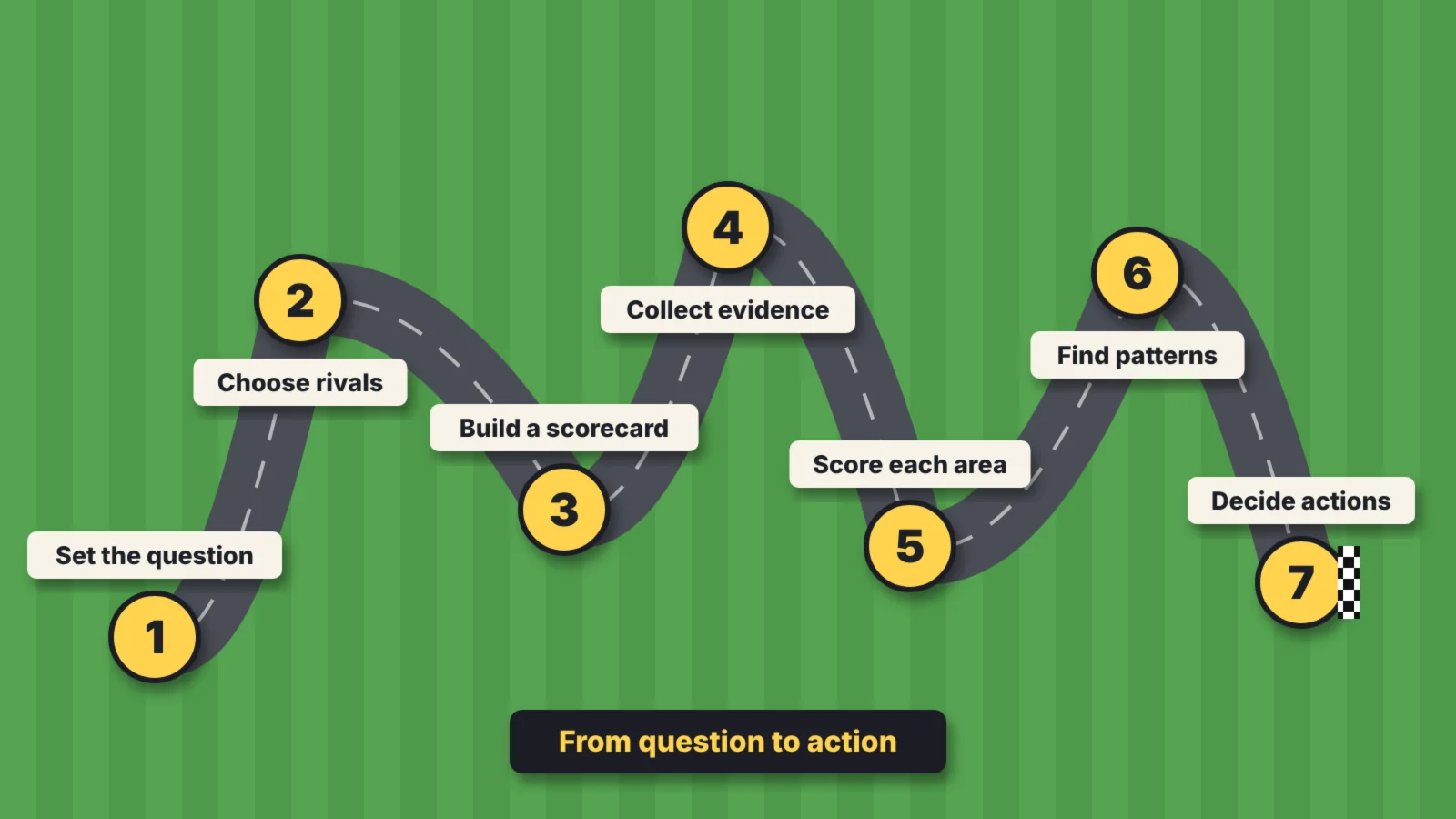
How to do a competitor analysis in 7 steps
- Set the question. Decide what the analysis should help you decide, such as where to focus next quarter, how to price a new service or why a competitor wins more enquiries.
- Choose three to five competitors. Include at least one direct competitor, one search competitor and one brand that appears in AI answers.
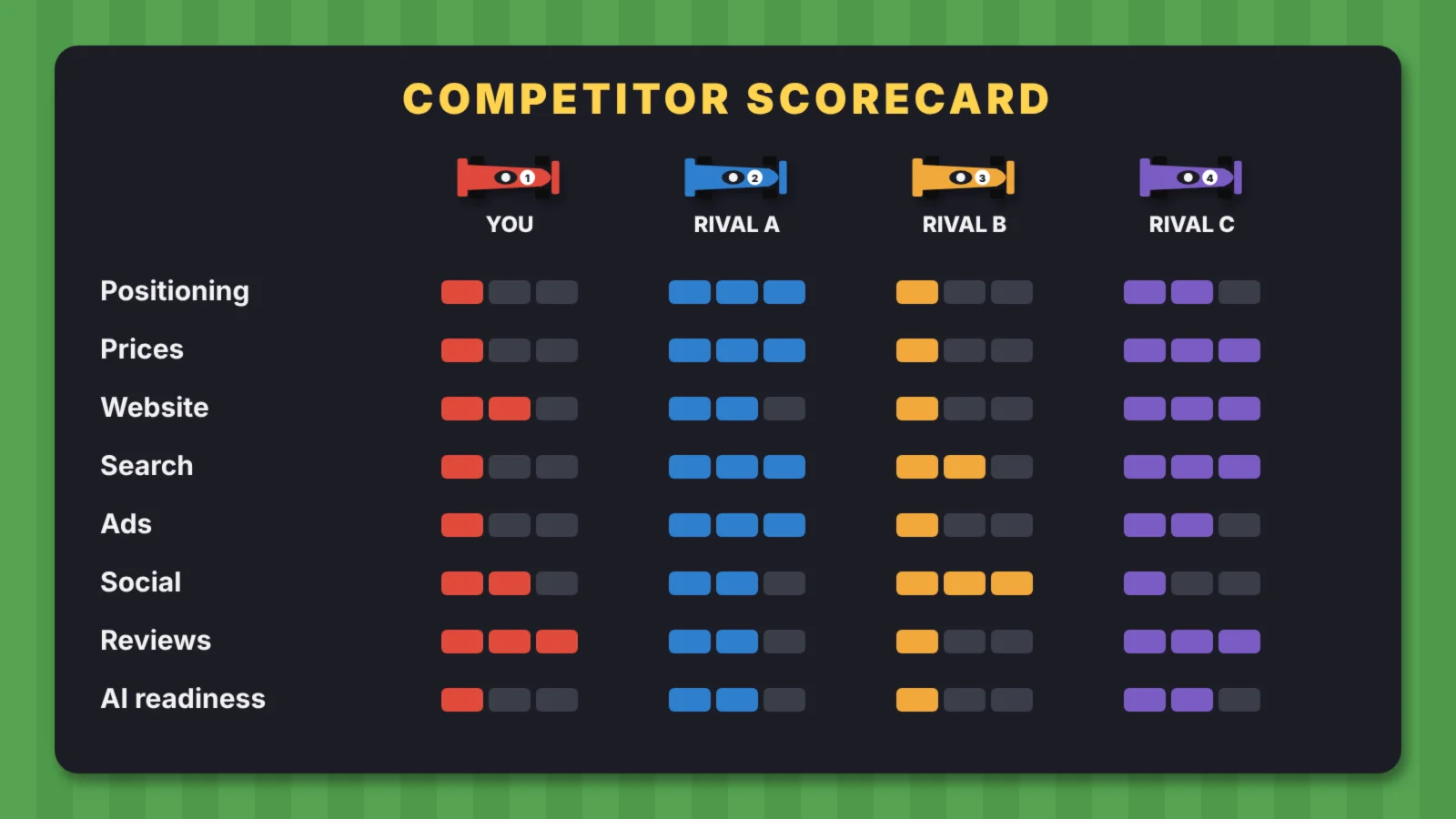
- Build a simple scorecard. Use a spreadsheet with one row per area from the list above and one column per competitor, plus your own business.
- Collect the evidence. Work through each area, saving screenshots and links rather than impressions. Use the same method for everyone.
- Score each area. A simple scale of weak, average or strong is enough. Add a one-line note explaining each score.
- Find the patterns. Look for claims everyone makes, needs nobody meets, channels nobody uses well and complaints that keep appearing.
- Decide two or three actions. Turn the biggest gaps and threats into specific actions with an owner and a date, then repeat the analysis every six to twelve months.
A worked example
A fictional accountancy firm in Bristol compared itself with three local rivals. The table below shows a shortened version of its scorecard.
| Area | Our firm | Rival A | Rival B | Rival C |
|---|---|---|---|---|
| Positioning | Generic “friendly accountants” | Specialists for contractors | Generic | Specialists for landlords |
| Published prices | No | Yes, monthly packages | No | Yes, from a set price |
| Google reviews | 4.9 from 31 | 4.6 from 210 | 4.2 from 48 | 4.8 from 95 |
| Search visibility | Weak | Strong for contractor searches | Average | Strong for landlord tax |
| Paid ads | None | Google Search, all year | None | Seasonal, before tax deadlines |
| AI answers | Not mentioned | Often mentioned for contractors | Not mentioned | Mentioned for landlords |
The patterns were clear. The two rivals with a clear specialism and published prices dominated their niches in search and in AI answers. Nobody specialised in small creative businesses, which made up a third of the firm’s clients, and the firm had the best rating despite having the fewest reviews.
The actions followed directly: position the firm for creative businesses, publish package prices, build a service page and guides for that audience and set up a routine to ask every client for a review.
Turn the findings into decisions
A competitor analysis feeds straight into other planning tools. The findings become the opportunities and threats in a SWOT analysis, and the strongest gaps often point to a new position for the brand.
A perceptual map turns the comparison into a picture by plotting each competitor on the two attributes customers care about most. Empty spaces on the map show positions nobody owns.
Keep the analysis alive rather than filing it away. Note competitor changes as you see them, check their ads and prices every quarter and repeat the full exercise once or twice a year.
Common mistakes
- Studying too many competitors. Ten half-finished profiles are less useful than four complete ones.
- Ignoring search and AI competitors. Directories and publishers can take more of your customers’ attention than your direct rivals.
- Collecting without deciding. A long document with no actions changes nothing.
- Copying the leader. Matching a bigger competitor’s tactics usually means competing on their terms with a smaller budget.
- Trusting tool estimates as facts. Traffic and keyword figures from SEO tools are estimates. Compare them with each other, not with your real analytics.
- Doing it once. Competitors change prices, messages and channels. An analysis from two years ago can point you the wrong way.
Frequently asked questions
What is a competitor analysis in digital marketing?
It is a structured comparison of how your competitors attract and convert customers online, covering their positioning, prices, website, search visibility, advertising, social media, reviews and presence in AI answers. Its purpose is to find gaps you can use and threats you need to answer.
How many competitors should I analyse?
Three to five is usually enough. Include direct competitors, at least one website that ranks for your main searches and any brand that AI tools often recommend in your category.
What free tools can I use for competitor analysis?
The Meta Ad Library and Google Ads Transparency Center show competitors’ ads. Google Trends compares brand interest, the Wayback Machine shows how their websites have changed and free versions of SEO tools give estimates of keywords and traffic. Review sites show what customers like and dislike.
How often should I do a competitor analysis?
Run a full analysis once or twice a year, or before a major decision such as a new service, a price change or a website rebuild. Check competitors’ ads, prices and messaging every quarter in between.
What is the difference between a competitor analysis and a SWOT analysis?
A competitor analysis looks outward at what rivals are doing. A SWOT analysis combines that external view with your own strengths and weaknesses, and the competitor findings usually feed its opportunities and threats.
On this page
Back to topSee where you stand against your competitors
Kutola compares your positioning, website, search and AI visibility, ads and reviews with the businesses your customers also consider, then turns the gaps into a clear plan. See how it fits into our digital audit and strategy work, or get in touch to talk through your market.