Customer journey map: examples, template and how to create one
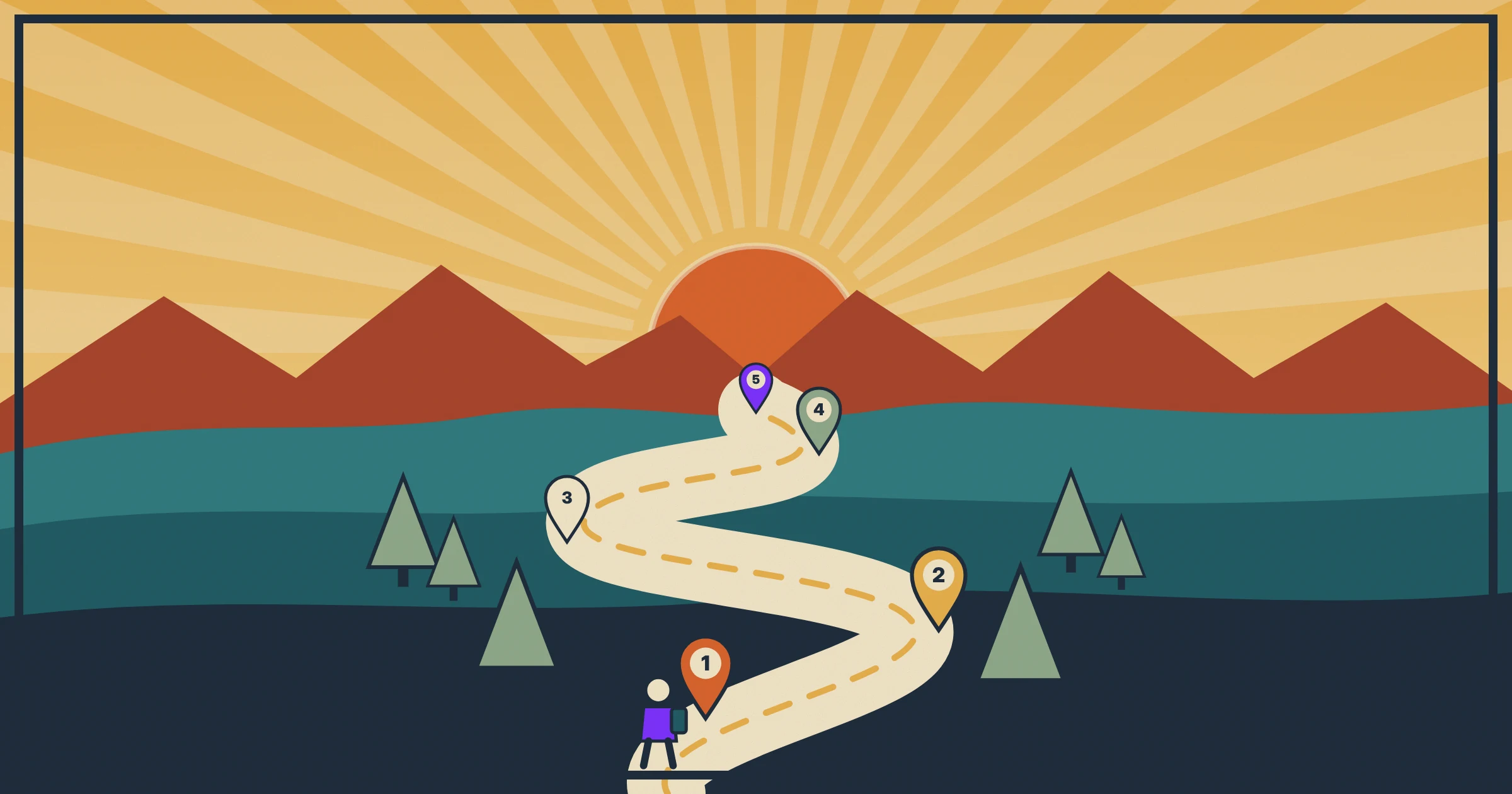
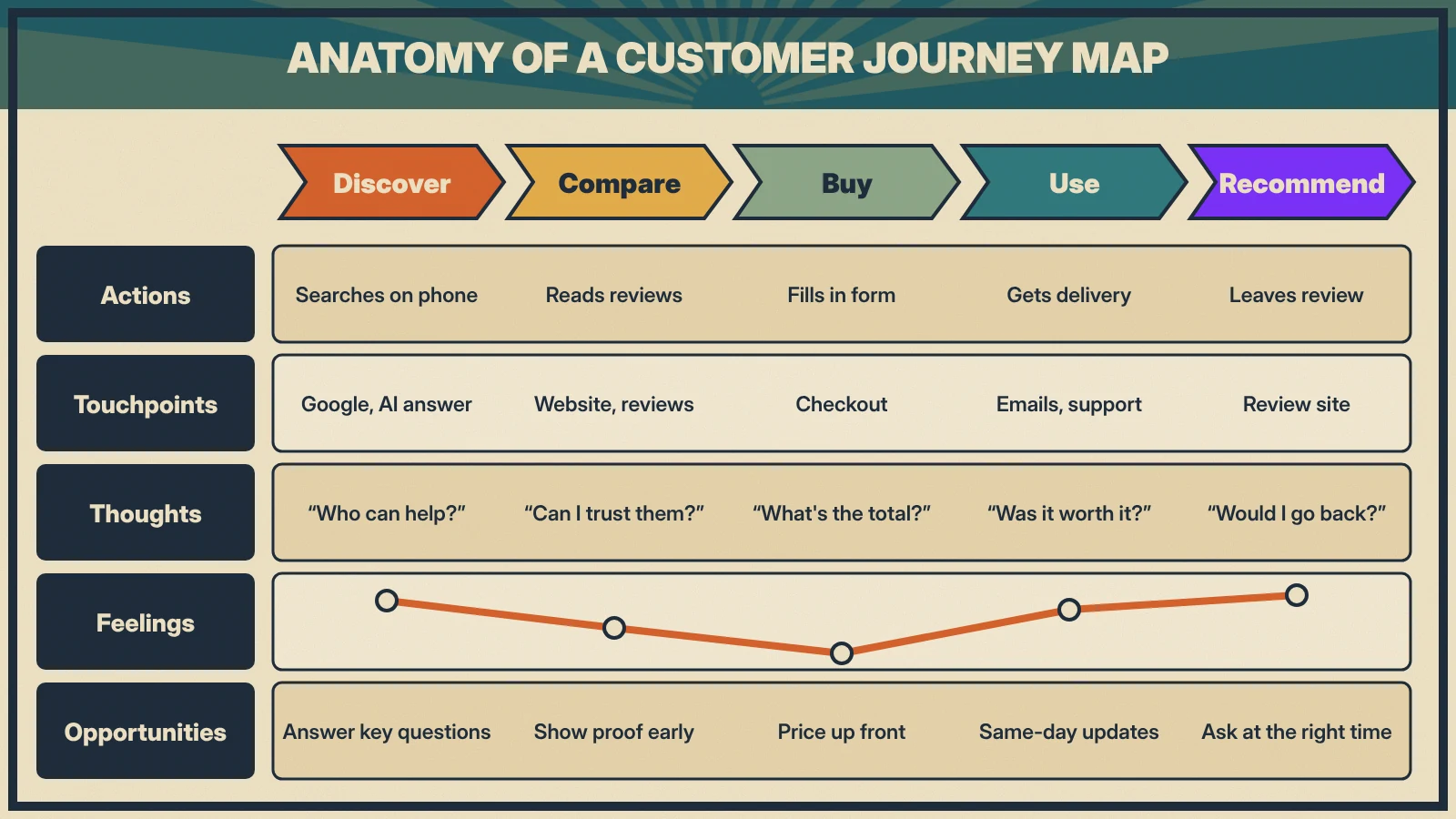
A customer journey map is a visual record of the steps one type of customer takes to reach a goal with your business, from first noticing a need to buying, using and recommending what you sell. For each stage it shows what the customer does, where they meet you, what they think and how they feel, so you can see where the experience breaks down and what to change.
Journey maps turn the audience research behind a digital marketing strategy into something a whole team can act on. This guide covers what goes into a customer journey map, the main types, how to create one in seven steps and a template you can copy. It ends with examples for an online shop, a B2B firm and a local business, and the mistakes that leave most maps unused.
What is a customer journey map?
Nielsen Norman Group, the user experience research firm, describes a journey map as a visualisation of the process a person goes through to accomplish a goal. Its Journey Mapping 101 guide names five components that most maps share:
- Actor: the one type of customer whose journey you map, usually a persona.
- Scenario and expectations: the situation and goal, such as “replace a broken boiler before the weekend”, and what the customer expects along the way.
- Journey phases: the high-level stages, which give the map its columns.
- Actions, mindsets and emotions: what the customer does, thinks and feels in each phase.
- Opportunities: what the map tells you to fix, change or try.
Most marketing teams add two more rows: touchpoints (every place the customer meets the brand, from a search result to a delivery email) and pain points. The scenario matters more than it looks. A map of “someone buying their first running shoes” and one of “a regular buyer reordering” will have different phases, channels and frustrations, even for the same shop.
A journey map is not the same as a funnel. A marketing funnel counts how many people move from one stage to the next and shows where they drop out. A journey map follows one type of customer through the experience and explains why they drop out. Most teams need both.
Why customer journey maps matter
Customers judge a business on the whole experience, not on the department that handled one step. A fast website means little if the confirmation email never arrives, and a good advert is wasted if the phone goes unanswered. The Institute of Customer Service’s UK Customer Satisfaction Index for July 2026 put satisfaction at 78.3 out of 100 and found that being easy to deal with had become more important to many customers over the previous six months. Ease is exactly what a journey map exposes.
Journey maps help in three practical ways:
- They find the gaps between teams. Marketing, sales, operations and customer service each own a few touchpoints. The map shows the hand-overs where nobody owns the experience.
- They show which content is missing. If customers in the comparison stage keep asking about delivery times or contracts, that question needs an answer on the page they are reading.
- They put the customer’s view into decisions. A shared map makes it harder to approve a change that suits the business but adds friction for the buyer.
GOV.UK offers a well-documented example. In 2016 a team from DVLA, DVSA and the Government Digital Service mapped 42 driving services from the user’s point of view, including learning to drive. A learner has to apply for a provisional licence, book a theory test, find an instructor and then book and take a practical test. That work led GDS to pilot step-by-step pages with “Learn to drive a car”, which sets out the whole journey in order, from checking you are allowed to drive to what to do when you pass.
Types of customer journey map
Choose the type before you start, because it decides what evidence you need. Nielsen Norman Group separates current-state and future-state maps, and two related maps are often confused with them.
| Type | What it shows | Use it when |
|---|---|---|
| Current-state map | The experience customers have today | You want to find and fix existing problems. This is where most businesses should start. |
| Future-state map | The experience you want customers to have | You are launching a product or redesigning a journey and need a shared target. |
| Experience map | How people reach a goal in general, not with one company | You are researching a market, such as how people plan a wedding, before deciding where your brand fits. |
| Service blueprint | The staff, systems and processes behind each touchpoint | The map shows a problem and you need to see which internal step causes it. |
A sensible order is a current-state map first, then a service blueprint for the two or three moments that hurt most, then a future-state map once you know what is realistic.
How to create a customer journey map in 7 steps
1. Set the goal and scope
Write down the business question the map should answer, such as “why do half of our quote requests never become bookings?”. Then decide where the journey starts and ends. A map from first search to first repeat order is a good default for most small businesses.
2. Choose one customer and one scenario
Map one persona at a time. If a florist sells to brides and to office managers ordering weekly arrangements, those are two maps. Trying to cover both in one blurs the very differences the map is meant to show.
3. Gather evidence
A map built from assumptions only confirms them. Combine what people do with what they say:
- Analytics: entry pages, paths through the site and where people leave, from Google Analytics 4 or similar.
- Five to eight short interviews with recent customers and, if you can, people who chose a competitor.
- Reviews, complaints, chat logs and the questions sales and service staff hear every week.
- Your own walk-through as a stranger, on a phone, as described in the steps of a digital marketing audit.
4. List the stages and touchpoints
Name the stages in the customer’s language, not your internal process. “Realise the boiler is broken” beats “lead generation”. Under each stage, list every touchpoint you found: search results, AI answers, review sites, social posts, the website, phone calls, emails, the invoice and the follow-up.
5. Add actions, thoughts and feelings
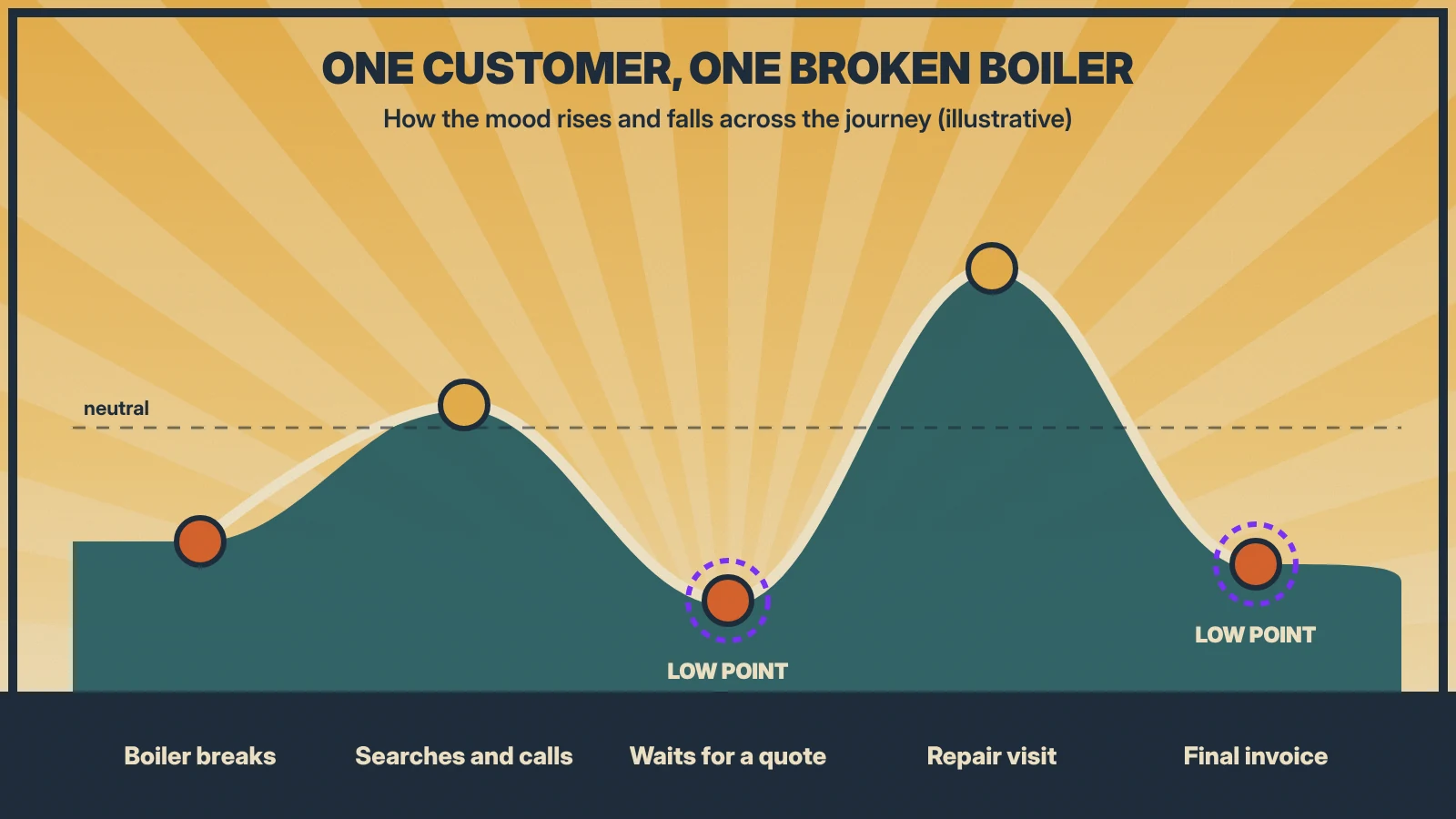
For each stage, write what the customer does, what they are asking themselves and how they feel, using their own words from interviews and reviews where possible. Plot the feelings as a line that rises and falls across the stages. The low points are where people give up.
6. Mark pain points and moments that matter
Highlight where effort is high, information is missing or expectations are broken. Some moments carry more weight than others, such as the first reply to an enquiry or the moment the final price appears. Behavioural science across the customer journey explains why the end of an experience and the moments of greatest uncertainty shape what people remember. A total that rises at checkout is also a legal risk: drip pricing is now banned in the UK.
7. Turn opportunities into actions with owners
For each pain point, agree one change, one owner and one measure. “Reply to every quote request within two working hours, owned by the office manager, measured by the share of quotes that become bookings” is an action. “Improve communication” is not. Review the map every six to twelve months, or after any big change to the website, pricing or team.
Customer journey map template
You do not need special software. A spreadsheet or a whiteboard works, with your stages as columns and these rows.
| Row | What to capture | Question to ask |
|---|---|---|
| Stage | A phase of the journey in the customer’s words | What is the customer trying to get done now? |
| Goal | What success looks like for the customer in this stage | What would make them move on to the next stage? |
| Actions | What they actually do | Where do they go, what do they search for, who do they ask? |
| Touchpoints | Every place they meet your brand or a competitor | Which of these do you control, and which do you only influence? |
| Thoughts | Questions and doubts, ideally quoted | What are they unsure about? |
| Feelings | A score from very negative to very positive | Where does the mood drop? |
| Pain points | Friction, delays, missing information | What makes this stage harder than it should be? |
| Opportunities | Changes to test, each with an owner | What one change would remove the biggest pain point? |
Customer journey map examples
These three examples are illustrative, but each shows the kind of finding a first map tends to produce.
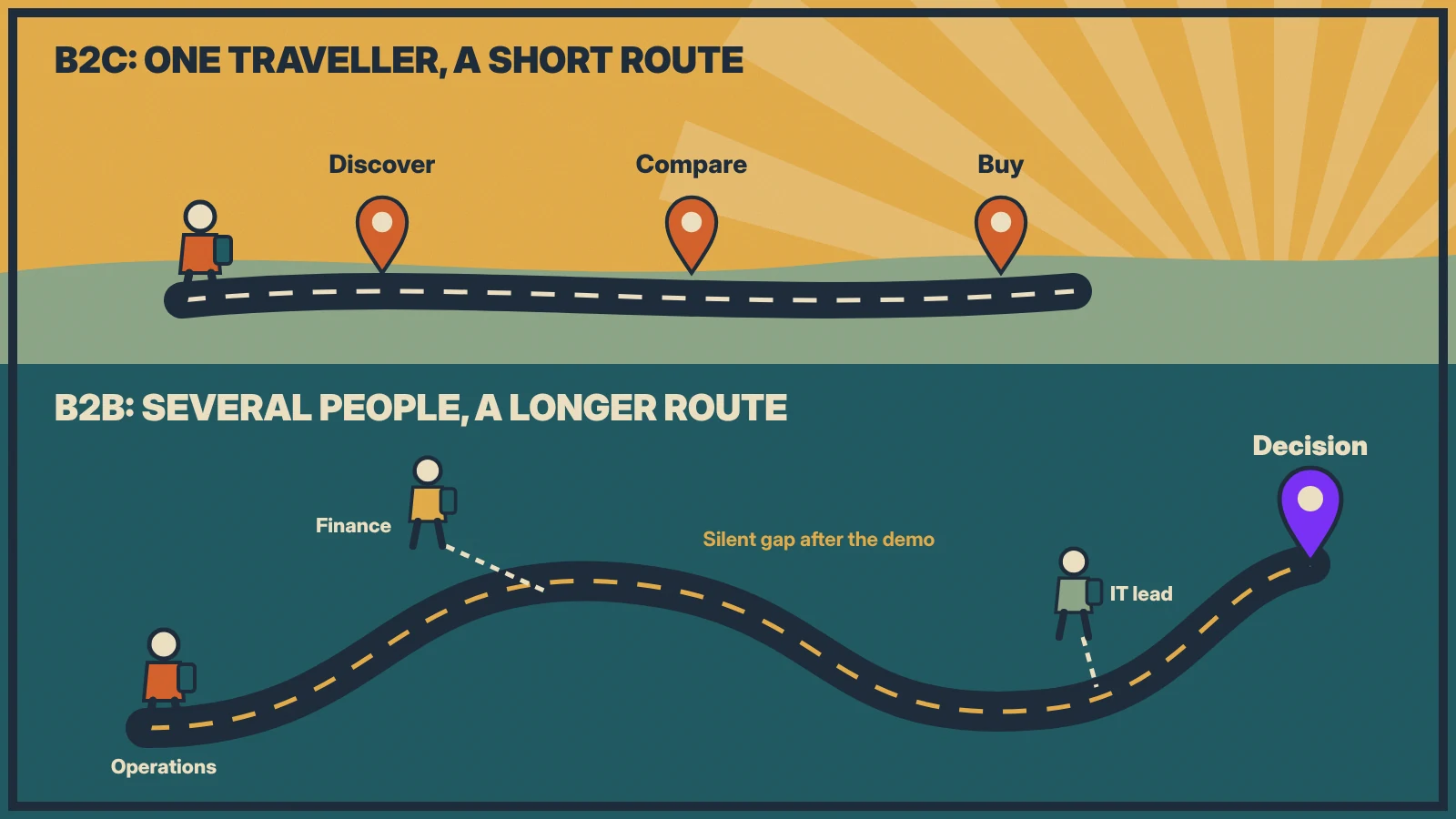
An online clothing shop (B2C). The persona is a first-time buyer who found a jacket through an Instagram post. Interviews show that they check the returns policy before adding anything to the basket, and on a phone the policy sits three taps away in the footer. The mood drops again after purchase, because the dispatch email arrives two days later than the order confirmation promised. The fixes: a one-line returns summary next to the “Add to basket” button and a dispatch email sent the same day. Social proof such as fit reviews helps at the same consideration stage.
A software or IT services firm (B2B). Here the journey has several actors: the operations manager who finds the problem, the finance director who signs off the budget and the IT lead who checks security. The map shows a long, silent gap after the first demo, while the champion tries to build an internal case. The fix is a short business case pack and a security summary they can forward, followed by a check-in from the account manager after one week.
A local heating engineer. The persona has a broken boiler on a Friday night. They search on their phone, compare three Google Business Profiles and phone the first one with recent reviews and visible opening hours. Two pain points stand out: an out-of-hours voicemail with no call-back time, and an invoice that arrives with unexplained parts. The fixes: a voicemail message that promises a call by 8am and a quote that lists likely parts before the visit.
Common customer journey map mistakes
- Mapping the process, not the customer. A map that follows your internal stages (“lead”, “opportunity”, “closed won”) hides what the customer experiences between them.
- Working from opinion. A workshop with no customer evidence produces the journey the team hopes for.
- One map for everyone. Averaging several personas into one map removes the differences that matter.
- Stopping at the sale. Delivery, onboarding, billing and support decide whether people come back and recommend you.
- Leaving out AI answers. Ofcom found that more than half of UK adults frequently see AI summaries in search results, so the first touchpoint is often an AI answer. Being cited there is the work of generative engine optimisation.
- A map with no owner. Without named actions and a review date, the map becomes a poster on the wall.
Frequently asked questions
What is a customer journey map?
A customer journey map is a visual record of the steps one type of customer takes to reach a goal with a business, from noticing a need to buying and recommending. For each stage it shows their actions, touchpoints, thoughts and feelings, so you can see where the experience breaks down.
What are the 5 stages of a customer journey map?
Many maps use awareness, consideration, purchase, retention and advocacy. The best stage names come from the customer’s own goal, so a boiler repair might run from “realise it’s broken” to “recommend the engineer”.
What should a customer journey map include?
Most maps include an actor or persona, a scenario with expectations, journey stages, the customer’s actions, thoughts and feelings, and opportunities to improve. Marketing teams usually add touchpoints and pain points as well.
What is the difference between a customer journey map and a marketing funnel?
A marketing funnel counts how many people move between stages and shows where they drop out. A customer journey map follows one type of customer through the experience and explains why they drop out.
How do you create a customer journey map?
Set a goal and scope, choose one persona and scenario, and gather evidence from analytics, interviews and reviews. Then list the stages and touchpoints, add actions, thoughts and feelings, mark the pain points and turn each one into an action with an owner.
On this page
Back to topSee your business through your customers’ eyes
Kutola maps user journeys from real customer evidence, finds the moments where people give up and turns them into a short list of changes for your website and channels. Get in touch to talk about your customer journey.