How to run influencer marketing that stays within UK rules
Influencer marketing is paying or rewarding people with an engaged social following to feature your brand in their content. It works best when the creator’s audience matches your customers, the content feels like their own and the partnership is labelled clearly. In the UK, any post that a brand pays for or controls, including gifts and affiliate links, must be obviously identifiable as an ad, and the CMA can now fine brands directly when it is not.
Influencer marketing is one tool within a wider social media strategy. This guide covers the main types of creator and partnership, how to choose the right people, how pricing works, the UK rules from the ASA and the CMA, a step-by-step campaign plan and how to measure the results.
What is influencer marketing?
Influencer marketing borrows the trust a creator has built with their audience. A recommendation from someone people already follow and believe often lands better than the same message from the brand itself.
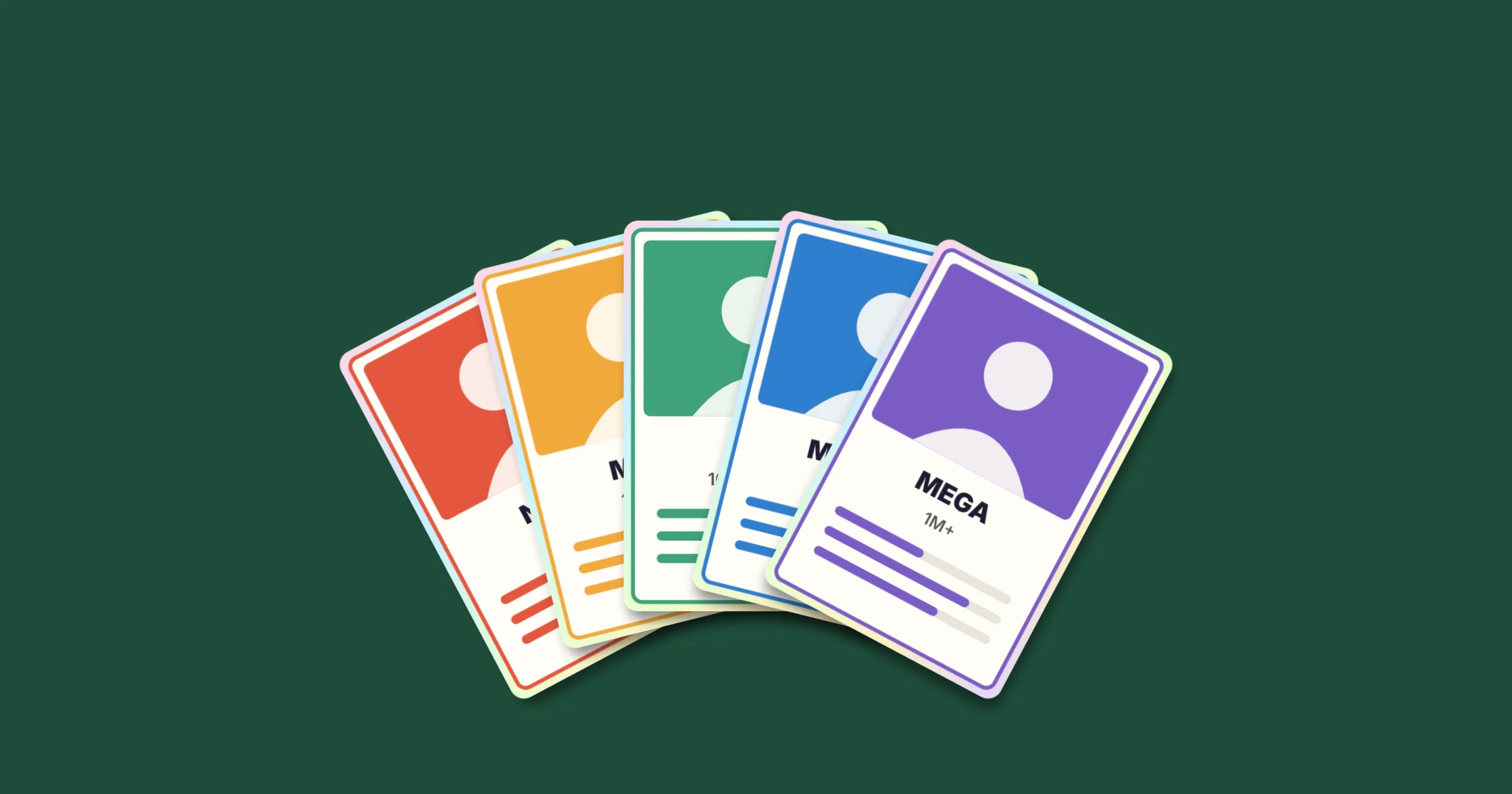
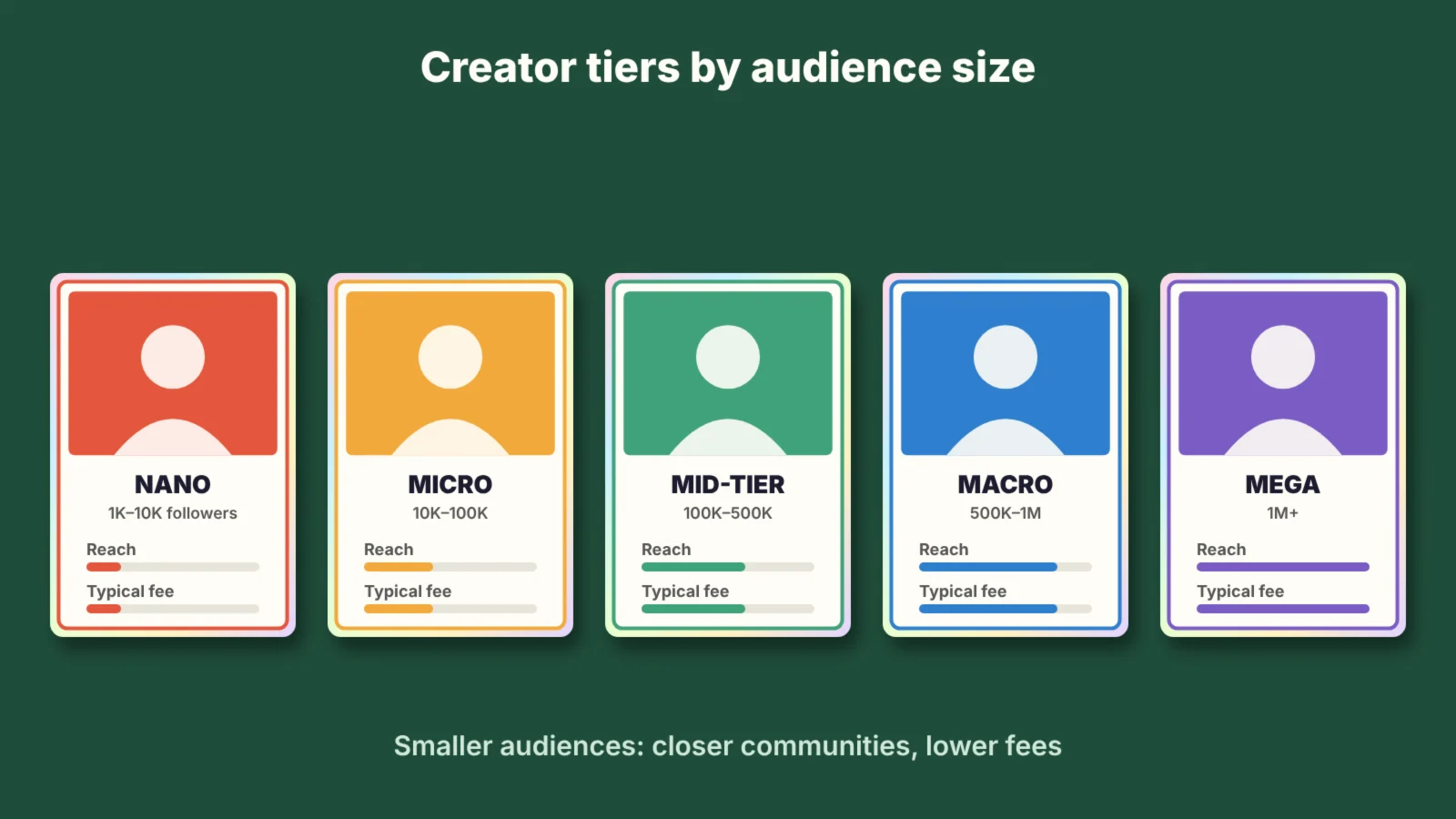
Creators are usually grouped by audience size. The bands below are widely used across the industry, though agencies and platforms draw the lines slightly differently:
- Nano: roughly 1,000 to 10,000 followers. Often close communities with high engagement, and usually open to gifting or small fees.
- Micro: 10,000 to 100,000 followers. Often specialists in a niche, such as running, skincare or home renovation.
- Mid-tier: 100,000 to 500,000 followers. Established creators with professional content and clear rates.
- Macro: 500,000 to 1 million followers. Broad reach, usually represented by an agent.
- Mega: more than 1 million followers, including celebrities. Expensive, and best suited to awareness campaigns for large brands.
Follower count is a weak guide on its own. A local food creator with 8,000 followers who all live in Manchester can be worth more to a Manchester restaurant than a national account with half a million.
When influencer marketing makes sense
Influencer marketing suits products people like to see in use before they buy: food and drink, beauty, fashion, fitness, travel, home, games, apps and many consumer services. It also works in B2B, where the influencers are often industry experts, consultants or well-known practitioners on LinkedIn and YouTube.
It works less well when the product is hard to show, the audience does not use social media to make decisions or the business cannot yet handle a rush of interest. It is also a poor fit for products where the rules on promotion are strict, such as financial products, unless you have expert support.
It sits close to two other approaches. User-generated content comes from customers who are not paid, while creator content is commissioned. Both are forms of social proof, and many brands use creators to produce content that then runs as ads from the brand’s own account.
Types of influencer partnership
- Gifting: sending a product with no obligation to post. Cheap, but you cannot control whether or what the creator posts.
- Paid posts: a fee for an agreed set of content, such as one reel and three stories, often with an approval step.
- Affiliate and discount codes: the creator earns a commission on each sale through their link or code. Low risk for the brand and easy to track.
- Ambassador programmes: a longer partnership over months, which builds more credibility than a one-off post.
- Creator ads: running the creator’s content as a paid ad, through Instagram partnership ads or TikTok Spark Ads, so it reaches people beyond their followers. Our guide to TikTok ad formats explains how Spark Ads work.
- Takeovers and events: a creator runs your account for a day or attends a launch, store opening or experience.
How to choose the right creators
Start with the audience, not the creator
Write down who you want to reach: age, location, interests and what they already buy. Then look for creators whose followers match. Ask shortlisted creators for screenshots of their audience insights, including the share of followers in the UK and their age split.
Look at engagement quality
Likes and follower numbers are easy to inflate. Read the comments instead. Real conversations, questions about products and replies from the creator suggest a genuine audience. Dozens of one-word comments or emojis from unrelated accounts suggest the opposite.
Check past content and values
Scroll back through several months of posts. Look at how they present other brands, how often they post ads and whether their tone and values fit yours. A creator who promotes a different product every day has less influence than one who is selective.
Check they label ads properly
Look at how they have handled previous partnerships. A creator who already labels ads clearly is less likely to cause a problem for your brand. The ASA publishes a list of creators who have repeatedly failed to label ads.
Start small
Test with a few creators before committing a large budget. Results vary widely, and a small test shows who drives real sales or sign-ups.
How influencer pricing works
There is no standard price list. Rates depend on audience size, engagement, niche, platform, the amount of content and how you want to use it. Common pricing models are:
- Flat fee per deliverable: a set price for each post, reel, story or video.
- Usage rights: an extra fee to reuse the content in your own ads, on your website or in email, usually for a fixed period.
- Exclusivity: an extra fee if the creator must not work with competitors for a time.
- Commission: a percentage of each sale, often combined with a smaller fee.
- Product only: common with nano creators, but the gift still counts as payment under UK rules.
Ask several creators of a similar size for rates to understand the market in your niche, and budget for usage rights from the start if you plan to run the content as ads.
UK rules: the ASA, CAP and the CMA
UK influencer marketing is regulated by the Advertising Standards Authority, which enforces the CAP Code, and by the Competition and Markets Authority under consumer law. The two bodies publish a joint Influencers’ guide to making clear that ads are ads, updated in October 2026 to reflect the Digital Markets, Competition and Consumers Act 2024. The CMA’s guidance on social media endorsements covers the same ground for consumer law.
The key rules:
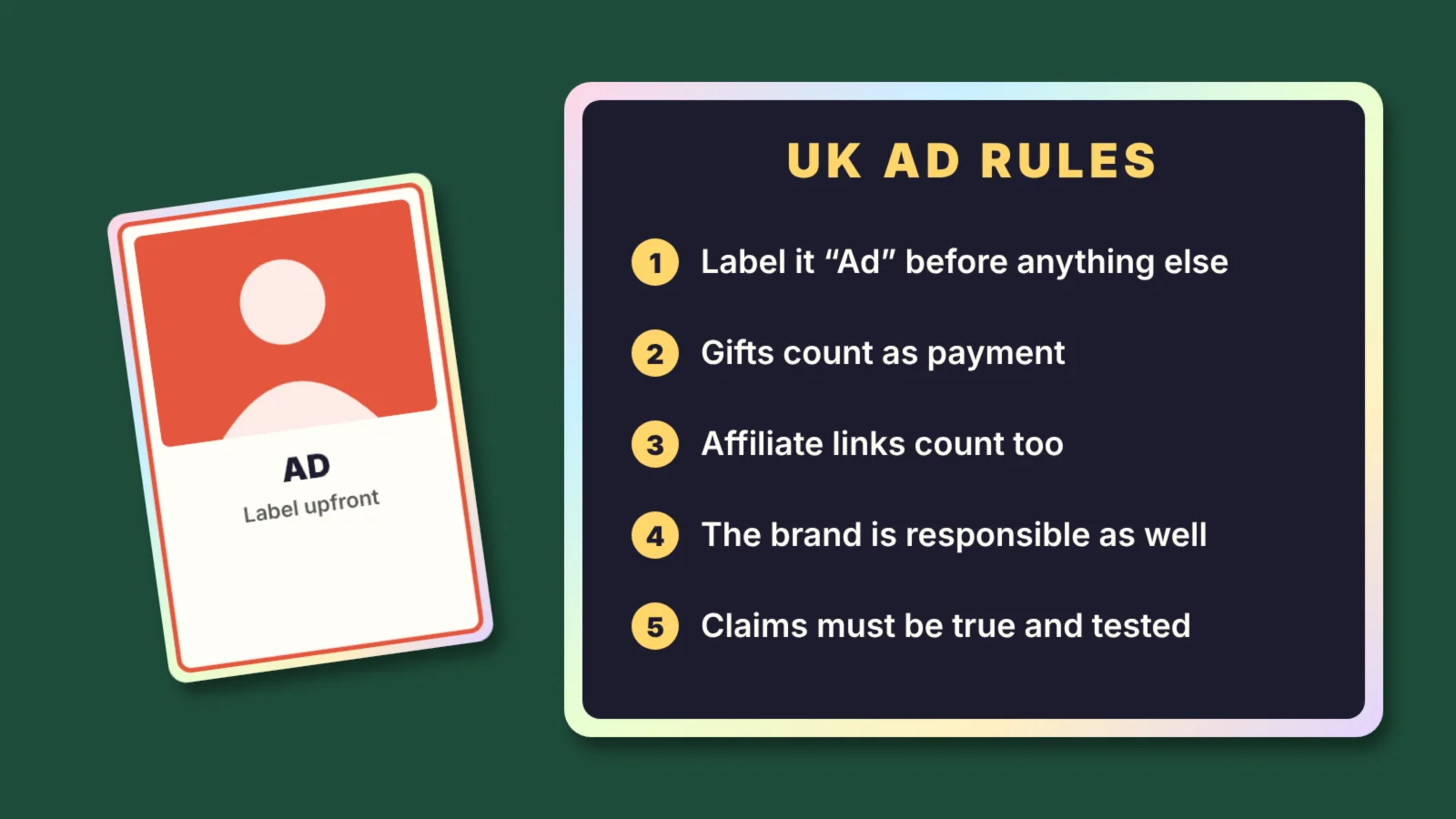
- Label ads clearly and upfront. Use “Ad”, “Advert”, “#ad” or “Advertisement” at the start of the post or video, where people see it before they engage. A label hidden among hashtags or at the end of a caption is not enough.
- Gifts count as payment. Free products, trips, meals and discounts are all a form of payment, so content about them needs to be clearly disclosed. Labels such as “gifted”, “spon”, “aff” or “I work with them” have been ruled inadequate on their own.
- Affiliate links make content an ad. If the creator earns from clicks or sales, the content that features those products is advertising and needs an ad label.
- The brand is responsible too. Both the brand and the creator can be held responsible for a misleading or unlabelled ad. Put the labelling requirement in the contract and check posts before and after they go live.
- Claims must be true. A creator must not claim to use a product they have not tried, and any claim about results needs the same evidence as a claim in your own ads. Under the DMCC Act, the CMA can fine businesses up to 10% of global turnover.
- AI content is not exempt. AI-generated images or avatars must follow the same rules, and some platforms require AI use to be disclosed.
Some sectors have extra rules. Since 5 January 2026, brands cannot pay for online ads for identifiable less healthy food and drink products, and that includes paid influencer posts. Gambling and alcohol ads must not appeal strongly to under-18s, which rules out many creators with young audiences. Financial promotions by influencers are covered by the FCA’s guidance on financial promotions on social media, and promoting regulated products without approval can be a criminal offence.
How to run an influencer campaign in 7 steps
- Set one goal. Awareness, content for ads, website visits or sales. The goal decides which creators, platforms and measures make sense.
- Define the audience and budget. Include fees, product costs, usage rights and any budget for boosting the content.
- Shortlist creators. Search the platforms, use a creator marketplace or work with an agency. Check audience fit, engagement and past ads.
- Write a short brief. Explain the product, the key message, what must be included, what to avoid and the labelling rules. Leave room for the creator’s own style, because that is what their audience trusts.
- Agree a written contract. Cover deliverables, deadlines, approval, payment, usage rights, exclusivity and the requirement to label every post as an ad.
- Review and publish. Check drafts for accuracy and labelling, then confirm each post once it is live.
- Track and learn. Give each creator a unique link with UTM parameters and a unique discount code, then compare results.
How to measure influencer marketing
- Reach and views: how many people saw the content, from screenshots of the creator’s insights or the platform’s partnership tools.
- Engagement: comments, saves and shares, which show more interest than likes alone.
- Clicks and sales: visits and conversions from each creator’s tracked link and code.
- Cost per result: total cost divided by sales, sign-ups or other results, so you can compare creators fairly.
- Content performance as ads: if you run creator content as ads, compare its cost per result with your other creative.
- Brand search: a rise in people searching for your brand name during and after a campaign.
Choose a small set of marketing KPIs before the campaign starts, and expect some of the effect to show up later and in channels you cannot track directly.
Common influencer marketing mistakes
- Choosing by follower count. A large audience in the wrong place or age group is wasted spend.
- Over-scripting. Content that sounds like an ad read word for word loses the trust you are paying for.
- Missing or hidden ad labels. It breaks the rules and damages trust when followers notice.
- No contract. Without one, deliverables, usage rights and labelling are open to dispute.
- Ignoring sector rules. Food, alcohol, gambling and financial products all carry extra restrictions.
- One-off posts only. A single mention rarely changes behaviour. Repeated partnerships with the right creators work better.
- No tracking. Without unique links and codes, you cannot tell which creators drove results.
Frequently asked questions
What is influencer marketing?
Influencer marketing is when a brand pays or rewards people with an engaged social media following to feature its products or services in their content. It can involve paid posts, gifting, affiliate links, ambassador programmes or running a creator’s content as ads.
Do influencers have to say #ad in the UK?
Yes, when the content is about a brand that has paid them, gifted them something or pays them commission through affiliate links. The label should be clear, such as “Ad” or “#ad”. It should appear upfront, before people engage with the content.
Does gifting count as advertising?
Under UK rules, gifts are a form of payment. If an influencer posts about a product they were given, they need to make clear that the content is connected to the brand. Labels such as “gifted” on their own have been found inadequate.
Who is responsible if an influencer does not label an ad?
Both the brand and the influencer can be held responsible. The ASA can rule against both, and the CMA can take enforcement action under consumer law, including fines for businesses.
Are micro-influencers better than big influencers?
Not always, but micro and nano creators often have more engaged, specialised audiences and lower fees, which makes them a good starting point for small businesses. Larger creators make more sense when broad awareness is the goal.
On this page
Back to topFind creators who fit your brand
Kutola helps brands choose the right creators, write briefs and contracts, keep campaigns within ASA and CMA rules and measure what each partnership delivers. See how it fits into our social media strategy work, or get in touch to talk through your next campaign.