Social media strategy: 7 steps, a free template and examples
A social media strategy is a plan that sets out what a business wants to achieve on social media, who it needs to reach, which platforms and types of content it will use, how it will talk to people and how it will measure the results. It links every post, reply and campaign to a business goal, so social media earns its place as a marketing channel instead of becoming a feed that has to be filled.
This guide explains what a social media strategy includes and why it matters for UK businesses. It then sets out seven steps to build one, from goals and platform choice to content, community and measurement, followed by a free one-page template, real brand examples, a worked example for a small business and the UK rules worth planning for.
Key takeaways
- A social media strategy connects social activity to business goals and decides which platforms, content and conversations deserve your time.
- Choose platforms by where your audience spends time and what you need from them. In the UK, YouTube, Facebook and Instagram reach the most adults, but reach alone doesn’t make a platform right for you.
- Three to five content pillars and a consistent voice make your posts recognisable before people see your name.
- Social platforms work as search engines, so profiles and posts written for search keep bringing in views long after the feed has moved on.
- Measure against the goal: reach and share of voice for awareness, engagement for interest, then clicks, leads and sales for conversion.
What is a social media strategy?
A social media strategy answers a small set of questions before any content is made. Why is the business on social media at all? Who should it reach there? Which platforms will it use, and what job does each one do? What will it post, how often and in what voice? Who replies to comments and messages? And which numbers show that it is working?
Those answers usually fit on one or two pages. The detail comes later, in the documents that put the strategy into practice:
| Document | What it decides | Time frame | Example |
|---|---|---|---|
| Social media strategy | Goals, audience, platforms and their roles, content pillars, voice, community approach and KPIs | A year, reviewed quarterly | Use Instagram and TikTok to make the brand known among 25 to 40 year old home cooks, measured by reach, saves and branded searches |
| Content plan | Themes, campaigns and formats for a period, with owners and resources | A month or a quarter | Four recipe series in spring, one supplier story a month, a summer giveaway |
| Content calendar | What goes out on which day, on which platform, with which caption | A week or a month | Tuesday: 30 second recipe reel on Instagram and TikTok; Thursday: carousel of three tips |
Social media is one channel inside a wider digital marketing strategy. The profile is owned media, the reach it gets is largely earned and any promoted posts are paid, which is why social so often sits across the lines described in the main digital marketing channels. This guide focuses on organic social media and treats paid promotion as a way to amplify what already works.
Why a social media strategy matters
Almost every customer uses social media, but each platform asks for a different kind of content and attention. Without a strategy, most businesses end up posting wherever they happen to have an account, in whatever style the person in charge prefers, and judging success by likes. A strategy fixes that in a few ways.
- Your audience is spread across many platforms. The UK had 55.5 million social media user identities in late 2025, and the average user spent around 16 hours a week on social media across 6.2 platforms a month, according to the Digital 2026 UK report by We Are Social and Meltwater. No business can be active everywhere, so choosing is part of the job.
- People search on social platforms. TikTok, Instagram, YouTube and Pinterest now work as search engines, and social posts appear in Google results and AI answers. A strategy plans for discovery as well as the feed, which is the focus of social media SEO.
- Customers expect conversation. In Sprout Social research, 73% of social media users said they expect brands to reply on social within 24 hours. Replies need people, rules and a response time, all of which have to be planned.
- Consistency builds memory. A recognisable voice, look and set of topics helps people remember a brand between purchases. That only happens when everyone posting works from the same plan.
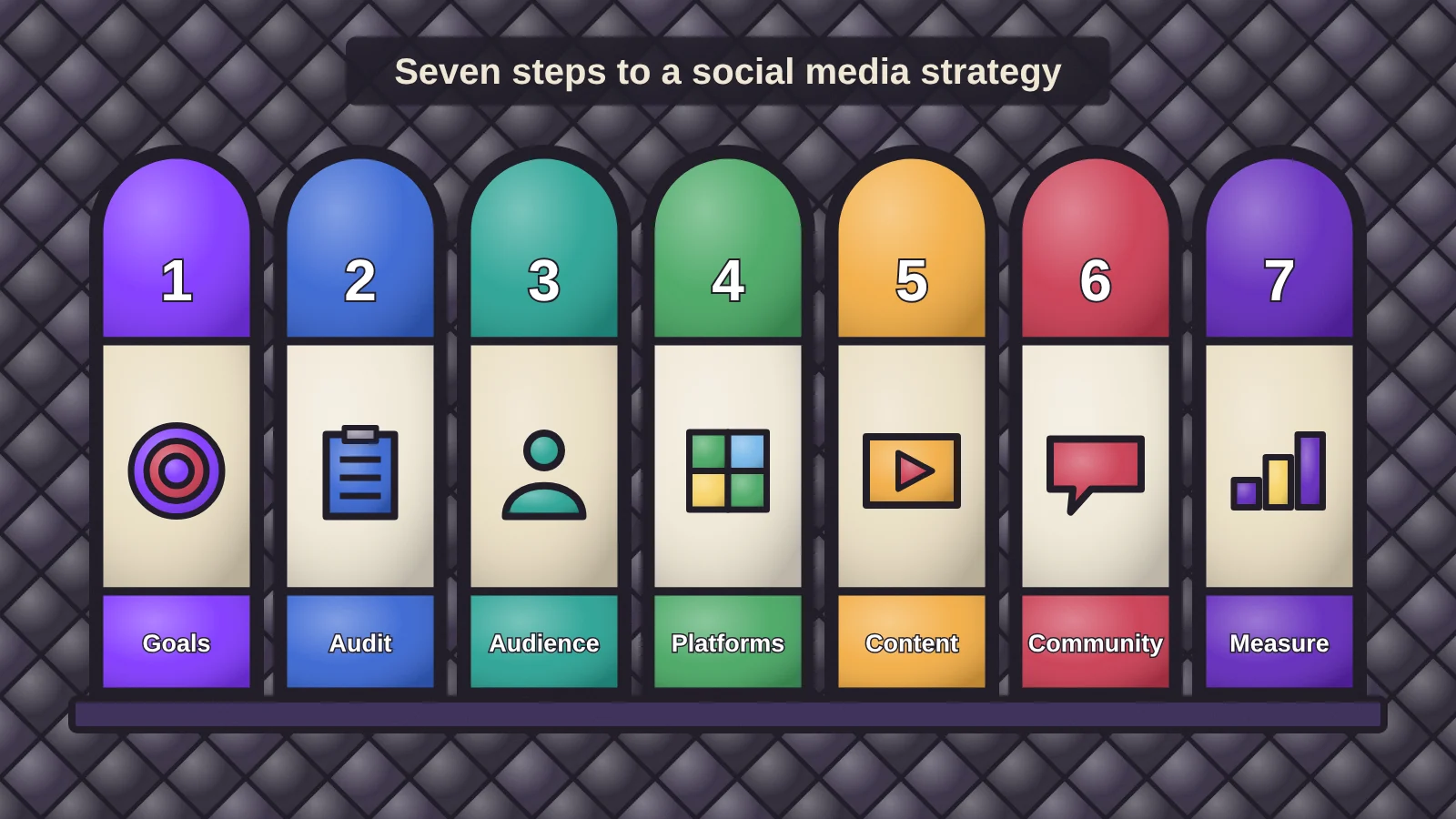
How to create a social media strategy in 7 steps
The steps below work for a business starting from scratch and for one that has posted for years without a plan. An established account spends longer on the audit, a new one on audience research and platform choice.
1. Set goals that serve the business
Start with what the business needs, then decide what social media can contribute. A business objective such as “grow online sales by 20% this year” might give social media the job of reaching new buyers and sending qualified traffic to product pages. An objective such as “hire 15 engineers” points to a very different social plan.
Most social goals fall into four groups:
- Awareness: getting the brand in front of people who don’t know it yet.
- Engagement and community: building a relationship with people who already follow or buy.
- Conversion: driving visits, enquiries, sign-ups or sales.
- Service and loyalty: answering questions, handling complaints and turning customers into advocates.
Give each platform one primary goal and make it measurable, for example “reach 40,000 people in Greater Manchester each month on Instagram” or “generate 25 demo requests a quarter from LinkedIn”. If you already have business objectives, the digital marketing strategy process shows how to turn them into channel goals.
2. Audit where you are now
List every account the business has, including forgotten ones. For each, note the follower count, how often it posts, average engagement, the best and worst performing posts of the last six months, how quickly messages are answered and how much traffic it sends to the website. Check that names, profile pictures, bios and links match across platforms.
Also check who has admin access. Accounts that sit in a former employee’s personal login are a common risk, and recovering them takes far longer than setting up shared business access now. If social media is one of several channels under review, a digital marketing audit looks at all of them against the same goals.
Finish by looking at three to five competitors or peers. Which platforms do they use, which posts get a response and what is missing? Gaps in what others post are often the clearest opportunity.
3. Know your audience
Write down who you want to reach in specific terms: their age range, role or life stage, location, problems, the language they use and what they want from social media. Simple personas help when several people create content. Base them on evidence rather than guesses:
- platform analytics, which show the age, location and active hours of current followers
- Google Analytics 4 referral data, which shows which platforms send visitors who buy or enquire
- customer interviews and sales or support conversations
- social listening, which tracks what people say about your brand, competitors and topics
- search data from inside the platforms, which shows the questions people type
The most useful audience question is often the simplest: where do your best customers already spend time, and what do they go there for? Someone who uses LinkedIn for industry news and Instagram for holiday ideas will respond to very different content on each.
4. Choose your platforms
Reach is the starting point. Ofcom’s Online Nation 2025 report found that YouTube reached 94% of UK online adults in May 2025 and Facebook with Messenger 93%. Instagram reached 78%, Reddit 60%, TikTok 56% and X 39%. Reddit’s reach grew sharply, up from 48% a year earlier.
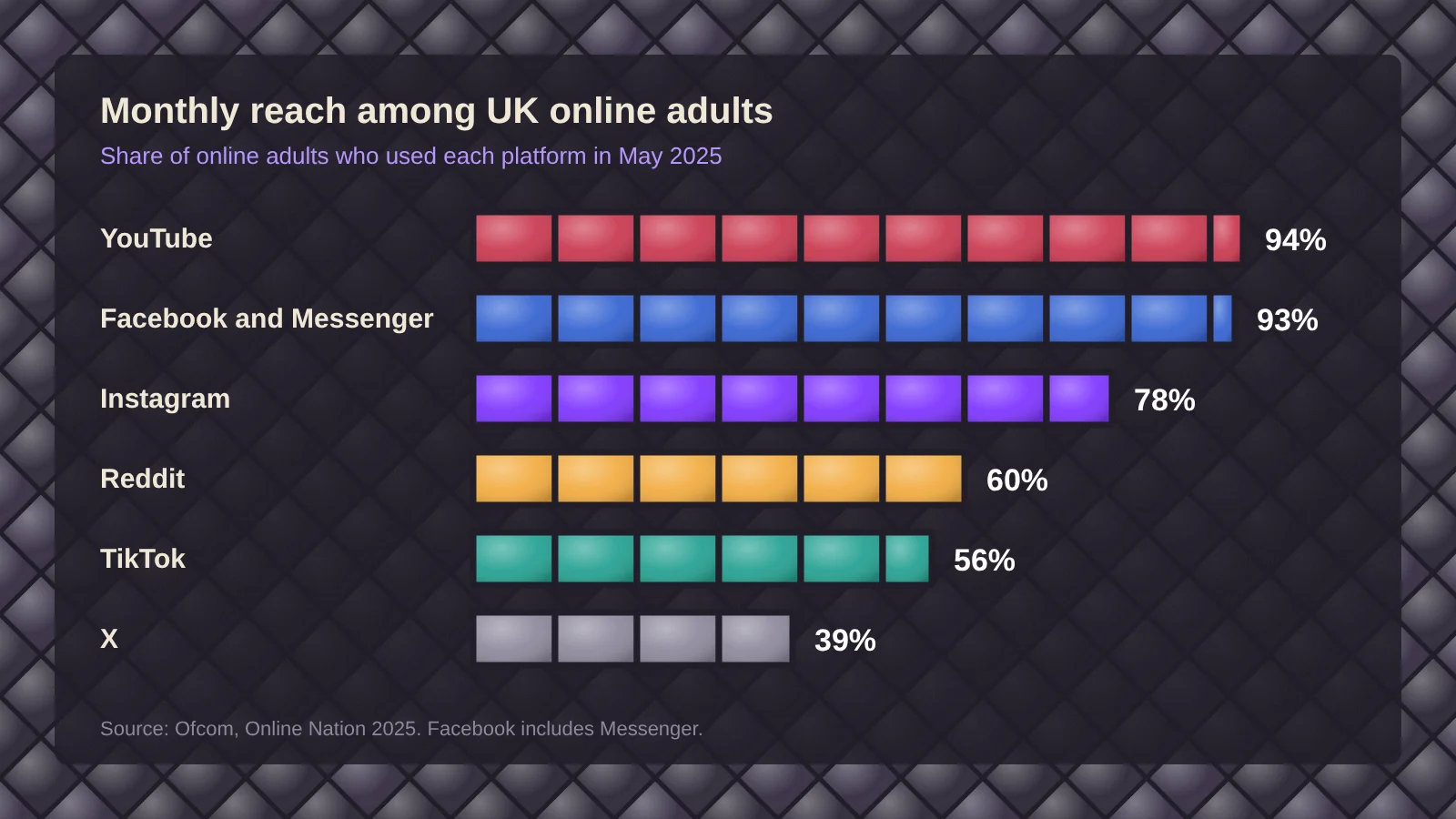
Reach doesn’t decide the choice on its own. What matters is whether your audience uses a platform in a way that fits your goal and whether you can make the content it rewards.
| Platform | Best for | Content it rewards |
|---|---|---|
| YouTube | Search-led discovery, explaining products and long-term visibility in Google | How-to videos, reviews, Shorts |
| Local communities, groups, events and older audiences | Short video, community posts, events | |
| Visual brands, consumer products, local businesses | Reels, carousels, Stories | |
| TikTok | Reaching new audiences quickly, younger buyers, entertainment-led brands | Short, native video that hooks in the first seconds |
| B2B, recruitment, expertise and thought leadership | Personal posts from people, documents, short video | |
| Planning-led purchases such as home, food, fashion and weddings | Vertical images and video linked to products | |
| Listening to honest opinions and answering questions in niche communities | Useful, non-promotional replies |
Most small businesses do better with one or two platforms done well than five done badly. Claim your name on the others so nobody else takes it, then add a platform only when the first ones run smoothly. Platform choice also shapes discovery: Instagram SEO and TikTok SEO work differently, so pick platforms whose search behaviour suits your topics.
5. Define content pillars, formats and voice
Content pillars are the three to five recurring themes your posts cover. They keep the feed focused, make planning faster and teach followers what to expect. A garden centre might choose seasonal planting advice, plant care problems, behind the scenes at the nursery and customer gardens. A software company might choose product tips, customer stories, industry data and the team.
A practical mix includes content that teaches, content that shows the people and process behind the business, content that proves your claims through reviews and customer stories, and a smaller share that sells directly. Social proof such as reviews, results and customer posts often does more selling than a direct promotion.
Then fix the voice. Decide how formal you are, whether you use humour, how you handle criticism and which words you avoid. Write it down with examples of good and bad posts, so a new team member or agency can match it. The voice should follow from your brand positioning: a premium accountancy firm and a skate shop shouldn’t sound the same.
Finally, plan for search. Use the words your audience types in captions, on-screen text, spoken audio and profile bios, and answer the questions you found in step 3. The seven steps of social media SEO cover this in detail.
6. Plan publishing, community and resources
Decide how often you can post to a good standard and keep that pace. A steady rhythm you can sustain for a year beats a burst of daily posts that stops after a month. Put the rhythm into a content calendar, with a mix of planned posts and space for timely ones.
Community management needs the same planning as publishing:
- a target response time for comments and messages, with cover for evenings and holidays if customers expect it
- guidance on what to answer publicly, what to move to a private message and what to escalate
- saved replies for common questions, written in your voice
- a simple process for complaints and a named person who decides when to pause scheduled posts during a crisis
Look beyond the brand account too. On LinkedIn, employees have on average ten times as many connections as their company has followers, according to LinkedIn, so encouraging staff to share their expertise can reach far more people than company posts alone. Creators and customers extend reach in the same way through influencer marketing and user-generated content.
Finally, be realistic about resources. Note who plans, creates, approves and replies, how many hours each person has and what budget exists for tools, production, creators and paid promotion. A strategy that needs more time than the team has will fail quietly.
7. Measure, learn and adjust
Choose metrics that match the goal from step 1. Likes and follower counts are easy to collect but rarely show business impact on their own.
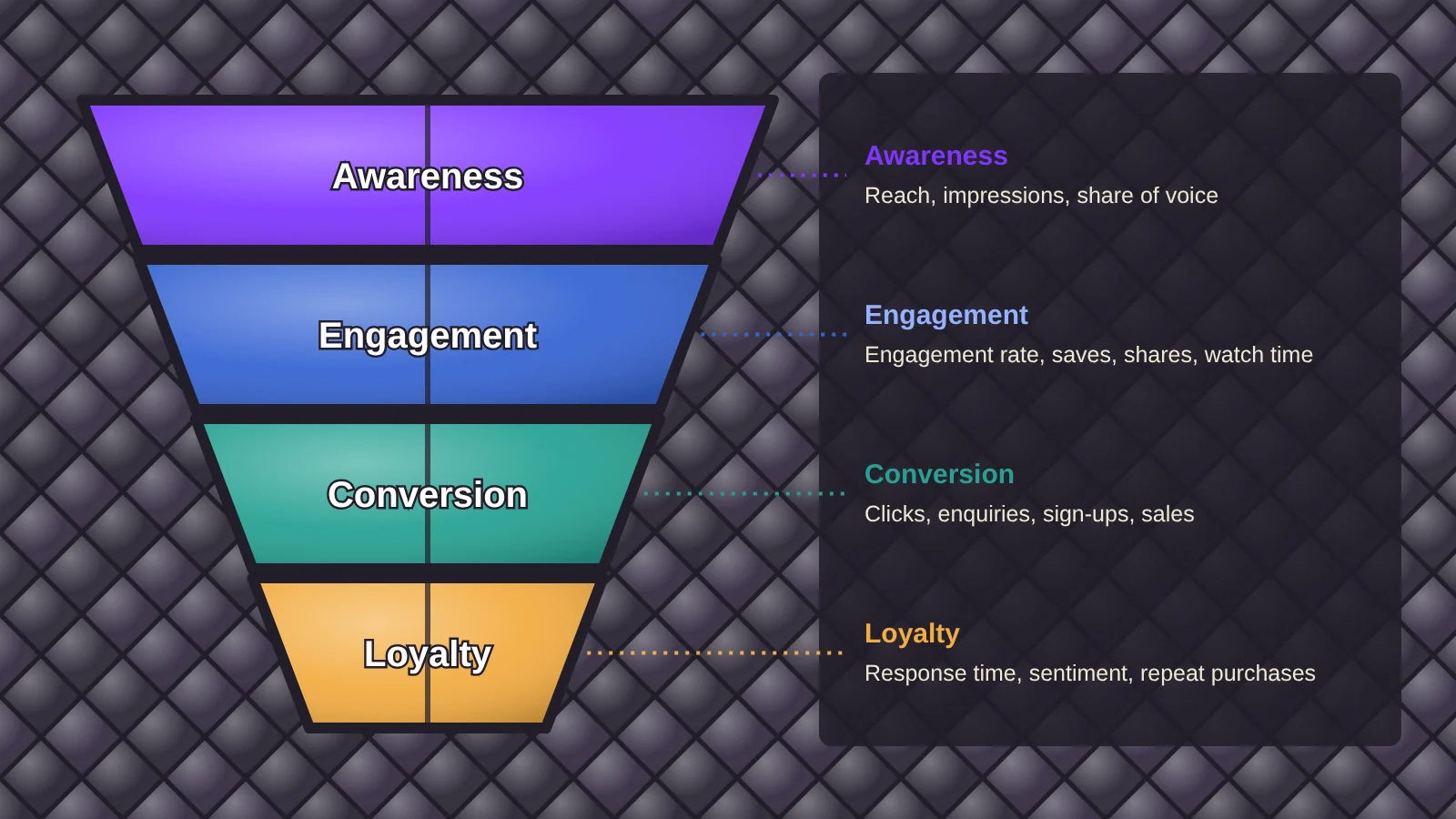
- Awareness: reach, impressions, follower growth from the target audience and share of voice against competitors.
- Engagement: engagement rate, saves, shares, comments and watch time.
- Conversion: link clicks, click-through rate, enquiries, sign-ups and sales from social traffic.
- Service and loyalty: response time, sentiment, repeat purchases and how much content customers create about you.
Add UTM parameters to every link you share, so Google Analytics 4 can show which platforms and posts send visitors who convert. For search inside the platforms, track the measures listed in how to measure social media SEO.
Be careful with benchmarks. Engagement rates vary widely by platform, sector and method: some reports divide engagement by followers, others by reach, which can produce very different figures for the same post. Your own trend over time is a more reliable guide than an industry average.
Review the numbers monthly and change one thing at a time, such as a format, a posting time or a hook, so you can see what made the difference. Review the strategy itself every quarter and rewrite it once a year or when the business changes direction.
Social media strategy template
Copy the table below into a document and fill in the right-hand column. If a section takes more than a short paragraph, it probably belongs in the content plan rather than the strategy.
| Section | What to write |
|---|---|
| Business objective | The business result social media supports, with a number and a deadline |
| Social goals and KPIs | One primary goal per platform and the two or three metrics that show progress |
| Audience | Who you want to reach, what they care about and where they spend time online |
| Platforms and their roles | Each platform you will use and the job it does, plus the platforms you won’t use and why |
| Content pillars | Three to five recurring themes, with the share of posts each one gets |
| Formats | The formats you will make for each platform, such as short video, carousels or live sessions |
| Voice | Three to five words that describe how you sound, with one example of a good post and one to avoid |
| Publishing rhythm | How often you post on each platform and when you review the calendar |
| Community management | Response time target, who replies, what gets escalated and how complaints are handled |
| Amplification | Plans for employees, creators, customer content and paid promotion |
| Resources | Who plans, creates, approves and replies, the hours each has and the budget |
| Measurement and review | Where the numbers come from, how often they are reported and when the strategy is reviewed |
Social media strategy examples
The best-known examples tend to be big brands with big audiences, but the useful lessons are about focus and consistency rather than budget.
Duolingo: one character, one platform-native tone
Duolingo built its TikTok presence around Duo, its green owl mascot, with almost every post featuring the character and playing on the running joke about Duo pressuring people who skip a lesson. Its global social media manager told Digiday that the more chaotic Duo behaved, the more new users the app saw. The lesson is not to copy the humour, which many brands have since tried. It is that a clear character and a tone made for one platform can do more than polished advertising moved from elsewhere.
Ryanair: turning criticism into a voice
Ryanair’s TikTok account answers the common complaints about budget flying with self-deprecating jokes, often voiced by a plane with a cartoon face, and joins trends quickly. As The Drum noted, the tone carried on after the person most associated with it left, a reminder that a voice has to be written into the strategy rather than living in one person’s head.
A worked example for a small business
Most businesses work at a much smaller scale. Here is what a one-page strategy could look like for an independent coffee roaster in Bristol that sells beans online and supplies local cafés:
| Section | Example |
|---|---|
| Business objective | Grow online subscription customers from 300 to 500 in 12 months and win five new café accounts |
| Social goals | Instagram: reach new home brewers in the South West and drive subscription sign-ups. LinkedIn: get in front of café owners and hospitality buyers |
| Audience | Home coffee enthusiasts aged 25 to 45 who buy good equipment and want to improve their brewing; independent café owners within 30 miles |
| Content pillars | Brewing guides (40%), sourcing and roasting stories (25%), customer and café features (20%), new coffees and offers (15%) |
| Formats and rhythm | Three Instagram posts a week, mostly reels and carousels; one LinkedIn post a week from the founder |
| Voice | Knowledgeable, warm, never snobbish; explains terms instead of assuming them |
| Community | Replies within one working day; brewing questions answered publicly, order problems moved to direct messages |
| Amplification | Reposting customer brewing setups with permission; a small paid budget to promote the best performing reel each month to people in the South West |
| KPIs | Reach among the target region, saves per post, clicks to the subscription page, subscriptions from social traffic, café enquiries |
| Review | Monthly numbers check, quarterly strategy review after each new coffee season |
Every line traces back to the objective. Brewing guides earn saves and attract the right followers, café features double as proof for trade buyers, and only a small share of posts asks for a sale.
Social media strategy for B2B
B2B social media follows the same steps with a few differences. Buying cycles are longer and several people take part in each decision, so the aim is to stay visible and credible over months rather than to prompt an immediate purchase. LinkedIn is usually the main platform, and posts from founders, experts and sales staff tend to reach and persuade more people than the company page.
Content that works in B2B shows expertise: original data, clear points of view on industry changes, practical advice and customer results. Measure beyond clicks too. Ask new leads where they heard of you, track how many target accounts engage with your posts and compare deal rates for contacts who follow you with those who don’t.
UK rules to plan for
Social media marketing in the UK falls under the same advertising rules as other channels. Three areas come up most often.
- Influencer and paid partnerships: any post a brand pays for or controls must be obviously identifiable as an ad. The ASA and CMA influencers’ guide recommends a clear “Ad” label at the start of the post, not hidden among hashtags.
- Giveaways and competitions: the CAP Code applies to prize draws on social media. The ASA expects significant conditions such as the closing date and how to enter to appear in the post itself, and winners to be picked at random or by an independent person, not by a member of staff scrolling through comments.
- Reviews and endorsements: fake reviews and undisclosed incentivised reviews are banned under consumer law, with direct fines from the CMA. The UK rules section of the digital marketing strategy guide and social proof and the law explain what this means in practice.
Common social media strategy mistakes
- Being everywhere. Opening accounts on every platform spreads effort thinly and leaves inactive profiles that make the brand look abandoned.
- Posting the same content everywhere. A landscape video with a long caption may suit Facebook but not TikTok. Adapt each piece to the platform.
- Treating social media as a broadcast channel. Unanswered comments and messages undo the work of good posts.
- Chasing trends that don’t fit. A trend only helps if your audience is part of it and the brand can join in naturally.
- Measuring vanity metrics. Follower numbers and likes say little about whether social media is helping the business.
- No owner. When social media is everyone’s side job, it drifts. One person should own the strategy, even if many contribute.
- Never reviewing the plan. Platforms change their features and algorithms often. A strategy that hasn’t been reviewed in a year is probably out of date.
Frequently asked questions
What should a social media strategy include?
A social media strategy should include business objectives, social goals and KPIs, a clear audience, the platforms you will use and the role of each, content pillars and formats, a brand voice, a publishing rhythm, a community management approach, resources and a measurement and review plan.
How do I create a social media strategy for a small business?
Start with one business goal, research where your best customers spend time and choose one or two platforms. Set three to five content pillars, post at a pace you can sustain, reply to every comment and review the results monthly. The template in this guide fits on one page.
How often should a business post on social media?
There is no single right number. Post as often as you can while keeping quality and replying to comments, which for many small businesses means two to four times a week on each main platform. Consistency over months matters more than volume.
What is the difference between a social media strategy and a content calendar?
A social media strategy decides the goals, audience, platforms, content themes and measures for a year. A content calendar is the day-to-day schedule of individual posts that puts the strategy into practice.
How do you measure the success of a social media strategy?
Measure against the goal each platform serves. Use reach and share of voice for awareness, engagement rate and saves for interest, and clicks, enquiries and sales tracked with UTM links in GA4 for conversion.
On this page
Back to topMake social media work for your business
Kutola builds social media strategies that start from business goals, from the audit and platform choice to content pillars, social search and measurement. Get in touch to find out where social media could take your brand next.