Social media content strategy: pillars, formats and a monthly plan

A social media content strategy is the part of your social media planning that decides what you post: the themes you cover, the formats you use on each platform, how often you publish and how you judge each post. It turns goals such as “reach more local buyers” into posts that people stop for, save and send to a friend.
It sits underneath your social media strategy, which sets the goals, audience and platforms. This guide covers how to choose content pillars, which formats each platform rewards according to recent data, how often to post and how to turn one idea into several posts. It ends with a one-month example plan and a simple way to measure what works.
What is a social media content strategy?
Most businesses that struggle on social media don’t lack a goal. They lack a repeatable answer to “what do we post this week?” A content strategy gives that answer before the week starts. It makes five decisions:
- Pillars: the three to five themes you post about, and the job each one does.
- Formats: which formats you make for each platform, such as Reels, carousels or document posts.
- Rhythm: how often you post on each platform and how much room you leave for timely posts.
- Production: where ideas come from, who makes them and how one idea becomes several posts.
- Measurement: which numbers show that each pillar and format is doing its job.
The day-by-day schedule of individual posts lives in a content calendar. If your business also runs a blog, newsletter or podcast, the social plan should draw on the same core topics as your wider content strategy, so each channel supports the others.
How to choose content pillars
Content pillars are the recurring themes your posts come back to. Good pillars come from what your audience already asks, not from what the business wants to say. Start with the questions you hear every week:
- questions customers ask in the shop, on calls and in emails to support
- comments and direct messages on your own posts and on competitors’ posts
- search suggestions inside TikTok, Instagram and YouTube when you type your topic
- reviews, both the praise and the complaints, which show what people care about
Group the questions into themes, then test each theme with three questions. Does the audience care enough to stop scrolling for it? Can you make at least two posts a month on it for a year without running dry? Does it connect to something the business sells or stands for? A theme that fails any of the three is a one-off post, not a pillar.
Then give each pillar a job. Some pillars reach new people, some build trust with people who already follow you and a smaller one asks for the sale. For an independent bike shop in Leeds, the pillars might look like this:
| Pillar | Job | Typical posts | Share of posts |
|---|---|---|---|
| Quick fixes | Reach people who don’t know the shop | 30 second repair videos: a squeaky chain, a slipping gear, a slow puncture | 40% |
| Local rides | Build a community around the shop | Route carousels, Sunday ride meet-ups, café stops on the way | 25% |
| In the workshop | Show expertise and the people behind it | A wheel build from start to finish, a mechanic’s tool of the week | 20% |
| Bikes and services | Turn followers into customers | New stock, service bookings before spring, customer reviews | 15% |
Only one pillar in four sells directly, yet every pillar points back to what the shop does. Reviews and customer stories in the selling pillar often persuade more than a promotion, which is why social proof deserves a regular slot.
Which formats work on each platform
Each format does a different job, and the data shows a clear split between formats that reach new people and formats that hold the people they reach. On Instagram, a Buffer analysis of more than 4 million posts found that Reels reached 2.25 times as many people as single images and 1.36 times as many as carousels. Engagement runs the other way. In Buffer’s 2026 engagement report, carousels had a median engagement rate of 6.90% of people reached, against 3.31% for Reels.
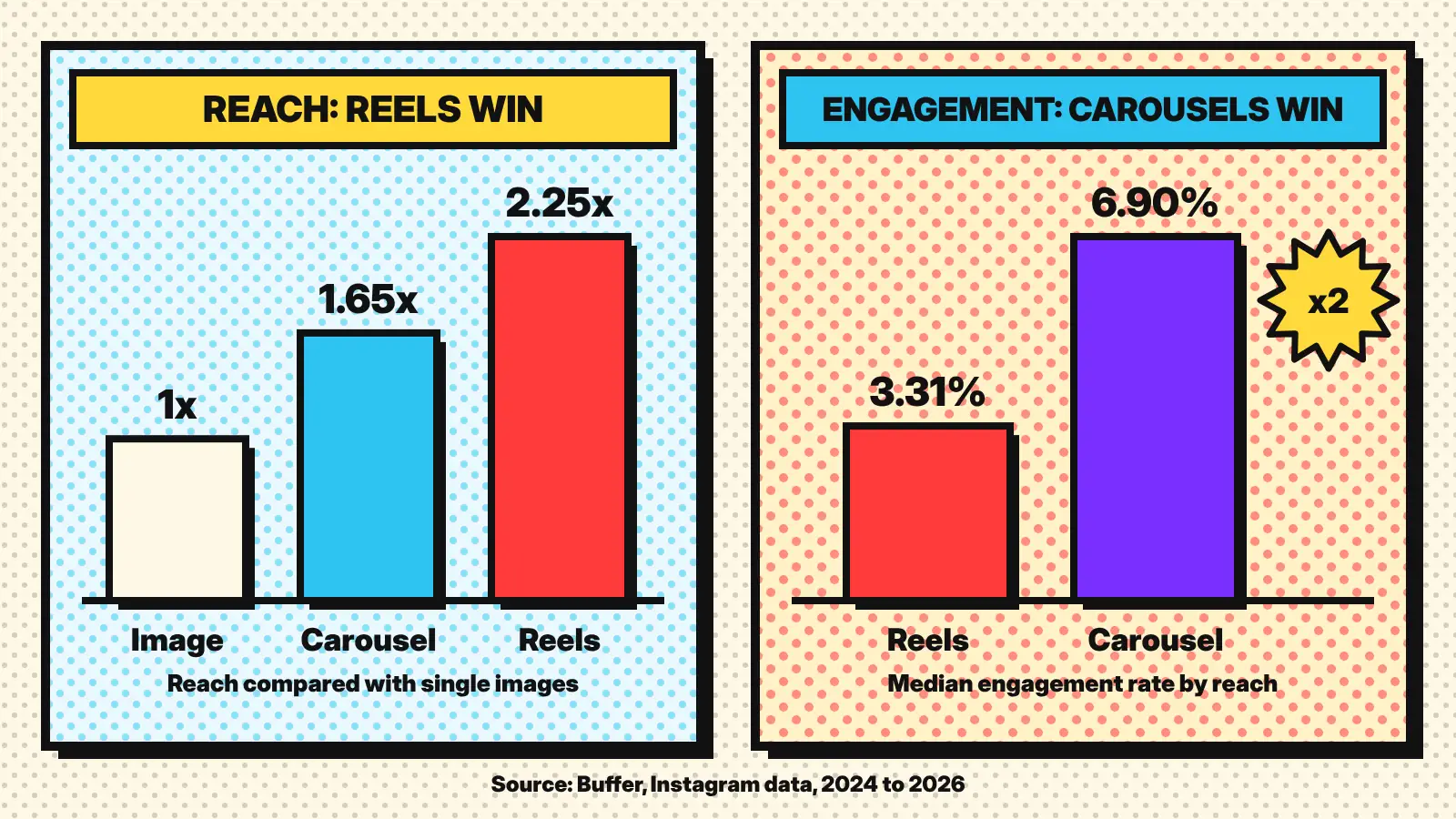
The platforms say the same thing about what they reward. Adam Mosseri, the head of Instagram, named watch time, likes per reach and sends per reach as the top ranking signals in early 2025, with sends counting slightly more for reaching people who don’t follow you. A post that someone sends to a friend is doing the job of a pillar meant for reach.
| Platform | Format for reach | Format for depth | What the data says |
|---|---|---|---|
| Reels | Carousels | Reels reach more people, carousels earn more engagement from the people they reach | |
| TikTok | Short video | Series of short videos on one topic | Video’s median engagement rate is about 77% higher than photos and carousels in Buffer’s format study of 45 million posts |
| Short video and personal posts | Document (PDF) carousels | Document carousels had a median engagement rate of 21.77% in the same study, the highest of any format on any platform | |
| YouTube | Shorts | Longer how-to videos | How-to videos can keep appearing in YouTube and Google search results long after they go live |
| Short video | Group posts and events | Works best for local communities and older audiences |
LinkedIn is worth a closer look if you sell to businesses. A LinkedIn representative told Digiday that video viewership on the platform rose 36% year on year in the three months to January 2025, so short video now sits alongside the document posts that have long done well there.
How often to post
Post as often as you can keep up for a year without the quality dropping. For Instagram there is now solid data on what that pace earns. Buffer studied 2.1 million posts from 102,000 accounts and found that posting three to five times a week more than doubled follower growth compared with posting once or twice. Gains continued at higher volumes but grew smaller for each extra post.
For most small teams, three feed posts a week on the main platform and one or two on the second is a realistic starting point. Three habits keep that pace going:
- Batch the work. Film four quick-fix videos in one afternoon rather than one every Monday.
- Plan 80%, leave 20%. Fill most slots in advance and keep the rest for news, trends and customer moments.
- Keep a backlog. Two or three evergreen posts ready to go cover a busy week or a holiday.
Turn one idea into several posts
Making every post from scratch is the fastest way to burn out. Instead, start each week with one core idea and adapt it to each platform. The bike shop’s “fix a slipping gear” idea could become a 30 second Reel and TikTok, a five-slide carousel with the steps, a LinkedIn post from the owner on why most gear problems are a five-minute fix, and a Story poll asking followers what noise their bike is making.
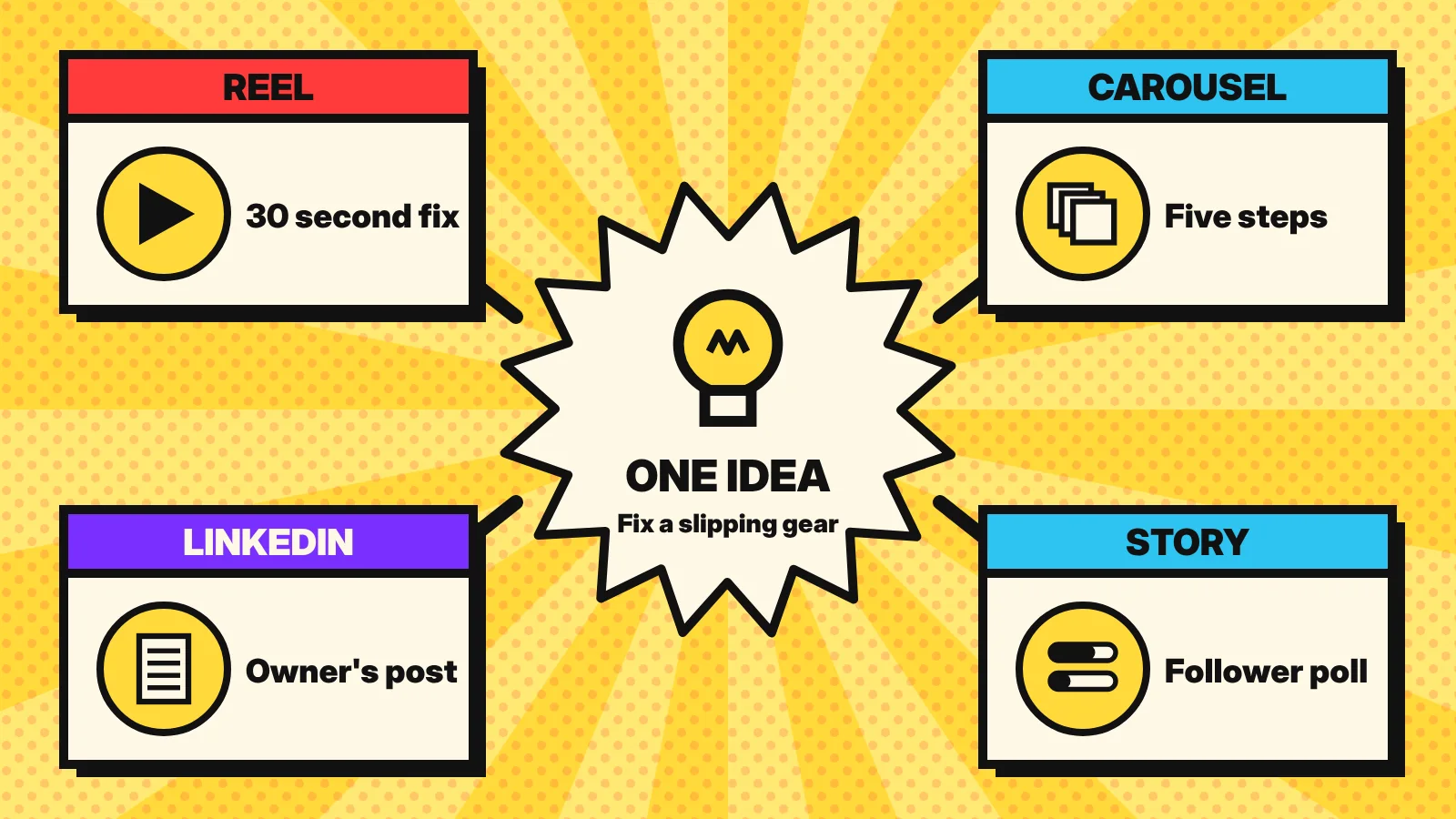
Adapt rather than copy. A landscape video with a long caption suits Facebook but looks out of place on TikTok, and platforms favour content made for them. Instagram updated its ranking in 2024 to reward original content over reposts, so videos carrying another app’s watermark start at a disadvantage. Export a clean file for each platform and rewrite the caption for the way people use it.
Make posts that get found in search
Social platforms are search engines too, and posts that answer a real question keep collecting views long after the feed has moved on. Plan for search when you write each post:
- Put the words people search for in the first line of the caption, in on-screen text and in what you say out loud.
- Name posts after the question, such as “why is my bike chain squeaking”, not after a campaign.
- Use a few specific hashtags that describe the post, not a long list of popular ones.
The steps of social media SEO cover this in detail, and the guides to writing Instagram captions for search and finding TikTok keywords go platform by platform.
A one-month content plan example
Here is how the bike shop’s pillars and formats could fill April, when people take their bikes out of the shed. The shop posts three times a week on Instagram, twice on TikTok and once on LinkedIn from the owner.
| Week | Core idea | TikTok | ||
|---|---|---|---|---|
| 1 | Five checks before your first spring ride | Reel of the checks, carousel checklist, spring service offer | Two short check videos | Why spring is the shop’s busiest month |
| 2 | Fix a slipping gear | Reel, step-by-step carousel, customer review | Fix video, reply video to a comment | Training a new mechanic |
| 3 | A Sunday ride to Otley | Route carousel, ride meet-up Story, new e-bike stock | Ride highlights, café stop video | Supporting local cycling clubs |
| 4 | Build a wheel in 60 seconds | Workshop Reel, tool of the week carousel, booking reminder | Time-lapse build, tool video | What a month of repairs says about Leeds riders |
Four ideas fill 24 posts. Each week mixes formats for reach and depth, and only about one post in six asks for a booking or a sale.
How to measure your social content
Judge each post by the job its pillar was given, not by likes alone. A quick-fix video meant for reach should be compared on reach, watch time and sends. A carousel meant to build trust is judged on saves and comments. A selling post is judged on link clicks, bookings and sales, tracked with UTM links in Google Analytics 4.
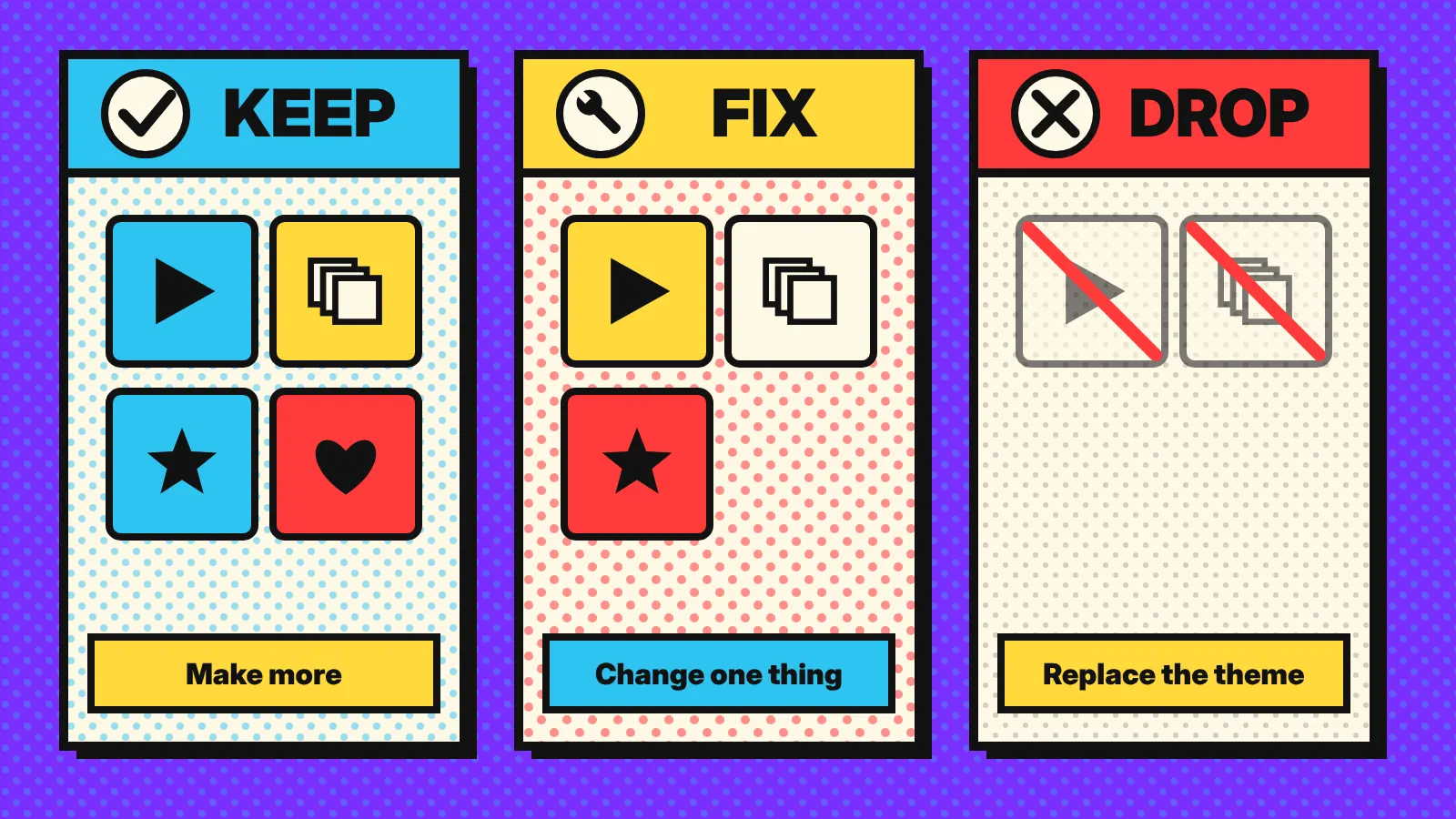
Once a month, group your posts by pillar and format and compare averages rather than single posts, since one viral video can hide a weak month. Then sort each pillar and format into three groups:
- Keep: it does its job, so make more of it.
- Fix: the topic works but the delivery doesn’t. Change one thing, such as the hook, length or cover image, and test again.
- Drop: three months of trying with no improvement. Replace it with a theme from your question list.
Be careful with benchmarks. Some tools calculate engagement rate against followers and others against reach, which gives very different figures for the same post. Your own trend over time is the more reliable guide.
Frequently asked questions
What is a social media content strategy?
A social media content strategy decides what a business posts on social media: its content pillars, the formats for each platform, how often it posts, how content is produced and how each post is measured. It turns the goals of a social media strategy into a repeatable plan.
What are content pillars in social media?
Content pillars are the three to five recurring themes a brand posts about, such as tips, behind the scenes, customer stories and offers. Each pillar has a job, from reaching new people to turning followers into customers.
What is the difference between a social media strategy and a social media content strategy?
A social media strategy sets the goals, audience, platforms and measures. A social media content strategy works inside it and decides the themes, formats, posting rhythm and production of the posts themselves.
How many times a week should a business post on social media?
Post as often as you can keep up with good quality. On Instagram, Buffer’s study of 2.1 million posts found that three to five posts a week more than doubled follower growth compared with one or two.
What type of content performs best on social media?
It depends on the job. On Instagram, Reels reach the most people while carousels earn the most engagement from the people they reach. On LinkedIn, document carousels have the highest median engagement rate in Buffer’s data.
On this page
Back to topKnow what to post every week
Kutola builds social media strategies with content pillars, formats and a posting plan your team can keep up, and a monthly review that shows what to keep, fix or drop. Get in touch to plan content that earns its place in the feed.