Content strategy: what goes into one, with a one-page template

A content strategy is the plan behind everything a business publishes. It decides why the content exists, who it is for, which topics and formats it covers, where it appears, who makes and maintains it and how its results are judged. Content strategist Kristina Halvorson summed it up as planning for the creation, delivery and governance of useful, usable content, and that last part matters: a strategy covers what happens to content after it goes live, not only what gets made.
This guide explains what goes into a content strategy, how it differs from content marketing and why it matters now that people find answers through Google, social platforms and AI assistants. It then sets out seven steps to create one, shows three well-known examples, gives you a one-page template and covers how to measure the results and the mistakes that most often hold content back.
Key takeaways
- A content strategy decides what to publish and why, and also who maintains it, when it is updated and when it is removed.
- Content marketing is one use of content. A content strategy also covers help pages, product pages, emails and anything else your audience reads.
- Most content online gets no search traffic at all, so choosing topics by real audience questions and search intent is where the strategy earns its keep.
- Three to five core topics, organised as pillar pages and clusters, build the depth that Google and AI search tools look for.
- Judge content by the job it was given, from search visibility and engaged time to enquiries, and review older pages as seriously as you plan new ones.
What is a content strategy?
A content strategy answers a short list of questions before anyone writes a word:
- What does the business need content to achieve?
- Who is the content for, and what do those people need to know, do or decide?
- Which topics will the business cover, and which will it leave alone?
- Which formats and channels suit those topics and that audience?
- How will the content sound, and what standards must it meet?
- Who plans, writes, approves, publishes and updates it?
- How will you know it is working?
The answers belong in a short document that everyone who creates content works from. The strategy itself changes slowly, usually once a year with a review each quarter. The detail sits in the documents that put it into practice: a content plan for the themes and campaigns of the coming months and an editorial calendar for what goes out on which day.
A content strategy sits inside your wider digital marketing strategy. That strategy sets the business goals, the audience and the mix of channels. The content strategy decides what you will say across those channels, and how you will keep saying it well.
Content strategy vs content marketing
The two terms are often used as if they mean the same thing. They overlap, but the scope is different. The Content Marketing Institute defines content marketing as a strategic marketing approach built on creating and distributing valuable, relevant and consistent content to attract and keep a clearly defined audience, and ultimately to drive profitable customer action. In other words, content marketing uses content to win and keep customers.
A content strategy covers that and more. Your service pages, pricing page, help articles, onboarding emails, FAQs and even error messages are content too. A customer who reads a confusing returns page has had a content experience, even though nobody would call that page marketing.
| Term | What it covers | Main question |
|---|---|---|
| Content strategy | All the content a business produces and maintains, on every channel | What should we publish and why, and how will it stay useful? |
| Content marketing | Content made to attract, engage and keep customers, such as articles, guides, videos and newsletters | Which content will bring in and nurture the right audience? |
| Content SEO strategy | The topics and pages that should rank in search, and how they link together | Which searches should we answer, and with which pages? |
| Social media content strategy | Content themes, formats and rhythm on each social platform | What will we post, where and how often? |
The last two are parts of the content strategy that deserve their own planning. Search is covered in detail in the content side of an SEO strategy, and social content in building a social media strategy. The content strategy is the layer above them that keeps the topics, voice and standards consistent.
Why a content strategy matters
Publishing is cheap. Publishing something that gets read, trusted and acted on is not. Without a strategy, most businesses end up with a blog of loosely related posts, service pages written years apart in different voices and nobody sure which pages are still accurate. A strategy changes that in four ways.
- Most content is never found. When Ahrefs analysed around 14 billion pages in its index, it found that 96.55% of pages get no traffic from Google. The usual reasons are topics nobody searches for, pages that miss the searcher’s intent and too few links. Each of those is a planning decision.
- Search engines reward content made for people. Google’s guidance asks for helpful, reliable, people-first content rather than content written to manipulate rankings. A strategy built on real audience questions produces that kind of content by design, and makes it easier to show the experience and expertise described in Google’s E-E-A-T.
- AI tools cite sources that cover a subject well. ChatGPT, Perplexity and Google’s AI Overviews build answers from pages they can read and trust. A site that covers a topic in depth, with clear structure, gives them more reasons to cite it.
- Time and budget are limited. A strategy says no to topics that don’t serve the audience or the business, so the people writing can spend their time on the pages that matter.
What goes into a content strategy
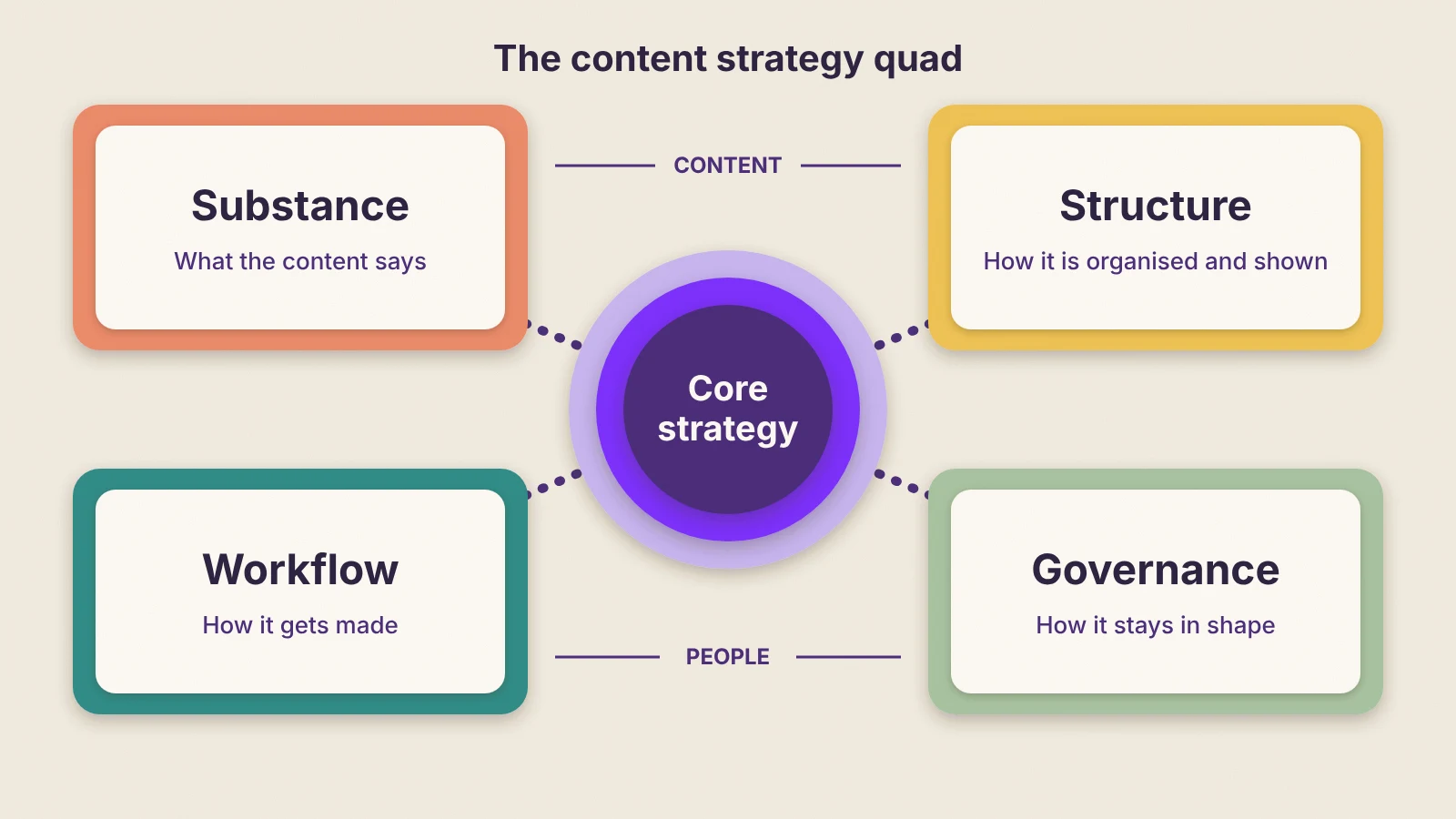
A widely used way to picture the scope comes from the agency Brain Traffic. Its content strategy quad places a core strategy at the centre and four areas around it: substance (what the content says), structure (how it is organised and shown), workflow (how it gets made) and governance (the rules and decisions that keep it in shape).
In practice, a written content strategy usually includes these elements:
- Purpose and goals: the business outcome content supports and the targets that show progress.
- Audience: two or three priority segments or a persona for each, with the questions and problems they bring to you.
- Core topics: the three to five subjects you want to be known for, each tied to what you sell.
- Formats and channels: which mix of articles, guides, video, email, social posts or tools suits each topic and where each one is published.
- Voice and standards: how the content sounds, the style rules it follows and the quality bar it must clear, usually drawn from the brand voice set out in your brand strategy.
- Structure: how pages are grouped, named and linked so that readers and search engines can find their way.
- Workflow and resources: who briefs, writes, reviews, approves and publishes, with realistic time and budget.
- Governance and measurement: who owns each page, when it is reviewed, when it is retired and which metrics show whether the content is doing its job.
How to create a content strategy in 7 steps
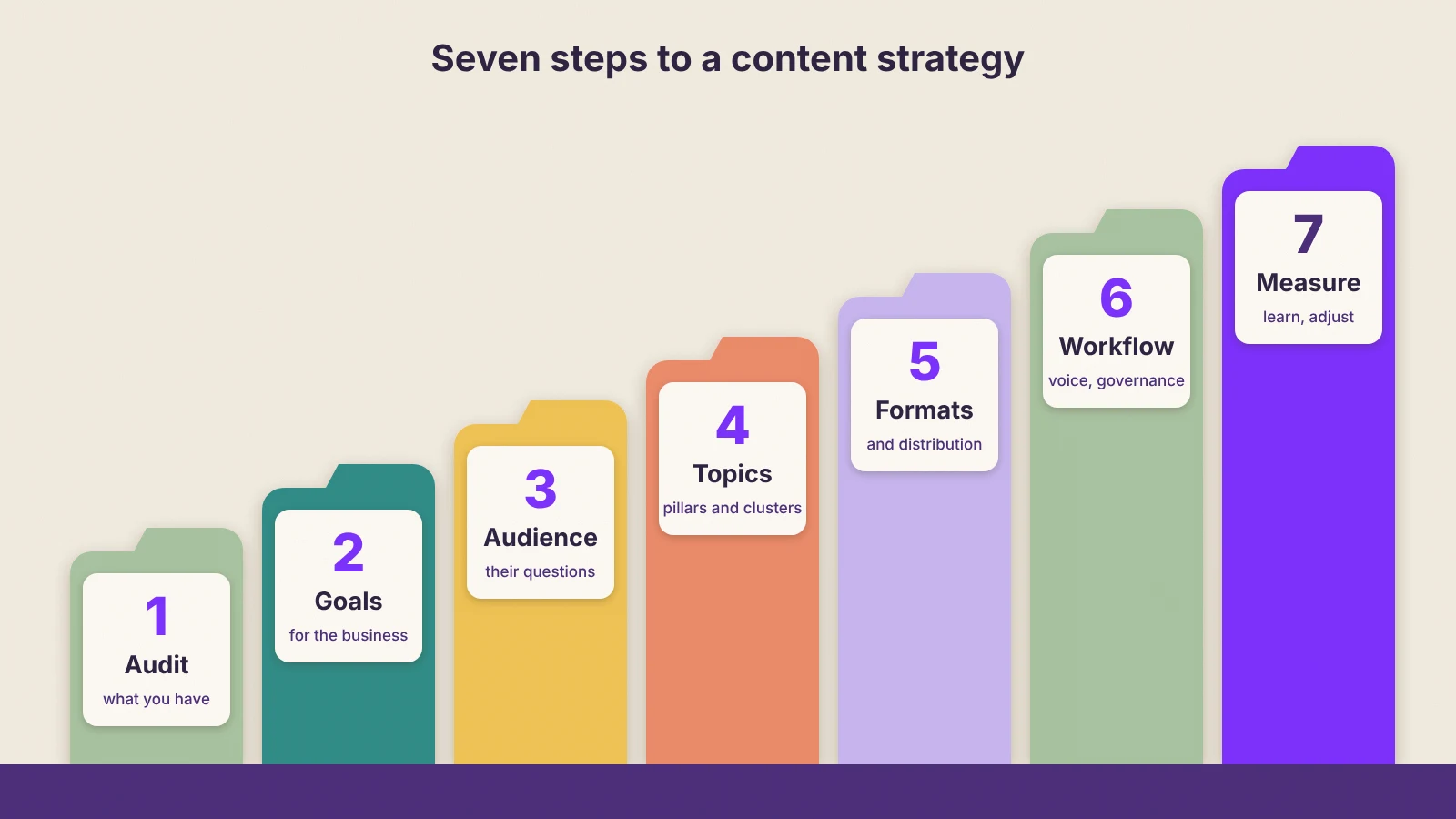
The steps work for a business starting out and for one that has published for years without a plan. An established site spends longer on the audit in step one. A new site moves faster to audience research.
1. Audit what you already have
List every page and asset you publish, with its traffic, conversions and last update date. Google Search Console shows which pages appear in search and for which queries, and GA4 shows what visitors do next. Mark each page to keep, update, merge or remove. Pages that compete for the same search, or that are years out of date, are common finds. If content is one part of a wider review, a digital marketing audit puts it in context with your other channels.
2. Set goals that serve the business
Start from the business objective, then give content a specific job. “Grow enquiries for our payroll service by 30% this year” might give content the job of ranking for payroll questions and turning readers into enquiries. “Cut support calls about returns” gives it a very different job. Write one primary goal and no more than three supporting ones, each with a KPI and a date.
3. Research your audience and their questions
Find out what your audience asks before they buy, while they compare and after they become customers. Good sources include sales and support teams, customer reviews, the People Also Ask box in Google, Reddit and industry forums, keyword tools and the questions people put to AI assistants. Group the questions by search intent and by stage, from first awareness to the final decision. The stages of the marketing funnel are a useful frame here, because each stage needs a different kind of content.
4. Choose core topics and map them as clusters
Pick three to five core topics where your audience’s questions meet what you sell and what you know. For each one, plan a pillar page that covers the subject broadly and a set of cluster pages that each answer one specific question. Every cluster links to its pillar and the pillar links back. This structure builds topical authority and stops your own pages from competing with each other. Equally important is the list of topics you won’t cover, because they don’t fit your audience or your expertise.
5. Decide formats and distribution
Match each topic to the format that answers it best. A step-by-step process may suit a written guide with a checklist, a product demonstration suits video and a cost question suits a calculator or a clear pricing table. Then decide where each piece will reach people: your website, an email newsletter, social platforms, partner sites or paid promotion. A useful rule is to plan distribution before you create anything, since a strong guide that nobody sees does no work.
Plan repurposing at the same time. One well-researched guide can become a LinkedIn carousel, a short video, a newsletter issue and a set of FAQ answers, each adapted to its channel rather than copied across.
6. Set the workflow, voice and governance
Write down who briefs, writes, edits, checks facts, approves and publishes, with the time each stage takes. Put the voice and style rules in a short guide that anyone can follow. Then decide the governance: every page gets an owner and a review date, high-traffic and fast-changing pages are reviewed more often and outdated pages are updated, merged or removed. Put the rhythm into an editorial calendar, with a realistic pace you can keep for a year rather than a burst that fades after a month.
7. Measure, learn and adjust
Decide in advance which numbers show that each piece is doing its job, check them monthly and review the strategy itself each quarter. Double down on topics and formats that work, fix pages that rank but don’t convert and stop producing types of content that consistently underperform. The measurement section below lists the metrics for each goal.
Content strategy for AI search
AI search doesn’t need a separate content strategy, but it does raise the bar for the one you have. Google says there are no additional requirements to appear in AI Overviews or AI Mode beyond being indexed and eligible to show with a snippet. What changes is how your content is used: an AI answer may quote one paragraph from your page, so each section needs to make sense on its own.
A few habits help content work for people and AI tools at the same time:
- Answer the question directly in the first sentence or two of each section, then add the detail.
- Use headings that match real questions, and tables or numbered steps where the information has that shape.
- Back claims with named sources, data and first-hand examples, and make it clear who wrote the content.
- Keep facts and dates current, because AI tools favour sources they can rely on.
These habits are the core of generative engine optimisation. To see how ready your pages are for AI search, from crawler access to structure and trust signals, you can run them through the AI Readiness Checker.
Content strategy examples
Each of the three examples below shows a different part of content strategy done well.
GOV.UK: start with user needs
When the UK government brought its departments’ websites together on GOV.UK, the content team set a simple rule. Its own publishing guidance lists “start with user needs” as the first principle of content design, and an early post on the team’s blog said GOV.UK should only publish content that meets a user need, unless it has to be published for legal or transparency reasons. The lesson for a business is the filter: if no one in your audience needs a page, it doesn’t get made.
Mailchimp: one voice, many tones
Mailchimp publishes its content style guide openly. It describes a voice that stays steady while the tone changes with the reader’s situation, so an error message sounds calmer than a product announcement. The guide gives every writer, designer and support agent the same rules, which is governance in its most practical form.
Red Bull: content as a product
Red Bull treats content as something people seek out, not a vehicle for ads. Its in-house studio, Red Bull Media House, has produced films, magazines and live events since 2007. The best-known result is Red Bull Stratos in 2012, when Felix Baumgartner’s jump from the edge of space drew more than eight million concurrent live streams on YouTube, a record for the platform at the time. Few businesses have that budget, but the principle scales: content tied closely to what your audience already cares about earns attention that ads have to buy.
A one-page content strategy template
Copy the sections below into a document and fill in each row. The example column shows a fictional accountancy firm in Bristol that works with small businesses. If a section needs more than a short paragraph, the detail probably belongs in the content plan rather than the strategy.
| Section | What to write | Example entry |
|---|---|---|
| Business goal | The outcome content supports, with a number and a date | 40 new small business clients from the website by next December |
| Content goals and KPIs | One primary goal and up to three supporting goals, each with a metric | Organic enquiries; newsletter sign-ups; clicks from Search Console on priority topics |
| Audience | Two or three priority segments and their main questions | Sole traders moving to a limited company; owners hiring their first employee |
| Core topics | Three to five pillars, each tied to a service | Making Tax Digital; payroll; company formation; year-end accounts |
| Formats and channels | The main formats and where each one is published | Guides and checklists on the website; monthly newsletter; short LinkedIn posts |
| Voice and standards | Three words for the voice and the rules every piece follows | Clear, calm, practical; every figure sourced from GOV.UK or HMRC |
| Workflow and resources | Who does what, and how much time or budget is available | A partner reviews every guide; one guide and one newsletter a month |
| Governance | Page owners, review dates and the rule for retiring content | Tax guides reviewed after each Budget; pages with no visits in a year merged or removed |
| Measurement | Which reports you check, how often and who acts on them | Monthly GA4 and Search Console review; strategy review each quarter |
How to measure a content strategy
Judge each piece of content by the job it was given. A guide written to bring new people to the site shouldn’t be judged on sales, and a pricing page shouldn’t be judged on shares.
| Content goal | Metrics to track | Where to find them |
|---|---|---|
| Visibility | Impressions, clicks and average position for priority topics; citations in AI answers | Google Search Console; manual checks or AI visibility tools |
| Engagement | Engaged sessions, engagement rate, scroll depth, returning visitors | GA4 |
| Audience growth | Newsletter sign-ups, followers gained from content, branded searches | Email platform; social analytics; Search Console |
| Conversion | Enquiries, demo requests or sales that started from or passed through content | GA4 key events and attribution reports; CRM |
| Content health | Pages past their review date, pages with no traffic, pages competing for the same query | Content inventory; Search Console |
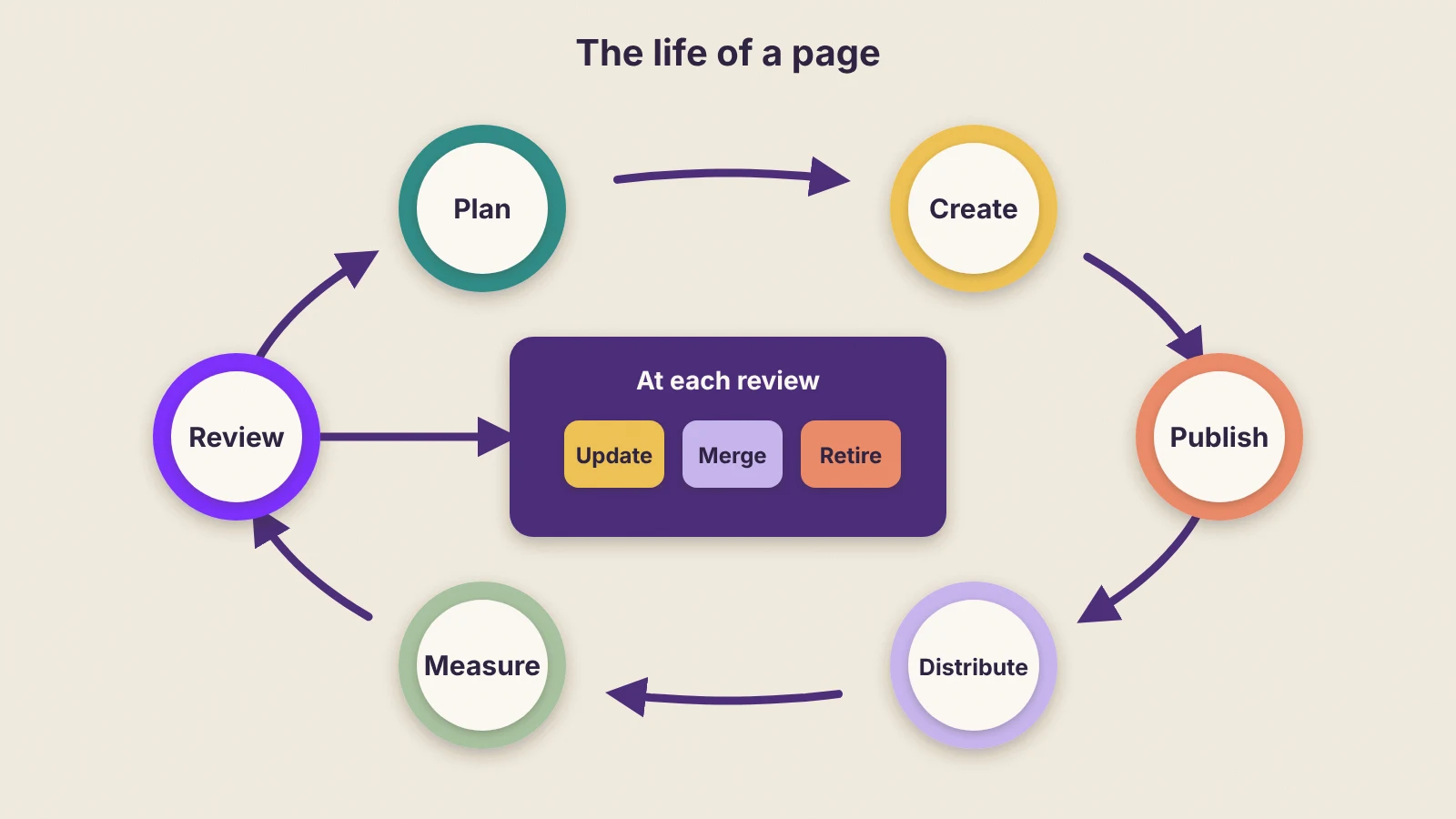
Content health is the row most strategies leave out. Every page you publish needs looking after, and a growing archive of outdated pages drags down trust in the rest. Building review and retirement into the cycle keeps the site useful as it grows.
Common content strategy mistakes
- Starting with the calendar. Filling a calendar with post ideas before goals and audience are clear produces a lot of content with no direction.
- Writing about yourself. Company news and product announcements have a place, but most people arrive with their own question. Content that answers it earns the right to mention what you sell.
- Covering too many topics. Twenty thin posts on twenty subjects build less authority than five in-depth pages on one.
- Publishing without distribution. New content rarely finds an audience on its own. Plan how each piece will reach people before it is made.
- Never updating. Outdated figures and broken advice damage trust. Evergreen content stays useful only if someone checks it.
- Blurring content and advertising. In the UK, the CAP Code requires marketing communications to be obviously identifiable as ads. Sponsored articles, paid partnerships and influencer posts need a clear label such as “Ad” from the start.
- Measuring output instead of results. The number of posts published says nothing about whether content is working. Track the metrics tied to each goal.
Frequently asked questions
What is a content strategy?
A content strategy is a plan that decides why a business creates content, who it is for, which topics and formats it covers, where it is published, who maintains it and how its results are measured. It covers all the content a business produces, from blog posts to service pages and help articles.
What should a content strategy include?
It should include business and content goals with KPIs, priority audiences and their questions, three to five core topics, formats and channels, voice and quality standards, a workflow with owners, governance rules for reviewing and retiring content and a measurement plan. The one-page template in this guide covers each one.
What is the difference between content strategy and content marketing?
Content marketing uses content to attract, engage and keep customers. A content strategy is broader: it plans and governs all of a business’s content, including service pages, help content and emails, as well as marketing content.
How do I create a content strategy for a small business?
Start with one business goal and the questions your best customers ask before they buy. Choose two or three core topics, publish one in-depth piece a month at a pace you can keep, share each piece through email and one social platform and review the results every month.
How often should a content strategy be reviewed?
Review results monthly and the strategy itself every quarter, with a fuller review once a year or whenever goals, products or the market change. Individual pages need their own review dates, with fast-changing topics checked more often.
On this page
Back to topTurn your content into a plan that works
Kutola builds content strategies that start from business goals and real audience questions, from the content audit and topic map to workflow, governance and measurement. Get in touch to find out what your content could do for your brand.