Who is your target audience? How to define it and build buyer personas
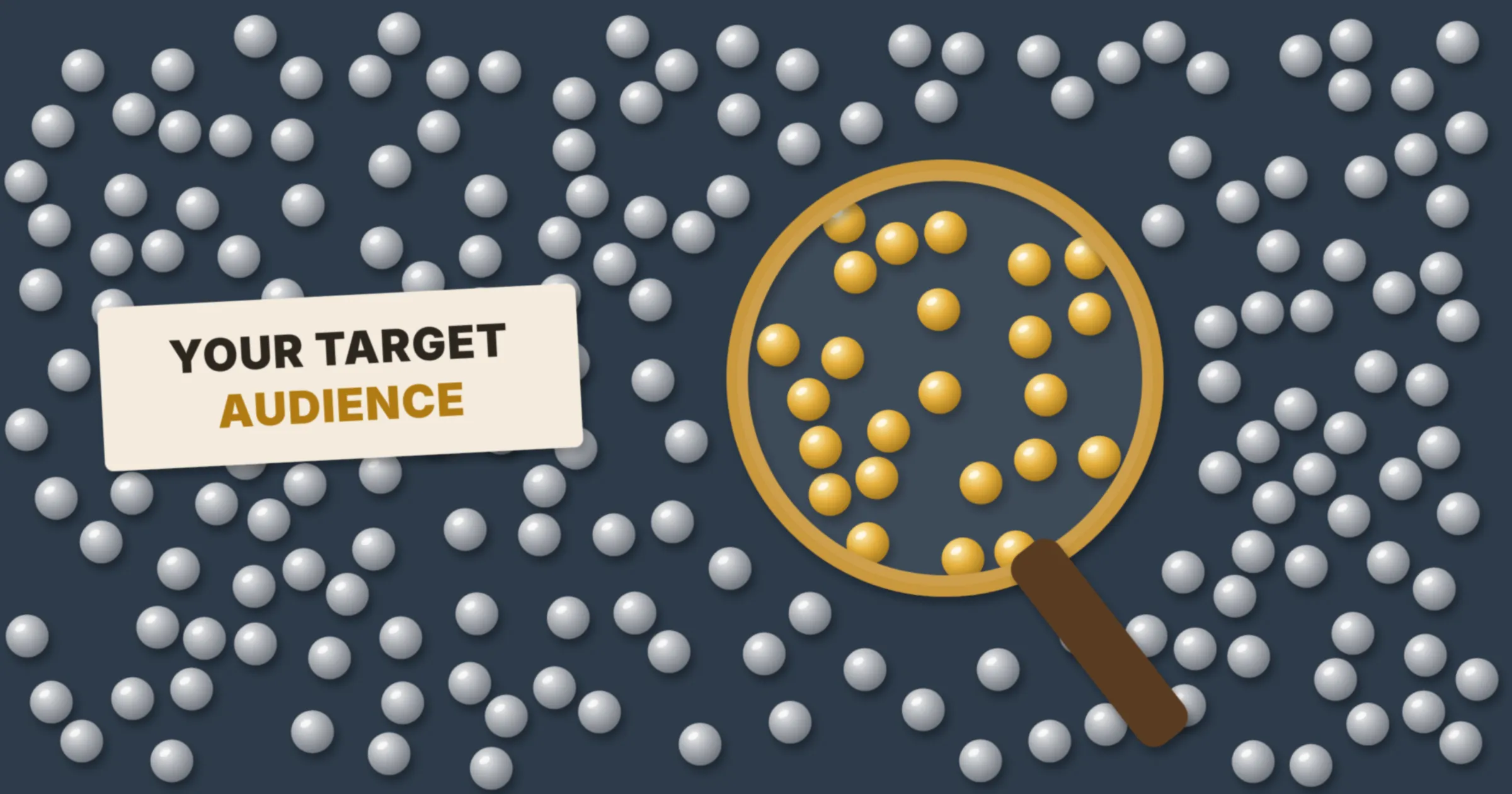
Your target audience is the specific group of people most likely to buy from you and the people your marketing should be built around. You define it by looking at who already buys, what they have in common and what problem they are trying to solve. A buyer persona then turns that group into a realistic picture of one customer, so everyone writing an ad, a web page or an email has the same person in mind.
Almost every part of a digital marketing strategy starts with “know your audience”, but few guides explain how to do it with the data a small business actually has. This guide covers what a target audience is, the main ways to segment one, how to define yours in six steps, where to find the data and how to build buyer personas that people will use.
What is a target audience?
A target audience is the group of people you aim your marketing at because they are the most likely to need what you sell and to choose you over the alternatives. It is narrower than your market. A bakery’s market might be everyone in town, while its target audience might be office workers within walking distance who buy lunch and coffee during the week.
Three related terms are often mixed up:
- Target market: everyone who could buy your product or service.
- Target audience: the part of that market you choose to focus your marketing on, sometimes split into a few segments.
- Buyer persona: a short, realistic profile of one typical customer within a segment, used to guide messages and decisions. Our glossary defines a persona in one line.
Why defining your target audience matters
Marketing aimed at everyone tends to persuade no one. A clear audience makes almost every decision easier:
- Better messages. You can talk about the problems your customers actually have, in their words.
- Less wasted spend. Ads, content and events go where your best customers spend time, rather than where everyone does.
- Clearer positioning. Knowing who you serve shows you how to stand apart from competitors who serve someone else.
- Easier choices. When a new channel, product or idea comes up, you can ask whether it suits the audience.
Choosing an audience does not mean turning other customers away. It means designing your marketing for the people you most want, so that it lands more strongly with them.
Ways to segment your audience
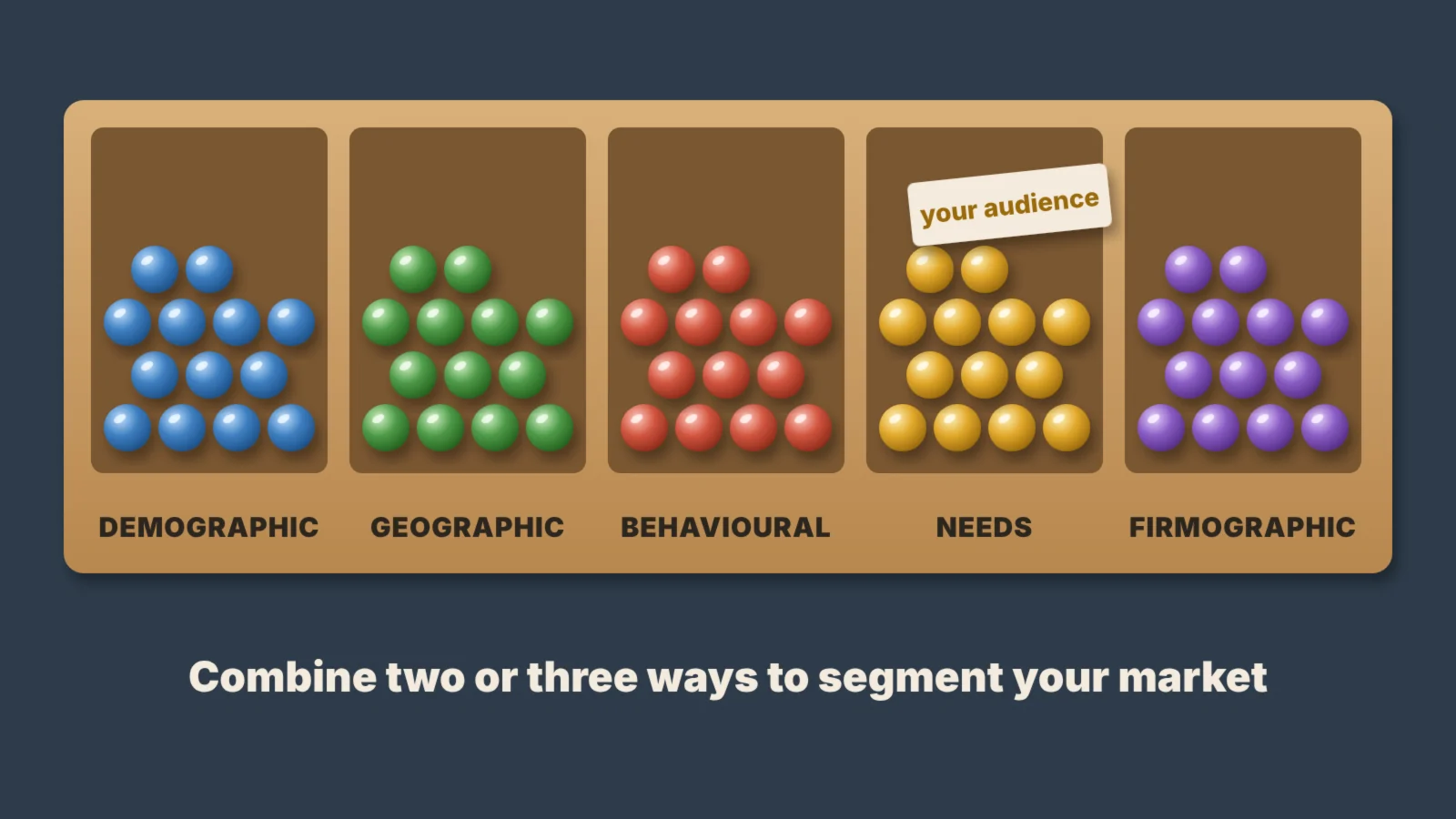
Segmentation means dividing a market into groups that share something useful for marketing. Most businesses combine two or three of these:
- Demographic: age, life stage, income, occupation and household. Useful, but rarely enough on its own.
- Geographic: where people live or work, from a postcode area to a country. Essential for local businesses and campaigns in several countries.
- Behavioural: how people buy, such as how often, how much, which channel and what triggers a purchase.
- Needs-based: the problem people want to solve or the outcome they want. Often the most useful for messaging.
- Firmographic (B2B): company size, sector, location and the role of the person who buys.
How to define your target audience in 6 steps
- Start with your best customers. List the customers who are the most profitable, the easiest to serve and the most likely to come back or refer others.
- Look for patterns. Note what they have in common: where they are, what they bought first, how they found you and what problem brought them to you.
- Ask them. Talk to five to ten customers or send a short survey. Ask why they chose you, what nearly stopped them and what they would search for.
- Check the size of the group. Use public data to see whether the audience is big enough in your area or market to support your goals.
- Look at competitors. See who your competitors focus on and where there is a group they serve poorly. Our guide to competitor analysis shows how.
- Write it down in one or two sentences. For example: “Homeowners in Bristol aged 35 to 60 who want a reliable heating engineer and value clear quotes over the cheapest price.”
Where to find data about your audience
You probably already have more information than you think. Use several sources and look for where they agree.
Your own customer data
Sales records, booking systems, your email list and your CRM show who buys, what they buy and how often. Even a simple spreadsheet of the last 100 customers can reveal clear patterns.
Website and search data
GA4 shows where visitors come from, which devices they use and which pages lead to enquiries. Search Console shows the searches that bring people to your site, which tells you the problems they are trying to solve in their own words.
Public data from the ONS
The Office for National Statistics publishes free data on population, age, households and employment. It estimated the UK population at about 69.3 million in mid-2024, and its Explore local statistics service lets you compare areas, which helps you judge whether there are enough people like your customers in the places you serve.
Conversations and reviews
Customer calls, reviews, social media comments and questions sent to your team show the language people use and the worries they have. These are often the best source of words for your website and ads.
How to build a buyer persona
A buyer persona is a short profile of one typical customer. It should be based on research, not guesswork, and short enough that people actually read it. A useful persona includes:
- A name and a short description, so the team can refer to the persona easily.
- Their situation: role, life stage or business type, as far as it affects buying.
- The problem they want solved and what triggers them to look for a solution.
- Goals and worries, including what would stop them from buying.
- How they search and decide: the channels they use, who else is involved and what proof they need.
- Words they use, taken from real conversations, reviews and searches.
Most small businesses need two or three personas at most. If you have more, check whether they really buy differently or are just described differently.
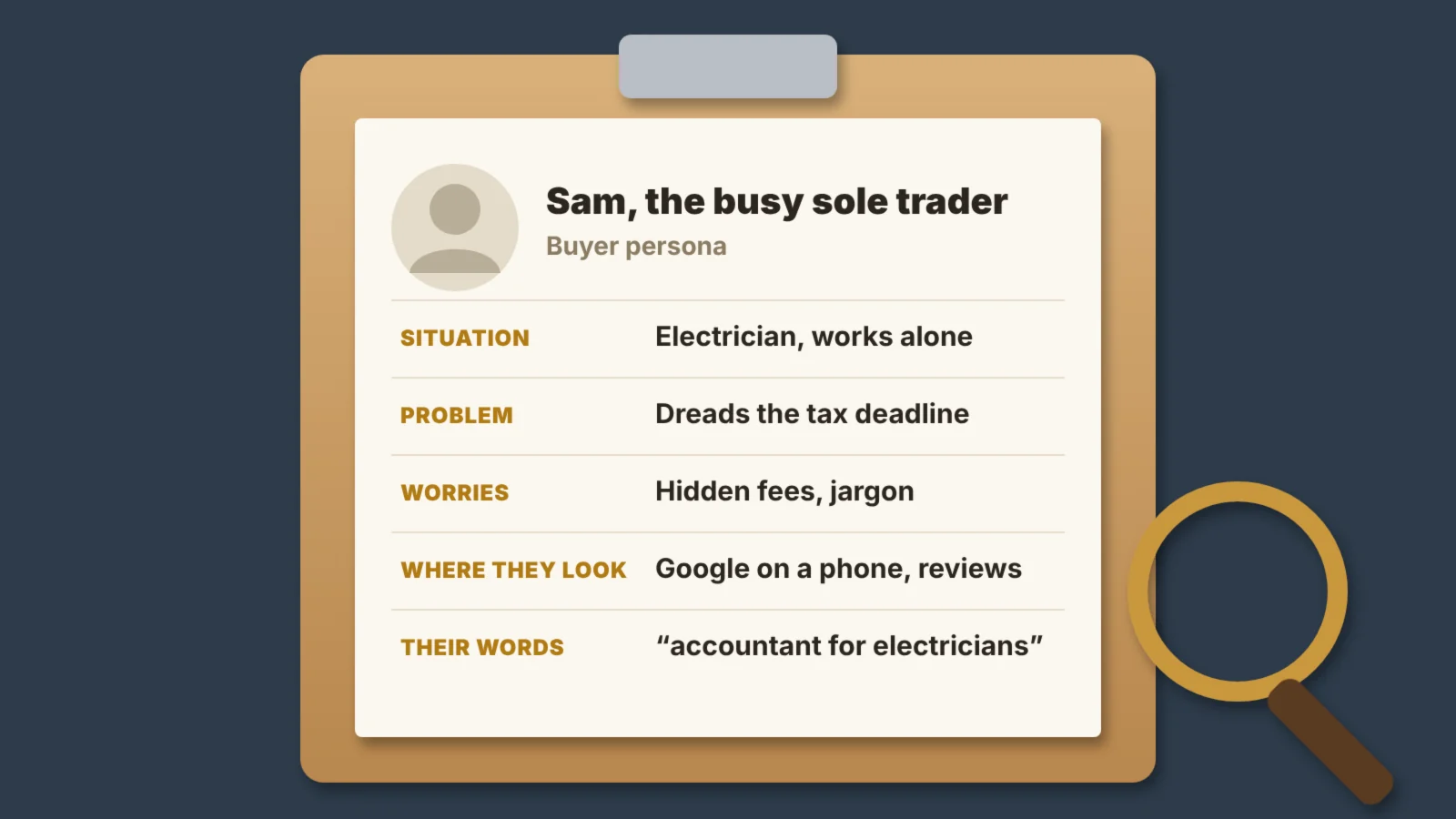
A buyer persona example
Here is a persona for a small UK accountancy firm that wants more clients among sole traders.
| Section | Persona: Sam, the busy sole trader |
|---|---|
| Situation | Self-employed electrician, three years trading, works alone, does admin in the evenings |
| Problem | Dreads the Self Assessment deadline and worries about Making Tax Digital |
| Trigger | A reminder from HMRC, or a friend who was fined for filing late |
| Goals | Pay the right tax, spend less time on paperwork, avoid surprises |
| Worries | Hidden fees, being judged for messy records, jargon |
| Where Sam looks | Google on a phone, reviews, recommendations from other tradespeople |
| Proof Sam needs | A fixed monthly price, reviews from other trades, a quick reply |
| Words Sam uses | “accountant for electricians”, “do I need to register for MTD”, “tax return help” |
With this persona, the firm knows to publish a clear price, collect reviews from tradespeople, write a plain guide to Making Tax Digital and reply to enquiries quickly.
How to use your target audience across your marketing
A target audience only helps if it shapes what you do. Use it to:
- Sharpen your offer, by building a value proposition around the problem your audience cares about most.
- Plan content, by answering the questions your personas actually ask.
- Target ads, by choosing locations, interests and audiences that match your segments rather than broad defaults.
- Map the journey, by following each persona from first search to purchase with a customer journey map.
- Measure what matters, by tracking whether the right people are enquiring, not just how many.
Review your audience at least once a year, or sooner if your products, prices or customers change.
Common target audience mistakes
- Defining the audience too broadly. “Adults aged 25 to 65” describes almost everyone and guides nothing.
- Relying only on demographics. Two people of the same age can want very different things. Needs and behaviour matter more.
- Inventing personas. A persona based on assumptions can send your marketing in the wrong direction. Use real customer evidence.
- Creating too many personas. Eight personas nobody remembers are less useful than two that everyone uses.
- Writing it once and forgetting it. Audiences change. Revisit yours when sales patterns shift.
- Keeping it in a drawer. Share the audience and personas with everyone who writes, designs or sells.
Frequently asked questions
What is a target audience?
A target audience is the specific group of people most likely to buy your product or service, and the group your marketing is designed to reach. It is usually defined by a mix of location, needs, behaviour and, where useful, demographics.
What is the difference between a target audience and a buyer persona?
A target audience is a group, such as homeowners in Bristol who need a heating engineer. A buyer persona is a realistic profile of one typical person in that group, with their goals, worries and the words they use.
How do I find my target audience?
Start with your best existing customers and look for what they have in common, then talk to some of them, check your website and search data and use public data such as ONS statistics to see whether the group is large enough.
How many buyer personas should I have?
Most small businesses need two or three. Add another only if that group buys in a genuinely different way or needs a different message.
Can a business have more than one target audience?
Yes. Many businesses have a main audience and one or two secondary segments. Give each one its own message rather than one message that tries to suit everyone.
On this page
Back to topKnow exactly who your marketing is for
Kutola helps businesses define the audiences that matter most, using their own customer data and market research, and turns that into a strategy and messages that reach the right people. See how it fits into our audit and strategy work, or get in touch to talk through your customers.