How to find your brand’s tone of voice and keep it consistent
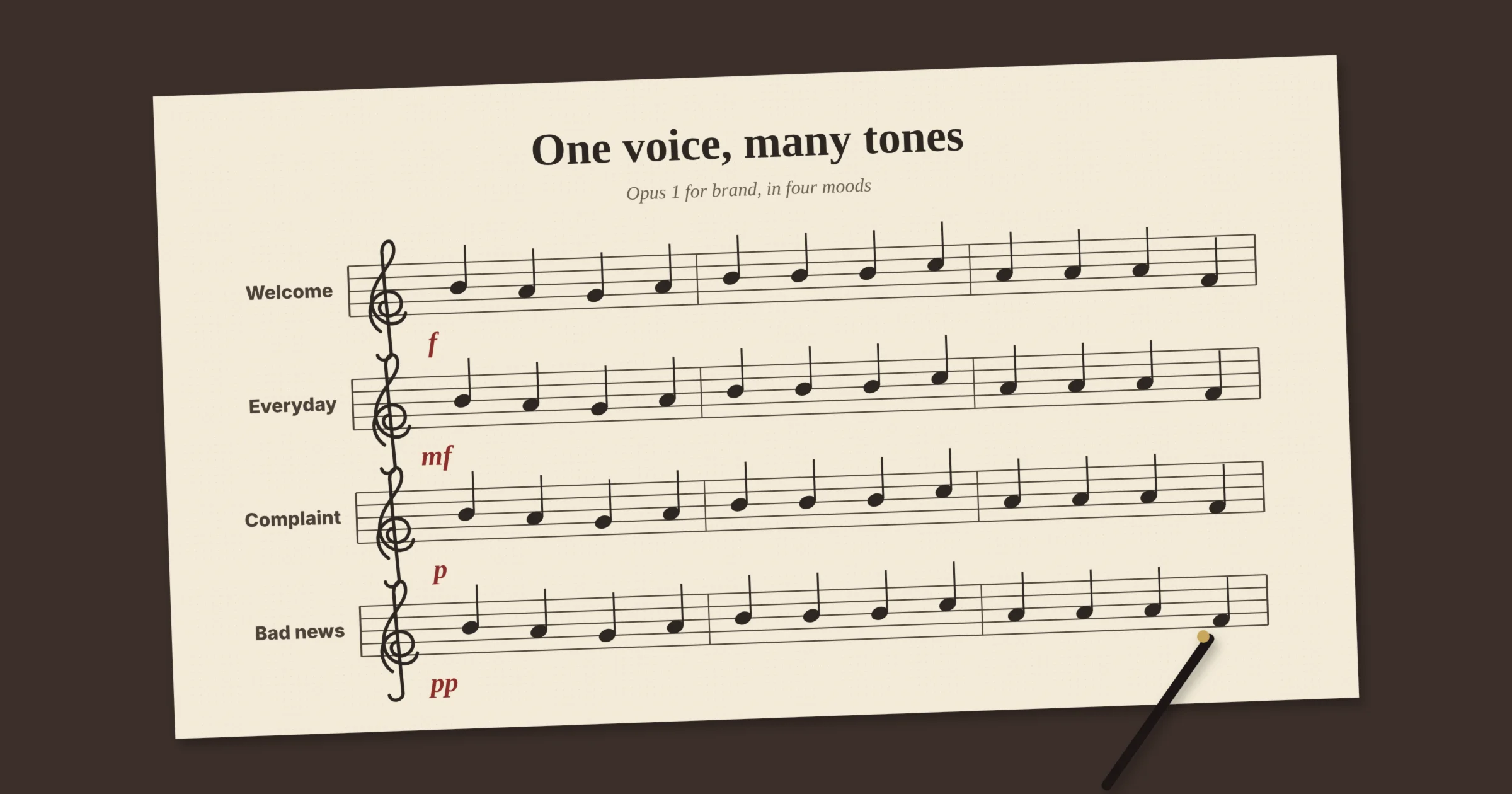
Tone of voice is the way your brand sounds in writing and speech: the words it chooses, how formal or relaxed it is, whether it uses humour and how it treats the reader. To find yours, start from what the brand stands for and who it talks to, describe the voice in three traits with clear dos and don’ts, then show writers how it shifts for different situations.
A consistent voice makes a business easier to recognise and to trust, wherever someone meets it. It is one of the outputs of a brand strategy and belongs in your brand guidelines alongside the logo and colours. This guide explains the difference between voice and tone, the four dimensions you can use to describe them, a six-step process, real UK examples and the mistakes to avoid.
What is tone of voice?
Tone of voice covers everything about how a brand expresses itself in words, as distinct from what it says. Two banks can tell a customer the same thing about a declined payment. One sounds like a policy document, the other like a helpful person. The facts are identical. The experience is not.
Voice shows up everywhere: website pages, emails, social posts, packaging, error messages, letters, chatbots and the way staff answer the phone. Customers notice when it changes from one place to the next, even if they could not say why.
Voice vs tone: what is the difference?
- Voice is your brand’s personality in words. It stays the same everywhere, like a person’s character.
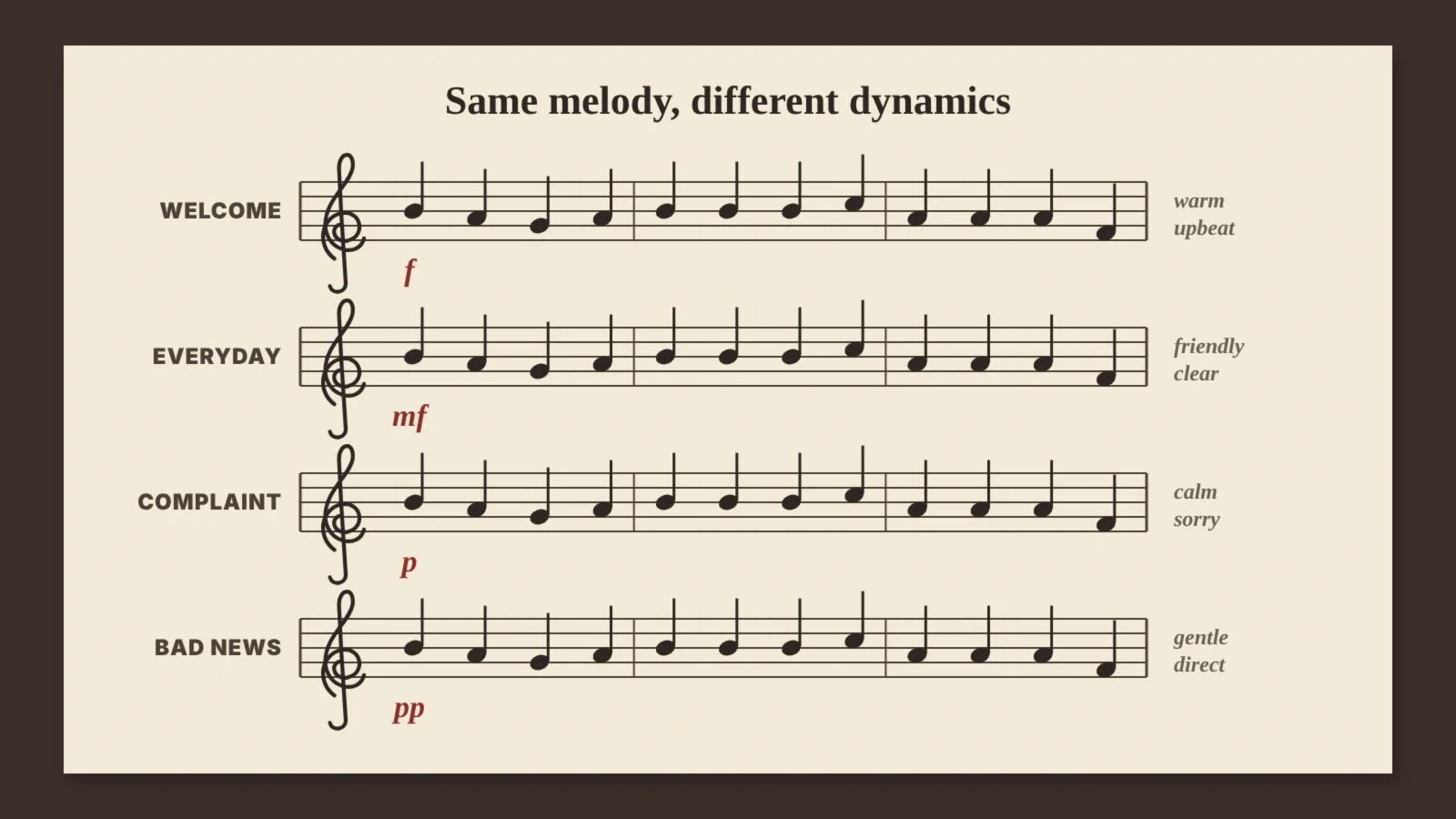
- Tone is how that voice adapts to the moment. You sound different congratulating a customer than apologising to one, but you are still recognisably you.
A good guide defines the voice once and then shows how the tone changes for common situations, such as welcoming a new customer, handling a complaint, writing an error message or delivering bad news.
The four dimensions of tone of voice
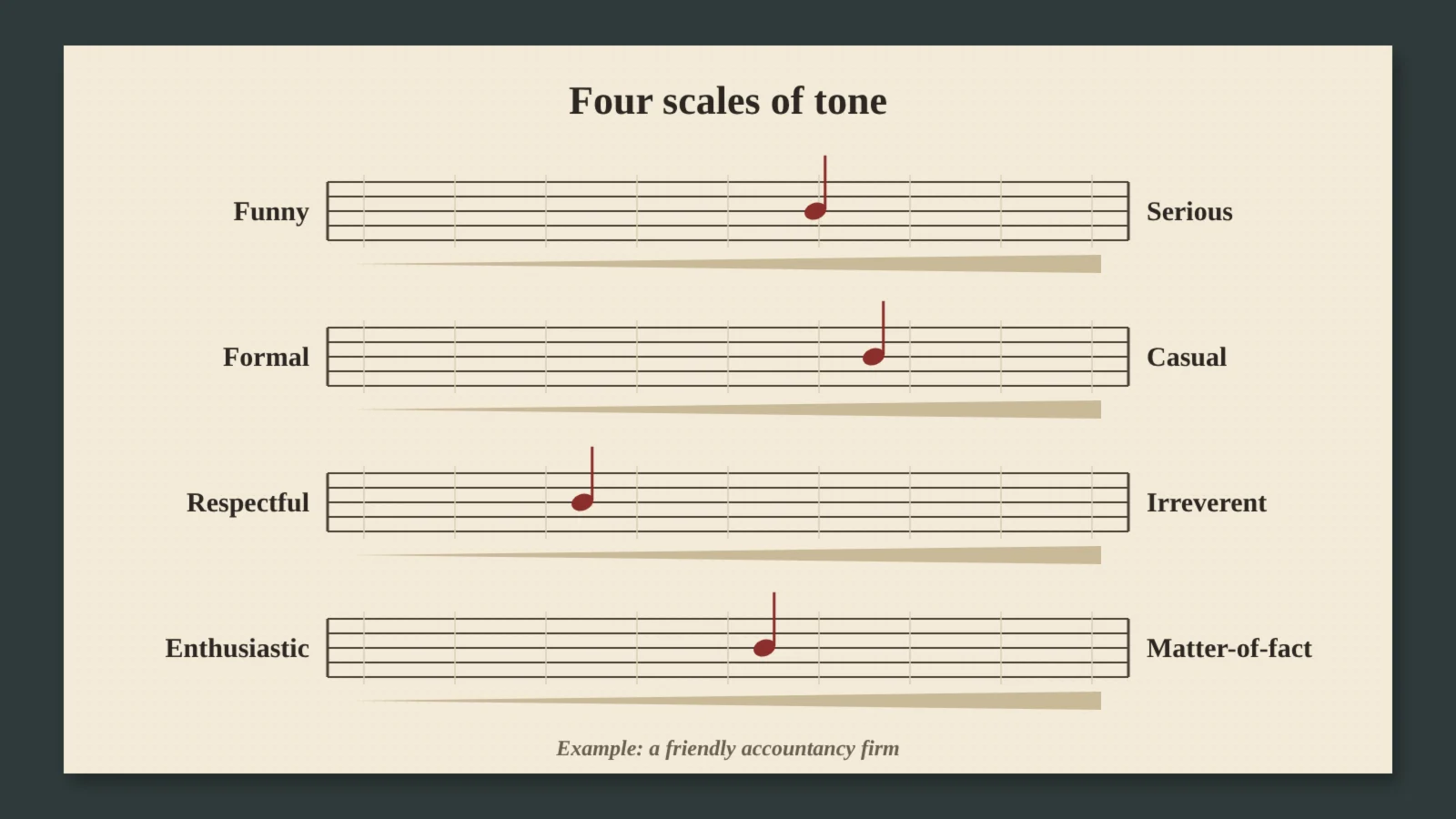
Research by the Nielsen Norman Group describes tone along four dimensions, each a scale rather than a choice between two options:
- Funny or serious. Does the brand use humour, and if so, how much?
- Formal or casual. Does it use contractions, everyday words and short sentences, or a more traditional style?
- Respectful or irreverent. Does it treat its subject with care, or poke fun at convention?
- Enthusiastic or matter-of-fact. Is it excited about what it offers, or calm and understated?
Plotting your brand on each scale gives writers something concrete to aim for. A law firm and a snack brand will sit in very different places, and both can be right for their audience.
How to find your brand’s tone of voice in 6 steps
- Start from the brand. Read your positioning, values and brand archetype if you have one. The voice should sound like the business those documents describe.
- Listen to your audience. Read reviews, sales calls, emails and social comments. Note the words customers use for their problems and for you. Your target audience decides how formal and how technical you can be.
- Audit what you already write. Gather 20 to 30 real pieces, from the homepage to an invoice reminder. Mark the ones that sound most like the brand at its best and the ones that sound like someone else.
- Ask the team. Ask staff for three words that describe how the brand sounds, or should sound. Repeated words are a good starting point.
- Choose three traits. Pick three adjectives and define each with a short explanation, a “this, not that” pair and an example. “Friendly, not overfamiliar” tells a writer far more than “friendly” alone.
- Test and refine. Rewrite a few real pieces in the new voice, such as a product page, a welcome email and a complaint reply. Share them with customers or colleagues, adjust and only then publish the guide.
A simple tone of voice chart
A voice chart puts each trait on one line, so writers can check their work quickly. Here is an example for an independent accountancy firm.
| Trait | What it means | Do | Don’t |
|---|---|---|---|
| Clear | Plain English, even on complex topics | “You can claim this cost against your tax bill.” | “Said expenditure may be eligible for relief.” |
| Reassuring | Calm and confident, never alarmist | “Missed the deadline? Here’s what to do next.” | “Failure to file will result in penalties.” |
| Straight-talking | Honest about costs and limits | “This service costs £300 and takes two weeks.” | “Competitive pricing tailored to your needs.” |
Tone of voice examples from UK brands
Monzo
The digital bank published its tone of voice guide in March 2018 and still keeps it public. It describes “straightforward kindness” as the thread running through all its writing. Writers are asked to put what matters most to the reader first, even when the message is uncomfortable, and to say who did something: “we blocked the payment” rather than “the payment was blocked”.
GOV.UK
The government’s style guide makes plain English mandatory for all GOV.UK content. Its A to Z includes a list of words to avoid, such as “agenda” unless it means a meeting and “tackling” unless it means rugby, because vague or figurative language makes content harder to understand. It shows that a strong voice does not have to be playful. Being clear and direct is a voice too.
What they have in common
Both guides are short, practical and full of examples. Neither relies on adjectives alone. They show writers what good looks like, explain why and make the guide easy for anyone in the organisation to find.
How to keep everyone using the voice
- Put the voice guide where people already work, such as the shared drive or the intranet, and link to it from your content strategy.
- Add before and after rewrites of real copy. Writers learn faster from examples than from rules.
- Write tone notes for high-stakes moments: complaints, outages, price rises and anything involving money or health.
- Brief freelancers, agencies and AI writing tools with the same guide, including a few sample paragraphs.
- Review a sample of published copy every quarter, and update the guide when the brand or audience changes.
Your voice should also run through your website copywriting, emails and social posts, not just campaigns. The everyday messages are where most customers actually hear you.
Common tone of voice mistakes
- Choosing traits every brand could claim. “Friendly, professional and innovative” describes almost everyone and guides no one.
- Forcing humour. Jokes in the wrong place, such as an error message or a complaint reply, make things worse.
- Copying another brand. A voice borrowed from a challenger bank or a smoothie maker rarely fits a different business or audience.
- Ignoring tone. Using the same upbeat voice for good news and bad news sounds careless.
- Writing the guide and filing it. Without examples, training and reviews, the voice drifts within months.
- Forgetting the small stuff. Forms, receipts and automated emails are read more often than most campaigns.
Frequently asked questions
What is tone of voice?
Tone of voice is how a brand expresses itself in words: its choice of language, level of formality, use of humour and attitude towards the reader. It shapes how customers experience the brand across every channel, from the website to emails and customer service.
What is the difference between voice and tone?
Voice is the brand’s consistent personality in words. Tone is how that voice adapts to the situation, so a brand sounds warmer when welcoming a customer and calmer when handling a complaint, while still sounding like itself.
What are the four dimensions of tone of voice?
The Nielsen Norman Group describes four: funny or serious, formal or casual, respectful or irreverent and enthusiastic or matter-of-fact. Each is a scale, and a brand can sit anywhere along it.
How do you describe a brand’s tone of voice?
Choose three traits and define each one with a short explanation, a “this, not that” pair and examples of what to do and avoid. A voice chart that shows all three on one page is easy for writers to use.
Should a small business have a tone of voice guide?
Yes, even a one-page version. It helps anyone writing for the business, including freelancers and AI tools, sound consistent, which makes the brand easier to recognise and trust.
On this page
Back to topGive your brand a voice people remember
Kutola helps you define a tone of voice that fits your brand and audience, then turns it into a practical guide your team, freelancers and AI tools can follow. See how it fits into our brand and digital experience work, or get in touch to talk it through.